%202.svg)
What is Givefront? Why should your organization consider alternatives? A look at the best available options.
Givefront is a nonprofit-first spend management and corporate card platform created specifically for 501(c) organizations. Founded in 2021 and based in the United States, Givefront focuses on providing financial tools tailored to the unique needs of nonprofits. It centralizes card spend, reimbursements, and receipt capture with features designed around the way nonprofits actually operate.
This guide will help you look at Givefront objectively, and compare it to other similar products to see which one is the best fit for your organization. Here are some reasons you may decide to consider alternatives to Givefront.

Givefront is designed to simplify nonprofit spending by giving finance teams visibility and control over card usage, reimbursements, and receipts. Its nonprofit-first approach focuses on transparency, accountability, and ease of use for staff and volunteers.
With its user-friendly interface and customizable features, Givefront stands out as a premier choice for nonprofits seeking to maximize their fundraising potential and make a greater impact.
You should make sure whatever platform you consider actually fits your organization’s needs. Take a moment to think through the following list.
Consider your organization’s structure carefully. A single-office nonprofit with 10 staff members has very different needs than a federated organization with multiple chapters or an NGO operating internationally. Think about whether you issue cards to employees only or also to volunteers and contractors. When evaluating platforms, it’s important to maintain focus on your core fundraising or donor management priorities to ensure the solution aligns with your most critical goals.
Also, don’t overlook total cost of ownership. Platform fees are obvious, but watch for FX fees on international transactions, per-user charges, and the soft costs of manual spreadsheet workarounds that eat up staff time.
Modern business spend platforms like Ramp, Brex, and Divvy/Bill Spend & Expense have become popular. These are good Givefront alternatives because of their polished card tools, automation features, and aggressive pricing. These companies compete hard for market share, which often means better rates and more features for users.
These platforms focus on corporate cards, expense automation, and financial controls. Nonprofits often pair them with separate fundraising and donor management systems.
Let’s look at the most common alternatives to Givefront and see how they stack up for mission-driven organizations. Many of these platforms also integrate with or compare to other platforms in the nonprofit technology ecosystem, providing greater compatibility and flexibility.
[[cta]]
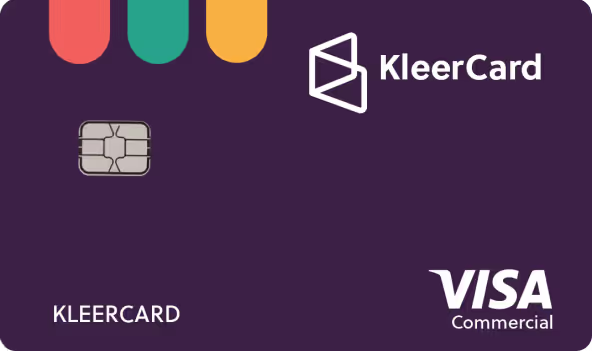
KleerCard is a nonprofit-first spend management and card platform built specifically for churches, schools, and nonprofits of all sizes. KleerCard focuses on day-to-day financial management, giving finance teams real-time visibility, clear approvals, and clean data that flows directly into their accounting system.
Standout feature: KleerCard offers "White Glove" onboarding, meaning they personally walk you through integrating KleerCard with other applications like Realm or Aplos. This is a feature that no other expense management platform currently offers.
Strengths relevant to nonprofits:
Unlike general business tools, KleerCard is intentionally opinionated about how nonprofits operate. It avoids forcing finance teams to rebuild nonprofit logic with workarounds or custom tagging, and it keeps front-line users focused on compliant spending rather than administrative overhead.
Why nonprofits choose KleerCard over Givefront:
KleerCard appeals to organizations that want a clean separation between fundraising and spending. If your nonprofit already uses a fundraising platform or nonprofit CRM to manage donors, donation forms, and campaigns, KleerCard provides a focused solution for controlling expenses, managing cards, and maintaining financial discipline.
KleerCard works best for nonprofits that want a purpose-built spend management solution that supports compliance and accountability without adding complexity or overlapping tools.
Ramp is a fast-growing corporate card and expense platform founded in 2019, widely used by US startups and mid-market companies for automated spend control and savings insights.
Strengths relevant to nonprofits:
Nonprofits often appreciate Ramp’s vendor insights and built-in controls. However, you’ll need to build custom categories and tags in your accounting system to track grants, restricted funds, and program-specific spending. Ramp won’t do that mapping for you.
Potential gaps versus Givefront:
Ramp works well as a Givefront alternative for tech-savvy finance teams (typically 5–20 staff) that are comfortable maintaining accounting rules themselves and don’t need grant labels visible to every cardholder at the point of purchase.
Brex launched in Silicon Valley in 2017, originally targeting venture-backed startups. It has since expanded to serve larger mid-market teams with more complex needs.
Key features that appeal to nonprofits:
The rewards structure and startup-focused culture may feel less relevant to mission-driven organizations. More importantly, nonprofit reporting still relies on mapping departments and locations in your accounting system. Brex doesn’t ship with grant-based budget templates, donation-source tracking, or built-in nonprofit tax features.
Brex makes sense as a Givefront alternative for larger nonprofits and NGOs with global operations, in-house accounting expertise, and the need to manage events, travel, and cardholders across multiple countries.
Divvy, rebranded under BILL Spend & Expense in 2023–2024, is a budgeting-driven card and expense platform popular with SMBs and some nonprofit organizations.
Advantages for cost-conscious organizations:
Tradeoffs versus Givefront:
Divvy’s budgets aren’t inherently grant- or fund-aware. Finance staff still need to align those budget envelopes with grant codes and donor restrictions in the accounting ledger.
Also, organizations should look closely at Divvy's pricing packages. The "Essentials" package costs $49 / user and contains all the same features that users of KleerCard get for free. Divvy also has a free option, but it is not nearly as robust as the free option through KleerCard.
Practical scenario: A $3M–$10M nonprofit with 3–5 program teams could use Divvy to set monthly caps for travel, events, and supplies. This works well for basic budget control. Where it gets messy: when a single purchase spans multiple grants or when you need to demonstrate restricted fund compliance during an audit.
Airbase is a more advanced AP and spend management suite combining corporate cards, bill payments, and approvals in one platform. It’s often used by mid-market companies in the $10M–$200M revenue range.
Strengths for nonprofits:
Like other general business tools, Airbase doesn’t ship with nonprofit-specific grant and fund structures. Those must be modeled in your accounting system and synced back via custom fields and tags.
Consider the complexity: Airbase requires implementation projects, admin training, and potentially consulting support. This may be overkill for small organizations or newer nonprofits with straightforward spending patterns.
Airbase is a realistic Givefront alternative for larger nonprofits and foundations with hybrid AP + card needs and enough staff to manage a more sophisticated system.

Many nonprofits in 2025 still use traditional tools like Expensify or SAP Concur alongside simple bank-issued corporate cards from institutions like Bank of America or Chase.
This setup functions as a loose alternative to Givefront: it captures receipts and manages approvals, but doesn’t unify cards, spend controls, and nonprofit-specific reporting in one place. You’re essentially layering a documentation tool on top of a basic payment mechanism. Standard processing fees may also apply when using online donation or payment platforms, adding to the overall transaction costs.
Expensify has been a go-to receipt scanning and reimbursement tool since the early 2010s, used across businesses and nonprofit organizations alike.
Strengths:
Nonprofit challenges:
Example scenario: A small nonprofit uses Expensify with a traditional corporate card to manage travel reimbursements. Staff snap receipts, expenses get approved, and everything exports to QuickBooks. But every grant still requires manual reconciliation—someone on the finance team has to tag each transaction to the right funding source after the fact.
Expensify is a low-cost, familiar Givefront alternative for basic reimbursement and documentation needs. It’s not a full replacement for dedicated nonprofit spend management, but it handles the fundamentals.
[[cta]]
SAP Concur is an enterprise-grade travel and expense system used by large universities, hospital systems, and global NGOs with complex compliance requirements.
Pros:
Cons for midsize nonprofits:
Compared with Givefront, Concur usually requires significant IT and finance resources to implement and maintain. It also doesn’t ship with grant/fund and Form 990 logic baked into the cards themselves—that still lives in your accounting system.
Concur makes sense as a Givefront alternative primarily for very large organizations already running SAP or other ERPs that need deep travel management tools more than card-native nonprofit features.
Some nonprofits replace or sidestep Givefront by adopting full financial suites like Sage Intacct for Nonprofits or Blackbaud Financial Edge NXT, then layering basic corporate cards on top. These financial suites are used by a wide range of groups, including nonprofit organizations, schools, faith-based groups, sports teams, and community organizations, to manage their nonprofit operations.
These platforms excel at grant, fund, and program accounting—the core of nonprofit financial management. Provide structured support for nonprofit accounting, compliance, and reporting. However, they don’t usually offer integrated card and spend management tools at the same depth as Givefront.
This category appeals to organizations that prioritize robust accounting and reporting first, and are comfortable managing card policies separately. KleerCard can integrate with or export to many of these systems, offering a way to bring controlled spend into a nonprofit-focused general ledger.
Sage Intacct is a cloud-based ERP with dedicated nonprofit editions, used heavily by organizations managing complex grants and multiple entities. G2’s 2025 analysis ranks it among the top alternatives for nonprofit accounting.
What it does well:
Many organizations rely on Intacct’s dimensional reporting while using simple bank cards or a generic spend tool, mapping every transaction back into Intacct dimensions during reconciliation.
The tradeoff: The accounting view is excellent, but front-line cardholders don’t see grant or donor restriction context at the point of spend like they might in Givefront. All that logic lives in the accounting system, which means more work for accounting staff to keep spend aligned with budget.
Intacct-centric setups work well for organizations with skilled controllers or CFOs who prefer keeping nonprofit logic in one authoritative system.
Financial Edge NXT is Blackbaud’s cloud accounting solution for nonprofits, often used alongside Raiser’s Edge NXT for fundraising and donor management.
Strengths:
As with Intacct, most nonprofits pair Financial Edge with traditional credit card programs and internal policies. You don’t get the unified “card + budgets + receipts” view that Givefront offers.
Implementation note: Migration and training complexity can be significant when moving to or heavily customizing Financial Edge in 2024–2025. Plan for onboarding time.
This is a thoughtful Givefront alternative for organizations whose main pain is accounting and reporting rather than card operations—but it doesn’t solve everyday spend control on its own.
A surprising number of nonprofits in 2025 still rely on simple cards from banks like JPMorgan Chase, Bank of America, or local credit unions—plus spreadsheets and email approvals for everything else. Organizations often use these manual processes to manage spending for in person events and to support individual fundraisers participating in campaigns or community activities.
This is often the default “alternative” to Givefront and platforms like KleerCard because it feels familiar and avoids new software contracts.
Typical setup:
Pros:
Cons:
This approach becomes increasingly risky and time-consuming once organizations pass roughly 10–15 staff or start managing multiple restricted grants and government contracts. At that point, the soft costs of manual processes often exceed the subscription cost of a proper spend management platform.

Yes, many nonprofits meet audit and compliance requirements while using general business spend platforms as Givefront alternatives alongside their accounting software. Auditors focus on strong financial management, clear approval workflows, and accurate documentation rather than which platform you use. The key is consistent transaction coding, receipt retention, and approval records inside your accounting system. With the right management tools and internal guidance, nonprofits can stay compliant without relying on a dedicated fundraising platform for expense control.
Switching from bank issued cards or Givefront to a new spend management platform typically takes four to eight weeks, depending on your organization’s size and complexity. The process includes mapping budgets, setting user access, configuring workflow automation, and issuing new cards. Most vendors provide onboarding resources, training services, and migration guidance to help nonprofit leaders manage the transition smoothly. Clear communication and early staff training make the biggest difference in long term adoption.
Many small to midsize nonprofits successfully manage grants, programs, and donor restricted funds entirely within their accounting software while using simpler spend management tools. This approach works well for organizations under five to seven million dollars in annual revenue with disciplined financial management processes. As fundraising campaigns grow more complex, nonprofit specific features can reduce manual work and help staff stay aligned. The right solution depends on how many campaigns, events, and funding restrictions your organization manages.
Training should focus on simple, user friendly workflows that help staff and volunteers manage money correctly from day one. Short walkthroughs, written policies, and clear guidance on receipt capture and approvals are more effective than long training sessions. Many platforms provide mobile access, making it easier for users to submit receipts and categorize transactions in real time. Ongoing reminders and periodic reviews help reinforce good habits and improve long term compliance.
Yes, it is common for nonprofits to use a fundraising platform for donations and donor management while relying on a separate spend management solution for outgoing expenses. Fundraising software handles donation forms, customizable donation pages, peer to peer fundraising, crowdfunding campaigns, and donor information. Spend management tools focus on payment processing, approvals, and financial controls. Integration typically happens through the accounting system, which serves as the source of truth for reporting.
Most Givefront alternatives focus on financial management and expense controls rather than fundraising efforts like campaign pages, auction management, or peer to peer campaigns. A full fundraising platform or nonprofit CRM is still needed to manage donors, engage supporters, and start fundraising online. Spend platforms are complementary tools that help nonprofits protect money raised through fundraising campaigns. Using specialized solutions together often helps organizations raise more money while maintaining strong oversight.
Sports teams, schools, and event focused nonprofits often benefit from separating fundraising tools from spend management software. Fundraising platforms support event management, fundraising pages, peer to peer campaigns, and customizable donation forms to help teams reach their fundraising goal. Spend management tools then help track expenses, manage transaction fees, and control spending after donations are collected. This combination gives organizations better access to features without overloading staff with unnecessary tools.


Speak to a member of our team and we can have you up and running in minutes, not weeks.