%202.svg)
An honest BILL Divvy Corporate Card review: how the rewards rules, 30% minimum spend, and forfeiture risk play out for churches, nonprofits, and schools.
Churches, nonprofits, and schools often land on the BILL Divvy Corporate Card when they're looking for a no-annual-fee option with no personal guarantee and built-in spend tracking. The pitch is straightforward: a charge card paired with free expense software that gives teams real-time visibility without forcing anyone to personally back the balance.
I have spent years talking with church treasurers, nonprofit CFOs, and school business managers who added Divvy to their shortlist. Many ran it for six to nine months before reaching out because a rewards rule or a control they assumed existed turned out to work differently than expected. That pattern is what this review unpacks.
KleerCard publishes this review and we compete directly with BILL in the nonprofit and church space. For independent perspectives, check recent takes from NerdWallet, Nav, and Bankrate as well.
The BILL Divvy Corporate Card is a charge card issued alongside the free BILL Spend & Expense platform. It carries no annual fee and requires no personal guarantee. Balances must be paid in full each cycle, so there is no APR. Rewards rates scale with payment frequency—weekly payers can earn significantly higher multipliers than monthly payers—but roughly 30 percent of the credit line must run through the BILL Divvy Corporate Card each month to unlock any rewards at all.
BILL acquired Divvy in 2021 for roughly $2.5 billion and rebranded the platform to BILL Spend & Expense in 2023. Most people still call it Divvy.
At its core it is a charge card, not a revolving credit card. You pay the balance in full each cycle. The card is underwritten to the business rather than requiring a personal guarantee or personal credit check. The real draw for many teams is the free BILL Spend & Expense software that comes with it—receipt capture, real-time visibility, and basic approvals without an extra subscription.
Eligibility is based on business credit that is generally good to excellent, around 670 or higher on the business side, with underwriting that looks at the organization’s financials, cash flow, and bank balances rather than a strict personal credit formula.
There is no annual fee. Because it is a charge card, there is no APR on carried balances—you simply pay what you owe each cycle. Foreign transaction fees do apply on purchases made outside the U.S., typically in the 1 to 3% range depending on the merchant and network. Late fees can apply if a cycle is missed. Employee cards are free to issue.
You can choose weekly, semi-monthly, or monthly billing cycles. That choice directly affects your rewards rate, which is the biggest lever in the program.
For churches and nonprofits that occasionally spend overseas—mission trips, conferences, or vendor payments—the foreign transaction fee is worth factoring in. Several alternatives, including KleerCard, waive those fees entirely.
Rewards are not based solely on what you buy. They are also based on how often you pay the bill.
Here is how the rates break down by billing cycle:
There is a $5,000 monthly cap on bonus-category spend that earns the higher rates.
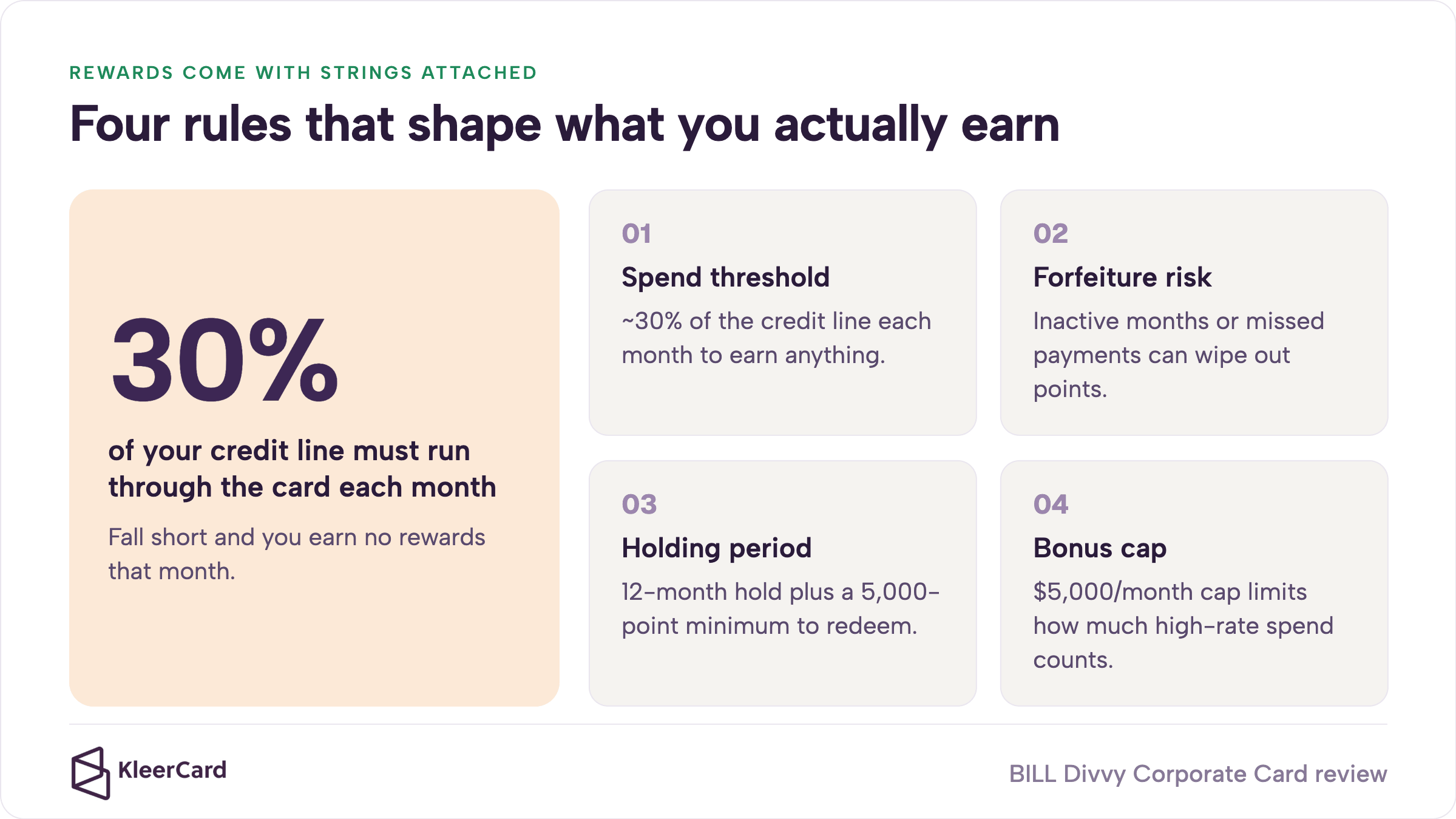
Four rules shape the program in practice:
Redemption values are modest once you get there. Per recent analysis from NerdWallet, 10,000 points are worth about $100 when redeemed for travel booked through a BILL partner, $52 for cash back, $51 for gift cards, and $49 for a statement credit.
Churches and nonprofits with seasonal giving or grant cycles often fall below that 30% threshold in slower months. That creates real forfeiture exposure even if the team is otherwise using the card responsibly.
For example, a missions-focused nonprofit with heavy year-end giving frequently sees spend drop well below the threshold in the first half of the year. Summer camp programs and grant-funded initiatives often experience similar lulls between funding cycles, making consistent 30% spend difficult even when the card is being used appropriately.
The free BILL Spend & Expense platform that powers the rewards tracking also serves as a real-time expense management platform for teams that want visibility without a separate tool.
The BILL Spend & Expense platform is genuinely useful. You get per-card budgets, unlimited physical and virtual cards, receipt photo capture through the mobile app, and integrations with QuickBooks Online, NetSuite, Sage Intacct, and Xero. Real-time visibility is strong, and many teams appreciate having one place to see spend without a separate expense tool subscription.
User feedback on G2 for BILL Spend & Expense is mixed but generally positive on visibility and ease of use, with some teams noting that receipt capture and approval workflows save meaningful time compared to manual reconciliation.
However, the platform has clear gaps for organizations with stricter policies. Virtual cards are tied to a budget and an expiration date, but they are not true single-use cards in the way some teams expect. There are no native time-of-day or day-of-week restrictions. Nonprofit-specific integrations are limited; there is no direct sync with donor management systems or common church management platforms like ACS or Shelby for fund-level tracking.
Finance teams at K-12 schools I’ve worked with often describe the practical friction of the old shared-card model. One private Christian school with around 540 students previously operated with just five cards across the entire campus. Teachers and coaches spent time playing “hide and seek” to locate a card or simply fronted purchases themselves and submitted reimbursement requests. Finance teams reported chasing missing receipts on a near-weekly basis, and month-end reconciliation of credit card statements was a lengthy manual process.
Stronger per-person controls and receipt capture at the point of purchase changed that dynamic dramatically for many organizations, often cutting reconciliation time from several hours per month to under an hour while reducing lost receipt issues.
Virtual card controls on BILL are functional for basic budgeting, but they lack the precision many ministries and schools want. True single-use cards that expire immediately after a transaction, combined with time-window restrictions, reduce risk more effectively than budget-plus-expiration cards alone, especially when cards are shared with volunteers or event coordinators.
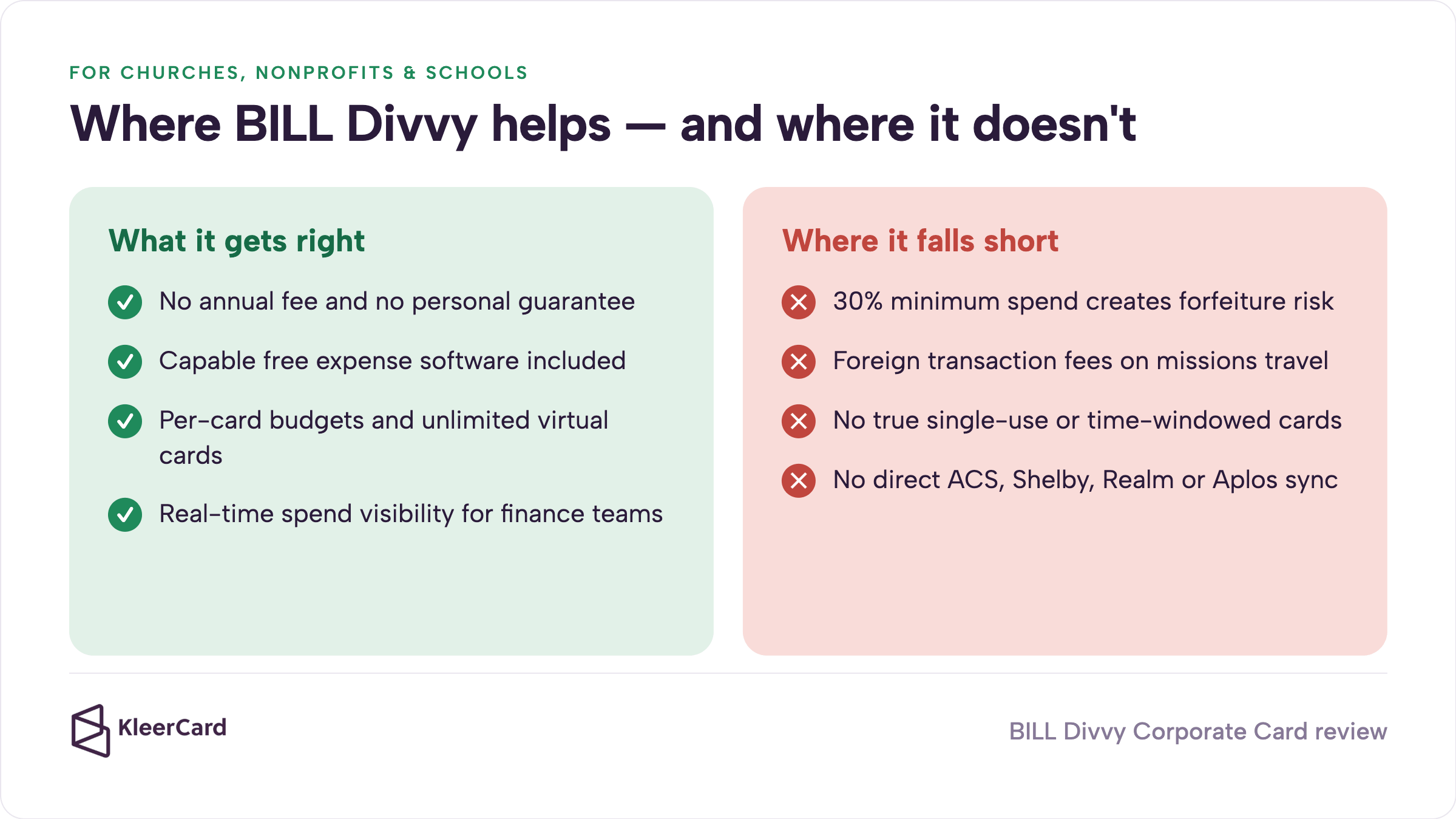
What BILL Divvy gets right:
Where it falls short for mission-driven organizations:
Stable for-profit small and mid-sized businesses with predictable cash flow tend to do well. Weekly or semi-monthly payers who can reliably clear the 30% threshold will capture the highest rewards rates. Teams that are already replacing a standalone expense management tool and mostly spend domestically will find the free software and real-time visibility useful. Larger nonprofits that comfortably clear the monthly spend threshold and do not need specialized fund accounting integrations can also make it work.
Many organizations in this position also explore dedicated nonprofit credit card options with no personal guarantee to compare control levels and integrations.
Seasonal organizations, one-time event teams, groups with significant international spend, and any team that needs true single-use virtual cards or time-based restrictions will feel the limitations quickly. Small organizations or those with lumpy cash flow will struggle with the 30% rule and the rewards forfeiture risk.
If fund accounting integrations matter—especially with ACS, Shelby, Realm, or Aplos—BILL will require manual exports or workarounds. Schools and ministries that want merchant category blocks, exact time windows, or classroom-level stipend cards that refill automatically will find stronger options elsewhere. Many also explore nonprofit-focused expense management tools for better control.
The core difference is what each platform optimizes for. BILL optimizes for rewards that scale with payment frequency and a capable free expense layer. KleerCard optimizes for granular per-card controls and native fund accounting workflows.
Consider a typical school field trip. With BILL you can issue a virtual card with a budget and an expiration date. That works. With KleerCard you can issue a true single-use virtual card for exactly $500 that expires the day after the trip, works only at approved merchants, and requires a receipt photo before the card can be used again. The same logic applies to a weekend retreat card that only functions Friday through Sunday or a classroom stipend card that refills monthly up to a set amount.
Tricia G., a finance lead at a church using ACS Financials, described spending 4 to 6 hours every month on manual data entry into their accounting system after reconciling expenses from their previous platform. The tool simply had no direct integration with ACS, so every transaction had to be re-keyed or reformatted by hand. That friction disappears when the card platform syncs natively with the software the finance team already trusts.
For missions teams that travel overseas, the foreign transaction fee on BILL adds up quickly. KleerCard waives those fees entirely. For volunteer coordinators who need to hand a card to a parent helper for a single event without exposing the full credit line, the single-use and time-windowed options reduce risk in ways that budget-plus-expiration cards cannot fully replicate.
KleerCard offers cash back to organizations spending more than $30,000 per month. For most churches, nonprofits, and schools with lower or more variable spend, we prioritize strong per-card controls, time-windowed virtual cards, and native integrations with platforms like ACS, Shelby, Realm, and Aplos over broad rewards programs.
For a deeper KleerCard vs BILL Divvy comparison tailored specifically to nonprofits and churches, see our dedicated guide.
Neither platform is universally better. The right choice depends on whether your team values rewards scaling with payment speed or values controls and integrations that match how mission-driven organizations actually move money.
It is a charge card. You must pay the full balance each billing cycle. There is no option to carry a balance and pay interest.
Approval is based primarily on the business’s financial profile—revenue, cash flow, and bank balances—rather than a strict personal credit score. Business credit in the good-to-excellent range, generally around 670 or higher, improves the odds, but BILL underwrites to the organization.
BILL publishes credit lines from $1,000 to $5 million. Some organizations, particularly those with strong revenue and cash reserves, receive higher limits through the underwriting process. NerdWallet and other reviewers have cited upper bounds as high as $15 million in certain cases, but that is not the standard published range. See BILL’s current credit offerings for the latest details.
No. The card is issued to the business and underwritten on the organization’s financials. There is no personal guarantee required.
Yes. Foreign transaction fees apply on purchases made outside the United States. The exact rate varies but typically falls in the 1 to 3% range. Several alternatives, including KleerCard, waive these fees.
Rewards rates depend on your billing cycle. Weekly payers earn the highest multipliers (up to 7x on dining and 5x on hotels). Monthly payers earn a flat 1x. You must run roughly 30% of your credit line through the card each month to earn rewards, and points are subject to a 12-month holding period plus a 5,000-point minimum redemption.
Yes. BILL reports payment performance to the Small Business Financial Exchange (SBFE). On-time payments can help build business credit history separate from personal credit. This matters for organizations planning to grow or seek additional financing, as positive payment history on the SBFE can strengthen future credit applications.
It can work for stable organizations that reliably clear the 30% monthly spend threshold and do not need deep fund accounting integrations. Seasonal giving patterns, missions travel, and the need for precise virtual card controls often push mission-driven teams toward alternatives with stronger nonprofit-specific features.
They are the same platform. Divvy was acquired by BILL and rebranded as BILL Spend & Expense. Most users and search results still refer to it as Divvy or the BILL Divvy Card.
No. There is a 12-month holding period on points, and you need at least 5,000 points to redeem. Redemptions are available for travel (through BILL partners), cash back, gift cards, or statement credits, with values that vary by redemption type.
It comes down to what matters most to your organization. Stable groups that pay weekly or semi-monthly and consistently clear the 30% threshold will usually find it worthwhile. Churches, nonprofits, and schools with seasonal cash flow, international spend, or the need for true single-use and time-windowed virtual cards often run into friction that makes other options more practical.
BILL Divvy is a strong fit for stable for-profit small and mid-sized businesses that can reliably hit the weekly or semi-monthly payment cadence and clear the 30% monthly spend threshold. The combination of no annual fee, no personal guarantee, and a capable free expense platform removes real friction for many teams.
For seasonal organizations, event-driven ministries, schools, and any group that needs precise virtual card controls or native fund accounting integrations, the rewards structure and feature gaps create ongoing workarounds. The honest trade-off is simple: BILL optimizes for rewards that scale with payment frequency. KleerCard optimizes for control and nonprofit-native workflows. Read the cardholder agreement, talk to peer organizations running similar programs, and check independent reviews from NerdWallet and Nav before deciding.


Speak to a member of our team and we can have you up and running in minutes, not weeks.