%202.svg)
Ramp vs Brex compared in 2026 by a competing card issuer. Pricing, eligibility, nonprofit fit, and what Capital One's $5.15B Brex acquisition changes.
KleerCard competes with Ramp and Brex for nonprofit and church buyers. Full disclosure at the bottom of this article.
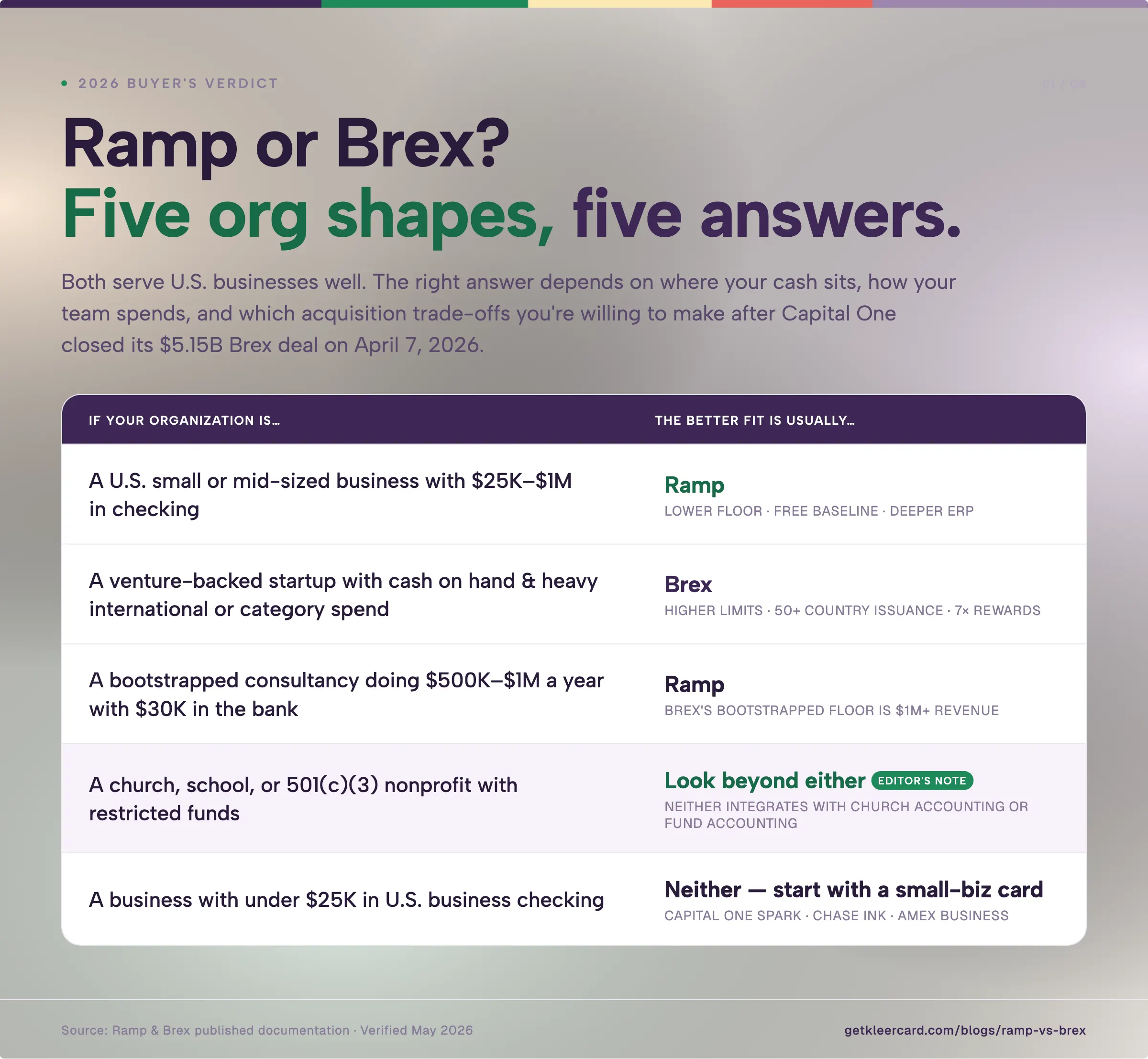
For most U.S. small and mid-sized businesses, Ramp is the better fit. It has a lower eligibility floor, a free baseline product, and deeper ERP integrations.
For venture-backed startups with cash on hand and a lot of international or category-heavy spend, Brex still has the edge. Capital One closed its acquisition of Brex on April 7, 2026, which is worth weighing if you're picking Brex right now.
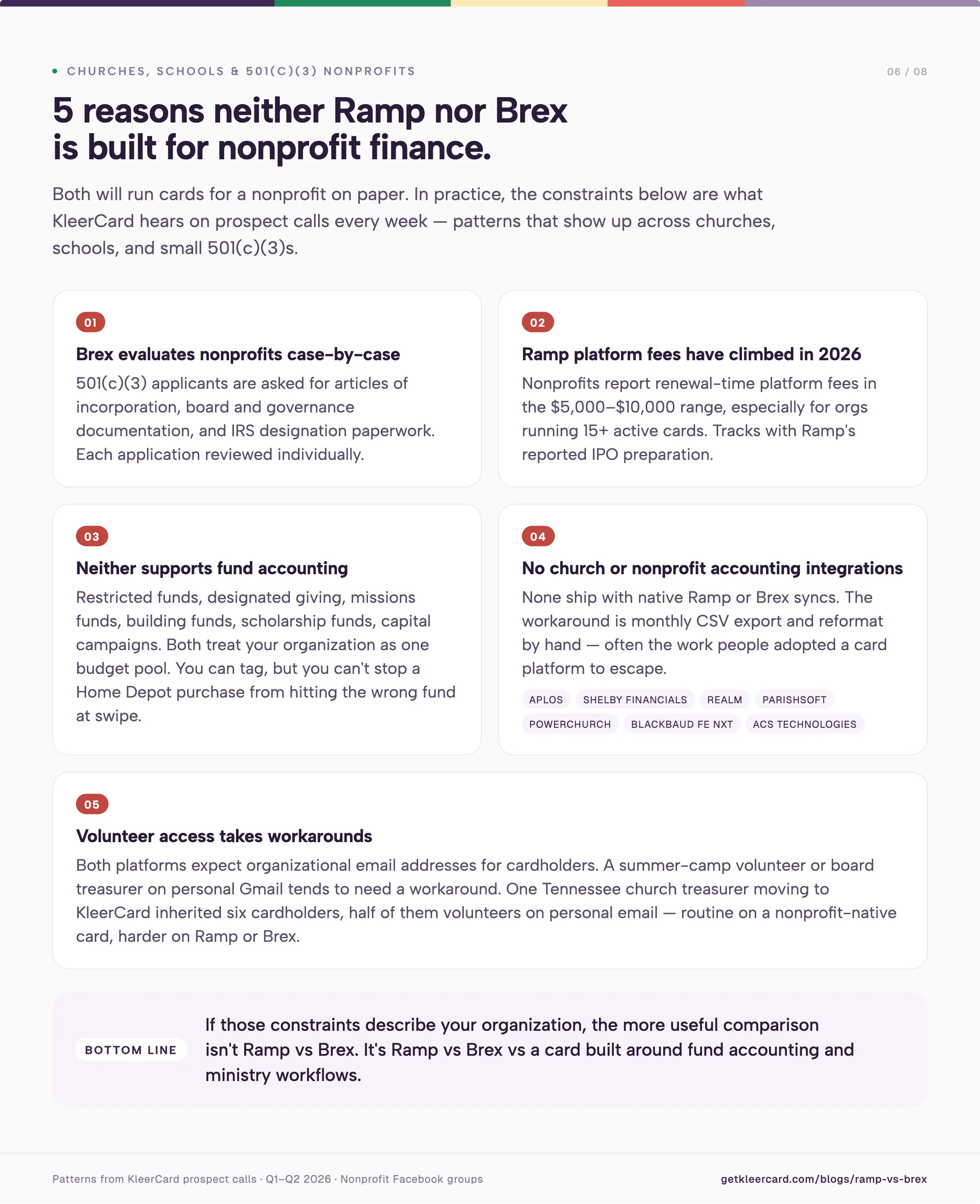
Churches, schools, and 501(c)(3) nonprofits with restricted funds probably want to look beyond either one. Neither integrates with church accounting software or supports fund accounting natively. (See our breakdown for nonprofits here.)
If you have less than $25,000 in your business bank account, neither will approve you on standard terms. A small business card from Capital One Spark, Chase Ink, or Amex is the more realistic path.
Capital One announced its acquisition of Brex on January 22, 2026, in a deal valued at $5.15 billion, 50% cash and 50% stock. The deal closed on April 7, 2026. That price represents a roughly 58% drop from Brex's $12.3 billion peak valuation, per CNBC's coverage.
Pedro Franceschi stays on as Brex CEO. Capital One says pricing, products, and support are unchanged for now, while acknowledging the transition will reshape product direction and policies over time.
A few things are still unanswered for buyers evaluating Brex this year: whether Brex keeps shipping product at the same pace under bank ownership, whether eligibility or pricing tightens as Capital One's risk models layer onto Brex's underwriting, and whether the customer base drifts toward Capital One's traditional commercial banking clients and away from the venture-backed startups Brex grew up serving.
Capital One has only said integration will be gradual. None of those questions have public answers yet.
If you're evaluating Brex right now, the product still works the way it did six months ago. The longer-term direction is the part that's uncertain.
A few situations where Brex tends to win:
Higher credit limits for cash-heavy startups. Brex underwrites against your cash balance and funding history. A company holding $2-5M can access credit limits 10-20x higher than traditional small business cards offer, per NerdWallet. That kind of headroom is useful for a funded startup with $80,000 in monthly card spend and eighteen months of runway.
Global card issuance. Brex issues local-currency cards in 50+ countries with no FX markup. A startup with engineers in Berlin, contractors in Bogotá, and a sales team in London avoids the layered FX fees a U.S.-issued card produces. Ramp charges a 3% currency conversion fee on foreign-currency purchases, per NerdWallet's Ramp review.
Category-rich rewards for startup spend. Brex pays up to 7x on rideshare, 4x on restaurants and travel booked through Brex Travel, and 2x on software subscriptions. For a team whose spend stack runs Uber, DoorDash, AWS, and conference travel, the points program can outpace Ramp's flat cashback. Points redeem through travel partners, statement credits, and gift cards.
Travel infrastructure. Brex's built-in travel booking earns 4x points and integrates with TravelBank for policy management. For finance teams managing distributed travel across multiple countries, it tends to come up well in side-by-side reviews against Ramp.
A few situations where Ramp tends to win:
Lower eligibility floor. Ramp accepts businesses with $25,000 in connected accounts. Brex's $50,000 funded-startup minimum (or $1M revenue if bootstrapped) excludes a large share of small businesses and most small nonprofits. A bootstrapped consultancy doing $600,000 a year with $35,000 in checking qualifies for Ramp and falls short of Brex.
Free baseline product. Ramp's free tier includes unlimited physical and virtual cards, bill pay, expense management, basic policy controls, and accounting sync. Brex's Essentials tier is also free, but the more useful Premium tier runs $12/user/month last published. For a 10-person company without multi-entity or PO workflow needs, Ramp's free product covers more than most teams use.
Independent roadmap. Ramp stays independent and venture-backed. Brex now sits inside a bank holding company with $475.8 billion in deposits, per Capital One's announcement of the deal. There are trade-offs in both directions. Capital One brings balance sheet scale and underwriting depth. Bank ownership tends to slow feature velocity. For teams that want faster product cycles over the next year or two, Ramp is the safer bet.
ERP depth. Ramp ships bi-directional, real-time sync with QuickBooks Online, NetSuite, Sage Intacct, and Oracle Fusion. Brex's QuickBooks Online integration caps you at one Brex account per QBO account, and edits in QuickBooks don't sync back to Brex, per Relay Financial's comparison. Finance teams running multi-entity setups on QuickBooks tend to feel that ceiling at month-end close.
Spend control granularity. Ramp lets you set merchant-level, category-level, and vendor-level restrictions on individual cards. Brex offers category-level controls. The practical difference: a Ramp card locked to "Office Depot only" works at Office Depot and nowhere else. A Brex card capped to "office supplies" works at Staples, Best Buy's office aisle, Amazon Business, and a long list of other merchants in the same MCC. For finance teams handing cards to non-finance staff, the more granular lockdown helps.
Most people searching "Ramp vs Brex" are running for-profit businesses. Both products serve that audience well, and what's above should be useful.
For churches, schools, and 501(c)(3) nonprofits, the constraints get more specific. A few patterns we hear from prospect calls at KleerCard through Q1 and Q2 2026:
If those constraints describe your organization, the more useful comparison is Ramp vs Brex vs a card built around fund accounting and ministry workflows.
The most common reason someone rules a platform out is that they don't qualify on day one. Both Ramp and Brex publish their requirements.
Per Ramp's published support documentation, an applicant must:
Sole proprietors and unregistered businesses don't qualify. Foreign owners can apply with a passport in place of an SSN.
Per Brex's published account requirements:
A bootstrapped services company doing $500,000 a year with $30,000 in the bank qualifies for Ramp and falls short of Brex's monthly-payment threshold. A venture-backed startup with $2M raised and $200,000 in monthly revenue qualifies for Brex but might find Ramp's cash requirement tight depending on burn rate. A church with $1.2M in annual giving and $80,000 in operating cash qualifies for Ramp; Brex will likely route the application into case-by-case review and ask for governance documentation before approving.
For nonprofits, Ramp is the cleaner path to approval. Brex's case-by-case review is real, but it tends to be slower, and the credit model wasn't designed for donation-funded organizations.
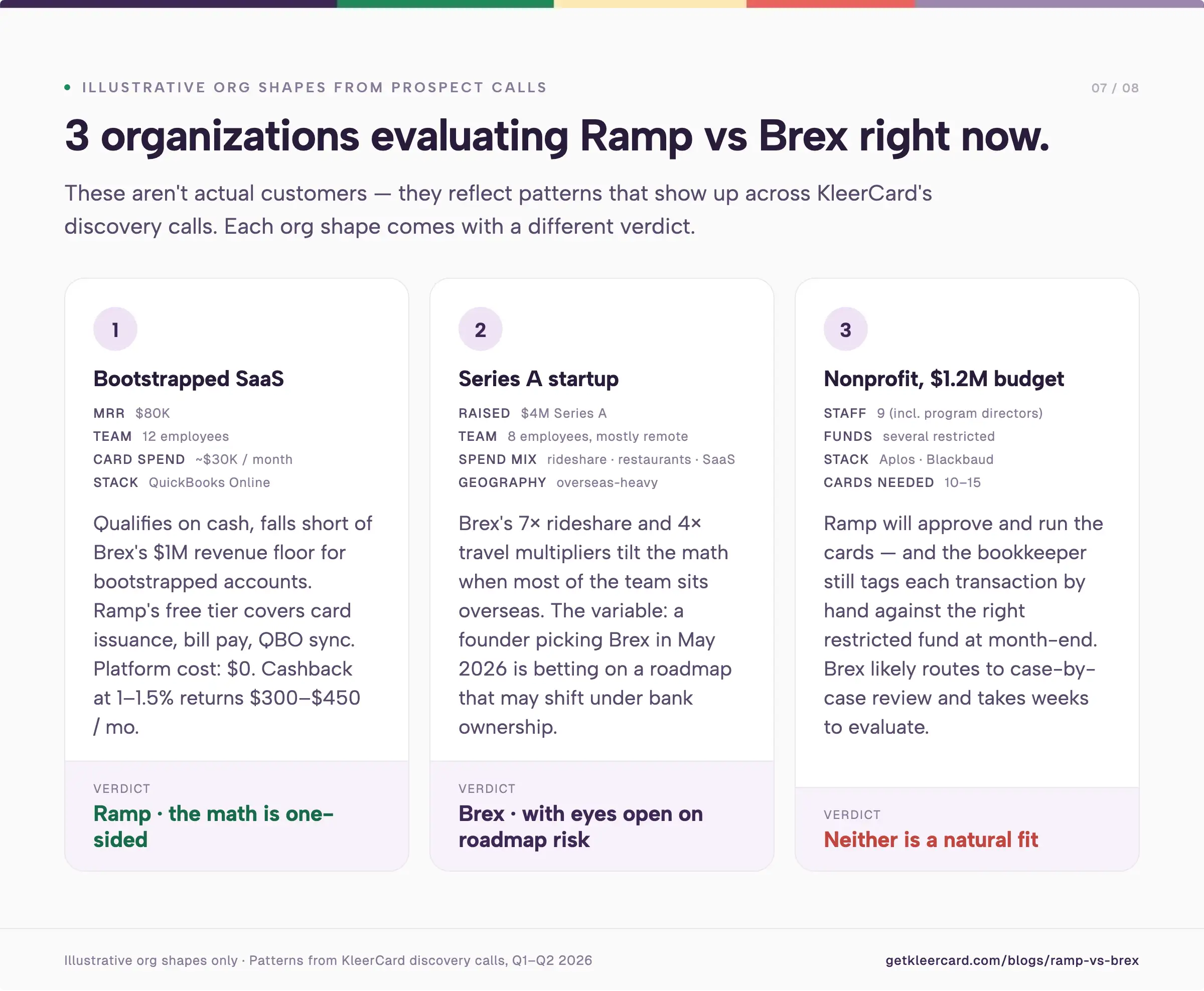
These are illustrative org shapes, not actual customers. They reflect patterns that show up in our prospect calls.
The math favors Ramp. The company qualifies on cash and falls short of Brex's $1M revenue threshold for bootstrapped accounts. Ramp's free tier covers card issuance, bill pay, and QBO sync. Total platform cost: $0. Cashback at 1-1.5% on $30,000 of monthly card spend returns $300-$450 a month.
Either platform works. Brex's category-rich rewards and global card issuance tilt the math when most of the team sits overseas. The 7x rideshare and 4x restaurant multipliers add up for travel-heavy founder schedules. The Capital One acquisition is the variable to weigh. A Series A founder picking Brex in May 2026 is betting on a roadmap that may shift toward enterprise priorities under bank ownership.
Neither product is a natural fit for this org shape. Ramp will approve the nonprofit and run the cards, and the bookkeeper will still tag each transaction by hand against the right restricted fund at month-end. Brex will likely route the application into case-by-case review and take weeks to evaluate. A platform built for nonprofits with native fund classification and church-accounting integrations is usually the better tool.
KleerCard sells neither Ramp nor Brex. We make a corporate card for churches, schools, and nonprofits, and we compete with both for that specific buyer. For most for-profit SMBs, KleerCard isn't the right answer.
KleerCard tends to be a good fit when:
KleerCard tends to be the wrong fit when:
For for-profit SMBs without nonprofit-specific needs, the choice comes down to Ramp vs Brex.
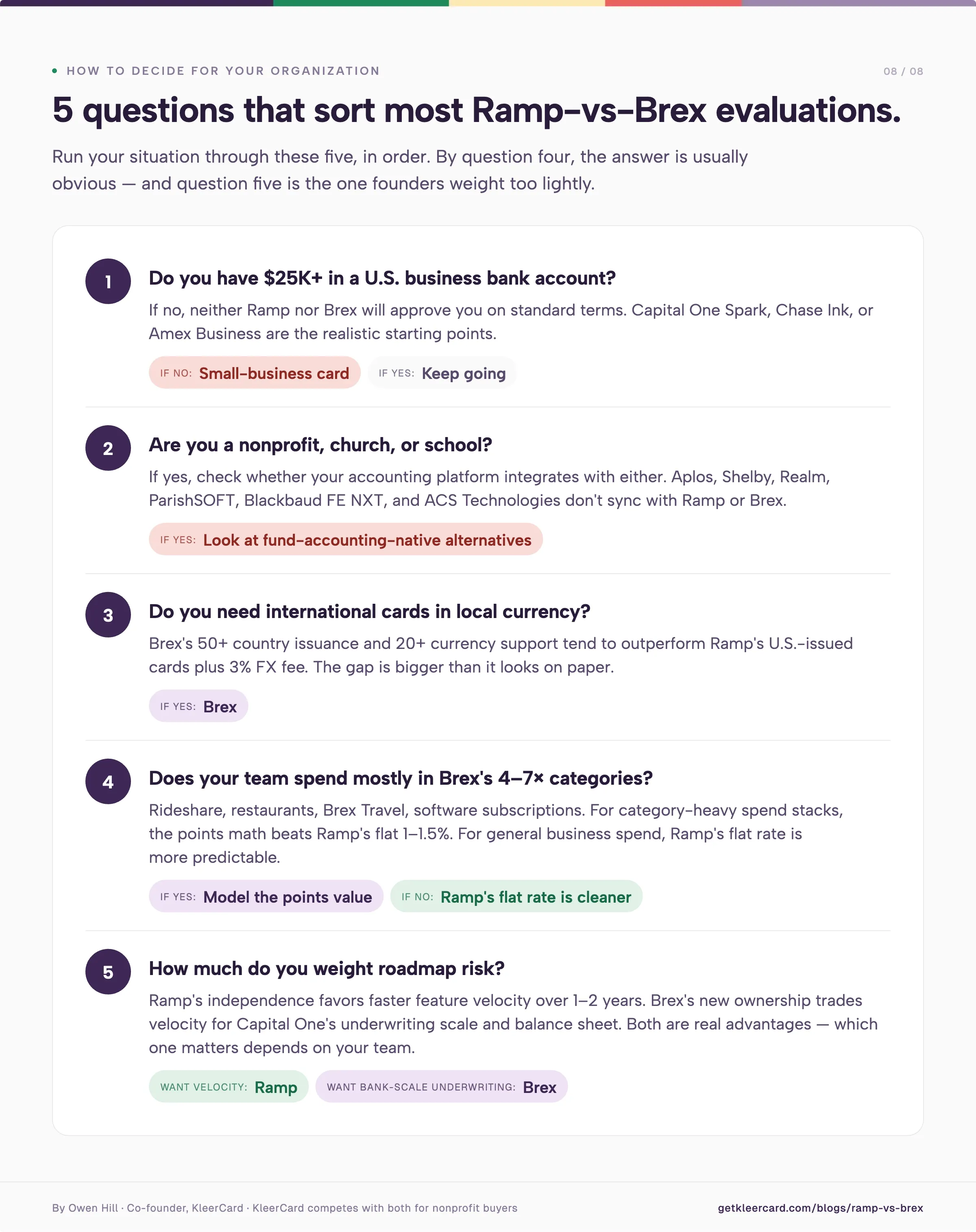
Five questions tend to sort most evaluations:
For most U.S. SMBs, Ramp tends to win on price, free-tier capability, ERP integrations, and roadmap independence. For globally distributed venture-backed startups with heavy travel and software spend, Brex tends to win on rewards and international infrastructure. For nonprofits, churches, and schools, neither is usually the best answer.
No. Brex still operates under its own brand with co-founder Pedro Franceschi as CEO. The acquisition closed on April 7, 2026, and Capital One says products, pricing, and support are unchanged for now. What will change over time is the product roadmap, the underwriting model, and the integration with Capital One's broader commercial banking stack. Capital One hasn't defined any of those changes yet.
For most small and mid-sized businesses, Ramp is cheaper on a published-price basis. Ramp's free tier covers cards, bill pay, expense management, and accounting sync. Brex's Essentials tier is also free, with fewer features. The paid comparison is closer. Ramp Plus costs $15/user/month plus a platform fee that varies by company size. Brex Premium costs $12/user/month last published. Both have negotiation room at scale. A 10-person team without multi-entity workflow needs tends to come out ahead on Ramp's free product.
Ramp accepts nonprofits as eligible applicants. Brex evaluates nonprofits case-by-case and requires 501(c)(3) documentation, articles of incorporation, and board governance information. Neither has native integrations with church or nonprofit accounting platforms like Aplos, Shelby Financials, Realm, ParishSOFT, ACS Technologies, Blackbaud, or PowerChurch. Neither supports fund accounting in its data model. Most nonprofit users end up exporting CSVs and reformatting them by hand for fund tracking, which is often the work the card was supposed to eliminate.
Neither requires a personal guarantee or a personal credit check. Both evaluate your business's cash balance, revenue, and funding history to set a credit limit. Traditional small business cards from issuers like Capital One Spark or Chase Ink usually require a personal guarantee from the business owner and pull a personal FICO score.
No. Both platforms restrict eligibility to incorporated businesses: corporations, LLCs, and limited partnerships. Ramp's documentation states this directly. Brex requires a formal business structure with a U.S. EIN. Sole proprietors and unregistered businesses are usually better served by small business credit cards from major issuers.
Ramp offers up to 1.5% flat cashback, with the actual rate set by Ramp and varying by customer, per NerdWallet's review. Brex uses a points-based program with category multipliers: 1x base, up to 7x on rideshare, 4x on restaurants and travel booked through Brex Travel, and 2x on software subscriptions. For spend profiles heavy in those categories, Brex points can outpace Ramp's cashback. For spend that runs mostly software subscriptions and general business expenses, Ramp's flat rate is more predictable.
Capital One hasn't announced changes. Integration is expected to be gradual over the months following the April 7, 2026 close. One thing worth watching: Capital One's underwriting standards differ from Brex's startup-cash-balance model, and a shift toward bank-style credit standards could affect existing customers at renewal. Brex's customer base spans early-stage startups to large enterprises. Capital One's commercial banking customers tend toward larger, more established businesses. A roadmap shift toward those customers would change Brex's product priorities over time.
Brex tends to be the better fit for most venture-backed startups in May 2026. Higher credit limits, 7x category rewards, 50+ country card issuance, and a more mature travel product all favor the funded-startup profile. The Capital One acquisition is the part to weigh. A founder who values an independent roadmap might look at Ramp for the 24-month window. A founder who values bank-backed underwriting scale and a larger credit ceiling gets that reinforced under Brex's new ownership.
Owen Hill, co-founder of KleerCard, wrote this article. KleerCard sells neither Ramp nor Brex. We make a corporate card for nonprofits, churches, and schools, and we compete with both products for that buyer.
If you want the church and nonprofit angle on either platform, our Ramp Card review for nonprofits and KleerCard vs Ramp for churches and nonprofits go deeper. To see what KleerCard does for your organization, sign up takes about five minutes.
Owen Hill co-founded KleerCard, a corporate card built for nonprofits, churches, and schools. He previously served as Budget Director at Compassion International, where he managed program budgets across dozens of country offices, and ran Switch Consulting, a fractional CFO practice for nonprofits. This article reviews KleerCard alongside Ramp, Brex, and other corporate cards.


Speak to a member of our team and we can have you up and running in minutes, not weeks.