%202.svg)
Honest 2026 review of Charity Charge Nonprofit Business and Corporate Cards. Eligibility floors, $0 fees, pros and cons, and fund accounting gaps.
Charity Charge offers two Mastercard products built for 501(c) nonprofits: the Nonprofit Business Card for simpler teams and the Nonprofit Corporate Card for larger organizations that need virtual cards and granular controls. Both carry no annual fee and no personal guarantee in standard underwriting.
I review these products the same way I talk with finance teams every week. The question is rarely “is this a real card.” The question is whether the card and the platform match how the organization actually tracks money, issues cards, and closes the books.
This review covers eligibility floors, real pricing, what each card actually controls, where the products fall short for churches and schools, and how they stack up against KleerCard, Ramp, and BILL Divvy. The comparison sections reflect what we see when nonprofits, churches, and schools evaluate Charity Charge in practice. Eligibility thresholds, fees, and product details were last verified against Charity Charge’s public pages in July 2026.
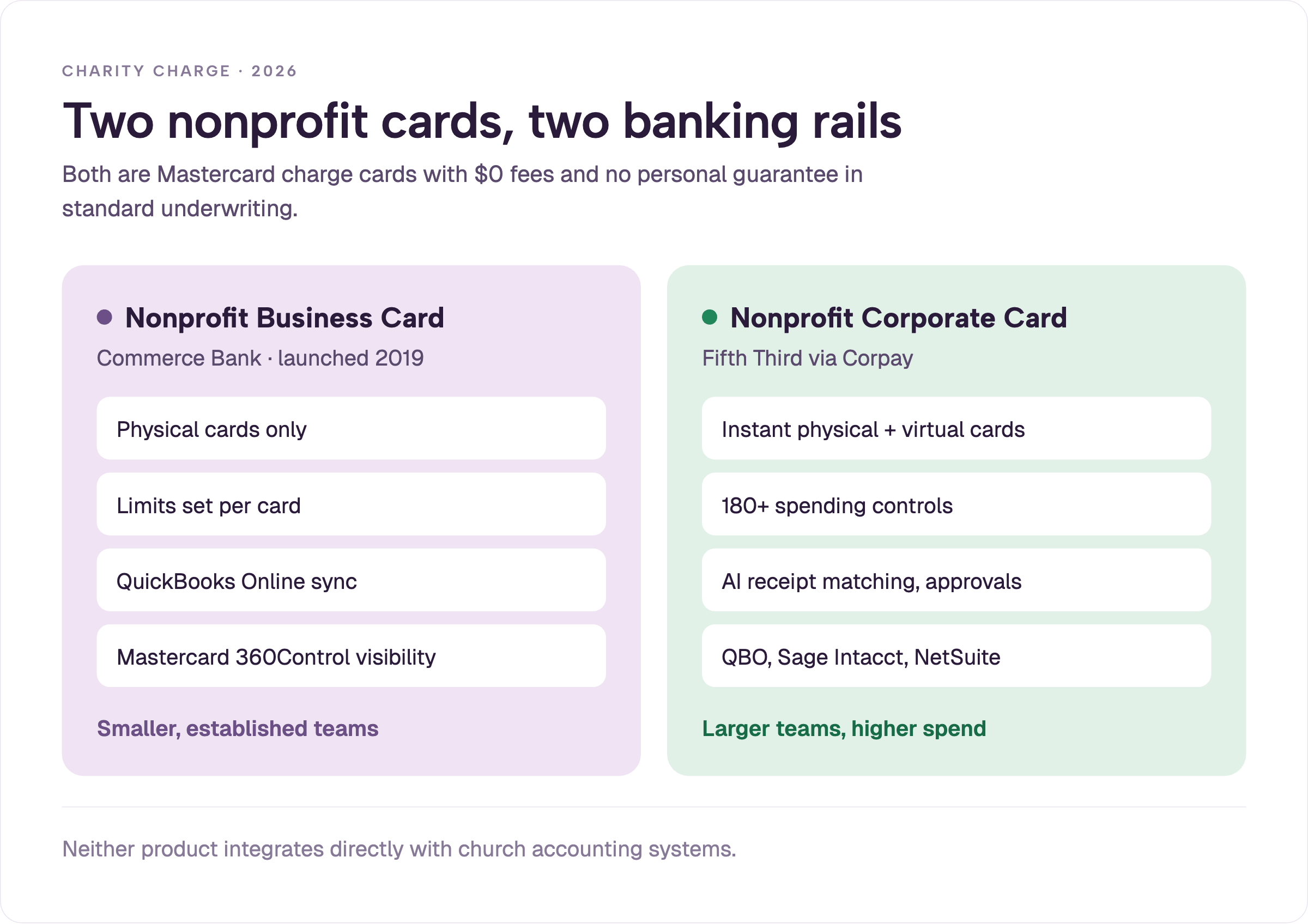
Charity Charge is a public benefit corporation that designs financial products exclusively for nonprofits. The Nonprofit Business Card launched in 2019 with Commerce Bank on the Mastercard commercial network.
It underwrites the organization rather than an individual. Cardholders get physical cards with adjustable limits, real-time visibility through Mastercard 360Control, QuickBooks Online integration, and access to Mastercard Easy Savings rebates plus CHAMPS group purchasing discounts.
The product works cleanly for smaller nonprofits that need a straightforward organizational card without personal guarantees or annual fees. It does not issue virtual cards. Spend controls live inside the Mastercard commercial tooling rather than a dedicated nonprofit expense platform.
Most of the organizations I talk with who land on the Business Card are looking for a simple way to get plastic into the hands of a handful of staff without tying the account to a board member’s personal credit. The Mastercard commercial rails give them basic limit controls and statement visibility. That is often enough when spending is predictable and the books live in QuickBooks Online.
The Nonprofit Corporate Card is the newer product aimed at larger teams and higher annual spend. It is issued by Fifth Third Bank through Corpay on Mastercard.
Features include instant physical and virtual cards, 180+ granular spending controls, AI receipt matching, custom approval workflows, and integrations with QuickBooks Online, Sage Intacct, and NetSuite. Approval typically returns in two to three business days with a dedicated account manager.
This is the product that competes most directly with spend-management platforms. It still does not offer native integrations with church-specific accounting systems.
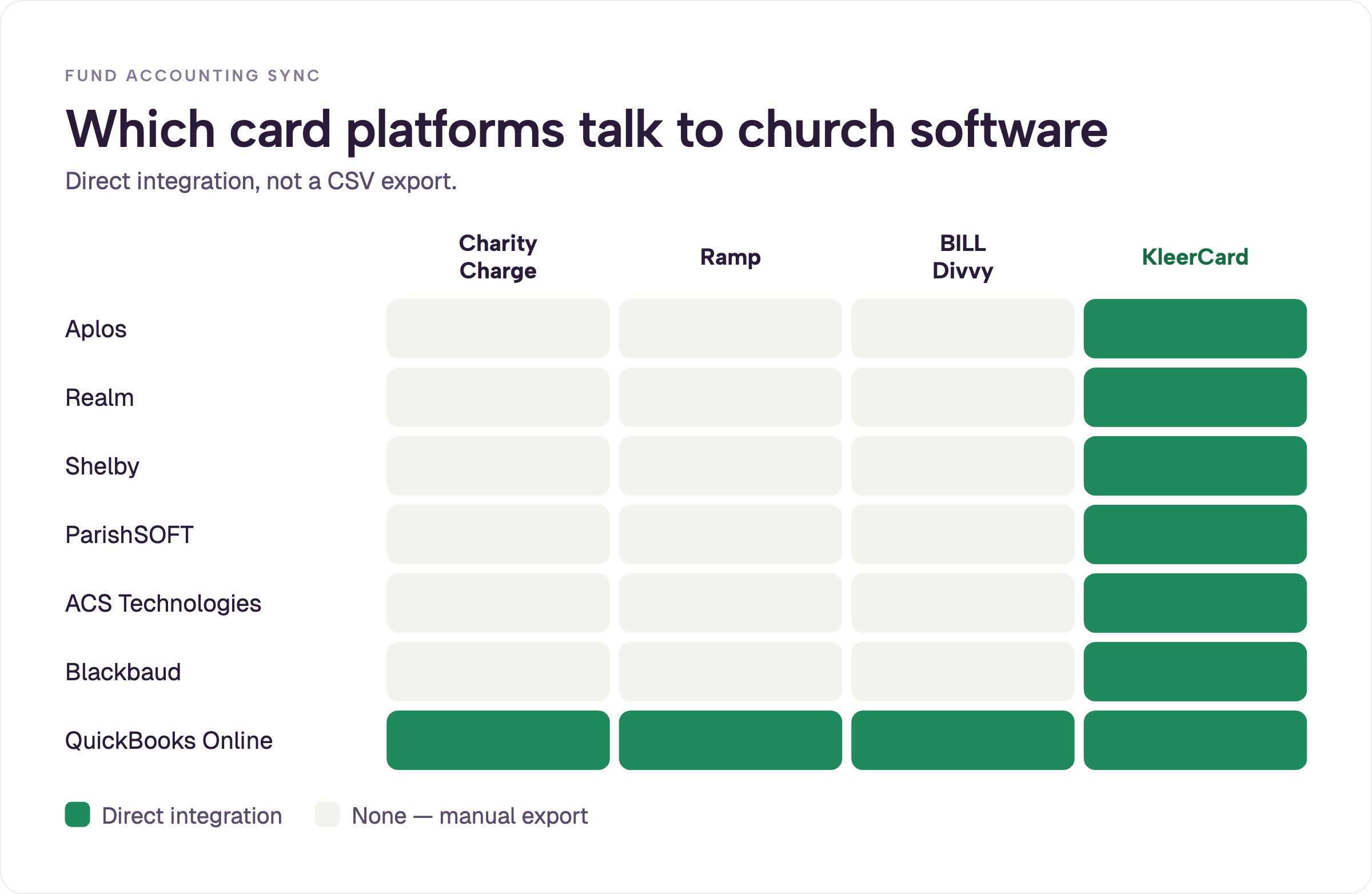
When a nonprofit has already outgrown five or ten physical cards and needs single-use virtual numbers for subscriptions or project budgets, the Corporate Card becomes the relevant option. The AI receipt matching and approval routing work as described. The limitation remains the same: if your ledger is built around fund accounting in Aplos, Realm, or Shelby, the transactions still leave the card platform as a flat export.
Both products require active 501(c) status.
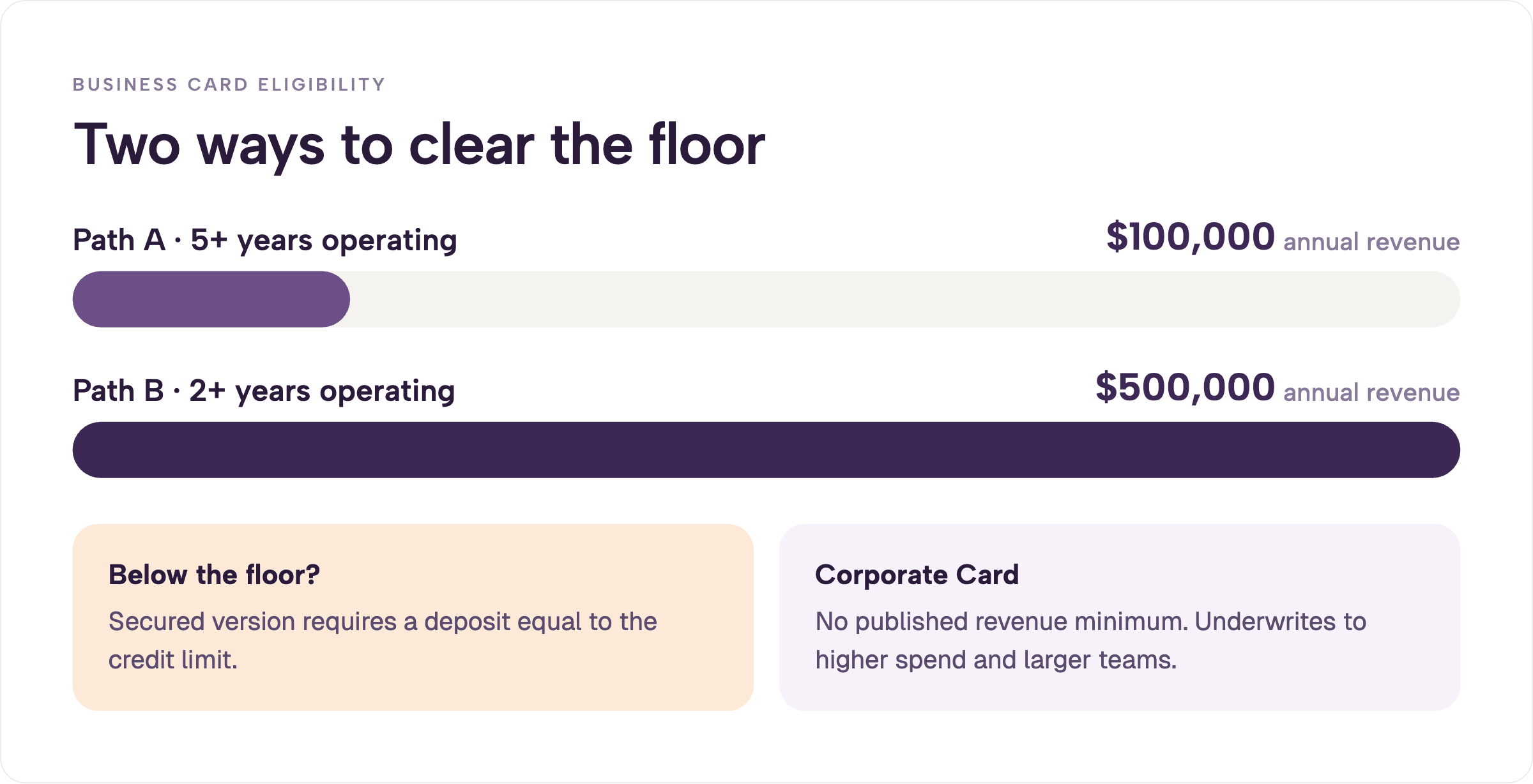
For the Nonprofit Business Card the published thresholds are:
Organizations that miss the floor can apply for the secured version, which requires a deposit equal to the credit limit held in a Commerce Bank savings account.
The Corporate Card has no published revenue minimum. Underwriting reviews two years of financial documents (990s, audited statements, or income statement plus balance sheet pairs), a board resolution, EIN documentation, and an explanation of cash flow if it is uneven.
Application timelines run five to ten business days for the Business Card and two to three business days for the Corporate Card. Complex financials extend either window.
I have seen newer church plants and small schools hit this floor hard. The secured option exists, but parking cash equal to the credit line is rarely practical when the organization is still building reserves. Established nonprofits with clean 990s clear the bar without drama.
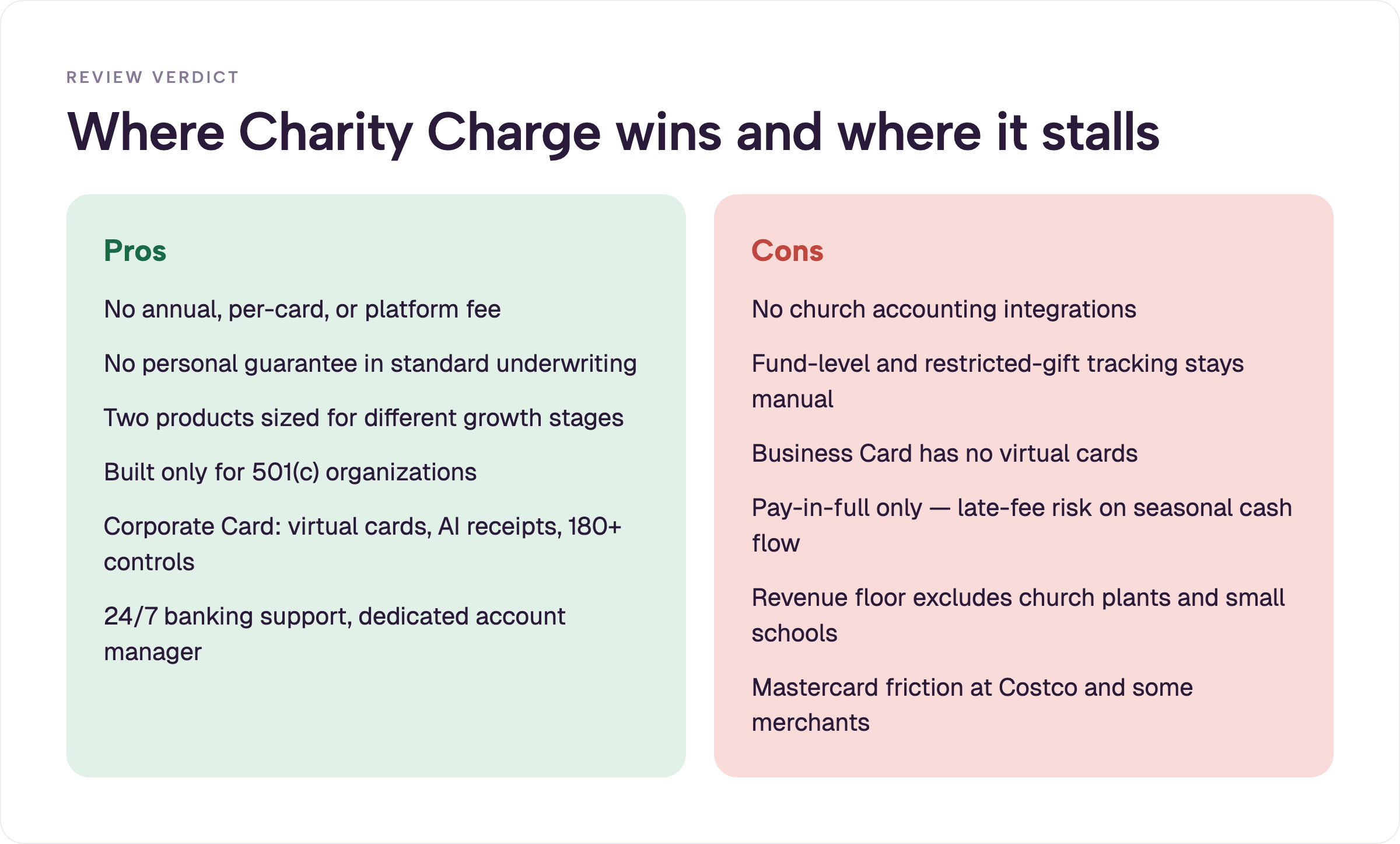
Both products charge $0 annual fee and $0 per-card fee. Charity Charge earns revenue from its banking and network partners rather than from cardholders.
Business Card terms include a foreign transaction fee and a late fee of 2.5 percent of the past-due amount. Grace period is at least 20 days from statement date when the prior balance was paid in full.
Corporate Card pricing follows Corpay and Fifth Third commercial terms. Both products function as charge cards. The full balance is due each cycle. There is no revolving option and no balance transfer.
That structure protects nonprofits from carrying debt. It also creates friction for organizations with seasonal cash flow. Churches whose giving peaks at year-end and schools whose tuition cycles do not line up with operating expenses can hit the late fee when timing slips.
I talk with finance teams every week who prefer the discipline of a true charge card. The same teams also tell me the late-fee risk becomes real when a major donor gift lands after the statement closes or when summer tuition revenue is still outstanding. Pay-in-full is clean until the cash calendar and the statement calendar diverge.
For comparison, see KleerCard pricing if you are evaluating platforms that combine cards with expense workflows.
Employee cards are unlimited on both products with no per-card fees. Limits can be set per card and adjusted as needed.
The Corporate Card adds virtual cards that can be issued instantly with merchant, amount, or time restrictions. AI receipt matching reduces manual coding. Custom approval workflows route requests before spend.
Accounting integrations on both products center on QuickBooks Online. The Corporate Card also reaches Sage Intacct and NetSuite. Neither product maintains direct integrations with Aplos, Realm, Shelby, ParishSOFT, ACS Technologies, ChurchTrac, or PowerChurch. Teams on those platforms export and import manually. See how accounting sync works when the card platform is built to talk to fund accounting systems from the start.
Vendor savings come through Mastercard Easy Savings and CHAMPS GPO discounts (typically 10–20 percent on selected office, shipping, travel, and medical suppliers). There is no flat-rate cash back on general spend. Confirm current rebate terms during application rather than relying on older marketing language.
The control model on the Corporate Card is solid for organizations that think in merchant categories and dollar limits. It is less natural for organizations that think in restricted funds and ministry dimensions. When every classroom supply purchase needs to land in the correct fund or class, the coding still happens after the fact in the accounting system.
I have watched finance teams try to solve the same problem by creating separate accounts for elementary classroom supplies, middle school classroom supplies, and upper school classroom supplies. That approach forces every teacher purchase to be coded to a unique account line. A cleaner structure keeps one classroom supplies account and assigns a dimension for the school level. The card platform then needs to support that dimension. Charity Charge does not. The work stays in the ledger.
For organizations that want the controls and receipt workflow in one place, see how expense management platforms handle pre-spend authorization.
The absence of a personal guarantee is the feature I hear about most often from boards. When a treasurer rotates off or a new executive director arrives, the card program does not have to be rebuilt around a new signature. That continuity matters.
The fund accounting gap is the one that shows up most clearly in the schools and churches I work with. Most of those organizations do not need ten different “classroom supplies” accounts. They need one classroom supplies account plus a dimension for elementary, middle, or upper school. Charity Charge does not give them that structure inside the card platform. The coding work stays in the ledger after the statement lands. For a deeper look at tools built around that reality, see the church solutions page.
Mastercard acceptance is another practical limit. Costco still does not take Mastercard in the United States. International mission teams sometimes run into merchants that prefer Visa. Neither issue is fatal, but both create workarounds that finance teams would rather avoid.
The practical difference shows up in daily operations. I have watched private Christian schools with roughly 540 students and a separate children’s center try to run an entire campus on five shared bank cards. Teachers and coaches spent part of every week hunting for the physical card or simply fronting the purchase and submitting reimbursement batches of ten or twelve at the deadline. Receipts disappeared. Month-end close stretched into days.
One maintenance director I spoke with described the old process clearly. A toilet needed supplies from Home Depot. Before he could leave campus he had to locate whoever currently held a card. That person might be on the other campus. The delay sat between a real facilities problem and the fix. Once he received his own card with a weekly check-in on the balance, the same purchase took minutes and the receipt uploaded on the spot.
When those same schools move to a platform that issues per-person cards and labeled loaner cards for departments, the numbers change fast. Sixty-plus cards become normal. Lost receipts drop below a handful across an entire school year. Month-end reconciliation shrinks to minutes because the coding and receipts are already attached. That shift is much harder when the card platform cannot talk directly to Shelby Financials or the student information system.
Amazon purchases illustrate the same gap. Before a dedicated integration, a finance office would see a single Amazon charge and then spend time matching it to the original order and the right fund. Platforms that sync itemized Amazon receipts eliminate that chase and keep the coding attached to the card. Charity Charge does not currently close that loop the same way. The lower-school administrative assistant who buys tablecloths and balloons for an event still has to code the charge after the fact instead of having the line items land already attached to her card. See how expense management platforms handle Amazon and similar high-volume vendors.
For schools and churches that need the card layer to talk to the ledger, see KleerCard for churches.
Ramp and BILL Divvy bring strong automation and, with Ramp and KleerCard, cash back. Both still leave church accounting platforms outside the native sync list. KleerCard was built the other direction: start with the fund accounting systems that churches and schools already use, then add the card and control layer on top.
The Business Card fits nonprofits that clear the revenue and tenure thresholds, run on QuickBooks Online, keep spending simple across a modest number of physical cards, and want to remove personal guarantees from board members.
The Corporate Card fits larger teams with higher annual spend that need virtual cards, AI receipt matching, custom approvals, and a dedicated account manager, still on QuickBooks, Sage Intacct, or NetSuite.
A regional foundation with stable cash and standard accounting software will find either product straightforward. A church plant, a small Christian school, or a multi-fund ministry that needs fund-level reporting inside the card platform will hit the gaps listed above.
If your organization already treats its chart of accounts like a standard business ledger and the main pain is simply getting cards into more hands without personal guarantees, Charity Charge solves that cleanly. If the pain is restricted gifts, ministry dimensions, and the constant export-import dance with church software, the decision usually lands elsewhere.
I see the same pattern in rollout conversations. Organizations that start with a single department, iron out the policy and receipt habits, then expand to administrators and finally teachers or coaches succeed faster. Trying to issue sixty cards on day one without those habits creates the exact receipt-chase problem the platform is supposed to solve. Charity Charge’s support team understands board transitions well. The operational stair-step still belongs to the finance office.
For a broader look at cards that do not require a personal guarantee, see the nonprofit credit cards with no personal guarantee guide. The best credit cards for nonprofits list places Charity Charge in context with the rest of the field.
Yes. Charity Charge is a public benefit corporation. The Business Card is issued by Commerce Bank. The Corporate Card is issued by Fifth Third Bank through Corpay. According to Charity Charge’s about page, the company serves over 3,000 mission-driven organizations.
No in standard underwriting. Both products underwrite to the organization. A personal guarantee can be required in certain circumstances when financials are weaker.
Yes for qualifying nonprofits. There is no annual fee, no per-card fee, and no platform fee. Late fees apply on past-due balances under the Business Card terms.
Yes on the Nonprofit Corporate Card. The older Business Card issues physical cards only.
Yes. Both products support QuickBooks Online. The Corporate Card also reaches Sage Intacct and NetSuite. Neither product offers direct integrations with church accounting platforms such as Aplos, Realm, Shelby, or ParishSOFT.
Both eliminate personal guarantees and annual fees. Charity Charge fits nonprofits on standard ERP systems. KleerCard fits churches, schools, and multi-fund organizations that need the card platform to sync directly with fund accounting software and to control spend before it happens. More detail lives in the dedicated KleerCard vs Charity Charge comparison.
Charity Charge delivers two legitimate nonprofit-first Mastercard products with transparent pricing and no personal guarantee in standard cases. The Business Card remains a clean option for smaller established 501(c)(3)s on QuickBooks. The Corporate Card brings modern controls to larger teams.
The product gap appears for churches, schools, and multi-fund ministries. When restricted-gift tracking, fund-level reporting, and direct accounting sync matter more than vendor rebates, the platform leaves that work outside the card system. KleerCard for churches and nonprofits was built for that exact operating reality.
I have seen the same organizations evaluate both options side by side. The ones that stay with Charity Charge usually have stable cash, standard ERP systems, and a board that simply wants the personal guarantee removed. The ones that move on usually have multiple funds, classroom or ministry budgets that need real-time visibility, and a ledger that already lives in Aplos, Realm, Shelby, or ParishSOFT.
If your nonprofit looks like a stable mid-market organization on standard accounting software, Charity Charge belongs on the shortlist. If your organization is a church, a school, or a ministry that tracks money by fund and needs the card to talk to the ledger, evaluate the difference in integrations and pre-spend controls before you decide.
You can schedule a demo or sign up for KleerCard when you are ready to see the difference in practice. For a wider view of the category, start with the best credit cards for nonprofits list or the no personal guarantee guide.


Speak to a member of our team and we can have you up and running in minutes, not weeks.