%202.svg)
Compare 9 school accounting and finance software platforms for charter and independent K-12 schools, by fund accounting depth and spend control fit.
Updated May 2026
Charter schools and independent K-12 institutions carry public-grade reporting duties on tighter budgets. They need real fund accounting without a full district ERP's price and setup.
This guide ranks the platforms that matter for charters and independents, shows where each one fits, and says plainly when a mainstream tool would serve you better.
Public districts are a different story. They standardize on Tyler, PowerSchool, or Skyward because state reporting and board-level control demand it, and most are not shopping for a new ledger.
The real decision for charters and independents is avoiding an expensive platform that adds little beyond what QuickBooks plus discipline already delivers.
The best accounting software for charter and independent schools uses fund accounting to track money by source and restriction, supports state and grant compliance reporting, and syncs with tools a small finance team can actually staff. Common options include QuickBooks Online with a fund workaround, MIP, Sage Intacct, Blackbaud Financial Edge NXT, and Veracross.
These nine sort by who they fit, how deep their fund accounting runs, and how they price for schools that are not full public districts.
| Platform | Best fit | Fund accounting | SIS or ERP scope | State and compliance reporting | Tuition and billing | Pricing model |
|---|---|---|---|---|---|---|
| QuickBooks Online | Most small charters and independents | Workaround only (no native single-fund balance sheet) | Finance only | Limited (manual export for state reporting) | None | ~$120/year |
| Blackbaud Financial Edge NXT | Private schools, nonprofits | Native | Finance plus donor and grant | Strong (GAAP) | Via add-ons | Quote, premium |
| Sage Intacct | Growing and multi-entity charters | Native, dimensional | Finance only | Strong | Via integrations | Subscription, mid to high |
| Skyward Business Suite | Larger independents or charters mimicking districts | Native | Full district ERP and SIS | Strong (state) | District-level | Quote |
| PowerSchool eFinancePlus | Charters needing K-12 state filing | Native, encumbrance | Finance and HR ERP | Strong (K-12 state filing) | District-level | Quote |
| Tyler Enterprise ERP (Munis) | Charters in states that already run it | Native, deep | Full ERP | Strong (state) | District-level | Quote, cloud or on-premise |
| MIP by Momentive Software | Charters, grant-funded programs | Native, modular | Finance only | Strong | None | Modular quote |
| Veracross | Independent K-12 schools | In business module | SIS-led, one record | Moderate (GAAP) | Built in | Per-school quote |
| FACTS | Faith-based and small private schools | Billing-focused | SIS and tuition | Limited | Built in | Per-student quote |
The table gives you the shortlist. For charters and independents, QuickBooks (with a disciplined workaround), MIP, Sage Intacct, Blackbaud, and Veracross usually deliver the best balance of fund accounting depth and cost.
QuickBooks Online is where most small charters and independent schools start. Fund accounting is where it falls short.

You could run 90% of the schools in America on QuickBooks Online for about $120 a year. Some schools pay tens of thousands for a specialized platform and get little back beyond the fund accounting you can approximate with a little manual work.
QuickBooks cannot produce a balance sheet for a single fund. A family gives to a restricted scholarship, and that gift lands in the books as profit. You cannot spend it on anything else, but the report does not show that.
Many specialized tools charge a lot to solve that problem, but they contribute less than they cost. One downside of these programs is that help is hard to find. Search for how to reconcile cards in QuickBooks and you get a hundred tutorials. Search for the same task in an obscure school platform and you get silence.
It is the equivalent of owning a Ferrari you cannot find a mechanic for.
So my starting recommendation is plain. Do not buy an expensive platform that adds no value over a tool you can staff and support. If your accounting feels too special for a mainstream system like QuickBooks, you may be making it harder than it needs to be.
If you do not want to use QuickBooks, the recommendations below break down the alternatives. The same logic applies in our full church accounting software guide.
Six questions still matter, but the answers shift when you are a charter or independent school.
Answer those six and the list above sorts itself.
Fund accounting tracks money by the purpose attached to it. A federal Title I grant, an athletics fund, and a building campaign each live in their own fund. When someone gives $1,000 to the building fund, you have to spend it on the building, not on utilities or a salary.
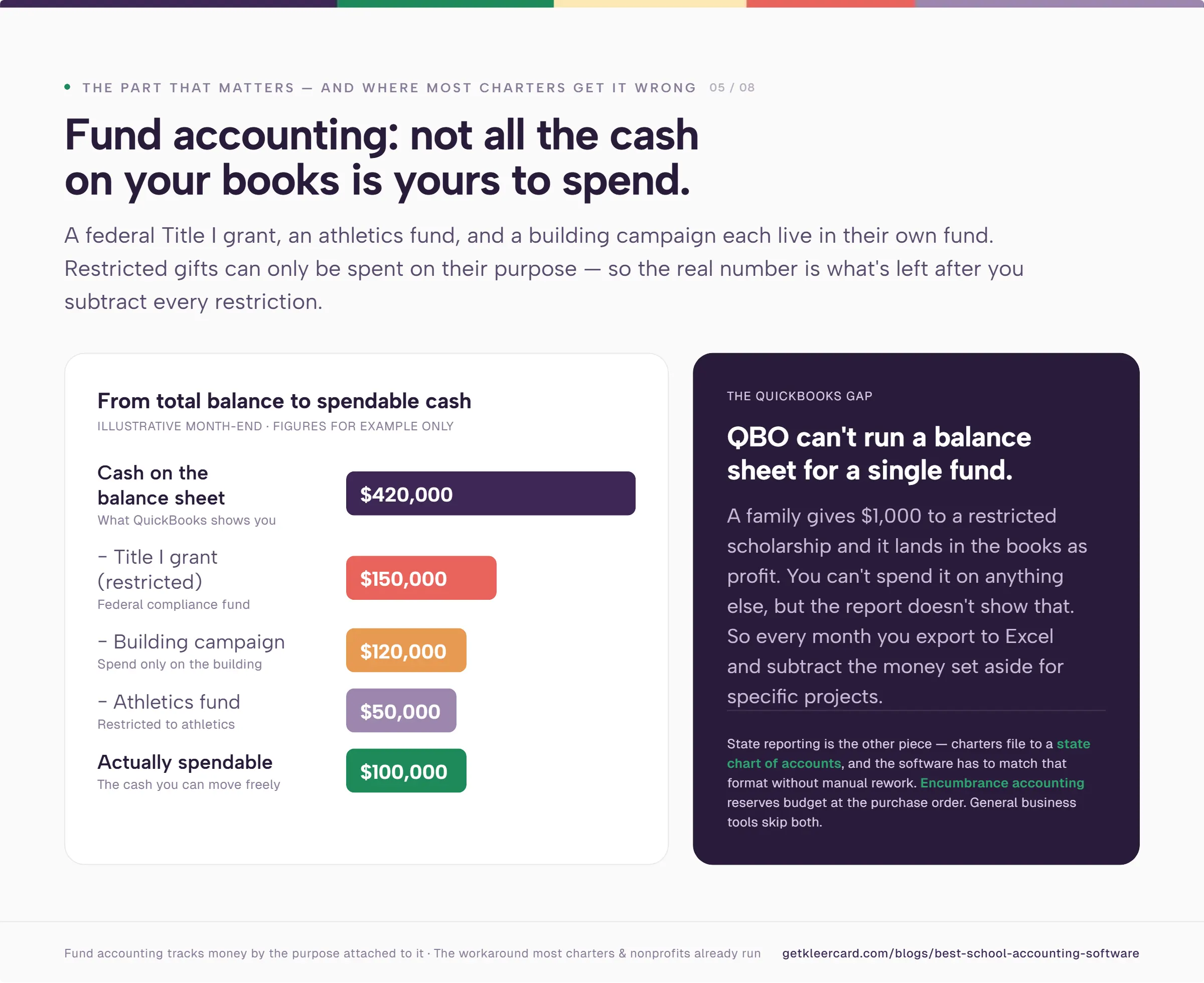
This is where most general tools break. In QuickBooks Online, you cannot run a balance sheet against a single fund. So at my church, and at many charter schools I advise, every month we export the balance sheet to Excel and subtract the money set aside for specific projects. The remainder is the cash we can spend.
That workaround is what most charters and nonprofits are doing, whether they admit it or not. State reporting is the other piece. Charters file to a state chart of accounts, and the software has to match that format without manual rework. Encumbrance accounting reserves budget at the purchase order. General business tools skip both.
True fund accounting sold as modules you assemble to fit. It handles tight fund separation and compliance reporting well. It carries no tuition billing or student management, so a charter pairs it with another system. This is the sweet spot for many charters that need public-grade fund accounting without a full district ERP price tag.
Dimensional fund accounting that reports across funds, programs, and locations without a rigid chart of accounts. It suits growing charters and multi-site independents that have outgrown entry-level tools. Sage Intacct is endorsed by the AICPA as its preferred financial management solution, which carries weight in an audit.
Cloud fund accounting built for nonprofits and private schools, with strong grant and donor tracking. It fits schools already running Blackbaud fundraising tools that want one connected record. The price sits at the top, so the value has to come from the donor and grant side, not the ledger alone.
A single-record system for independent K-12 schools. Its business module ties tuition billing to the ledger, so a payment posts once and lands everywhere, which removes double entry between billing and the books. It also ties your books to your student system, which narrows your future options.
Tuition management and student information for private and faith-based schools. Most schools run FACTS for enrollment and tuition, then connect a general ledger for full fund accounting. It earns its place on the tuition side more than the accounting side.
These full ERPs are overkill for most charters and independents. They shine in large public districts that need one source of truth across many campuses and heavy state filing. Charters that choose them usually do so because their state or authorizer already runs that system. Setup is long and expensive, and the payoff is rarely worth it unless you are already in that ecosystem.
For private school accounting software specifically, the field narrows to four. Blackbaud Financial Edge NXT and Sage Intacct lead when you want deep fund accounting in a dedicated finance system. Veracross and FACTS lead when you want tuition billing tied to the student record.
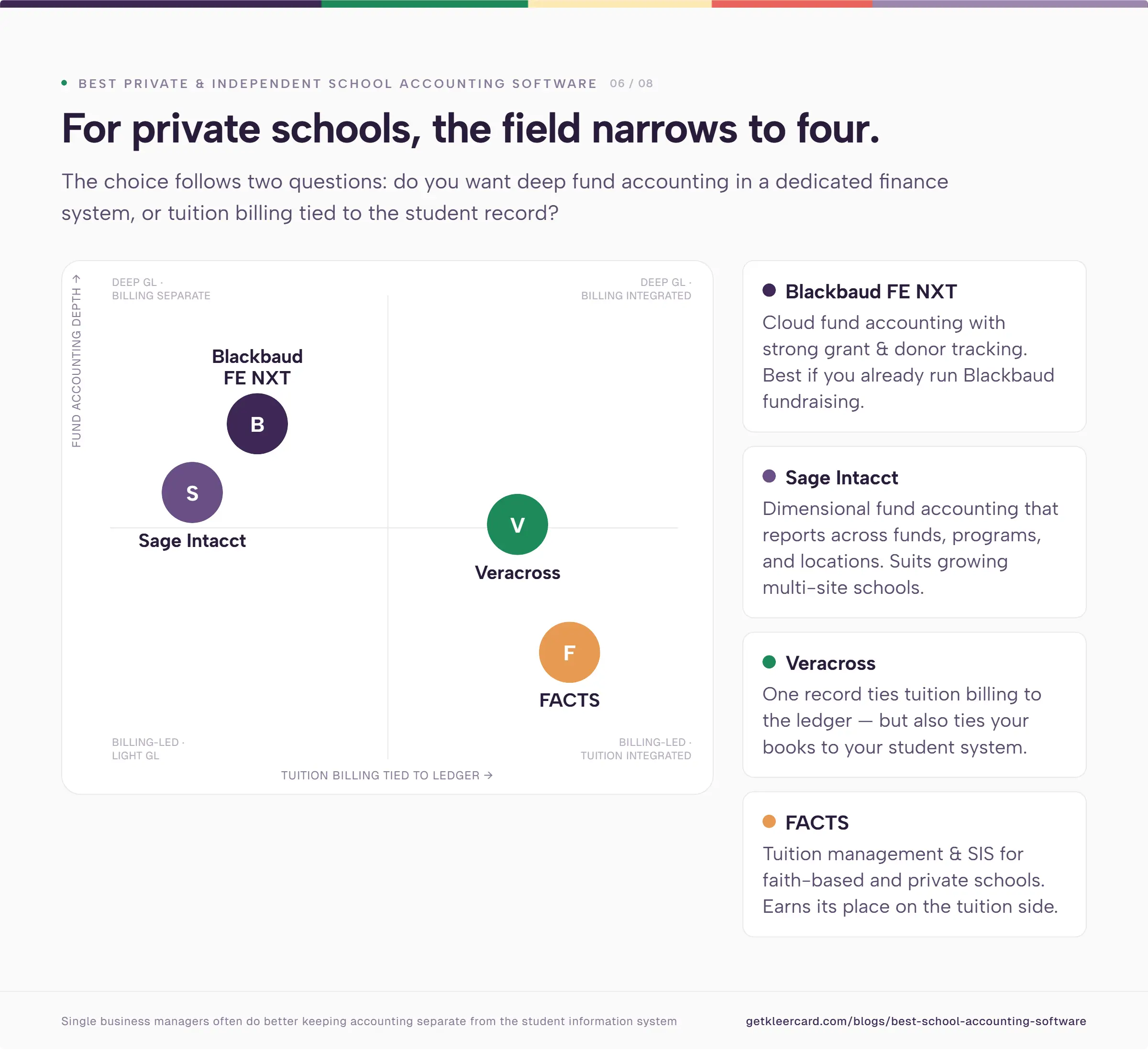
The choice usually follows whether you already run Blackbaud for fundraising and whether you want billing in the same system as the ledger. Independent schools with a single business manager often do better keeping accounting separate from the student information system, so a switch on one side does not force a rebuild on the other.
Your accounting software is the record of truth. It tells you what happened after the money moved. The bigger pain for charters and independents is controlling the money before it moves, then feeding clean data back to the ledger.
Teachers get a small classroom budget and no clean way to spend it. They borrow a shared office card that is gone the moment another teacher has it, or they front the cost at Walmart and wait weeks for reimbursement.
But if you can give the teacher their own card with a controlled budget that problem disappears. I know which teacher to ask about a Hobby Lobby charge because the card is theirs. We dig into how to do this well in our guide to the best cards for teachers.
Amazon is the other constant. To keep the card number off a dozen personal accounts, many schools route every Amazon order through one person. That works until the office manager is busy, and then the teacher buys it at Walmart on the way in.
An Amazon Business account fixes the root problem. Enrollment in Amazon's Tax Exemption Program removes sales tax on eligible orders for a qualified 501(c)(3), and many schools recover real money that way. Pair it with a card that captures the receipt automatically and the office no longer chases anyone. KleerCard handles the Amazon Business spend tracking and the sales tax nonprofits overpay on everything else.
School vehicles bring a smaller version of the same story. A driver will not float $120 to fill the van, so it comes back near empty for the next person. A card locked to gas pumps solves it. Clip it to the van's key ring and set a rule to fill up under half a tank.
Real control is matching authority to spend with ability to spend. Give a teacher a card carrying their actual budget, set it to a quarter or a year, and they cannot exceed it. Layer in merchant limits, time-of-day rules, and approval workflows where they help.
Districts are locked into US Bank or Wells Fargo P-card systems through board votes and long-term contracts.
The result is the two-card setup I opened with. Teachers end up fronting conference travel, waiting weeks for reimbursement, and buying supplies out of pocket. Half the time the culprit is the procurement system, not teacher pay. The system never gave people a clean way to buy what they need.
Charters and independents do not have to inherit that model. You can give teachers and department leads budget-capped cards with real-time visibility and automated receipt capture without going through a board vote for a new ERP.
The right platform follows the school, not the brochure. Start with your reporting obligations and your fund accounting needs, then size the tool to the staff who will run it.
For most charters and independents, that points to a mainstream ledger like QuickBooks with a disciplined fund workaround plus a spend layer on top, not a five-figure district ERP.
If your business office is buried in manual coding, receipt chasing, and Amazon order routing, the fix is a spend management layer that syncs directly with whatever accounting system you already have.
Every card transaction lands with the receipt attached. Month-end close goes from days to minutes. Teachers stop fronting their own money. That's the solution we built with KleerCard.
You can see how it fits schools or create an account and start with a few departmental cards. The path for charters and independents is clearer than most leaders expect, and it does not require replacing your entire financial system.
Owen Hill is co-founder of KleerCard, a corporate card and expense management platform built for nonprofits, churches, and independent schools. He previously served as Budget Director at Compassion International and founded Switch Consulting, a fractional CFO practice for mission-driven organizations.
QuickBooks Online with a fund workaround works for most small charters. When you outgrow it, MIP by Momentive and Sage Intacct usually deliver the best balance for charters that need public-grade fund accounting without a full district ERP price tag. Blackbaud and Veracross work well when you also need strong donor or tuition integration.
Yes, and many should. QuickBooks lacks true fund accounting, so you cannot run a balance sheet against a single fund without an Excel workaround. For charters with light grant reporting, that trade is often worth the savings. Add a spend management layer for the card and receipt side. See how KleerCard syncs with QuickBooks Online.
Blackbaud Financial Edge NXT, Sage Intacct, Veracross, and FACTS are the most common. The choice usually follows whether you already use Blackbaud for fundraising or want tuition billing in the same system as the ledger.
District purchasing is locked down, often to a single card program through board votes and long-term contracts. Replacing it requires committee approval that is hard to get. Most districts layer Amazon Business accounts and departmental cards on top of the existing system instead.
It ranges from about $120 a year for QuickBooks Online to tens of thousands for a district-style ERP. Most charters land in the mid-range with modular tools like MIP or Sage Intacct. Pricing is usually quoted by student count or number of entities.
Accounting software is the system of record that reports what was spent. Spend management controls spending before it happens through budget-capped cards, approval workflows, and receipt capture, then syncs the data into the accounting platform. Charters and independents need both, since one records and the other controls.


Speak to a member of our team and we can have you up and running in minutes, not weeks.