%202.svg)
KleerCard vs Charity Charge: honest comparison for nonprofits, churches, and schools. Eligibility, fund accounting fit, pricing, and where each card wins.
By Owen Hill, co-founder of KleerCard. Former Budget Director at Compassion International. Founded Switch Consulting, a fractional CFO practice for nonprofits.
Last verified against current published terms: May 19, 2026.
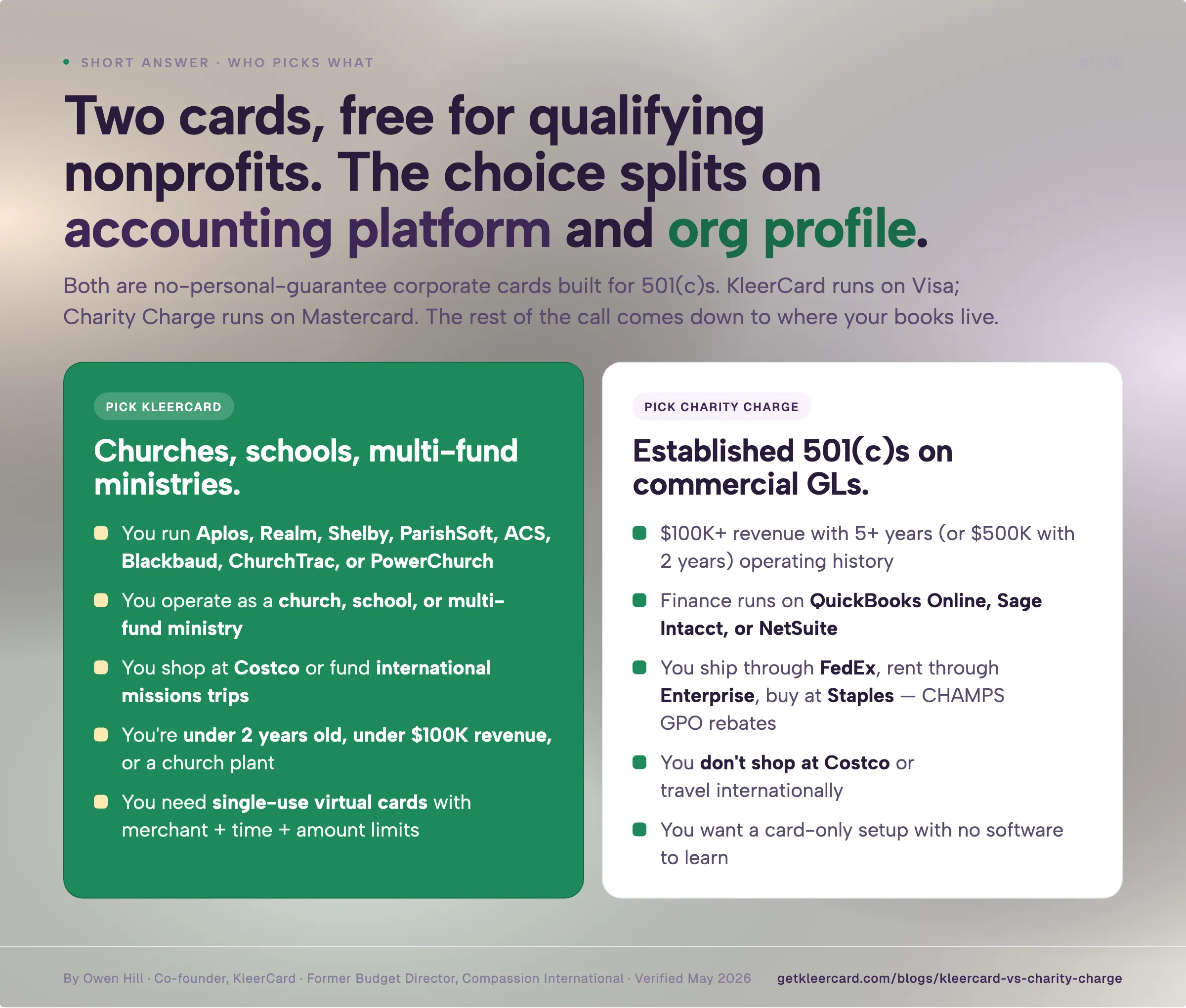
KleerCard and Charity Charge are both corporate cards built for nonprofits. Both are free for qualifying organizations. Neither requires a personal guarantee in standard underwriting. The decision splits along two questions.
Pick KleerCard if your finance team uses fund accounting software like Aplos, Realm, Shelby, ParishSoft, ACS Technologies, or Blackbaud. Pick it also if you operate as a church, school, or multi-fund ministry. Or if you shop at Amazon or Costco or need a Visa card for international trips/missions.
Pick Charity Charge if you have $100K+ in annual revenue with 5+ years of operating history (or $500K with 2 years), your finance team runs on QuickBooks Online, Sage Intacct, or NetSuite, and you don’t shop at Costco or travel internationally (Charity Charge uses MasterCard, which is not accepted at Costco and is more restricted internationally).
The rest of this article walks through pricing, eligibility, integrations, and the cases where Charity Charge is the better answer.
KleerCard works with churches, schools, and nonprofits. We serve more than 1,000 organizations and process roughly $190 million in annual transaction volume. Our Visa Commercial card is issued by The Bancorp Bank, N.A., with SOC 2 and PCI DSS compliance. If that's the kind of organization you're building for, this comparison is written for you.
Both KleerCard and Charity Charge belong on your shortlist if your organization is one of these:
If you're a for-profit business with no 501(c) status, Charity Charge won't underwrite you, and KleerCard isn't built for solo contractors or one-person shops.
One more qualifier worth naming up front: both products are charge cards. If you're looking for revolving credit to float operations across cash-flow gaps, neither one is the right tool. If you're looking for a nonprofit credit card with no personal guarantee and the controls to manage spend across staff, ministries, or programs, both are designed for that work.
The Charity Charge information here comes from the company's Nonprofit Business Card page, its Nonprofit Credit Card page, the Commerce Bank pricing terms PDF, its published FAQ, and reviews from NerdWallet and Givefront.
The KleerCard information comes from what we work on directly, including our pricing page. Customer details come from named demo calls and published testimonials, with permission to use first names and last initials.
Pricing, eligibility thresholds, and features change. Verify any specific number with each vendor before you sign.
The table reflects the Charity Charge Corporate Card, which is the closer head-to-head with KleerCard on spend management depth. Charity Charge also offers a simpler Nonprofit Business Card for smaller teams, covered later in this article.
| Feature | KleerCard | Charity Charge Corporate Card |
|---|---|---|
| Built for | Churches, schools, nonprofits | 501(c) nonprofits broadly |
| Card network | Visa | Mastercard |
| Issuer | The Bancorp Bank, N.A. | Fifth Third Bank via Corpay |
| Annual fee | $0 | $0 |
| Personal guarantee | None | None in standard underwriting |
| Eligibility floor | None published | Larger teams, higher annual spend |
| Virtual cards | Unlimited (single-use, recurring, merchant/time/amount restricted) | Yes |
| Fund accounting integrations | Aplos, Realm, ParishSoft, Shelby, ACS Technologies, Blackbaud | None direct (manual export) |
| Standard ERP integrations | QuickBooks Online, QuickBooks Desktop, NetSuite, Sage | QuickBooks Online, Sage Intacct, NetSuite |
| Receipt capture | OCR capture and matching, auto-lock after 7 days for missing receipts | AI receipt matching |
| Cash back | Custom plans only (~$30K+/mo card spend) | None on general spend |
| Approval timeline | 1 to 2 business days | 2 to 3 business days |
| Compliance | SOC 2, PCI DSS | Standard commercial card protections |
KleerCard is a Visa Commercial card issued by The Bancorp Bank, N.A., bundled with expense management software. We built it for churches, schools, and nonprofits, so the card and the software ship together with nothing for you to integrate.
The platform handles unlimited physical and virtual cards, pre-authorization workflows that block out-of-policy spend before it happens, OCR receipt capture, auto-lock for missing receipts after 7 days, and direct accounting integrations with QuickBooks Online, QuickBooks Desktop, NetSuite, Sage, Aplos, ACS Technologies, ParishSoft, Realm, Shelby, and Blackbaud.
Let's say your youth pastor runs a Wednesday night program. You issue a recurring virtual card capped at $80 a week, restricted to grocery stores, that refills each Monday. The pastor buys snacks and uploads receipts through the app. Transactions sync to your accounting system the next morning. Done.
No reimbursement form. No spreadsheet. No Sunday-night text from the youth pastor.
Jared, an Executive Pastor at one of our customer churches, reported on a published success story that his month-end close went from 3 days to 7 minutes after switching to KleerCard.
Emily, an HR and Finance Director at a nonprofit, reported that her team's receipt collection dropped from 40 hours per month to 1 hour in the first month after switching from a legacy reimbursement workflow.
Those numbers vary by organization. They show what happens when the card and the accounting platform share a language.
Charity Charge is a public benefit corporation founded in 2014 by Stephen Garten that designs financial products for nonprofits. The company reports more than 3,000 nonprofits using its programs, including Springfield Museum, Lake Homes Development, Comfort Cases, Mana Food Bank, Humane Indiana, and EveryLibrary.
Charity Charge offers two products.
The Nonprofit Business Card launched in 2019 in partnership with Commerce Bank on the Mastercard commercial network. It serves smaller nonprofits with simpler needs. The Business Card gives you physical cards with adjustable per-card limits, QuickBooks Online integration, real-time visibility through Mastercard's 360Control platform, Mastercard Easy Savings rebates, and CHAMPS GPO membership (10 to 20 percent off at FedEx, Enterprise, Staples, and selected medical and travel vendors). The Business Card does not issue virtual cards.
The Nonprofit Corporate Card is the newer product, built for larger teams with higher annual spend. Fifth Third Bank issues it through Corpay, Mastercard's largest corporate card issuer. The Corporate Card adds physical and virtual cards, 180+ granular spending controls, AI receipt matching, custom approval workflows, and integrations with QuickBooks Online, Sage Intacct, NetSuite, and other major ERPs. Approval lands in 2 to 3 business days.
The two products run on different banking infrastructure. Which card a nonprofit qualifies for depends on size, spend, and financials.
Visa and Mastercard aren't interchangeable for nonprofits.
Both Charity Charge products run on Mastercard. KleerCard runs on Visa. For most domestic purchases, the network doesn't matter. Two situations where it does:
Costco. Costco's U.S. warehouses don't accept Mastercard for credit purchases. If your church, school, or nonprofit shops at Costco for event supplies, hospitality, food pantry inventory, or bulk office supplies, a Mastercard-only program means keeping a separate Visa around or handling those purchases through reimbursement.
International missions trips. Visa has wider international acceptance than Mastercard in several regions. For churches funding short-term mission travel, using Visa is helpful.
Worth checking against your organization's actual spending patterns before signing with either platform.
KleerCard underwrites organizations directly. No personal guarantee, no published revenue minimum, no required cash balance in a business checking account. The application takes about eight minutes online. Approval takes 1 to 2 business days for most organizations.
If your operating history doesn't yet support a credit line, we offer a pre-funded option that converts the card to a debit setup with the same controls and integrations. Our functional floor is three or more active cardholders. If you're a solo operation with one or two people needing card numbers, a basic business card from your bank is a better fit.
We also work with church plants and new nonprofits. Anna, a virtual bookkeeper recently appointed treasurer for a Dayton church plant, set up KleerCard with around $40K in bank accounts on a $29/month plan. Shaunze, a co-pastor at a church under 100 members, set up KleerCard with virtual cards for 1099 contractors and a $350 fall festival pre-planning card. Neither would qualify for Charity Charge's unsecured products under the published thresholds.
Charity Charge's published thresholds for the Nonprofit Business Card require either:
The Corporate Card serves nonprofits with higher annual spend. Charity Charge doesn't publish a specific revenue floor for it. Underwriting depends on the financial documents Corpay reviews during application.
For either product, you submit your 501(c) determination letter, two consecutive fiscal years of financials, a board resolution authorizing the card, and your EIN.
If you fall short of the Business Card thresholds, you can apply for a Secured Credit Card through a Commerce Bank Business Savings Account. The credit limit equals your cash deposit, so a $5,000 limit means $5,000 sitting in deposit.
Mid-sized and larger established 501(c)(3)s with stable financials clear both bars and can pick on other dimensions.
Your accounting software determines what reconciliation looks like. The deeper picture lives in our fund accounting software for churches guide; here's the short version for this comparison.
Both KleerCard and Charity Charge integrate. Transactions sync from the card platform into the accounting system without a manual export. Receipts attach. Coding happens once. A regional foundation running on Sage Intacct with 40 staff will get a workable experience on either platform.
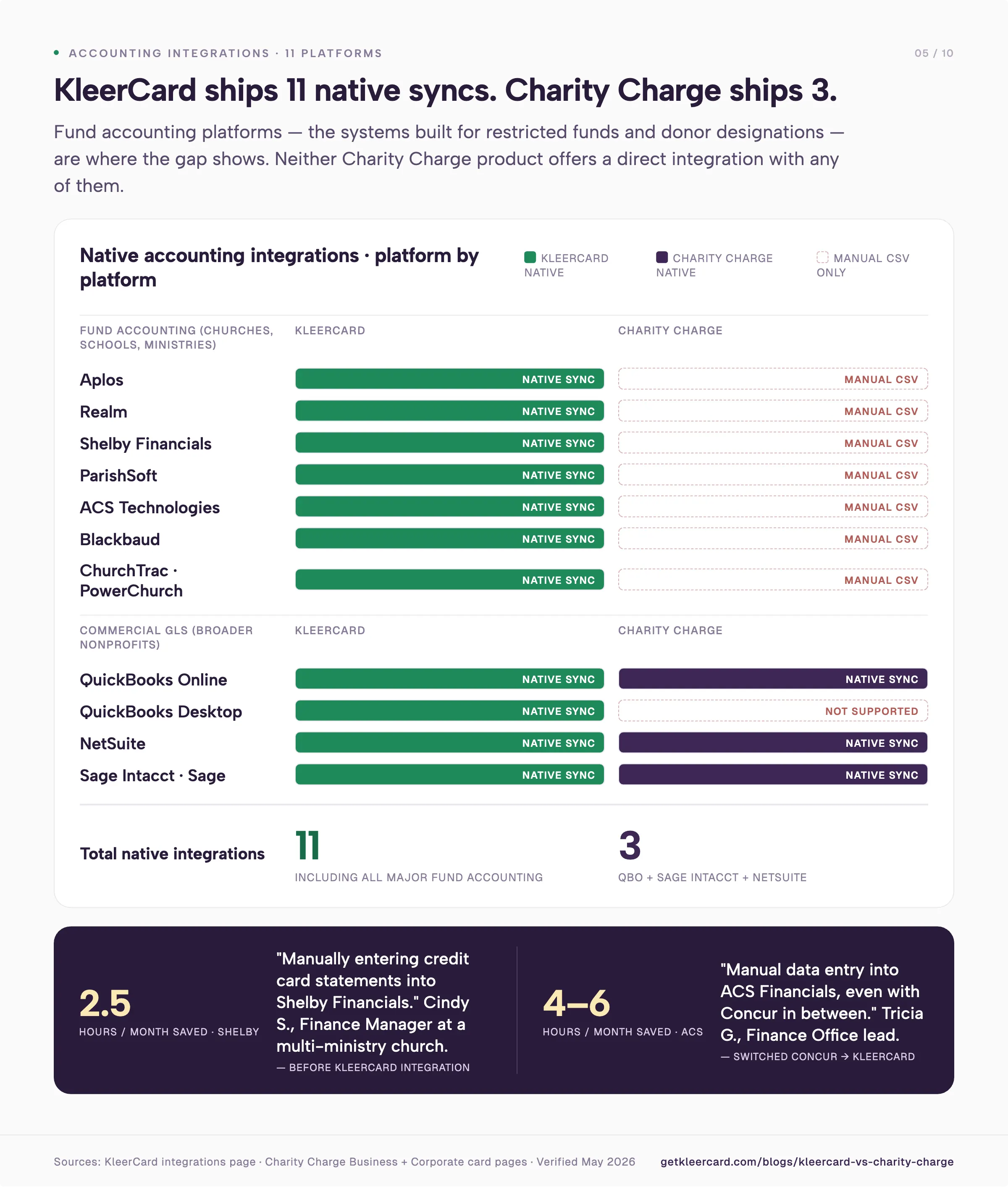
Integration depth changes. Neither Charity Charge product maintains direct integrations with Aplos, Realm, ParishSoft, Shelby, Blackbaud, ACS Technologies, ChurchTrac, or PowerChurch.
On Charity Charge, you reconcile by hand. You export transactions from 360Control or Corpay, reformat the CSV to match the fund accounting import schema, map ministries to funds, import, and fix the rows that didn't map. Many fund accounting platforms don't have APIs, so export-and-import is the only available workflow.
KleerCard has direct exports ready for each of those accounting systems. The card platform and the accounting platform share a language, so fund-level coding happens once.
Two customer scenarios show the difference at month-end:
Cindy S., a Finance Manager at a multi-ministry church, spent 2.5 hours per month manually entering credit card statements into Shelby Financials. Her staff couldn't see budget status in real time. They only knew where they stood after she processed each month's statement.
Tricia G., a Finance Office lead at a church that switched from Concur to KleerCard this spring, was spending 4 to 6 hours per month on manual data entry into ACS Financials after her reconciliation work. She described the total time impact as days of her time each month. Concur couldn't handle her church's multiple fund accounts, which forced the manual workflow even with Concur sitting between the cards and the accounting platform.
The same situation exists on every platform that doesn't ship a direct integration with fund accounting software, including both Charity Charge products. The time savings from removing that manual step can run from a few hours to a full day each month, depending on transaction volume.
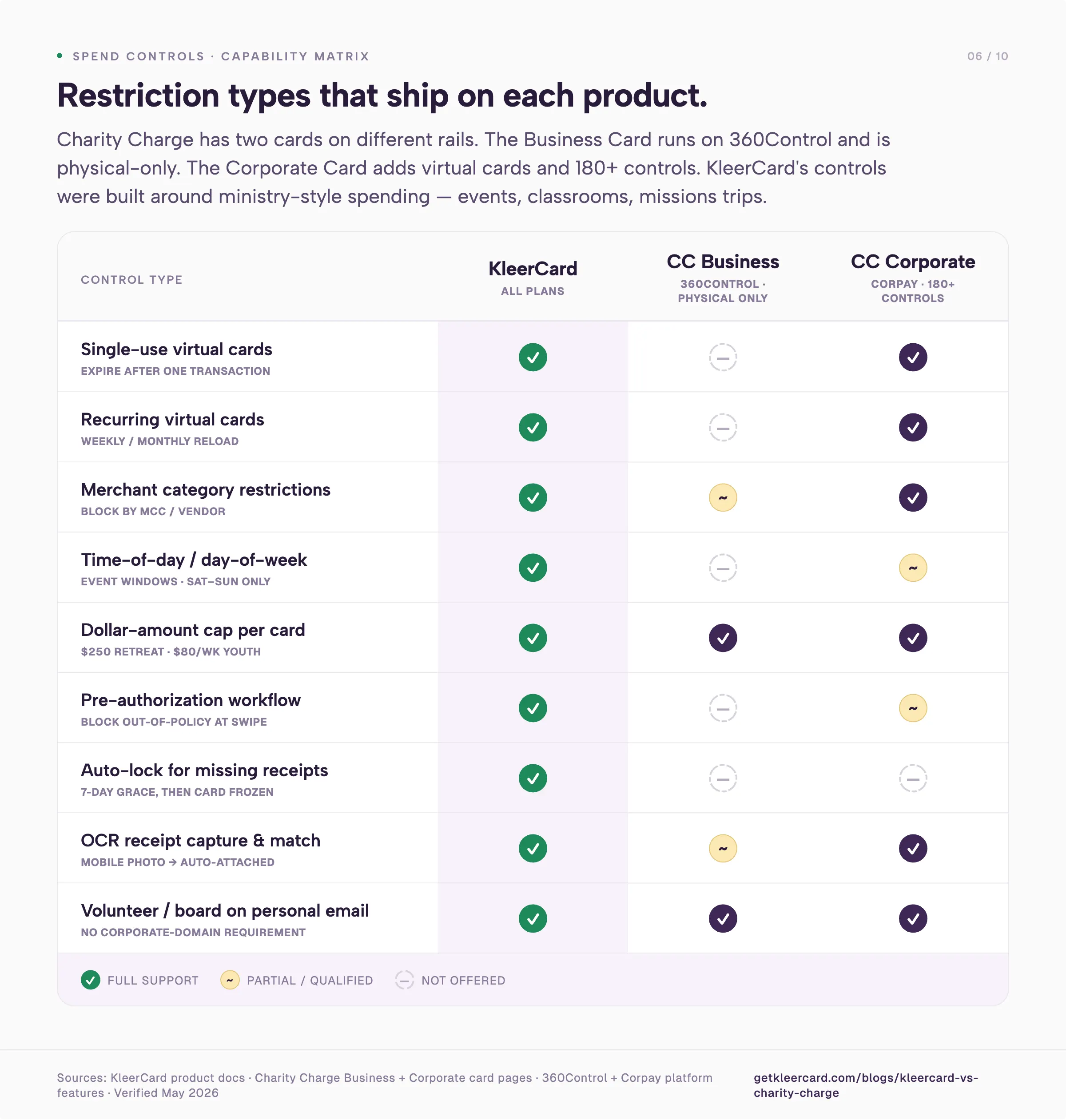
The Charity Charge Business Card runs on 360Control, Mastercard's commercial card management interface. Finance admins can set per-card limits, restrict by category or merchant, block online or in-person transactions, pause or cancel cards, and pull transaction reports. 360Control was built for commercial spending across industries, so the framing comes from a general business angle.
The Corporate Card adds 180+ options on top, including merchant-specific blocks, location restrictions, and dollar-amount limits set in real time from the dashboard.
KleerCard's controls grew out of how money moves in churches, schools, and ministries:
Both platforms let you add a volunteer treasurer or board member on a personal Gmail address without friction, which sounds small but matters for volunteer-led teams.
Across our customer calls, churches and schools tell us roughly 50 to 60 percent of their day-to-day purchases run through Amazon. Curriculum, VBS supplies, classroom materials, kitchen and hospitality items, office supplies, facility purchases, event inventory. The order detail Amazon shows on the website (line items, ship-to address, who placed the order) is exactly what a finance team needs at month-end. That data almost never makes it onto the credit card statement because Amazon charges separately for each item..
KleerCard's Amazon Business integration connects your organization's Amazon Business account to KleerCard so every Amazon order auto-matches to the card transaction. The itemized receipt, the order summary, and the transaction all come together in KleerCard, coded and ready to sync to your accounting system.
No screenshotting order pages. No forwarding confirmation emails. No chasing receipts a week after the purchase.
One operational benefit we hear about on calls: when staff switch from personal Amazon accounts to a shared Amazon Business account, organizations report meaningful reductions in Amazon spend, driven by visibility alone. Cindy, a Finance Manager at one of our customer churches, reported roughly a 10 percent drop in Amazon spending after the switch.
Neither the Charity Charge Business Card nor the Corporate Card publishes a direct Amazon Business integration. Charity Charge holders can still order from Amazon Business with their card, but matching the itemized order data back to the card transaction must be done manually.
KleerCard onboarding runs through 2 to 3 thirty-minute Zoom calls with a dedicated implementation lead. Time-to-first-transaction is hours after the final setup meeting. We made high-touch onboarding part of the product because nonprofit finance teams often include retired volunteers, accidental treasurers, and non-technical lay leaders who can't be productively onboarded through documentation alone.
Charity Charge's Corporate Card includes a dedicated account manager. The Business Card includes a Charity Charge account team plus 24/7 Commerce Bank commercial card support.
Both platforms run real human support. Worth checking on your demo call whether the onboarding cadence fits your team's bandwidth.
Both Charity Charge products carry a $0 annual fee, $0 per-card fee, and $0 platform fee. Charity Charge earns its revenue from its banking and network partners. The Business Card terms include a 2.5 percent late fee on past-due balances and a foreign transaction fee. The grace period is at least 20 days from the statement date when the prior balance is paid in full. Both products are charge cards, so the full balance is due each cycle.
KleerCard pricing:
For a 21-user organization on the Standard tier with a custom user count, the math works out to roughly $356 per year. My own church runs that exact setup: 2.5 paid employees plus volunteer cardholders, 21 active cards.
The Charity Charge Business Card pays no flat cash back on general spend. Savings come through two vendor programs.
Mastercard Easy Savings gives automatic statement rebates on enrolled merchants like select fuel, hotel, and dining categories. The merchant list rotates.
CHAMPS GPO membership gives Business Card holders 10 to 20 percent off at FedEx, Enterprise, Staples, and selected medical, shipping, and travel vendors, with no enrollment fees and no purchase minimums. For a school spending $40,000 a year on office supplies and shipping, those CHAMPS savings can move real money when the spend lands on CHAMPS vendors.
The Corporate Card pricing structure is governed by Corpay and Fifth Third Bank. CHAMPS GPO and Mastercard Easy Savings do not extend to Corporate Card holders. Confirm rebate eligibility with your Charity Charge account manager during onboarding.
KleerCard doesn't offer cash back on standard plans. Organizations spending over $30,000 a month on cards can get custom pricing that includes cashback.
For most churches and schools, per-card spending limits and merchant category controls do more work than 1% back would.
KleerCard also doesn't maintain a vendor discount program like CHAMPS GPO. If your organization spends heavily through FedEx, Enterprise, Staples, or the other vendors on the CHAMPS list, the Business Card's rebates are worth weighing against KleerCard's integration depth.
Charity Charge is the better fit in a few situations.
You're a $500K+ annual revenue 501(c)(3) running on QuickBooks Online with stable cash flow. The Business Card is free, the eligibility is clean, and the CHAMPS GPO discounts on supplies and shipping pay back the time it takes to set up.
You're a regional foundation or membership association with 30+ staff on Sage Intacct or NetSuite. The Corporate Card with AI receipt matching, 180+ controls, and direct ERP sync covers the spend management features most of those organizations need, and stays free for qualifying nonprofits.
You ship heavily through FedEx, rent cars often, or buy through Staples and the broader CHAMPS vendor list. A focused analysis with your actual vendor mix could make Charity Charge the right call on that math alone.
You want a card-only setup with no software platform to learn. The Business Card on 360Control is straightforward: issue cards, set limits, view transactions, upload receipts, sync to QuickBooks Online.
You're a church, a school, or a multi-fund ministry. The direct integrations with Aplos, Realm, Shelby, ParishSoft, ACS Technologies, Blackbaud, ChurchTrac, and PowerChurch save your team from manual export-and-import on either Charity Charge product.
Your organization is under 2 years old, under $100K in annual revenue, or operating as a church plant or unincorporated ministry. Charity Charge's thresholds rule out the unsecured products. We underwrite without those gates.
You need single-use virtual cards with merchant, time, and amount restrictions. The Charity Charge Business Card doesn't issue virtual cards. The Corporate Card does. We built KleerCard's pre-authorization workflow around volunteer-led, event-driven spending.
You manage spend across multiple campuses, ministries, or grants. Coding to restricted funds at the card itself is how we designed the platform. On Charity Charge, that coding moves into your accounting software after the fact.
Your organization shops at Costco or funds international missions. A Visa works in both. Mastercard does not work at Costco's U.S. warehouses, and has narrower international acceptance.
Your organization shops at Amazon. KleerCard’s Amazon Business integration eliminates the manual matching of purchases to receipts that’s often necessary.
Some situations call for a different kind of tool.
An organization that needs a revolving credit line for cash flow won't find one here. Both products are charge cards with full balance due each cycle. A traditional bank-issued business credit card is a better structure for that need.
A for-profit business falls outside both products. Ramp, BILL, or Brex are reasonable starting points.
Charity Charge has built two real products. The Business Card is a clean, free credit card for established 501(c) nonprofits with stable financials. The Corporate Card brings virtual cards, AI receipt matching, custom approval workflows, and 180+ controls into a nonprofit-native platform. For nonprofits on QuickBooks Online, Sage Intacct, or NetSuite that clear the eligibility floor, it's a legitimate choice.
We built KleerCard for a different audience. The churches, schools, and multi-fund ministries we work with are often using fund accounting software or trying to track fund accounts manually. They have volunteer treasurers and seasonal staff. They split a $200 Amazon order across three ministry funds. They shop at Costco. They fund missions trips overseas. They want the card platform to share a language with their accounting platform.
If KleerCard is the right fit, you can apply for KleerCard online or book a demo. The Charity Charge Nonprofit Business Card review covers that product in depth if you're leaning that direction, and the credit cards for nonprofits with no personal guarantee guide has broader context on the landscape.
I hope this guide has been useful in helping you figure out the right fit.
Owen Hill is co-founder of KleerCard, a corporate card built for nonprofits, churches, and schools. Before KleerCard, he served as Budget Director at Compassion International and ran Switch Consulting, a fractional CFO practice for nonprofits. KleerCard is reviewed alongside other tools throughout this article.
For established 501(c) nonprofits running on QuickBooks Online, Sage Intacct, or NetSuite, Charity Charge belongs on the shortlist alongside KleerCard. Both products are free for qualifying organizations. Neither requires a personal guarantee in standard underwriting. Both offer real spend controls.
The split shows up in accounting integrations and card network. KleerCard ships direct integrations with church and school accounting systems (Aplos, Realm, Shelby, ParishSoft, ACS Technologies, Blackbaud) that Charity Charge does not, and runs on Visa rather than Mastercard.
For churches, schools, and multi-fund ministries, KleerCard tends to be the better fit. For traditional nonprofits on standard accounting platforms, Charity Charge competes head-on.
Neither, in standard underwriting. Both cards underwrite to the organization based on its 501(c) status and financial documents (plus operating history for Charity Charge's Business Card).
Charity Charge notes in its published FAQ that a personal guarantee can be required in specific circumstances tied to weaker financials. Most established nonprofits face no personal liability on either platform.
KleerCard, if your organization runs on purpose-built fund accounting software. We built direct integrations with Aplos, Realm, Shelby, ParishSoft, ACS Technologies, Blackbaud, ChurchTrac, and PowerChurch. Coding to restricted funds and donor-designated revenue happens at the card level, with the data flowing into the fund accounting platform.
Neither Charity Charge product maintains direct integrations with those systems, so organizations on those platforms reconcile manually through CSV export-and-import. Customers like Cindy S. (Shelby Financials) and Tricia G. (ACS Financials) have reported saving multiple hours per month when the card platform syncs with their accounting platform.
Both Charity Charge products are free for qualifying nonprofits, with no annual fee, no per-card fee, and no platform fee. KleerCard is free for up to 5 users, then $29 per month for up to 15 users on the Standard tier and $49 per month for up to 30 users on the Pro tier. Custom pricing applies above 30 users, with no per-user fees on any tier. For a 21-user organization, KleerCard's Standard tier with a custom user count works out to roughly $356 per year.
The unsecured Charity Charge Business Card requires either 5+ years of operating history with $100K+ in annual revenue, or 2+ years with $500K+. Organizations under those thresholds can apply for the Secured Credit Card through a Commerce Bank Business Savings Account, where the credit line equals a cash deposit (a $5,000 limit requires a $5,000 deposit).
KleerCard doesn't have equivalent eligibility floors and underwrites smaller and newer organizations, including church plants and nonprofits under 2 years old.
Yes, on the Nonprofit Corporate Card. The Corporate Card issues physical and virtual cards through the Charity Charge platform. The older Nonprofit Business Card is physical-card-only.
KleerCard issues unlimited virtual cards on every plan, including single-use, recurring, merchant-restricted, time-restricted, and amount-restricted variants.
For most domestic purchases, no. For two situations, yes. Costco's U.S. warehouses don't accept Mastercard for credit purchases, so a Charity Charge program (Mastercard) means keeping a separate Visa for Costco shopping.
Mastercard also has narrower international acceptance in several regions, which can matter for churches funding short-term mission travel. KleerCard runs on Visa, so both Costco and overseas missions work as expected.
KleerCard approves most applications in 1 to 2 business days, and time-to-first-transaction tends to happen in hours. Onboarding is 2 to 3 thirty-minute Zoom calls with a dedicated implementation lead.
The Charity Charge Corporate Card returns underwriting decisions in 2 to 3 business days. The Charity Charge Business Card runs 5 to 10 business days for most applicants, longer for complex financials.
Two questions handle most of the decision. First, what accounting software does your finance team use? If it's QuickBooks Online, Sage Intacct, or NetSuite, both platforms integrate, so the choice then turns on eligibility, features, card network, and CHAMPS GPO discounts. If it's Aplos, Realm, Shelby, ParishSoft, ACS Technologies, Blackbaud, ChurchTrac, or PowerChurch, KleerCard is the only option on the shortlist with direct integrations.
Second, does your organization clear Charity Charge's eligibility thresholds? If you're under 2 years old, under $100K in revenue, or operating as a church plant, the Business Card is out of reach and the Secured Credit Card requires cash equal to your credit line. KleerCard underwrites without those gates.


Speak to a member of our team and we can have you up and running in minutes, not weeks.