%202.svg)
Learn what tithing software does, which platforms rank highest in 2026, must-have features, and how to steward restricted funds once the gift arrives. Practical guide for church treasurers.
Tithing software collects and tracks gifts. It does not finish the financial job. Once the money lands, restricted funds still need clean tracking. Receipts still need capture. Day-to-day spending still needs controls that match the budget authority you already set.
This guide shows what the leading platforms actually do, how to evaluate them against your existing accounting stack, and what happens next so the gift is stewarded all the way through.
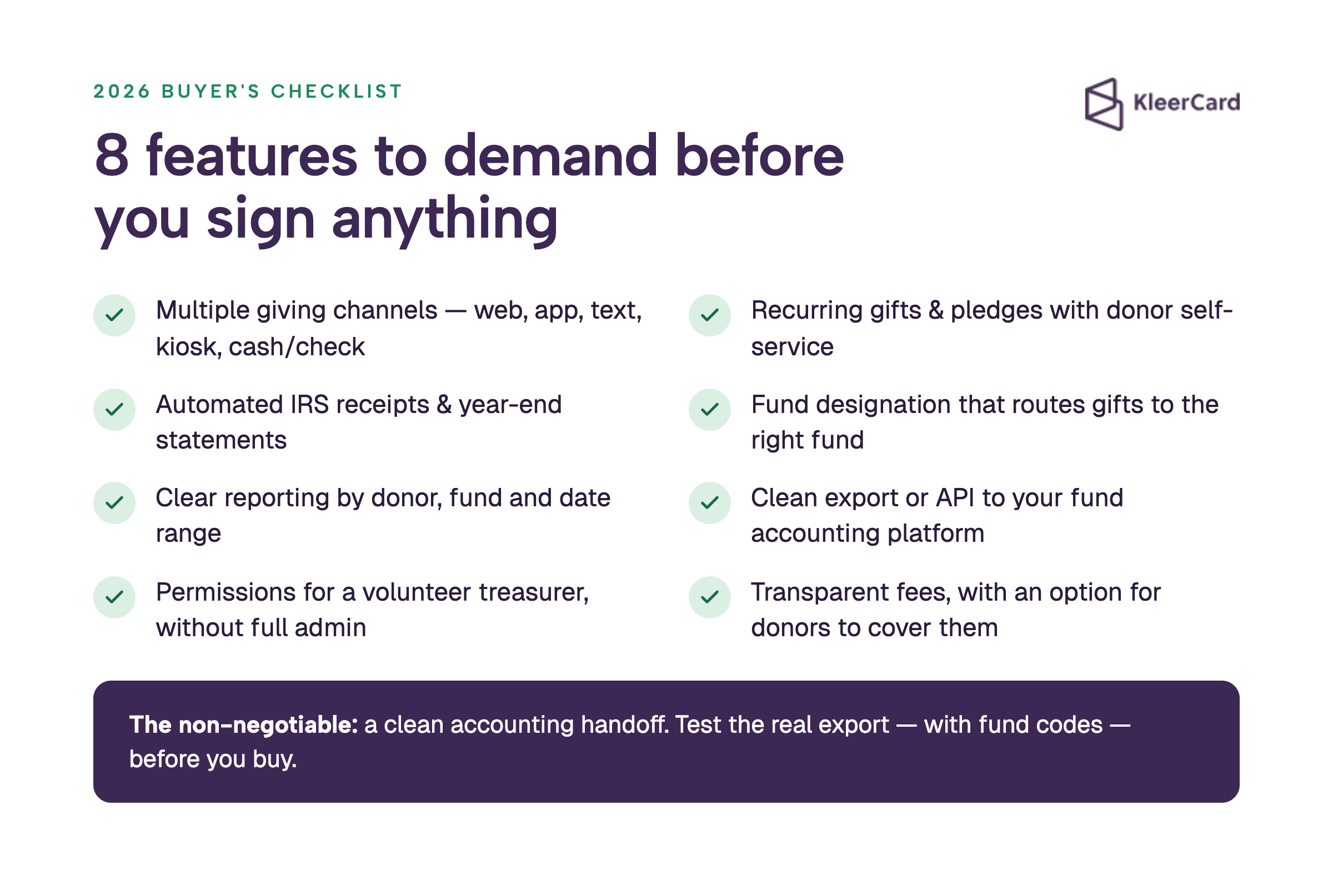
Any platform worth evaluating should deliver these capabilities without workarounds:
The non-negotiable item for most churches is the accounting handoff. If the export forces line-by-line CSV editing or loses fund designations, the platform creates more work than it removes.
I have watched churches spend hours every month reformatting files because the giving platform and the accounting platform never talked cleanly. That friction is avoidable. Test the actual export before you sign anything. Ask for a sample file that includes fund codes and confirm it lands in your chart of accounts without manual cleanup.
Volunteer usability also matters more than most feature lists admit. Many church finance offices rely on part-time staff or board members who log in once a week. A platform that requires constant technical support or complex permission setup will sit unused or generate incomplete records. Look for clear roles that let a treasurer issue receipts and pull fund reports without full administrative access.
Fees and exact feature sets change. Always verify current processing rates, ACH options, and export formats on the official sites for each. None of these tools manage outbound spend controls or card-level budgets.
Tithely continues to win on simplicity and price for many smaller churches. Planning Center makes the most sense when the rest of your operations already live inside that suite. Pushpay tends to fit larger congregations that value the polished donor experience and are ready for enterprise pricing. The others fill specific niches around mobile conversion or cost.
The common gap across all of them is the same. They solve the inbound side well. They leave the outflow side (restricted fund tracking after the gift, reconciliation, and day-to-day spend control) to whatever system you already use. That is not a criticism of the tools. It is simply the boundary of what they were built to do.

Start with your existing stack. If you run Shelby, Aplos, ACS/Realm, or Blackbaud, test the actual export before you commit. Ask for a sample file that includes fund designations and confirm it lands in your chart of accounts without manual cleanup.
Match platform complexity to your size and volunteer capacity. A two-person finance office does not need enterprise engagement tools. A multi-campus church does need reliable multi-fund reporting and permissions.
Run a short pilot with real gifts. Watch how quickly a non-technical treasurer can issue a receipt, pull a fund report, and hand the data to the bookkeeper. Measure total cost of ownership: monthly fees plus processing fees plus the hours still spent reconciling.
I recommend treating the accounting handoff as a hard requirement rather than a nice-to-have. Churches that skip this step often discover the pain only after they have already moved the bulk of their giving onto the new platform. By then the switching cost is higher.
Also look at how the platform handles mixed giving. Most churches still receive cash and checks alongside digital gifts. The ability to record those envelopes and checks in the same system, with the same fund designations, keeps the weekly deposit process clean. When digital and paper live in separate places, reconciliation becomes a weekly translation project.

Tithing software (also called church giving software or online tithing platforms) is a digital system that lets members give by web form, mobile app, text, kiosk, or recorded cash or check. It records the donor, amount, date, payment method, and fund designation. It generates tax receipts, year-end statements, and exportable reports for the finance office.
It is not full church accounting software. It is not a complete church management system. Its job is inbound collection and donor-side convenience. The best versions make recurring gifts automatic and keep fund designations intact so the data can move into your general ledger without manual re-keying.
In practice, most churches run tithing software alongside a separate accounting platform. The giving tool handles the front door. The accounting system remains the record of truth for restricted balances, financial statements, and audit trails.
The distinction matters because many platforms market themselves as complete solutions. They are excellent at collecting and acknowledging gifts. They are not built to produce per-fund balance sheets or manage the full set of financial controls after the money is in the bank.

Members give more consistently when the path is short. Recurring options reduce the seasonal dips that hit after summer or holidays. Automated receipts cut the year-end scramble for contribution statements. Finance teams stop counting envelopes by hand and stop chasing missing paper.
You see the payoff in two places: higher participation rates and cleaner data for stewardship reports. Churches that still rely only on cash and checks spend disproportionate time on counting, depositing, and reconciling. Digital channels shrink that work while expanding the ways people can respond.
I see the same pattern across churches of different sizes. When giving stays locked to Sunday morning cash and checks, participation stays limited to the people who remember to bring something. When the same people can give from their phone during the week or set a recurring gift after payday, the volume and consistency both rise.
The administrative side improves just as clearly. Manual counting, handwritten deposit slips, and paper contribution ledgers create opportunities for error and delay. A clean digital record with fund designations already attached reduces the time the finance team spends every Monday morning and every year-end.
The gift is only the first half of the workflow. Restricted gifts must stay restricted. Cash and digital batches must reconcile to the bank. Day-to-day spending must stay inside the budgets those gifts support.
Fund accounting works best with clean dimensions rather than a long list of near-duplicate accounts. One “classroom supplies” or “missions” account plus a department or campus dimension lets you slice the same data without rebuilding reports every month. Fragmented charts of accounts create the opposite problem: every purchase requires a unique account code and custom reporting later.
I have seen this pattern repeatedly. When a church tells me their situation is unique and needs its own set of accounts, the chart of accounts is usually the problem, not the ministry. The same data structure works across organizations. The labels change. The underlying dimensions do not have to.
One church with two and a half staff originally issued one card per person. Staff borrowed cards from each other, and volunteers often made purchases out of pocket and waited for reimbursement.
After rolling out the cards they issued 21 cards to staff and the volunteers who needed to spend. Each of those volunteers received a card with a set budget — sometimes a single amount, sometimes a monthly reload.
The hospitality director has a monthly budget for coffee and kitchen supplies. The facilities director has a budget for the various needs around the church facilities. When the security coordinator needed a first-aid kit, a one-time card with a preloaded amount was issued so he could buy it without waiting for reimbursement.
The cards simply made the outflow side match the control level the inbound gifts already required.
Public results from other churches follow the same pattern. One executive pastor moved month-end close from three days to seven minutes. An HR and finance director reduced receipt collection and coding from roughly 40 hours per month to one hour in the first month.
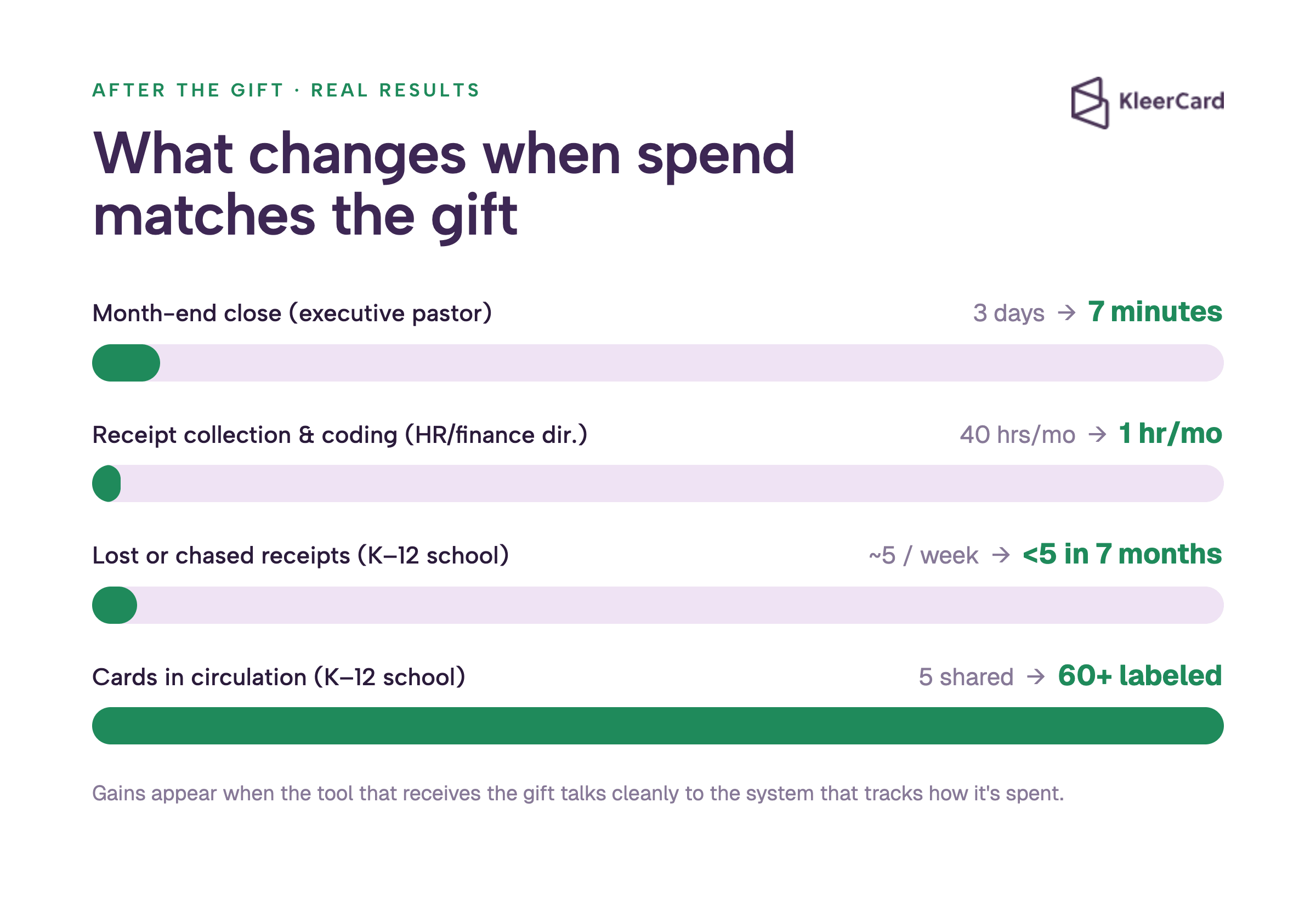
These gains appear when the platform that receives the gift talks cleanly to the system that tracks how the money is spent. In my experience, cards and expense tools typically absorb 60 to 70 percent of a church’s financial workflow once they are in place. The remaining work still lives in the accounting system of record.
The platforms that solve both the getting-information-in problem and the storage problem reduce the sticky-note and spreadsheet layer that used to sit between the two.
This is the part most tithing software conversations skip. The gift arrives. The real work of stewardship continues. Restricted funds need per-fund visibility. Spend needs to stay inside the authority you already granted. Receipts need to land while the transaction is still fresh. When those pieces stay disconnected, the finance office absorbs the friction every single week.
The same principle applies to restricted gifts that arrive through the tithing platform. Once the money is designated for a building fund, a missions project, or a scholarship, the accounting system must be able to show the remaining balance and prevent it from being spent elsewhere. Clean dimensions make that reporting simple. Fragmented accounts make it a custom report every time someone asks a basic question.

I’ve watched churches choose only on the giving experience and ignore the export. The donor side feels smooth. The bookkeeping side becomes a monthly cleanup project.
Treating the giving platform as a full financial system creates silos. Tithing software is excellent at collection and donor records. It is not a replacement for fund accounting or a general ledger that can produce balance sheets by fund.
Building a chart of accounts with separate near-identical accounts for every ministry instead of using dimensions multiplies reporting effort. One account plus a dimension (department, campus, or project) is almost always cleaner than a long list of near-duplicates. I have seen this create real friction for bookkeepers who then spend time on precision that does not change any decision the leadership team is actually making.
Launching digital giving without a clear plan for spend controls simply moves the bottleneck from collection to disbursement. The money comes in faster. The ability to spend it responsibly does not automatically improve. Teachers, coaches, and ministry leaders still need a controlled way to buy what the budget already authorized.
Underestimating volunteer training time produces incomplete records and lost receipts later. A platform that looks simple to the vendor can still create friction for a part-time treasurer who only logs in once a week. Plan a short, concrete training process and keep the first month light so people can form the habit of photographing receipts and coding gifts correctly.

Tithing software focuses on collecting gifts, recording donors, issuing receipts, and exporting data. Church accounting software (or fund accounting platforms) maintains the general ledger, tracks restricted balances, produces balance sheets by fund, and handles the full set of financial statements. Most churches need both, connected by a clean export or integration.
Modern platforms generate IRS-compliant receipts automatically for each gift and produce year-end statements for donors. The church still remains responsible for the accuracy of the records and for any required filings. Detailed guidance on contribution statements appears in related resources on church donation receipts and in IRS Publication 526.
Yes, when fund designation is built into the giving form and the export preserves those designations. The receiving accounting system must then track the restricted balances correctly so the money cannot be spent on other purposes. This is one of the places where tracking restricted funds becomes essential after the gift arrives.
Many platforms offer direct integrations or reliable CSV exports for these systems. Always test a real export that includes fund codes before committing. Integration quality varies and is one of the highest-impact selection criteria for churches already running fund accounting. Strong accounting integrations matter more than feature lists on the giving side.
Most churches treat the method as secondary to the intent. Platforms that allow donors to cover processing fees keep the net amount closer to the intended gift. The spiritual conversation belongs to the pastoral team. The software simply removes friction.
Text-to-give is often included or available as a low add-on. Processing fees still apply to the underlying card or ACH transaction. Confirm current rates and any keyword or short-code fees with the vendor.
Tithing software solves the inbound problem for most churches. The platforms that rank highest in 2026 make giving easy, automate receipts, and protect fund designations. The churches that finish the job also connect that data cleanly to their fund accounting system and put matching controls on the spending side so restricted gifts stay restricted and everyday purchases stay visible and limited.
Evaluate the tools against your actual accounting stack, test the export, and plan the outflow controls at the same time. When both halves of the workflow work together, month-end shrinks, receipts stop disappearing, and the finance team spends less time reconciling and more time supporting the mission.
If you are looking for the spend-management side that pairs with the giving tools you already use, start with the resources on spend management built for churches and expense management. You can also sign up for KleerCard to see how the outflow controls work in practice. The goal is simple: keep the gift protected from the moment it arrives until it is spent according to its purpose.


Speak to a member of our team and we can have you up and running in minutes, not weeks.