%202.svg)
A statement of functional expenses sorts nonprofit spending into program, admin, and fundraising. Learn to build one, allocate shared costs, and stay compliant.
A statement of functional expenses is a nonprofit financial report that lays your spending out in a grid. Each row is a natural expense like salaries or rent. Each column is a function: program services, management and general, and fundraising. The grid shows how much of every dollar supported your mission.
Most finance teams meet this report at year-end. The auditor asks for it, or the Form 990 preparer does, and the scramble begins. The work feels harder than it should, because the spending was never sorted by function while it happened.
I've spent much of my career in nonprofit finance. I was a budget director at Compassion International, then ran a fractional CFO practice for nonprofits. Today I serve as my church's volunteer treasurer.
I've built this statement on enterprise fund accounting systems and on spreadsheets. The mechanics are the same either way, and you can learn them in an afternoon.
Click here to download a free template.
The report answers one question for donors, boards, and grantmakers. Of everything you spent, how much carried out the mission, and how much kept the organization running and the money coming in.
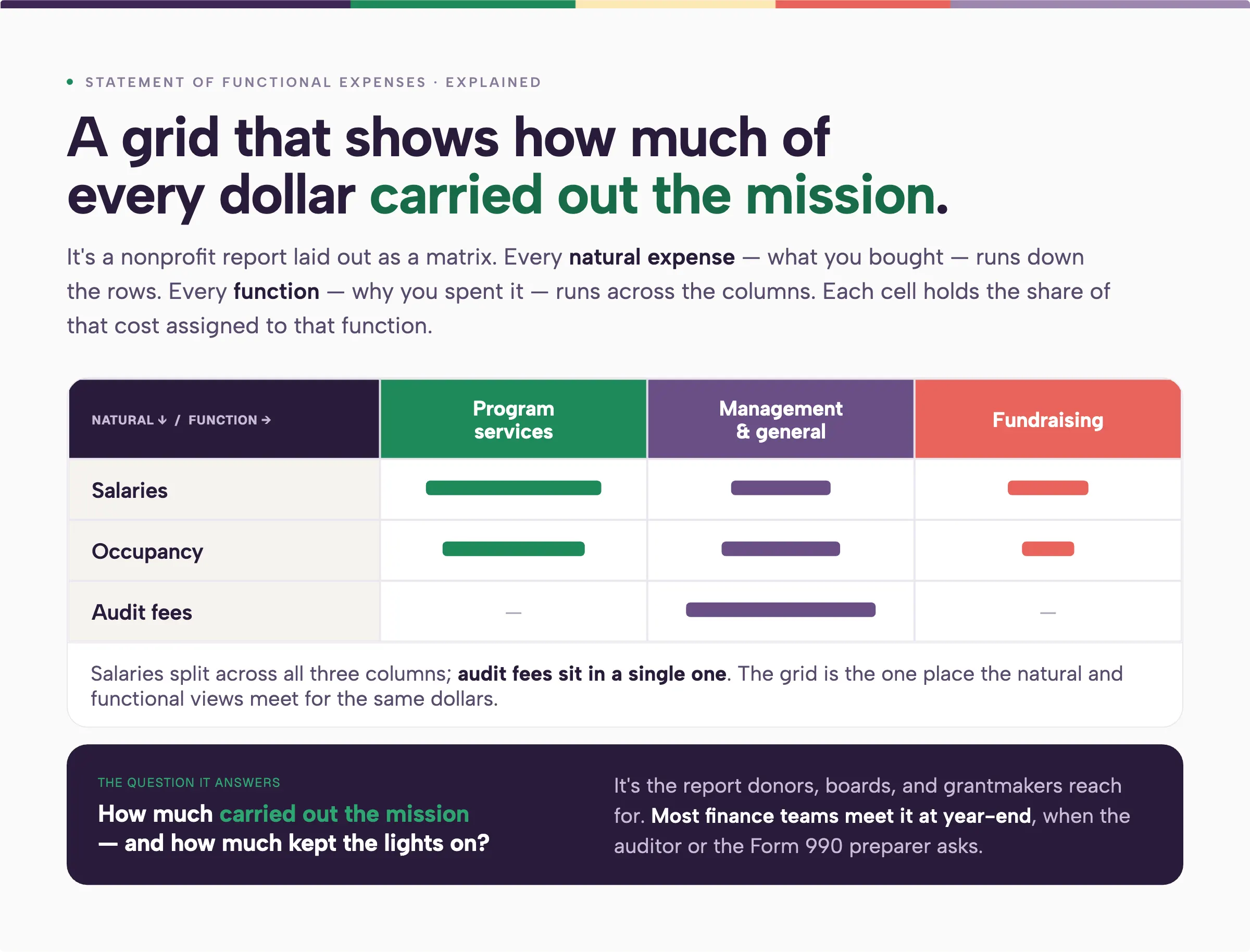
The format is a matrix. Natural expense categories run down the rows. Functional categories run across the columns.
Each cell holds the share of that cost assigned to that function. Salaries might split across all three columns, while audit fees sit in a single one.
Natural classification describes what you bought. Salaries, rent, supplies, insurance, software. Functional classification describes why you spent it: to deliver a program, to run the organization, or to raise money.

Your accounting system already tracks the natural side. Functional reporting adds the second view, and the statement is the one place both meet for the same dollars.
A staff salary shows why this matters. One person's pay can land partly in program, partly in management, and partly in fundraising, depending on how they spend their week.
The statement of functional expenses sits alongside three others: the statement of activities, the statement of financial position, and the statement of cash flows. Those three have for-profit equivalents in the income statement, balance sheet, and cash flow statement.
This one is specific to nonprofits. It exists to tie spending to purpose, which is the question your supporters care about most. For the wider context, our overview of how nonprofit accounting works walks through how these reports fit together.
Under FASB ASU 2016-14, every nonprofit that follows GAAP has to present an analysis of expenses by both natural and functional classification. The guidance lives in ASC 958-720-45-15, and it took effect for fiscal years beginning after December 15, 2017.
You can present that analysis in one of three places. Put it on the face of the statement of activities, in a separate statement of functional expenses, or in the notes. Size is not the trigger. Following GAAP is.
Before this update, only voluntary health and welfare organizations had to produce a full statement of functional expenses. The update extended the nature-and-function analysis to every nonprofit. It also asks you to disclose how you allocate shared costs. The allocation steps that follow are part of the requirement, not an extra.
The IRS requirement runs on its own track. Organizations that file the full Form 990 complete the functional expense matrix in Part IX of the return, which splits every expense line across program services, management and general, and fundraising.
The version you file depends on size, and the IRS sets the thresholds:
So a small nonprofit that follows GAAP still owes the nature-and-function analysis in its financial statements. That holds even in a year when it files the 990-EZ and never touches Part IX. The two rules can both apply, and they can apply at different sizes.
Every expense falls into one of three functions.

Program services carry out the mission. For a food bank, that's food and distribution; for a school, instruction; for a shelter, veterinary care and adoptions. These costs vary the most from one organization to the next.
Management and general keeps the organization running. Accounting and legal fees, the finance function, general office costs, insurance, and board governance. The share of leadership time spent managing rather than delivering belongs here too.
Fundraising brings in revenue. Events, donor communications, grant writing, and fundraising software. The cost of asking, in other words.
Some organizations add a fourth function, membership development, for the cost of recruiting and keeping members. At the higher level, the split is program services on one side and supporting activities on the other. Management and fundraising make up the support.
Overhead means management and fundraising combined. For years, a common rule of thumb put at least 65 percent of spending toward programs and no more than 35 percent toward overhead. That figure is now treated as a rough guide, not a law.
A young organization spends more on overhead while it builds its donor base and infrastructure. An established one usually spends less. Healthy ratios vary by mission, size, and age.
Overhead is not waste. Underfunding your operations and your fundraising is one of the quieter ways a nonprofit stalls. For more on presenting these numbers well, see our guide to nonprofit expense reporting.
This is the part that takes real time. Some costs are direct and need no math. Others are shared and need a method you can defend.
Direct costs go where they belong at full value. Grant-writing fees are fundraising, program supplies are program, and audit fees are management and general. No splitting required.
Shared costs need an allocation basis. Pick the basis that best reflects how the cost was used, then apply it the same way every year.
I learned the value of tagging spending in real time the hard way. The reporting tools at the organizations I worked with could produce this statement without much trouble. The recurring problem was reconstructing how money was spent months later, from transactions nobody had coded to a function while they happened.
The allocation gets far easier when each cost is tied to a program or function at the moment it happens. Reconstructing a year of untagged spending every spring is a tax you pay for skipping that step. Tag it once, up front, and the year-end statement becomes a review instead of an excavation.

Your chart of accounts does most of the heavy lifting here. If it's messy, fix that first, because every later step inherits its structure.
Part IX of the Form 990 is itself a statement of functional expenses. It uses four columns: total expenses, program services, management and general, and fundraising. The natural lines on the return are fixed, covering compensation, fees, occupancy, and the rest.
An internal statement that already uses those natural categories transfers almost line for line. That's the payoff for building your chart of accounts with the 990 in mind.
Run one reconciliation check before you file. The column totals in Part IX should agree with total expenses on your statement of activities. A clean tie-out is what a preparer looks for, and it's the first thing an auditor confirms.
The software you already run shapes how hard this step is.
QuickBooks can produce a version of this report using Classes. You set up a Class for each function, tag every transaction, and run a profit-and-loss by Class. It works, with one caveat I'll state plainly: it depends on disciplined tagging, and a single mistagged transaction distorts the report. QuickBooks Online handles this a little better than the desktop version, though the discipline requirement is the same.
Fund accounting platforms built for nonprofits, like Aplos, ACS Technologies, and Realm, handle functional reporting more directly. The structure is built in, so you spend less time forcing a general-ledger tool to behave like a nonprofit one.
Whichever you use, the statement is only as clean as the data feeding it. Spending that arrives already coded to a function turns the year-end build into a quick review instead of a month of cleanup.
A finished statement looks like this for a midsize nonprofit. The numbers are illustrative, built to show the structure rather than to model any real organization.
The bottom row tells the story at a glance. Almost two-thirds of spending goes to programs, with the rest split between running the organization and raising money. That profile reads as healthy for an established nonprofit, though the right mix depends on your mission and your age.
A few patterns draw a reviewer's attention every time. Most are easy to avoid once you know to look for them.
The fix for most of these fits on one page. Write a short allocation policy, have your board or finance committee approve it, and review it once a year. Consistency is what holds up.
I co-founded KleerCard for nonprofits, churches, and schools that need spending sorted as it happens, not reassembled later.
Cards can be assigned to a program, a team, or an administrative function, and receipts attach at the point of sale. Every purchase ties to a function and a named person from the moment it clears. Your finance team sees the categorized spend in real time through KleerCard's expense management.
By the end of the year, the data that feeds your statement of functional expenses is already organized. That's the same idea behind separating program and administrative spending from the start.
KleerCard doesn't produce your statement of functional expenses, and it doesn't file your Form 990. Your accounting software does that work. What we do is hand it clean, function-tagged data, so the allocation that used to eat a week takes an afternoon.
Click here to download.
The template comes in Excel, with the natural-and-functional structure and the totaling formulas already built in, plus a filled example to follow. You can adapt the categories to match your own chart of accounts, then drop in your numbers and let the totals and percentages calculate themselves. No email required.
A statement of functional expenses is a nonprofit financial report that shows spending in a grid. Each row is a natural expense, like salaries or rent. Each column is a function: program services, management and general, and fundraising. The grid shows how much of every cost supported the mission.
Natural classification describes what you bought, such as salaries or rent. Functional classification describes why you spent it: program services, management and general, or fundraising. The statement reports both for the same dollars, which is what makes it useful to donors and auditors.
Two separate rules apply. Every nonprofit that follows GAAP must present expenses by nature and function under FASB ASU 2016-14, somewhere in its financial statements. Full Form 990 filers also complete the functional expense matrix in Part IX of the return.
Program services, management and general, and fundraising. Some organizations add a fourth, membership development, for the cost of recruiting and keeping members.
Assign direct costs to one function at full value. Split shared costs using a basis that reflects real use: time for salaries, square footage for occupancy, and headcount or usage for technology. Document the method and apply it the same way every year.
QuickBooks can produce a version using Classes, with each function tagged on every transaction. It works with disciplined tagging, though purpose-built fund accounting software handles functional reporting more directly.
They share the same structure, but they are not the same document. Part IX is the functional expense section of the IRS return. Your statement of functional expenses is the financial-statement report that feeds it.
The statement of functional expenses rewards a year-round habit. Sort spending by function as it happens, write down how you allocate the shared costs, and the report mostly builds itself.
If your team wants every purchase tagged to a program from the moment a card is swiped, that's the problem we built KleerCard to solve. You can see how it fits nonprofits like yours.


Speak to a member of our team and we can have you up and running in minutes, not weeks.