%202.svg)
See how one private Christian school went from opaque “Amazon $X” charges and 5 weekly receipt chases to itemized data, 60+ cards, and month-end in minutes.
School finance offices know the line. A credit-card statement shows “Amazon” and an amount. Then someone has to dig through orders, emails, and packing slips to figure out what was bought, which classroom or event it belonged to, and who actually used the card.
At a private Christian school with roughly 540 students pre-K through 12 and about 100 staff, that hunt was the single hardest part of reconciliation. Five shared cards covered the whole campus. Lost or late receipts ran about five every week. Month-end credit-card work was lengthy.
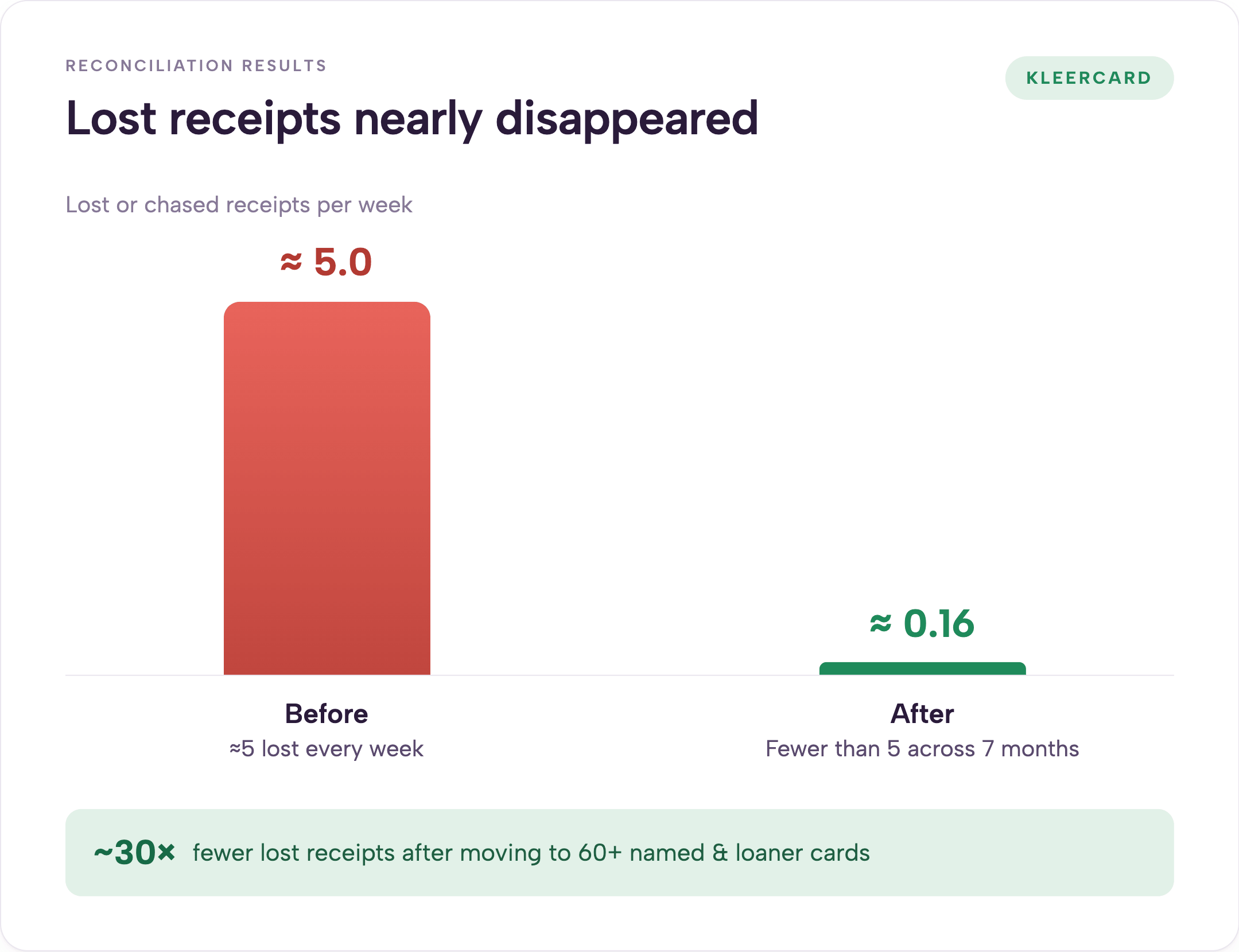
After the finance office moved to more than 60 individual and loaner cards tied to Amazon Business, the same team saw fewer than five lost receipts across seven months of the school year. Month-end dropped to a few minutes. Every Amazon charge arrived already itemized, receipt-attached, and tagged to the right cardholder.
I have watched this happen in private Christian schools for years. The constraint was never trust or budget authority. It was physical access to a card and the absence of a process that captured clean data at the moment of purchase. This is how that change worked, the exact numbers, and the practical steps any similar school finance team can take.
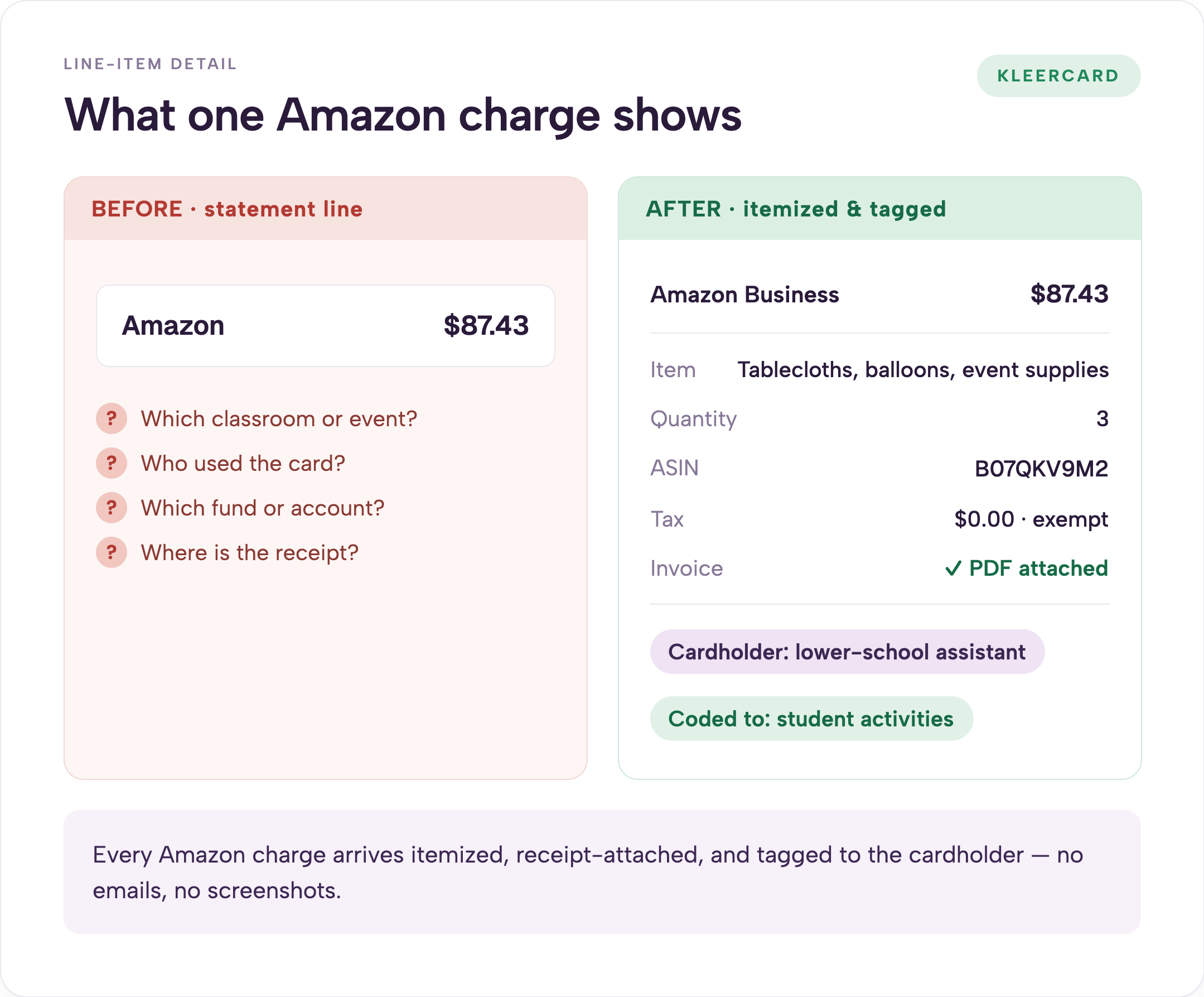
Before the change, an Amazon charge on the statement looked like this: “Amazon $87.43.” Finance then had to match the amount to an order, find the receipt, identify the buyer, and decide which account or fund should absorb it. Multi-shipment orders made the problem worse. One $300 order could post as four or five separate charges days apart.
After Amazon Business was connected to the spend-card platform, each charge arrived with the full line-item detail already attached: item description, quantity, ASIN, tax, and the PDF invoice. The charge was already tagged to the specific cardholder.
Private Christian schools and K-12 finance teams report Amazon as the single hardest vendor to reconcile because statement lines show only “Amazon” and an amount, forcing manual matching of orders, receipts, and cardholders.
Amazon Business Level 3 data plus a spend-card integration attaches the exact items purchased, quantities, tax, and PDF invoice directly to each card charge as it posts, including multi-shipment orders.
One private school with 540 students reduced lost or chased receipts from roughly five per week to fewer than five across seven months after moving from 5 cards to 60+ with the Amazon Business integration.
A concrete example from the same school: the lower-school administrative assistant ordered tablecloths, balloons, and event supplies. The charge landed in the platform already itemized and assigned to her. She coded it to the correct student-activities account without the finance office having to guess which event it belonged to.
For the full mechanics of how the data lands, see Amazon Business expense tracking.
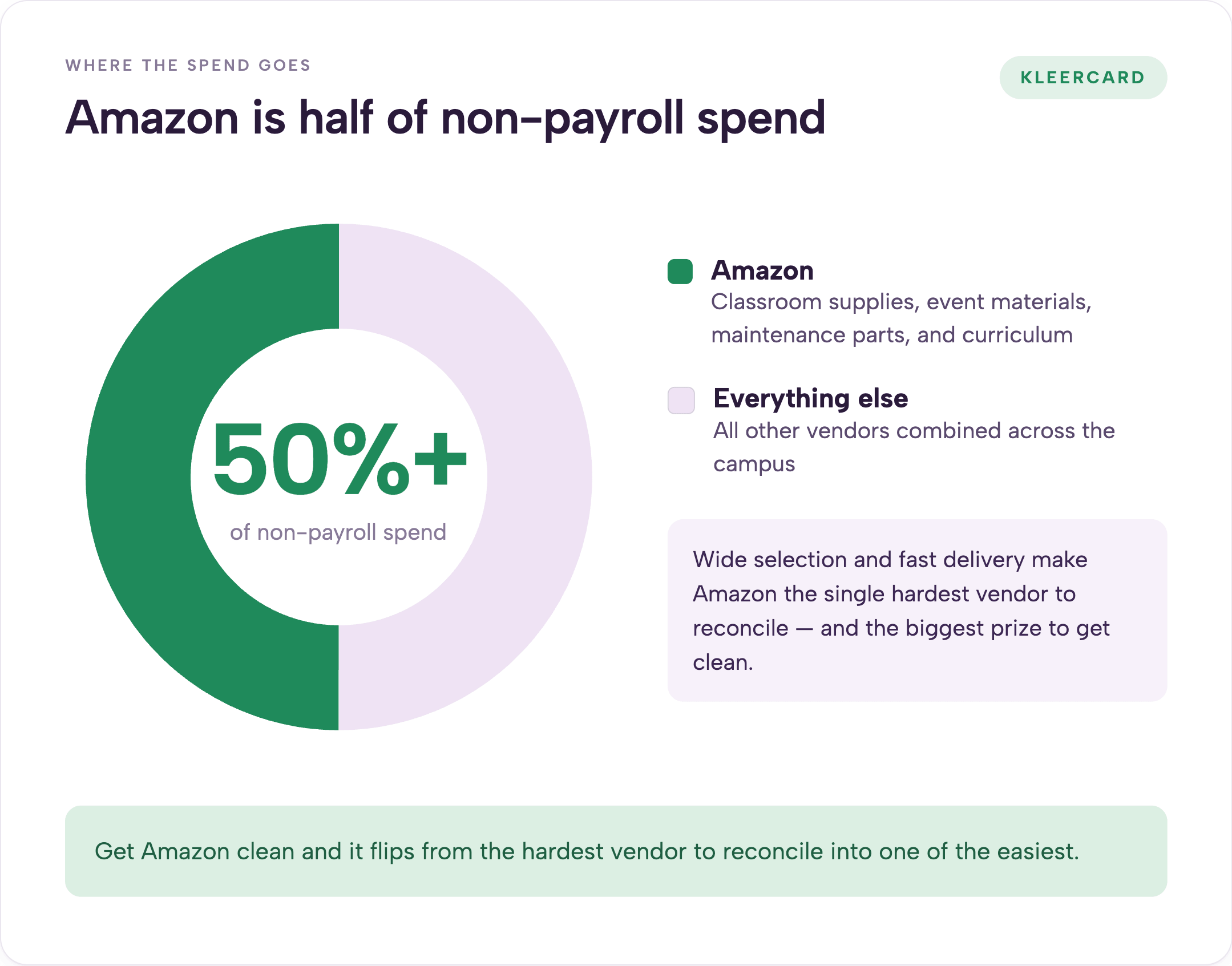
In my work with school and nonprofit finance teams at Compassion International and later Switch Consulting, and as treasurer of a church that currently runs 21 cards, I see the same pattern every year. Amazon regularly accounts for half or more of non-payroll spending at the schools and nonprofits I work with. Classroom supplies, event materials, maintenance parts, and curriculum all land there because selection is wide and delivery is fast.
Most schools try to control the risk by banning staff from loading the school card into a personal Amazon account. The concern is integrity, not the dollar amount. A family member can rent a movie for $2.99 that evening and the default payment method is still the school card. The school then spends hours getting a reimbursement check cut for a $2.99 charge it cannot be seen condoning.
When personal accounts are banned, the next friction appears. Teachers and coaches send product links to one office manager who places the order. When that person is busy or out, staff simply stop at a store and front the cost. Reimbursement batches then arrive at the deadline.
Pure Amazon Business tools (budgets, approvals, Business Credit Account) improve the buying side. They do not automatically solve the card-statement side for organizations that still need physical and virtual cards that work at Home Depot, the grocery store, and Amazon. The expense management layer is what closes that gap. Guidance from organizations such as the GFOA on purchasing card policies reinforces the need for clear controls and reconciliation processes that traditional high-limit cards often lack.
Amazon Business itself is free to create. Verified 501(c)(3) organizations can enroll in the Amazon Tax Exemption Program at no charge so eligible purchases post without sales tax. Multiple users can be added with different roles. Guided buying and budget tools sit on top of that. See also the official Amazon Business for education overview for school-specific features.
Eligible commercial cards can receive Level 3 line-item data that includes item description, quantity, ASIN, tax amount, shipping address, order ID, invoice ID, and more. That data is useful only if it lands inside the system the finance team actually uses every day. Official documentation from Amazon Business on line-item transaction details lists the full set of available fields and the card networks that support them.
A modern spend management platform issues the physical, virtual, and labeled loaner cards. It sets per-person or per-department budgets and captures receipts at the moment of purchase.
When the Amazon Business account is connected, each charge that posts to a card automatically pulls the matching line-item detail and PDF invoice and tags it to the cardholder who made the purchase. Multi-shipment orders are matched shipment by shipment instead of leaving finance to reconcile four partial charges against one original order.
The result is that finance can see exactly what the maintenance director bought at Home Depot or what the lower-school assistant bought for Grandparents Day without sending a single email asking for screenshots. This combination turns Amazon from the hardest vendor into one of the cleanest. See the dedicated Amazon Business expense tracking overview for more detail.
The private Christian school with roughly 540 students pre-K through 12 and about 100 staff that produced these numbers operated on five shared bank cards with a monthly line of credit before the change.
Teachers and coaches played a daily game of locating the card. The director of operations might have given it to the academics director. By the time a science teacher found the right person, the experiment supplies were needed the next day.
Many simply used personal cards and submitted reimbursements. Batches of ten or twelve requests arrived at every deadline.
Amazon charges were the worst. A statement line said only “Amazon” and an amount. Finance then hunted the order history, the receipt, and the person who placed it.
After the finance office rolled out more than 60 cards (a mix of individual cards and labeled loaners such as “Fine Arts Loaner 1,” “Upper School Loaner 2,” and “Athletics Loaner 5”), the same campus saw fewer than five lost receipts across seven months.
Month-end credit-card reconciliation moved from a lengthy process to a few minutes because the team already checked the platform weekly.
The maintenance director was part of the first pilot group. Before, he had no card in his own name. Fixing a toilet meant first locating whoever held one of the five shared cards, sometimes on the other campus, then driving to Home Depot.
Now he carries his own card, does a quick weekly spend check-in with his director, uploads the receipt on the spot, and moves on.
The lower-school principal is already planning the next expansion: every lower-school teacher will receive a card with a modest classroom limit (the number floated was around $125). The workflow the principal describes is simple: use the card, photograph the receipt, upload it, done.
Approvals stay lightweight. Administrators receive a self-loading limit (currently $5,000). Anything above routes to the head of school.
Teachers who need more request it from their administrator, who approves by email. People without a card still use a simple internal form that points them to the right loaner.
Restricted and grant funds continue to live in their own accounts inside Shelby Financials. The finance manager oversees the flow. Student activity and booster funds have their own cards under a responsible administrator.
The full operational story of this school’s move from five cards to sixty-plus is covered in the companion piece on how a private Christian school went from 5 cards to 60+. Schools looking for broader solutions for educators can start with a short demo.
At the private Christian school with roughly 540 students and about 100 staff that moved from 5 cards to 60+, the finance office began with Amazon Business policy. Create the organizational account. Enroll in the Amazon Tax Exemption Program if the school qualifies. Ban the loading of school cards into personal Amazon accounts. Require the Business account for all school purchases. Nonprofits can also review tax-exempt purchasing options for additional context.
On the card side, issue a mix of named cards and clearly labeled loaners that are tracked on the dashboard. Many departments keep two or three loaners so a teacher can borrow one without waiting for an administrator to hand over a personal card. Set weekly reconciliation cycles so month-end is only a final check. Real-time receipt tracking makes this practical for both Amazon and non-Amazon spend. See also Amazon Business expense tracking for the integration details.
Line-item detail makes fund and department coding straightforward. Classroom supplies can sit in one account with a dimension for elementary, middle, or upper school instead of forcing every teacher to code to a unique account. The same principle applies to restricted gifts: the itemization shows exactly what was purchased so the finance manager can confirm the money stayed inside its purpose.
At this school, bill pay and bank reconciliation still run outside the card platform (manual checks and Shelby). The card platform does not have to own every process to solve the Amazon and receipt problems. Organizations that later want to consolidate can add bill pay and reimbursements. For broader context, see solutions for non-profits.
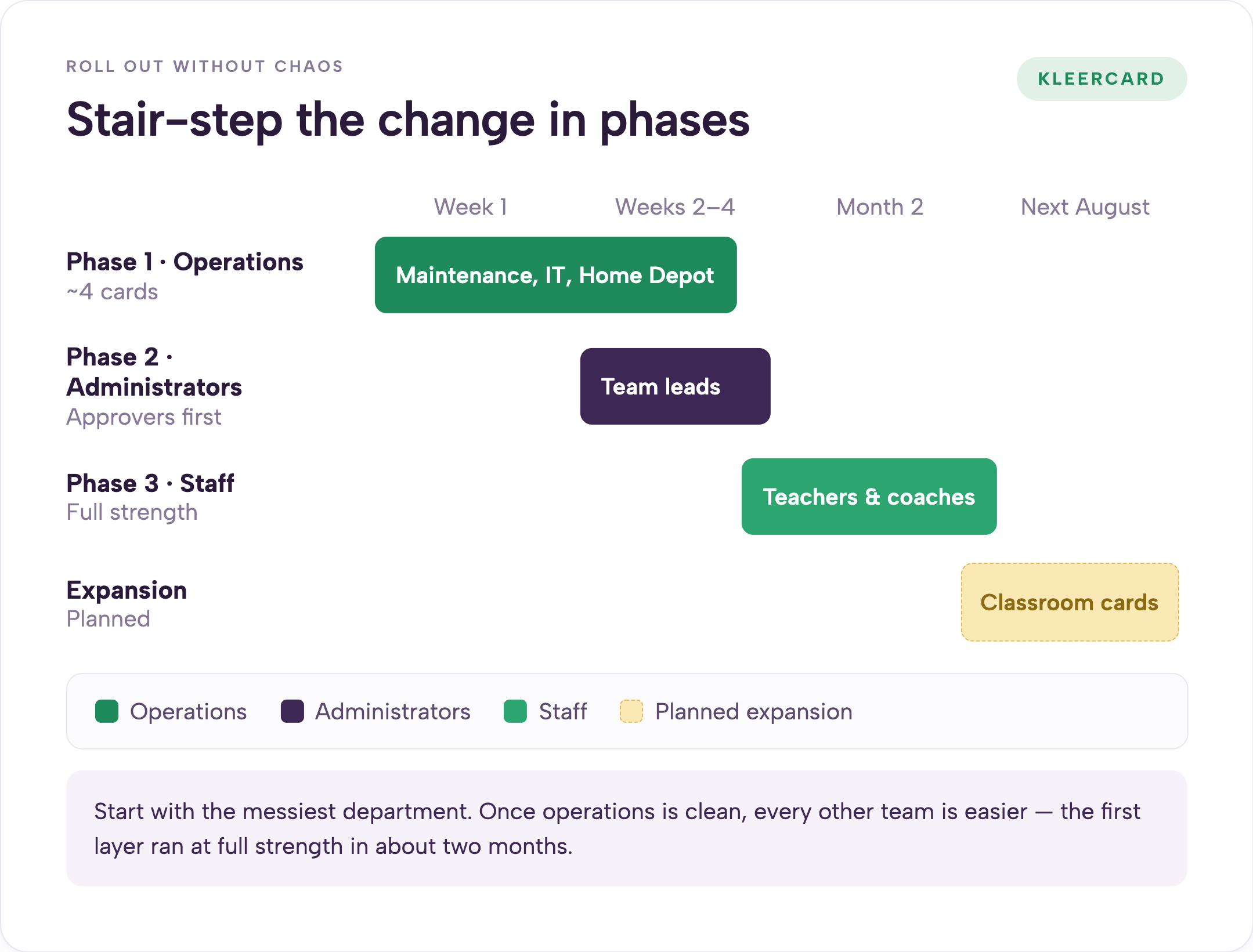
The private Christian school with roughly 540 students and about 100 staff that moved from 5 cards to 60+ did not flip a switch for the entire campus on day one. They staged the rollout deliberately.
Phase one focused on the hardest department: operations (maintenance, IT, vehicles, janitorial, Home Depot runs). About four people received cards. The logic was simple. If the messiest workflow could be cleaned up, every other department would be easier. They caught on within days.
Phase two brought on the administrators. Once the people who coach teachers and coaches were fluent, the next expansion became low-risk.
Phase three opened cards to teachers, coaches, and support staff. The first layer was running at full strength within roughly two months. The lower-school teacher expansion is planned for the following August.
The practical advice the finance office gives other schools is the same: start small, iron out policy and workflow with one group, then expand. Stair-step the change instead of trying to train the entire staff at once. Test the Amazon Business connection early so the line-item data is flowing before the broader rollout begins. Hands-on help is available through white-glove setup.
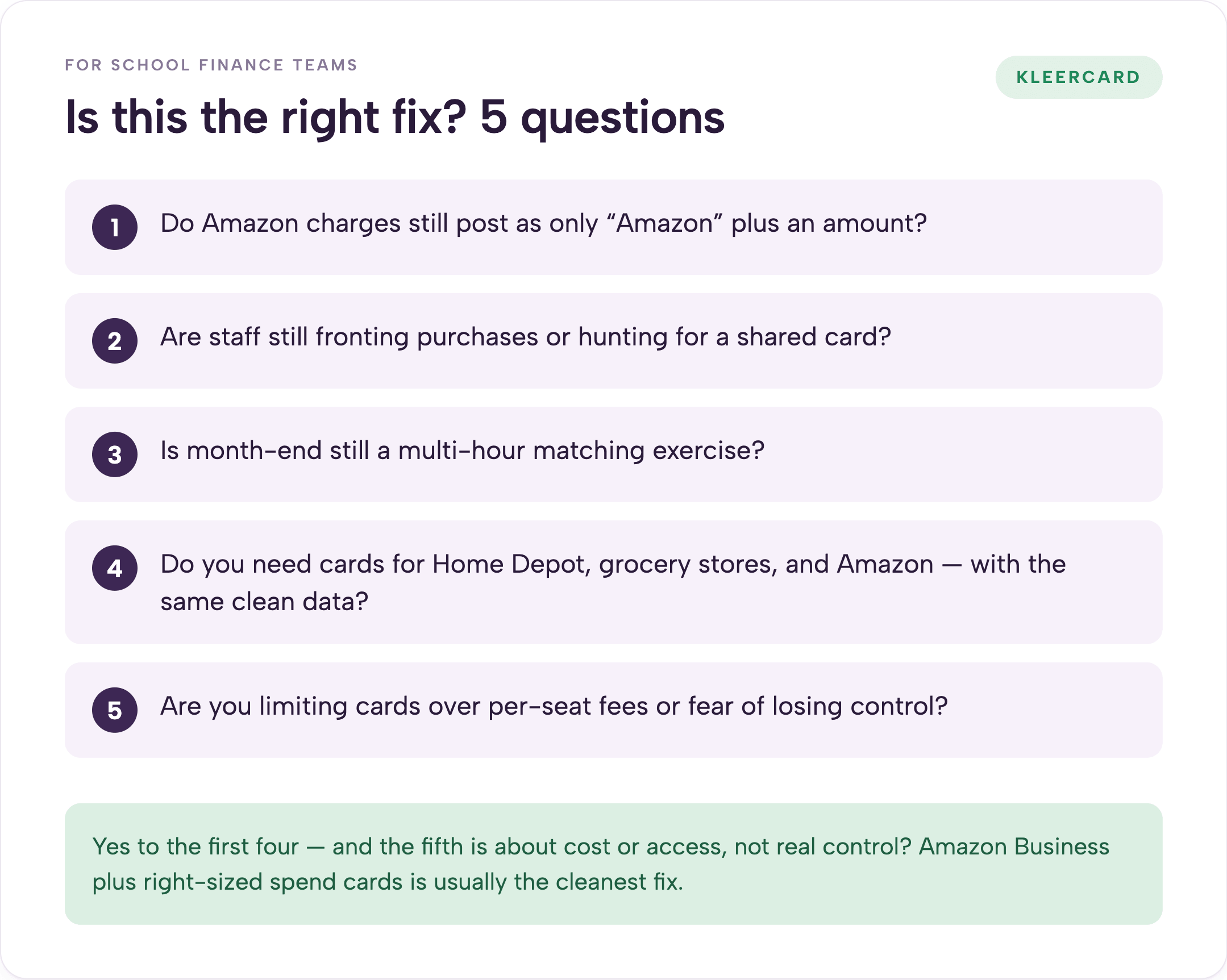
If Amazon charges still appear on statements as only “Amazon” plus an amount, if teachers and coaches are still fronting purchases or hunting for a shared card, and if month-end is still a multi-hour matching exercise, the combination of Amazon Business + spend cards is usually the cleanest fix. The private Christian school with roughly 540 students pre-K through 12 and about 100 staff that moved from 5 shared cards to more than 60 proved the numbers: fewer than five lost receipts across seven months and month-end reduced to minutes. Ask these questions before choosing a path:
If the answer to the first four is yes and the fifth is driven by cost or access rather than real control, the combination of Amazon Business plus right-sized spend cards is usually the cleanest fix.
Pure Amazon Business Credit Account tools work well for some districts. Many private schools still need physical and virtual cards that function outside Amazon, and they need the data to land in the same place the finance team already works. Cards that require no personal guarantee are especially useful for schools and nonprofits. Compare options on the best credit cards for school districts page and current pricing. See the full product for feature details.
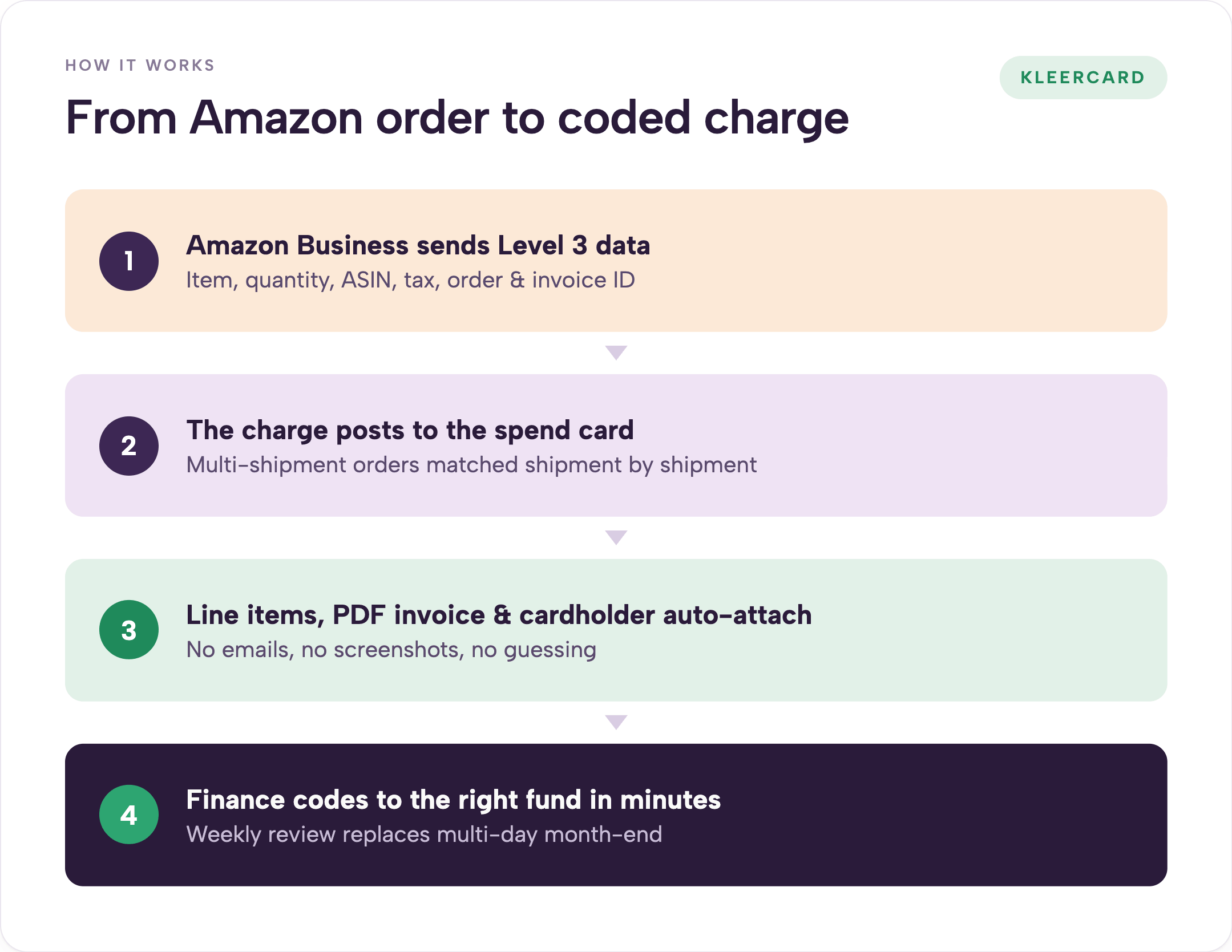
When the Amazon Business account is connected to the spend-card platform, each charge that posts pulls the matching shipment’s item description, quantity, ASIN, tax, and PDF invoice and attaches them to that specific card transaction. Multi-shipment orders are matched shipment by shipment. Real-time receipt tracking keeps the process clean.
The private Christian school with roughly 540 students pre-K through 12 and about 100 staff that moved from 5 cards to 60+ runs Shelby for the general ledger and FACTS on the student side. The full line-item detail and cardholder tagging that arrive with every Amazon charge after connecting Amazon Business to the spend cards make coding into the correct Shelby accounts and dimensions faster and more accurate, because finance already knows exactly what was purchased and who bought it. The same pattern works with other school accounting systems that accept detailed transaction imports or CSV feeds.
One large order can generate several charges as items ship. Without integration those charges appear as separate “Amazon” lines with no easy way to reconnect them. The integration matches each shipment’s line items and invoice back to the original order and the card that paid for it.
Creating an Amazon Business account is free. Verified 501(c)(3) organizations can enroll in the Amazon Tax Exemption Program at no charge so eligible purchases post without sales tax. Business Prime adds additional controls and is optional. See the official Amazon Business for education page for current enrollment details.
The private Christian school described here moved from 5 shared cards to more than 60 (a mix of individual cards and labeled loaners). The number follows the real list of people who legitimately spend on behalf of the school rather than an arbitrary limit. Many schools start with a small pilot and expand once the workflow is proven. The full story is in how a private Christian school went from 5 cards to 60+.
Yes. At the private Christian school with roughly 540 students pre-K through 12 and about 100 staff that moved from 5 shared cards to more than 60, the lower-school principal is preparing to issue every lower-school teacher a card with a modest classroom limit (around $125 was the example discussed). The workflow is: use the card, photograph the receipt, upload it, and finish—no reimbursement paperwork required. This is the same school that reduced lost receipts from roughly five every week to fewer than five across seven months after connecting Amazon Business to its spend cards.
The constraint was never trust or budget authority. It was physical access to a card and the absence of a process that captured clean data at the moment of purchase.
One private Christian school with 540 students and 100 staff proved the numbers: fewer than five lost receipts across seven months, month-end reduced to minutes, and Amazon charges that arrive already itemized and tagged. The same combination of Amazon Business and right-sized nonprofit credit cards is available to any school finance team ready to stop hunting for orders.
Schedule a short demo or start with a white-glove pilot if you want to test the workflow with a handful of cards first. You can also explore the full product, solutions for educators, and the companion case study on the 5-to-60 transition.
I have worked with nonprofit and school accounting systems for years, first at Compassion International and later at Switch Consulting. I currently run 21 cards for my own church of 2.5 staff. The pattern is consistent: once the data is clean and the cards are right-sized, the finance office gets its time back and the rest of the team can focus on the mission.


Speak to a member of our team and we can have you up and running in minutes, not weeks.