%202.svg)
Compare the best credit cards for HOAs that issue in the association’s name with no personal guarantee. Controls, receipts, board transitions, and honest pricing for 2026.
HOA boards rotate. Treasurers change. Homeowners expect clean reporting on every landscaping invoice and pool chemical run. Most associations still run on one or two bank cards tied to a single officer’s credit. That creates personal liability risk and a constant search for the plastic when the maintenance team needs to fix a gate or restock supplies.
I have seen the same access and continuity problems play out in churches, private schools, and other member-based organizations for years.
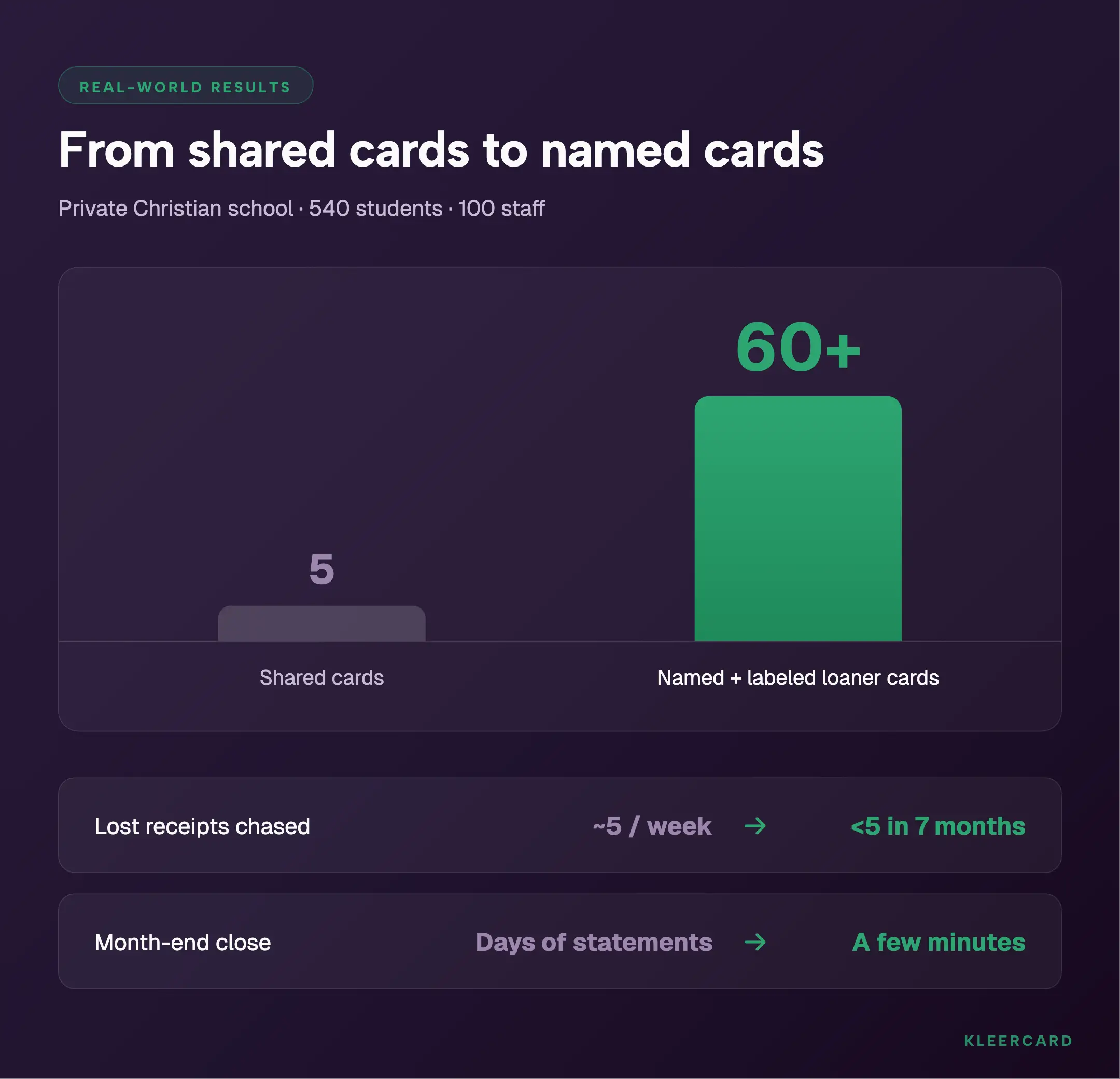
A private Christian school with roughly 540 students and 100 staff ran for years on five shared bank cards. The maintenance director could not fix a toilet or make a Home Depot run without first locating whoever held the card that day. After the school moved to named cards—including labeled loaners—the same campus now runs more than 60 cards. Lost receipts dropped from roughly five chased every week to fewer than five across seven months. Month-end close moved from lengthy statement processing to a few minutes.
I am Owen Hill, co-founder of KleerCard and treasurer at a church that runs 21 cards with only 2.5 paid staff. Before this I spent years at Compassion International and Switch Consulting working with nonprofits and member organizations on financial systems and controls. The operational realities of volunteer boards, rotating officers, and the need for clean homeowner reporting look the same whether the organization is a church, a school, or a homeowners association.
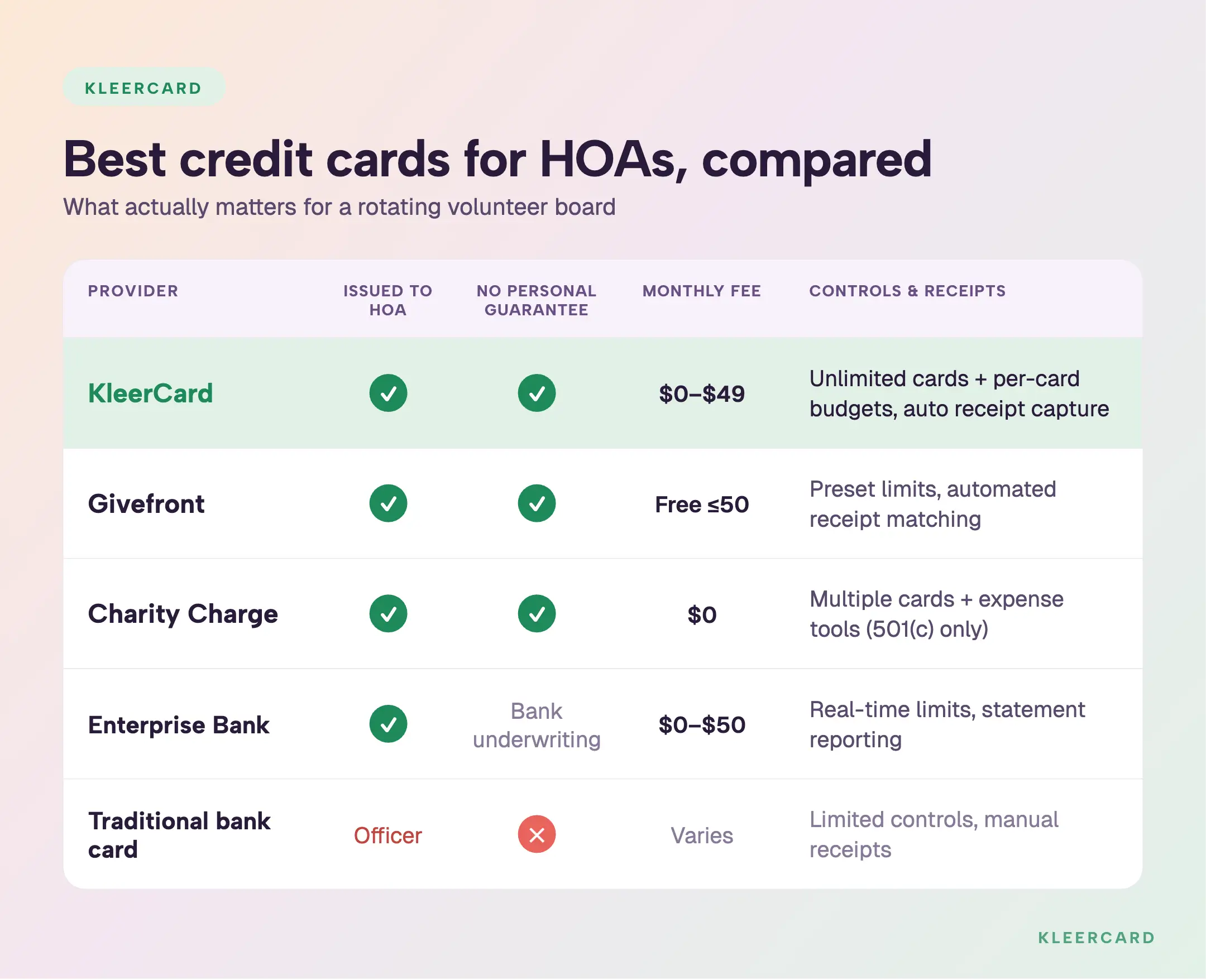
This guide compares the cards that actually work for homeowners associations and similar community associations. We focus on cards issued in the association’s name, no personal guarantee requirements, real spending controls, and the practical realities of volunteer boards. You will see an early comparison table, the specific problems traditional cards create for HOAs, and a clear decision framework so your board can choose once and move on.
See current pricing and plan details, the nonprofit credit card product page, and solutions for nonprofits and member organizations. For a broader view of no-personal-guarantee options, review the credit cards for nonprofits with no personal guarantee guide.
Most HOAs start with a single bank card or a couple of cards held by the treasurer and property manager. The problems show up fast.
Someone needs to buy pool chemicals or run to the hardware store for a broken lock. The card is with another board member who is out of town or already used it for a different vendor. Work stops or the maintenance person fronts the money and waits for reimbursement.
Board transitions make it worse. The outgoing treasurer’s name is on the account. Incoming officers inherit liability or must re-apply. Receipts disappear. Homeowners ask for transparency and the board has incomplete records.
I have watched the same friction play out across volunteer-led organizations. A private Christian school with roughly 540 students and 100 staff ran for years on five shared bank cards. Administrators spent time hunting for the plastic across campuses. Teachers stopped asking and used personal cards. The maintenance director could not fix a toilet or make a Home Depot run without first locating whoever held the card that day.
After the school moved to named cards—including labeled loaners for departments—the same campus now runs more than 60 cards. Lost receipts dropped from roughly five chased every week to fewer than five across seven months. Month-end close moved from lengthy statement processing to a few minutes because the team reconciles weekly. Amazon orders that once appeared only as a single line item now arrive with full itemization tagged to the cardholder.
Access and continuity when people change roles were the real constraints for that school—and for most HOAs. Trust and budget were never the issue. HOA boards face the identical access problem every time leadership rotates or a vendor needs payment on short notice. The same pattern shows up in church spending controls and other member-based groups we work with.
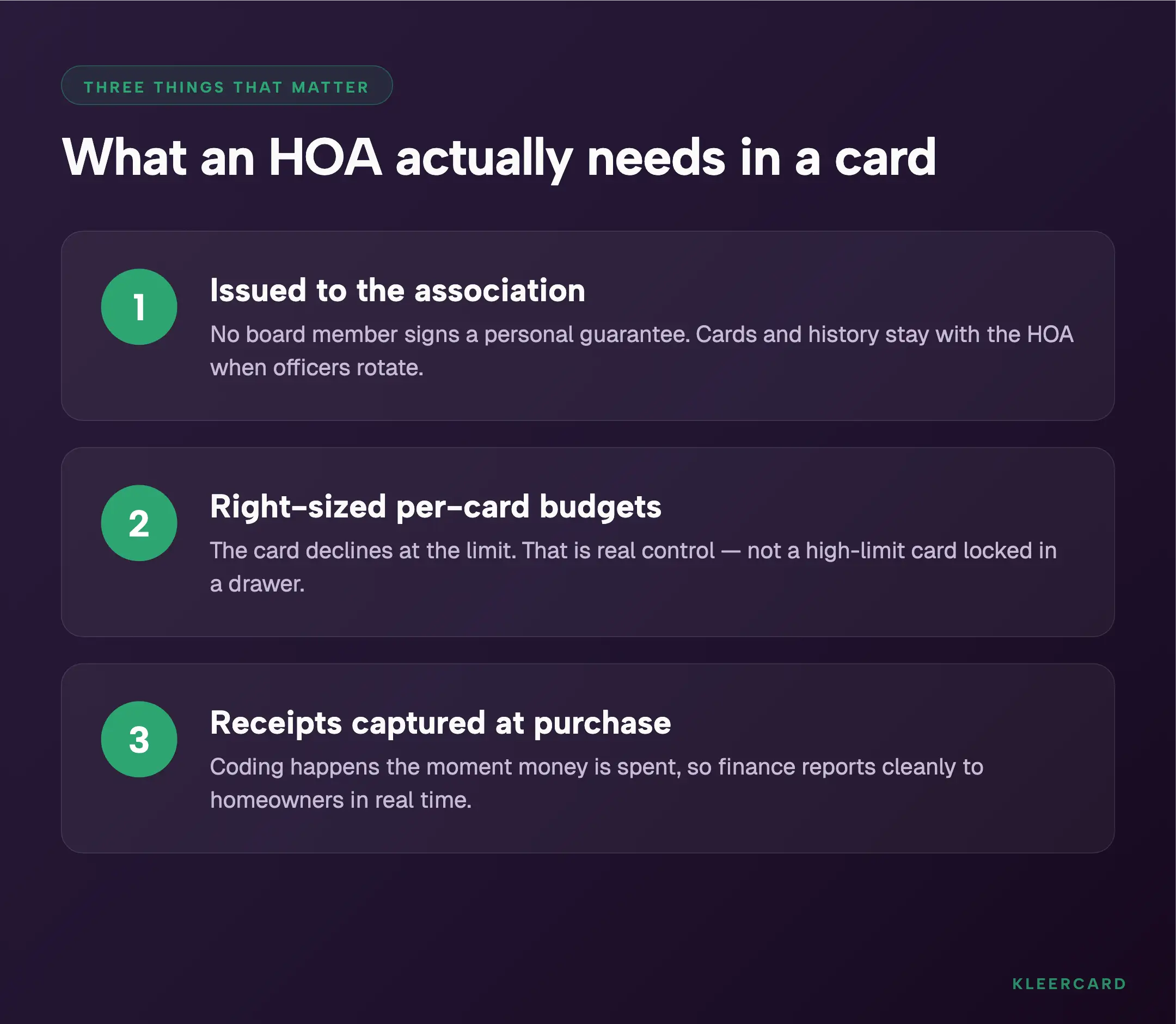
Three traits matter more than rewards points for any homeowners association.
Secondary features that help: virtual cards for vendors and one-time projects, Amazon Business integration so common-area supplies arrive itemized and tagged to the right cardholder, and native sync to the accounting system the board already uses. See receipt tracking and Amazon Business expense tracking for how these work in practice.
I run my own church on 21 cards with only 2.5 paid staff. The same principles apply to HOAs. Line-of-sight accountability works better than a high-limit card sitting in a drawer. Budget authority and the ability to spend must line up. When they do, most other controls become secondary. This is the core of the nonprofit credit card model we built for organizations that cannot put personal credit on the line.
KleerCard issues cards to the organization with no personal guarantee. Boards set per-card budgets, issue unlimited physical and virtual cards, and enforce receipt capture with automatic reminders and card lock. Accounting integrations cover the platforms most associations use. Pricing starts at free with a wallet balance and scales to $29 or $49 per month depending on users and features. Full details sit on the product page and pricing page.
The practical fit for HOAs is the combination of continuity and day-to-day controls. Maintenance, landscaping vendors, and committee chairs can each hold cards with clear limits. Incoming treasurers inherit a clean history instead of a personal account in someone else’s name.
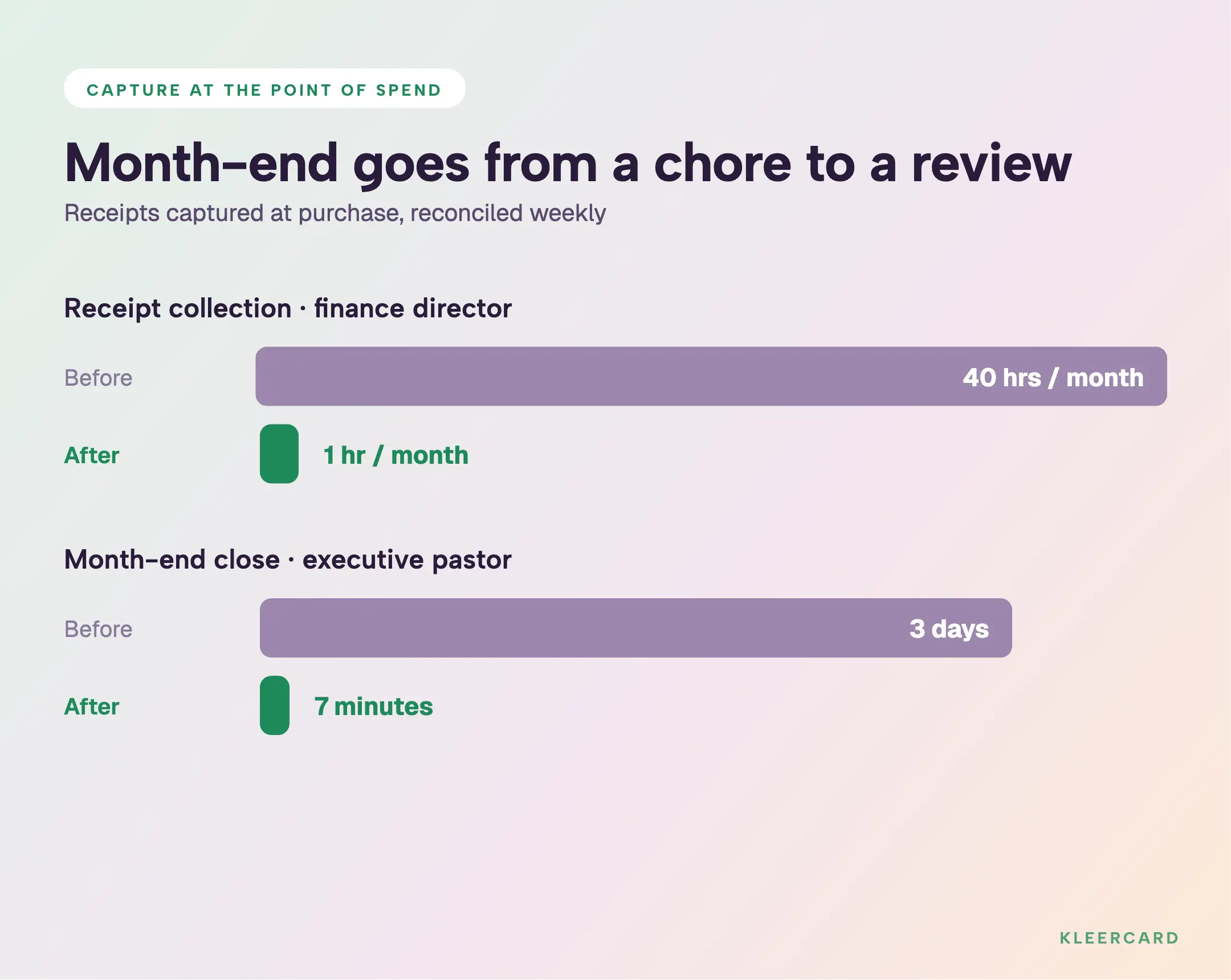
We see associations and similar organizations cut receipt-chasing time dramatically once capture happens at the point of spend. One finance director moved from 40 hours a month of receipt collection to one hour. An executive pastor moved month-end close from three days to seven minutes. The underlying change is the same: capture the detail when the money is spent instead of reconstructing it later. The white-glove setup process is designed for boards that want that outcome without a long internal project.
Givefront markets heavily to HOAs as a free card issued to the association with no personal guarantee and spend-management tools. The free plan covers up to 50 users with no annual fees according to Givefront’s own pricing and HOA materials. The pitch matches the core needs: preset limits, real-time tracking, receipt matching, and continuity across board changes. For very small self-managed associations that want zero cost, it is a legitimate option to evaluate on their HOA card page.
The trade-off is feature depth and long-term support model. Boards should confirm current eligibility, accounting integrations, and what happens if the free tier changes. Application availability has varied in the past, so verify the current intake process before planning a switch.
Charity Charge is built exclusively for nonprofits and underwrites to the organization’s EIN with no personal guarantee and no annual or platform fees. Associations that qualify as 501(c) organizations and meet the revenue and tenure thresholds can use it. The platform includes expense tools and is designed around restricted funds and board oversight. Confirm current rules on the Charity Charge eligibility FAQ.
Many HOAs file Form 1120-H under Section 528 or operate as 501(c)(4) social welfare organizations. Charity Charge states that most tax-exempt organizations in good standing, including 501(c)(3), (c)(4), (c)(5), and (c)(6) entities, can apply if they meet the operational history and revenue tests. Always verify eligibility for your specific tax status before applying.
Several banks offer cards specifically for community associations. Enterprise Bank’s community association credit cards provide tailored credit lines, real-time limit changes, unlimited physical and virtual cards, and integration support. Rewards are modest (1.25x–1.5x). Annual fees range from $0 to $50.
These work well for associations that want a banking relationship and simple reporting. They typically lag specialized platforms on receipt automation and multi-user budget enforcement. The advantage is local relationship banking and the ability to keep deposits and cards with the same institution.
Standard business cards from major banks still require an officer’s personal guarantee in most cases. They solve the immediate need to pay a vendor but recreate the liability and transition problems that HOAs are trying to escape. Use only if the association truly needs a single card and accepts the personal exposure.
I have seen the personal-guarantee problem force rapid switches when a prior provider changed terms or was acquired. Boards that move the account into the association’s name avoid that risk entirely. For a wider set of no-personal-guarantee alternatives, see the best credit cards for nonprofits comparison.
Answer these questions before you apply.
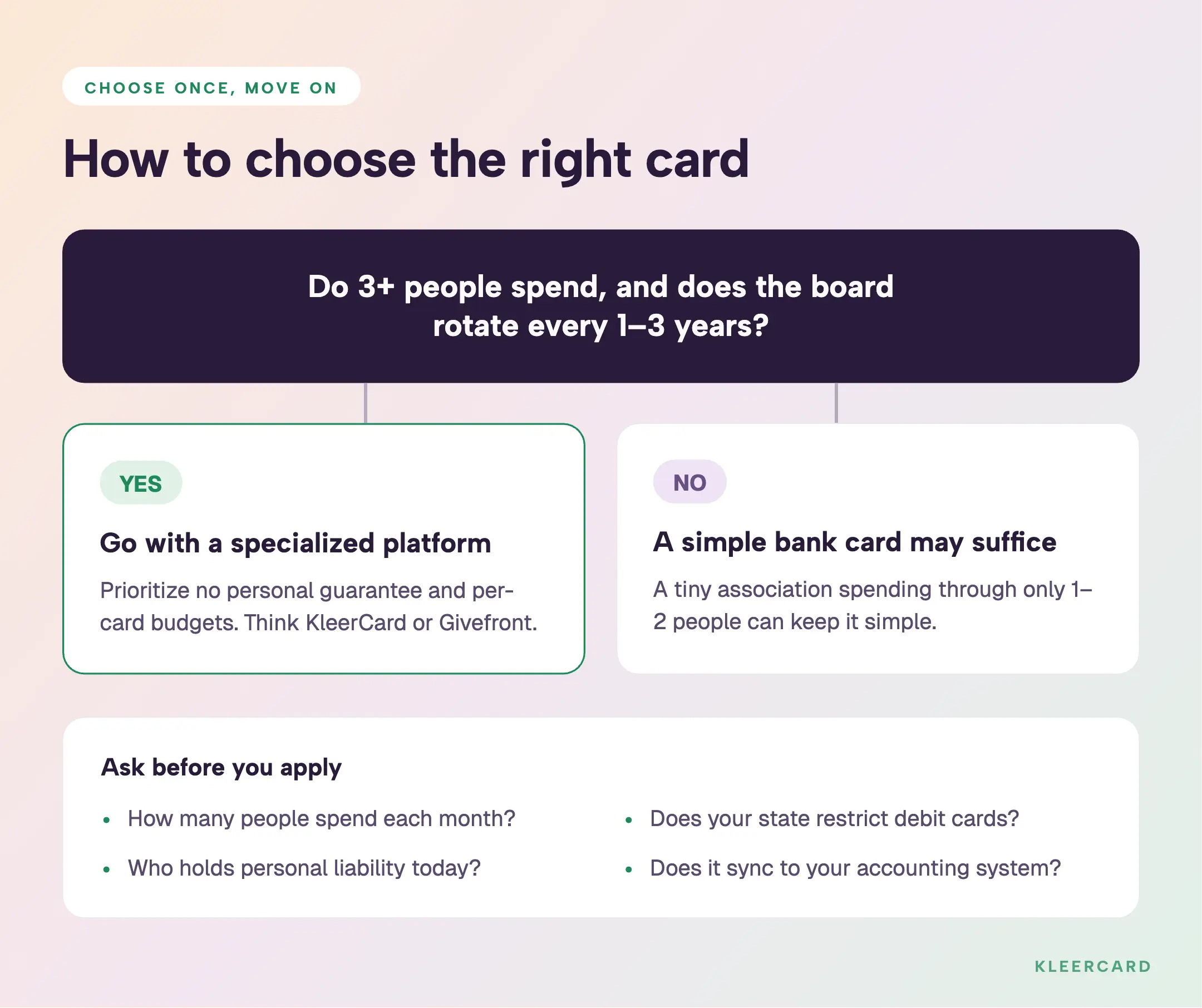
If the board changes every one to three years and more than three or four people need to spend, prioritize no personal guarantee and per-card budgets. If the association is tiny and spends only through one or two people, a simple bank card may still suffice.
For deeper comparison of no-personal-guarantee options across nonprofits and member organizations, see the full credit cards for nonprofits with no personal guarantee guide and the nonprofit credit card overview. You can also schedule a short demo to walk through controls with your board.
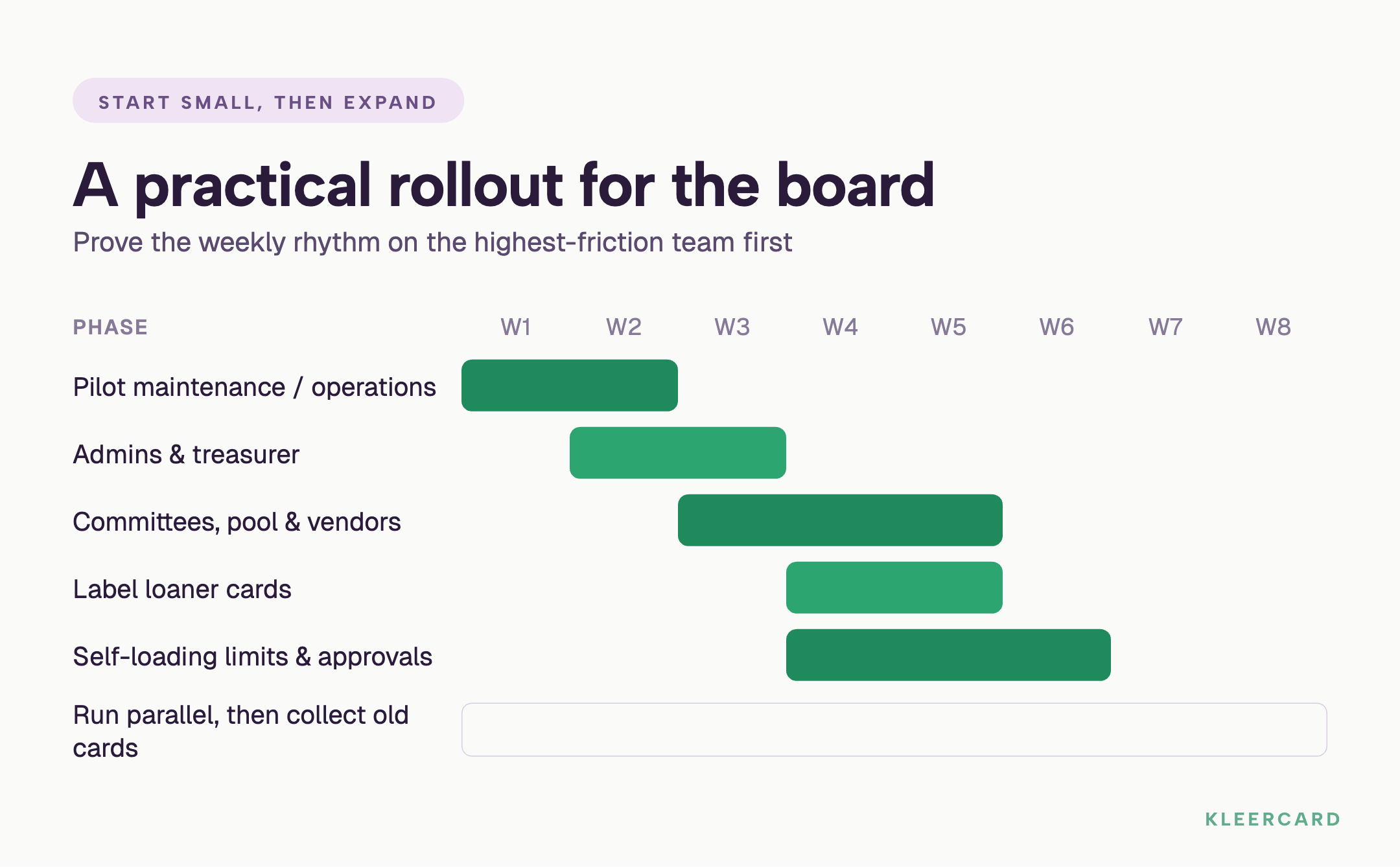
Start small and expand. The most reliable pattern we see across homeowners associations and similar volunteer boards is:
The goal is line-of-sight accountability. Every charge traces to a named person and a budget the board already approved.
In the school example with 540 students and 100 staff, the operations team (maintenance, IT, vehicles) went first because that department created the most friction. They caught on within days. Administrators followed. Teachers and coaches came later. Within two months the first layer was full-fledged. Lost receipts fell from about five per week to fewer than five in seven months, and month-end credit-card work shrank to a few minutes of review. The same staged approach works for HOA boards. Maintenance and vendor spend is almost always the highest-friction area. Prove the weekly rhythm there first. Then expand.
See expense management, receipt tracking, and Amazon Business expense tracking for the operational details. The white-glove setup path is available if the board wants hands-on configuration help.
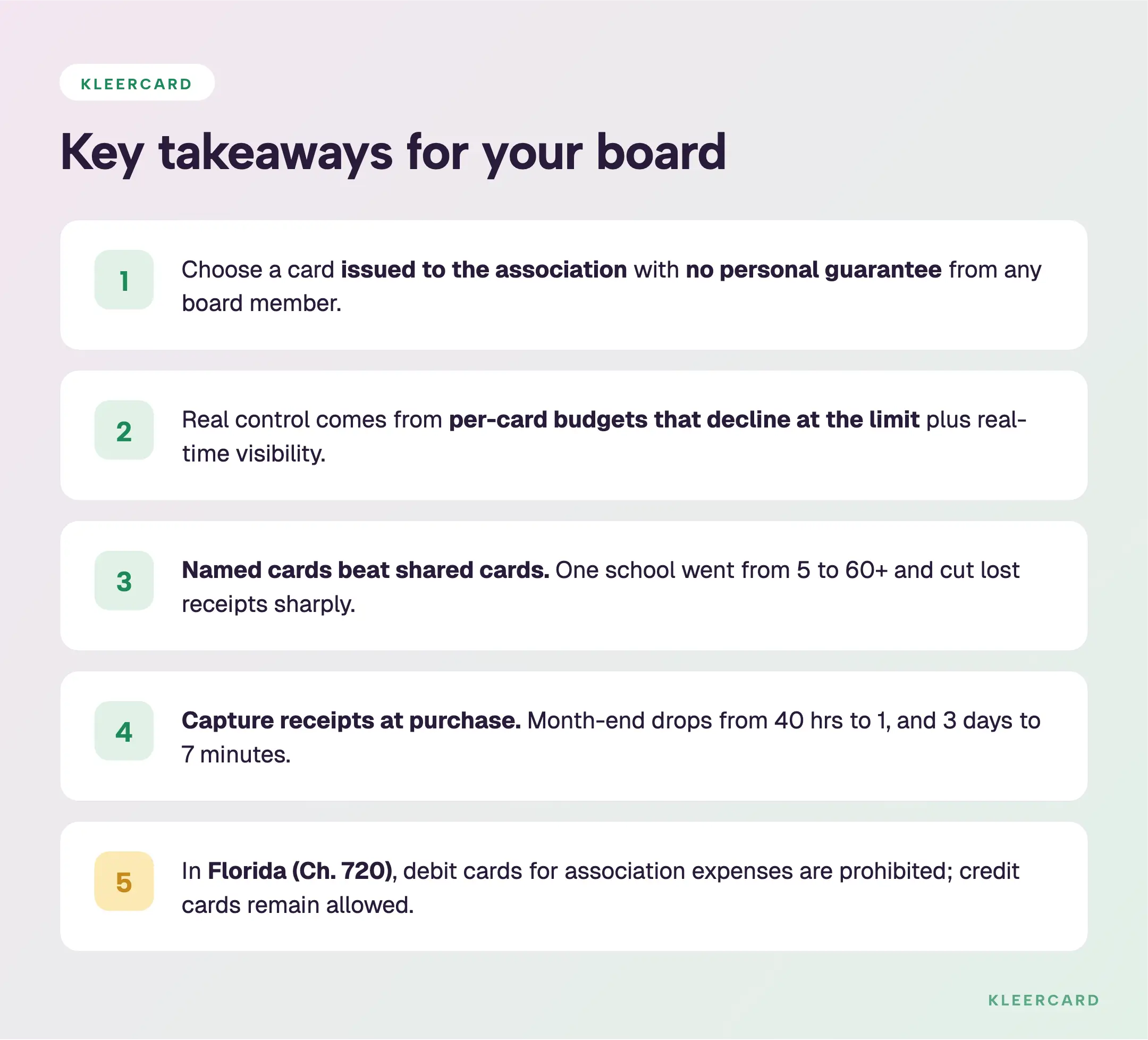
Florida amended Chapter 720 of the Florida Statutes to prohibit debit cards issued in the name of the association or billed to the association for any expense. Credit cards remain allowed when the governing documents do not prohibit them and the expense is properly pre-approved in meeting minutes or the written budget. Other states vary. Always check your declaration, bylaws, and state statute before opening any account.
Using a debit card for an expense that is not a lawful obligation of the association can be treated as theft under Florida law. A lawful obligation is one that has been properly pre-approved by the board and is reflected in the meeting minutes or the written budget.
Restricted reserves and special assessments should be coded carefully so the association can report accurately to homeowners and auditors. One account plus a department or fund dimension is usually cleaner than creating dozens of near-duplicate expense accounts. The same principle applies to common-area versus operating spend.
Yes. Specialized platforms underwrite to the association’s EIN and issue the account in the organization’s name. Traditional bank cards still frequently require a personal guarantee. See the no personal guarantee guide for a full comparison.
In Florida, no. Chapter 720 prohibits debit cards for association expenses. Credit cards are permitted when authorized. Other states have different rules; check local statutes and your governing documents.
Enough that the people who actually spend can access a card without hunting for one. Many associations move from one or two shared cards to a set of named cards for maintenance, board officers, and key committees, plus a few labeled loaners. The exact number depends on how many people currently share cards or front personal funds.
Givefront continues to market a free option up to 50 users on its pricing page. Confirm current terms, eligibility, and feature limits directly with the provider. Paid platforms trade a modest monthly fee for stronger receipt automation, more integrations, and dedicated support.
When the card is issued to the association, the account and history stay with the HOA. Incoming officers receive access without re-applying under personal credit or inheriting someone else’s liability. This continuity is one of the main reasons boards move away from personal or officer-tied cards.
Yes. Pair the cards with an Amazon Business account. The stronger platforms sync itemized receipts and line items back to the charge and the cardholder so finance does not have to reverse-engineer “Amazon” statements. See Amazon Business expense tracking for the integration approach.
If your current HOA setup still relies on personal guarantees or a couple of shared cards that force people to wait or front money, the highest-leverage change is moving the account into the association’s name and giving controlled cards to the people who actually spend.
The same shift that took a private Christian school with 540 students and 100 staff from five shared cards to more than 60, reduced lost receipts from roughly five per week to fewer than five in seven months, and turned month-end from a multi-hour scramble into a few minutes of review works for homeowners associations facing identical access and continuity problems.
Review the comparison table with your board. Confirm state rules. Then decide whether a free entry-level option or a platform with stronger receipt and multi-card controls fits the size of your association.
Schedule a short demo, explore nonprofit and association solutions, or go straight to the nonprofit credit card page to see the controls in practice. You can also sign up when the board is ready to start.


Speak to a member of our team and we can have you up and running in minutes, not weeks.