%202.svg)
Teacher classroom cards end the reimbursement deadline flurry. See how schools cut month-end close from 40 hours to 1 hour and stop teachers fronting costs.
Teachers still dig into their own wallets for classroom supplies. The average teacher spends hundreds of dollars a year out of pocket. Many wait weeks for reimbursement while the paperwork piles up at month-end.
That cycle is the reimbursement deadline flurry. Receipts get lost. Approvals stall. Teachers stop buying what their students need because they cannot float the cost any longer.
KleerCard classroom cards stop the flurry. We issue each teacher a controlled Visa commercial card loaded with a clear monthly classroom budget. They buy what they need, snap a photo of the receipt in the app, and the transaction lands in the right budget automatically. No personal money. No reimbursement form. No deadline scramble.
In our work with schools, the change is immediate and measurable.
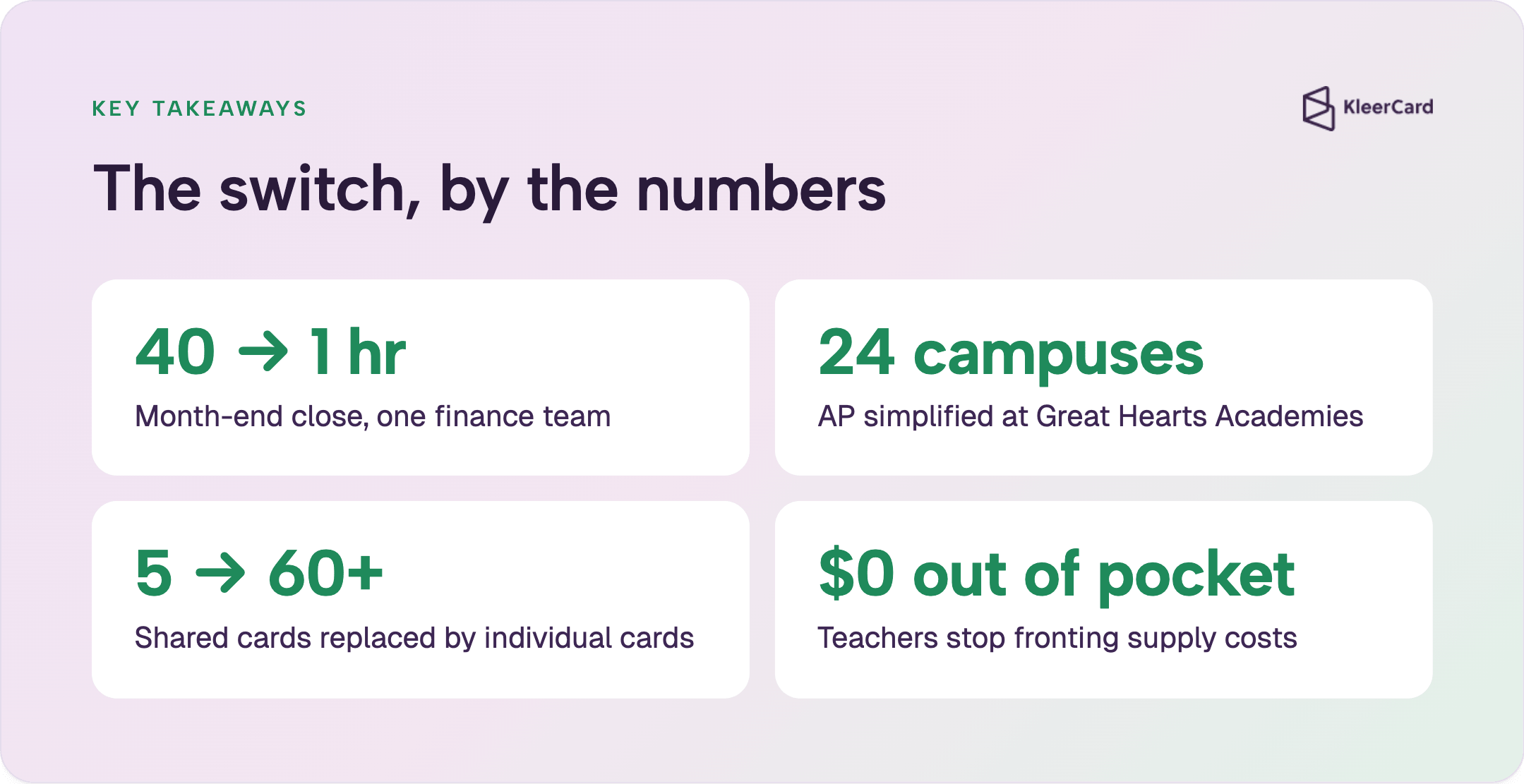
Most schools still run on a handful of shared cards that staff check out like library books. Teachers buy supplies on personal cards and submit receipts in batches. Finance teams chase documentation at the monthly deadline.
The cost shows up in two places. Teachers lose cash flow and time. Finance teams lose hours matching paper to transactions and reconciling missing receipts.
We hear the same story from business offices across independent and faith-based schools. Petty cash drawers with handwritten logs. Reimbursement requests that arrive in piles. Teachers who simply stop buying materials because they cannot wait three or four weeks to be paid back.
The teacher-reimbursement problem is really a procurement-tooling problem. When a school has no clean way for a teacher to spend an assigned classroom budget, the teacher spends personal money and waits.
Teacher classroom cards are individual Visa commercial cards issued through KleerCard and loaded with a specific monthly budget. The card is tied to the teacher or the program. Merchant category controls and spending limits sit on the card itself.
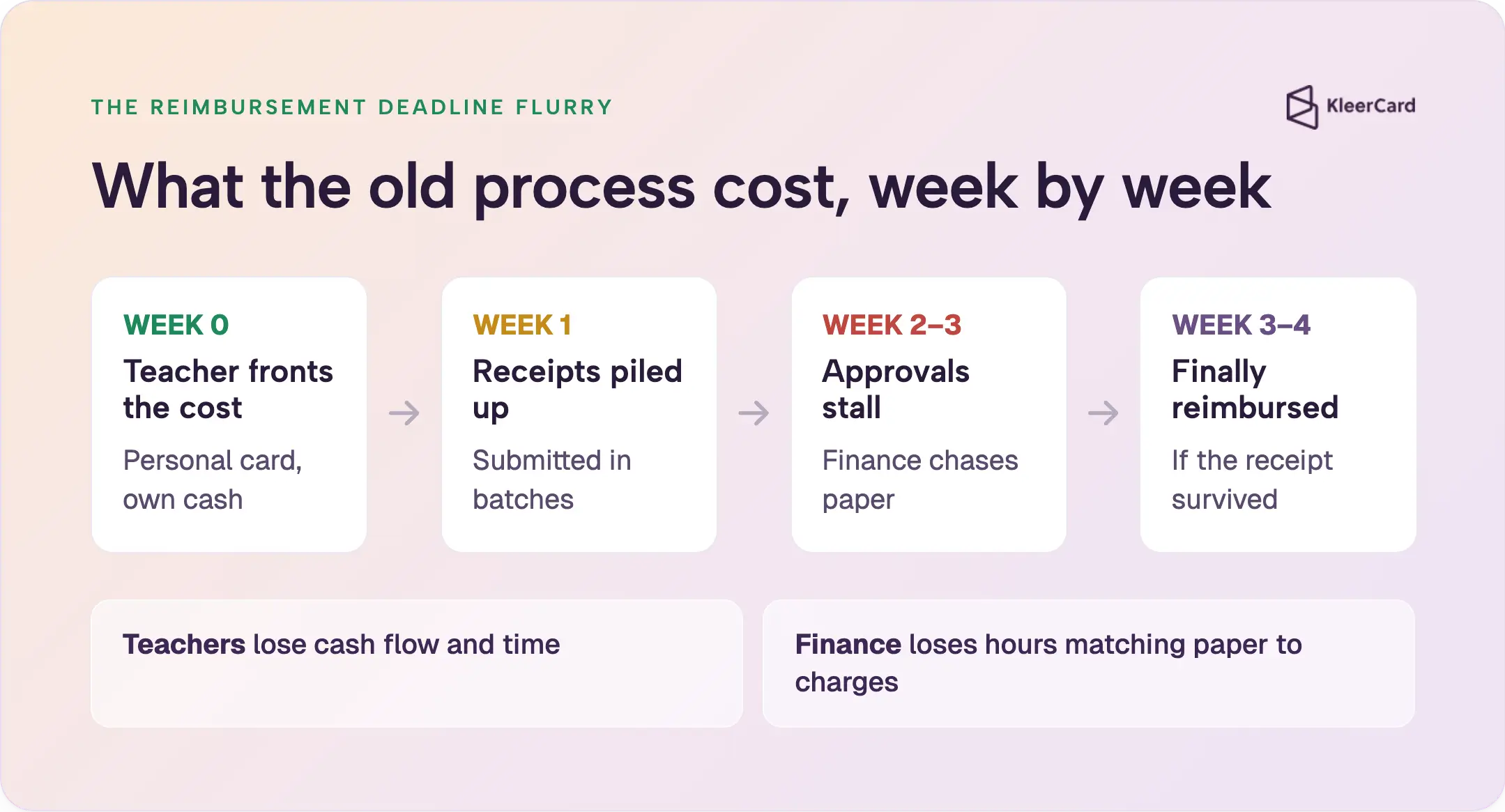
The teacher makes the purchase, opens the KleerCard app, and takes a photo of the receipt. The system matches the receipt to the transaction, assigns it to the right budget or fund, and pushes the data into the school’s accounting platform. No separate expense report. No reimbursement form. No personal out-of-pocket step.
Administrators can also issue single-use virtual cards for field trips or one-time events. The card is pre-loaded with the exact amount, restricted to the right categories, and set to expire when the event ends. Once the receipt is uploaded, the card locks.
Real-time visibility means the business office sees every transaction as it happens. Auto-reminders and auto-lock features pull the receipt-chasing work off the finance team’s desk and put it back on the person who made the purchase.
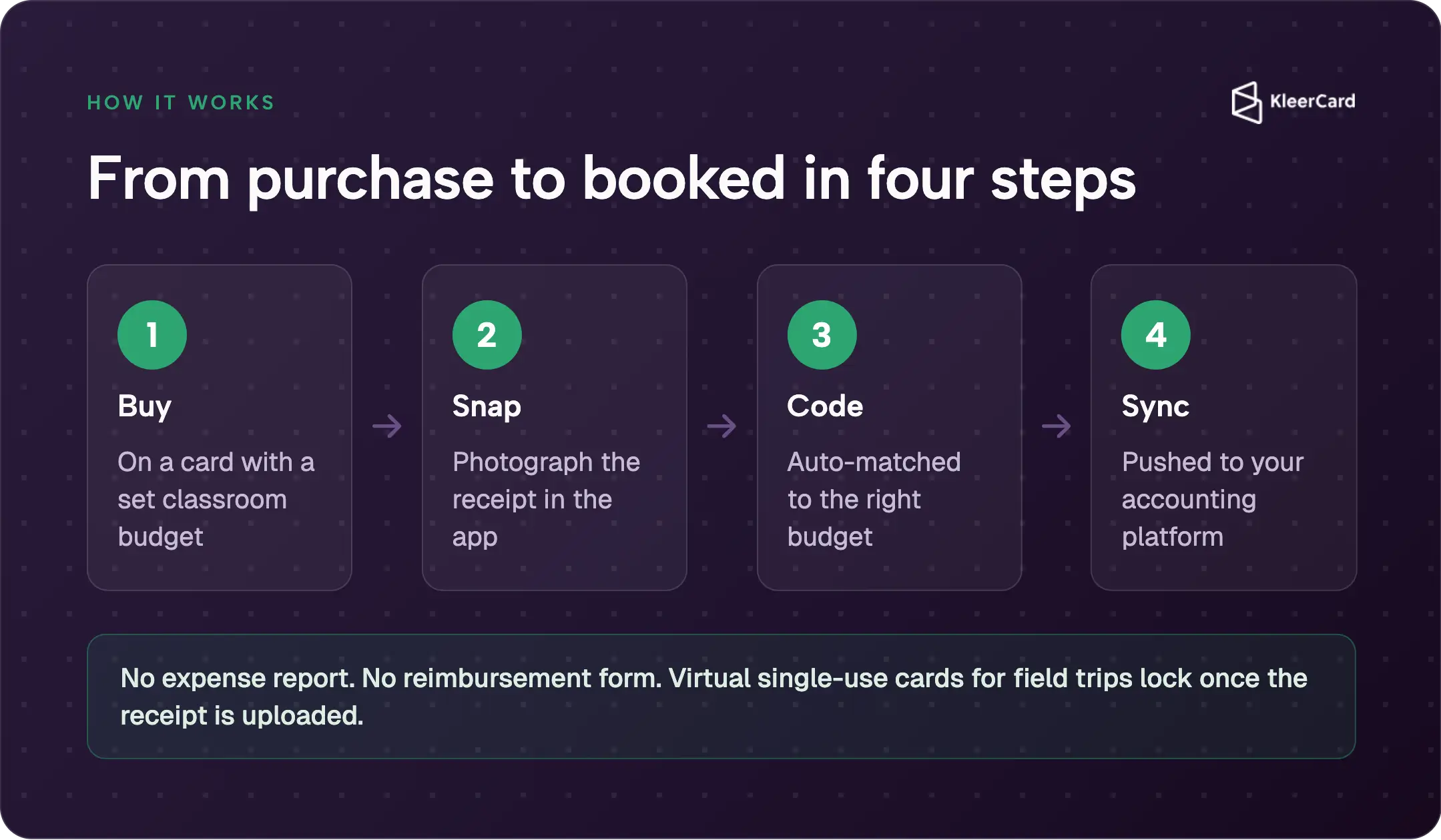
Schools that switched to individual teacher cards and the KleerCard platform report the same pattern: the month-end scramble shrinks dramatically and teachers stop fronting costs.
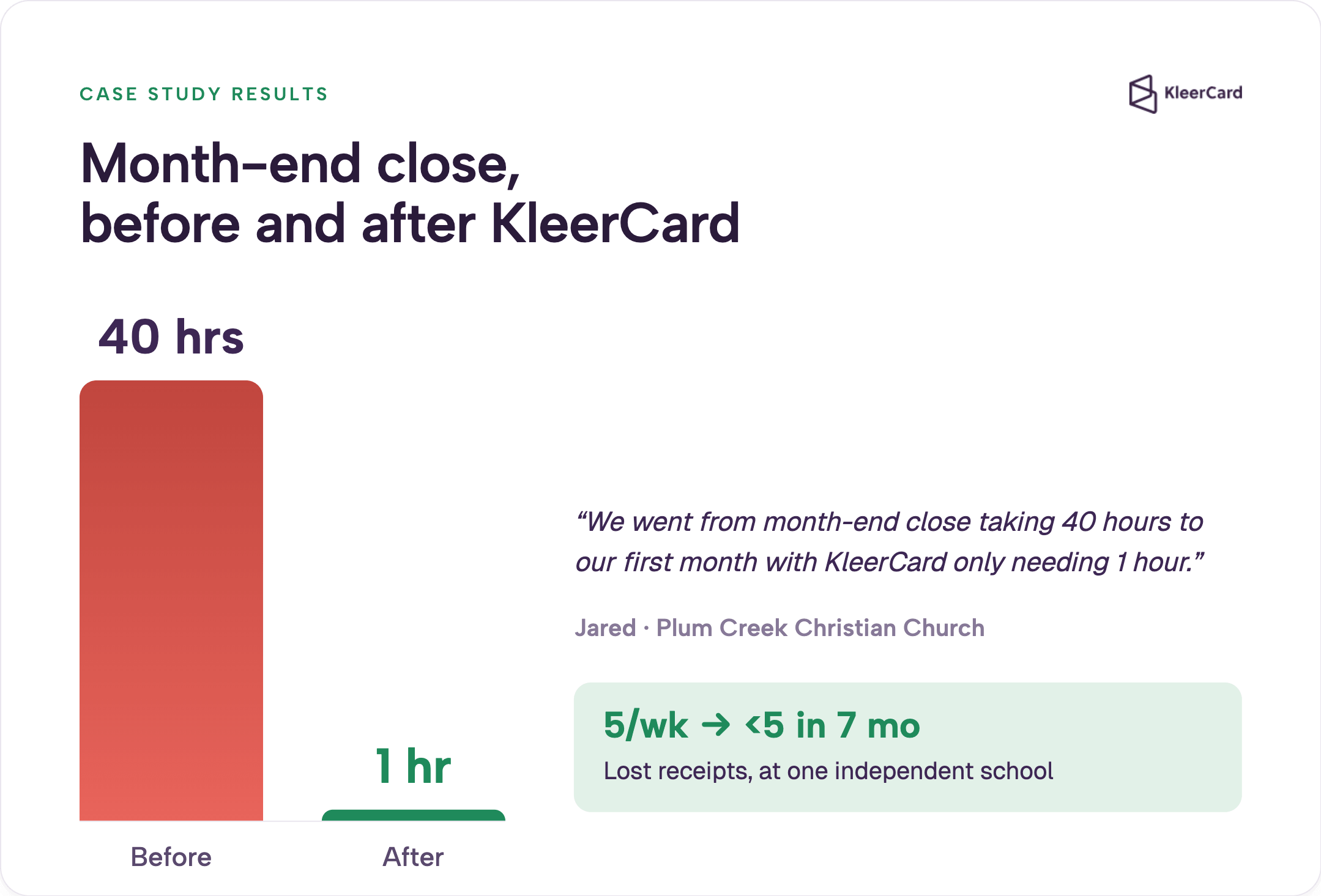
Jared at Plum Creek Christian Church described the before-and-after this way: “We went from month-end close taking 40 hours to collect receipts and code expenses, to our first month with KleerCard only needing 1 hour. Best decision we could have made.”
Tracy Taylor at Great Hearts Academies reported that consolidating onto KleerCard simplified the AP function across 24 campuses.
Emily at Haven Classical School noted that the Amazon Business integration saved her staff time on routine ordering because detailed line-item receipts arrive automatically.
One independent school we worked with moved from five shared campus cards to more than sixty individual and loaner cards. Receipt losses that used to average five per week dropped to fewer than five over a seven-month period.
The common result is straightforward. Teachers spend the budget they were given. Finance teams stop chasing paper. Month-end close becomes a review instead of a reconstruction.
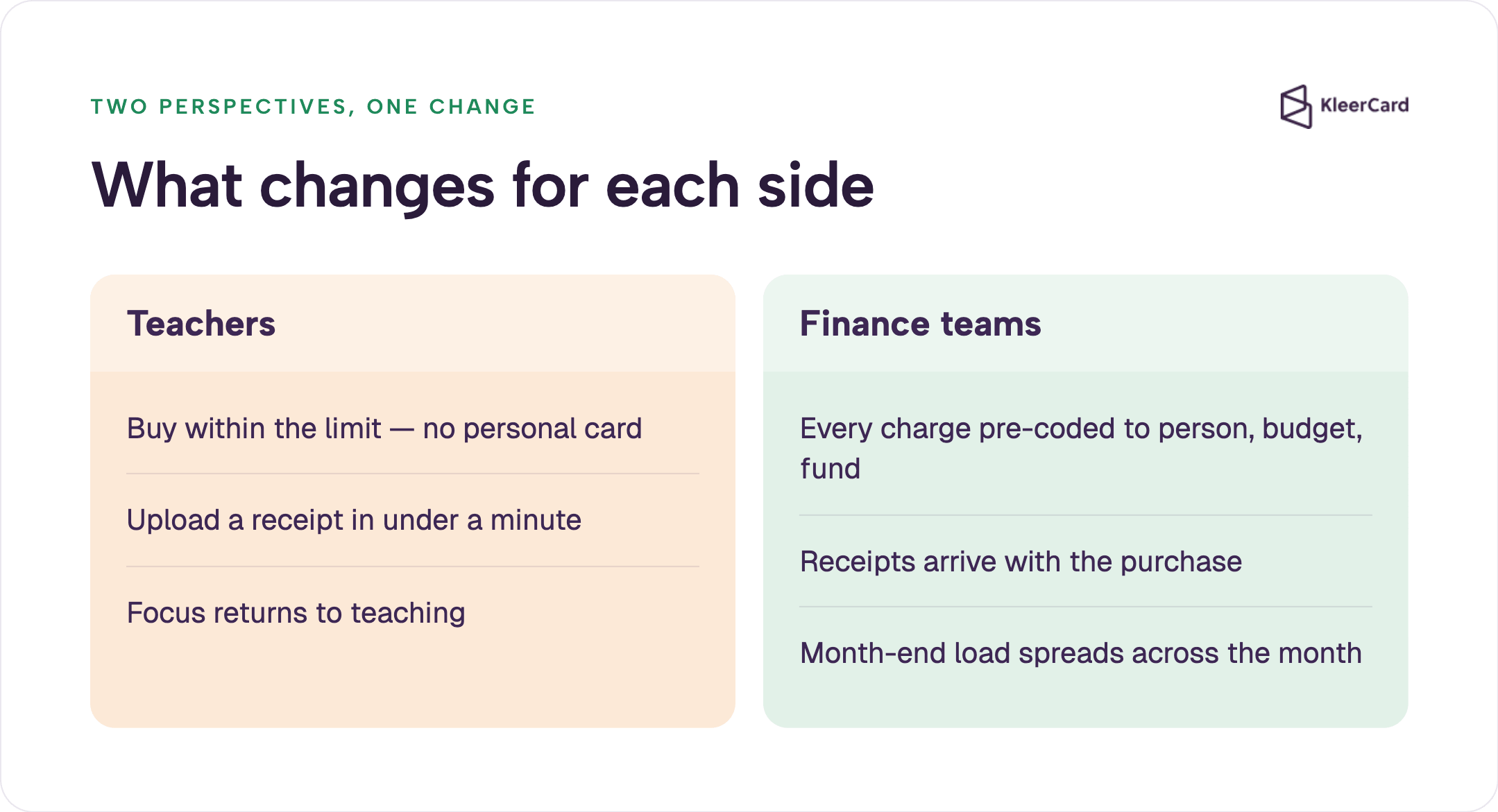
Finance teams gain visibility and capacity. Every transaction is already coded to a person, a budget, and a fund. The eight- or ten-person AP load that used to peak at month-end spreads out across the month. Receipts arrive with the purchase instead of weeks later.
Teachers experience the change differently. They no longer decide whether a classroom material is worth floating on a personal card. They buy what the students need within the assigned limit, upload the receipt in under a minute, and move on. First-year teachers and thirty-year veterans describe the same relief: the budgeting stress disappears and the focus returns to teaching.
When the reimbursement deadline flurry ends, both sides get time back. Teachers keep more energy for students. Finance teams keep more capacity for higher-value work.
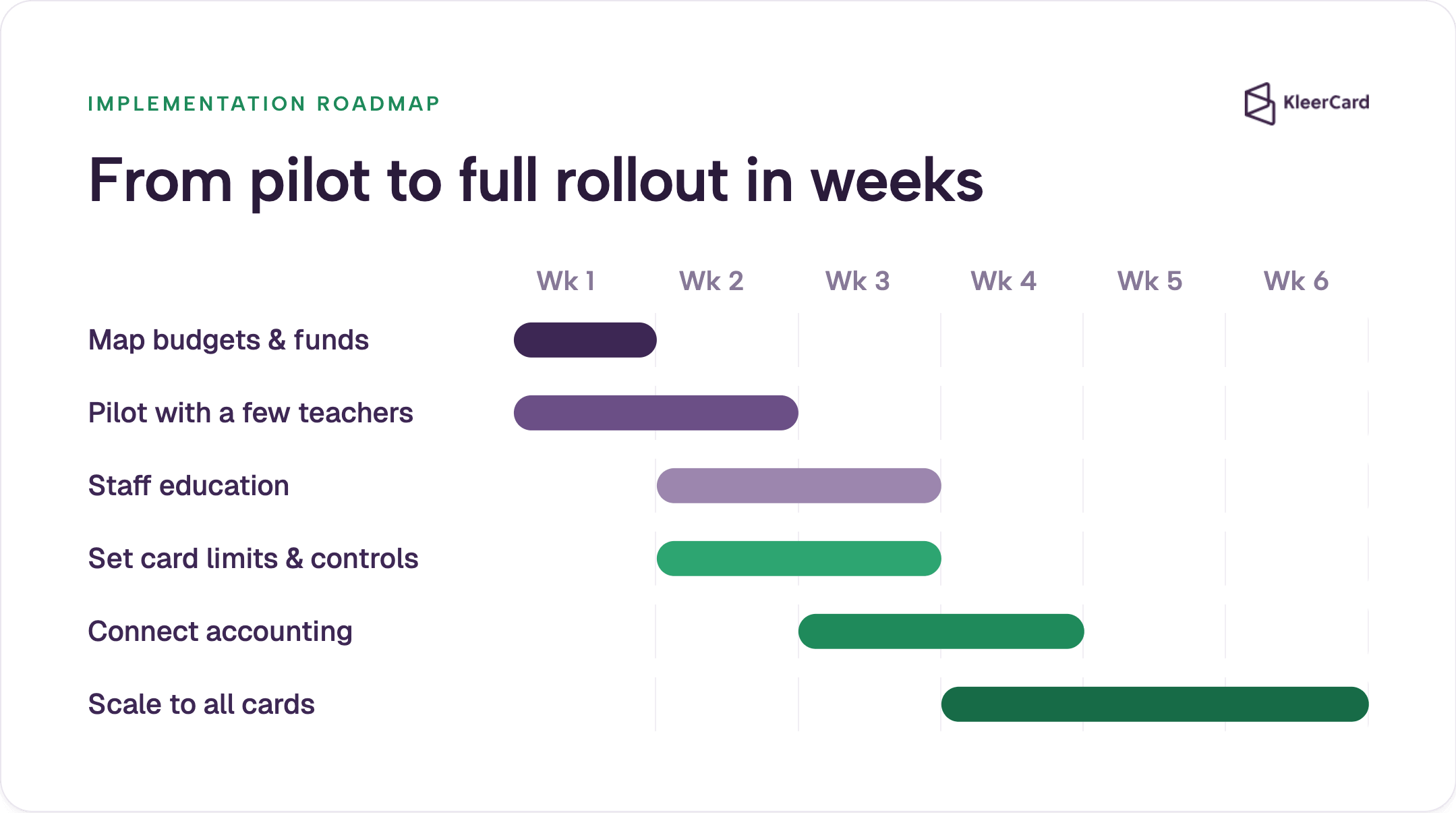
Most schools start with a focused pilot. We help them map the existing classroom budgets and specialty funds onto individual cards. Sample testing with a few teachers and the central office confirms the workflow. Staff education covers the mobile app and the simple rule: buy, snap, done.
Onboarding organizes employee data, sets the per-card limits and category controls, and connects the accounting integration (QuickBooks, NetSuite, Blackbaud, Aplos, ACS, Realm, Shelby, and others). Support stays available while the first month of real transactions runs.
Schools that begin with a clear map of fund types and a short pilot typically scale to full teacher and program cards within weeks. The same process works for single-campus independent schools and multi-campus systems.
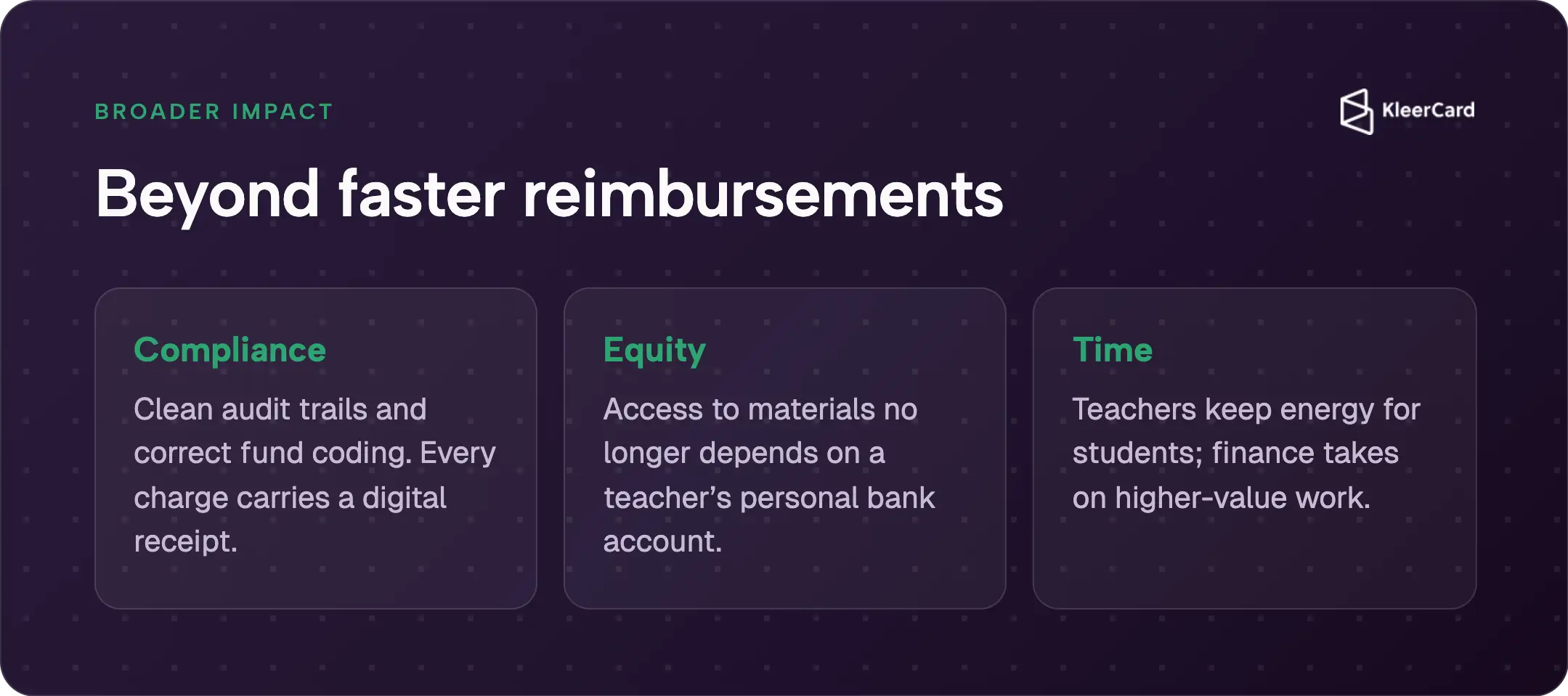
The most immediate compliance wins are clean audit trails and correct fund coding. Every transaction carries a digital receipt and is already assigned to the right budget. Specialty funds no longer disappear into personal reimbursements or taxable payroll distributions.
Equity improves because access to materials no longer depends on a teacher’s personal bank account. A first-year teacher and a veteran receive the same controlled ability to obtain what the classroom needs.
The paperless system also removes a recurring source of stress. Teachers report they can focus on lesson design rather than receipt organization. Finance teams report they can take on higher-value projects instead of reconstructing paper trails at month-end.
These gains rest on a simple foundation: pre-funded classroom cards that remove the need for personal spending and end-of-cycle reimbursement paperwork.
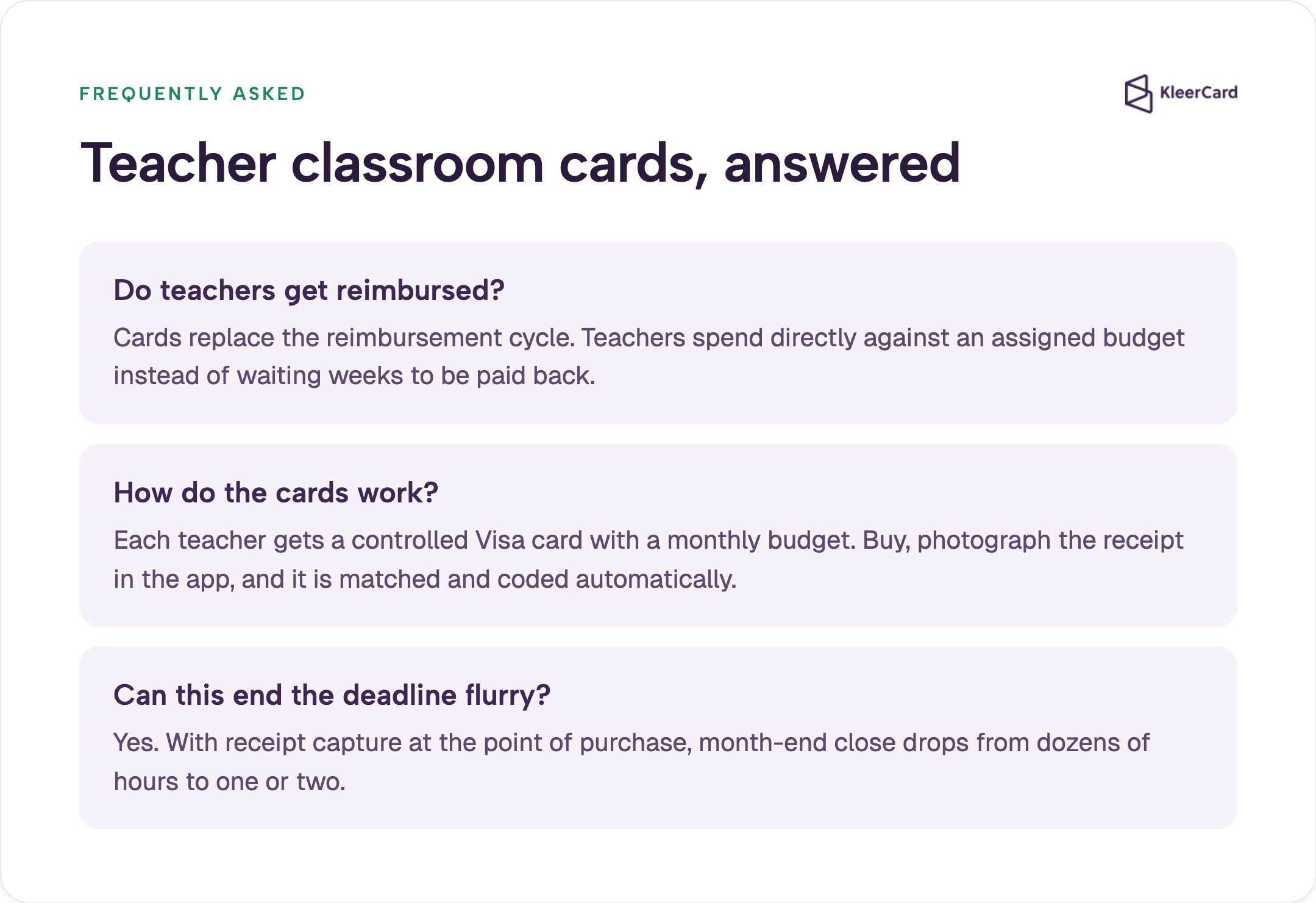
Teachers routinely spend hundreds of dollars of personal money each year on classroom supplies. Many schools still rely on reimbursement processes that leave teachers waiting weeks to be paid back.
Many schools still process reimbursements through multi-step paper or email workflows. Those processes often involve delays, missing receipts, and hard monthly deadlines. Classroom cards replace that cycle with direct spending against an assigned budget.
Each teacher receives a controlled Visa commercial card loaded with a set monthly classroom budget. They make the purchase, photograph the receipt in the KleerCard app, and the transaction is matched and coded automatically. No personal funds and no later reimbursement form are required.
Yes. When every teacher has a card with a clear budget and receipt capture happens at the point of purchase, the end-of-cycle paper scramble disappears. Schools report month-end close dropping from dozens of hours to one or two hours.
Schools using KleerCard report dramatic reductions in receipt-chasing time, cleaner fund accounting, and teachers who no longer front costs. One finance team cut month-end close from 40 hours to 1 hour. Multi-campus systems have simplified AP across two dozen locations.
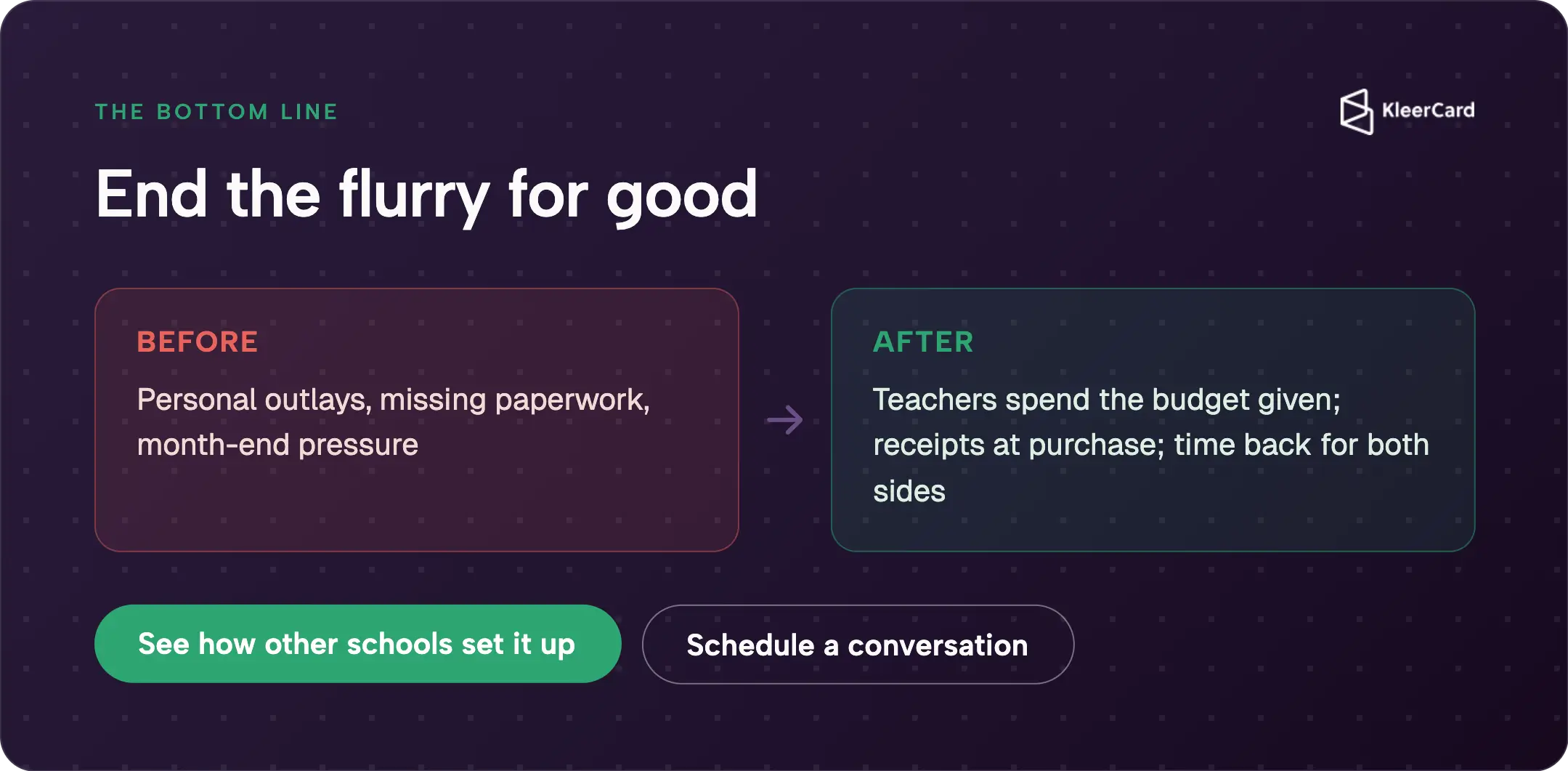
The reimbursement deadline flurry is not inevitable. When schools issue teacher classroom cards with clear budgets and automatic receipt capture, the old cycle of personal outlays, missing paperwork, and month-end pressure ends.
Schools that made the switch report the same pattern: teachers spend the budget they were given, finance teams stop reconstructing paper, and both sides get time back for the work that matters.
If your school still manages classroom funds through shared cards and reimbursements, the path is clear. Review how other schools set up individual teacher cards or schedule a conversation to see how the same model maps onto your budgets and accounting system.


Speak to a member of our team and we can have you up and running in minutes, not weeks.