%202.svg)
An expense reimbursement policy sets the rules for repaying out-of-pocket spending. Learn what to include, IRS accountable plan rules, and how to write one.
An expense reimbursement policy is the written set of rules your organization uses to repay people who spend their own money on its behalf. It names which costs qualify, how someone submits a claim, who approves it, and what proof has to come with it.
For a business, that policy keeps travel and client meals consistent. For a nonprofit, a church, or a school, the person fronting the cost is different. It might be a volunteer, a ministry leader, or a teacher buying classroom supplies. Donors and boards expect every dollar to trace back to a purpose, and a clear policy is how that spending stays defensible.
I have set up and run reimbursement plans for churches and nonprofits, as a church treasurer and a co-founder of KleerCard. A good policy speeds up the reimbursements you process. It also helps you process far fewer of them, which most organizations overlook.
A reimbursement policy puts four decisions in writing. It defines which expenses qualify, how a person reports them, who approves them and on what timeline, and what documentation supports each claim.
A strong policy goes two steps further. It states how fast you pay people back, and it sets how long you keep the records. Those two details decide whether your volunteers trust the process and whether your books survive an audit.
Without a written policy, reimbursements turn into guesswork. One staff member gets paid back for a meal, another gets denied for the same thing, and finance burns hours sorting out which receipts count.
A clear policy fixes that in a few ways:
Nonprofits carry one more reason. You answer to donors and to the board reviewing your Form 990. A written policy keeps spending mission-aligned and easy to defend when someone asks. The policy protects the people doing the spending as much as it protects the finance office.
These elements are worth copying into your own document. Each one removes a recurring argument before it starts.
Name what you will reimburse. Common categories include travel, lodging, mileage, meals tied to a ministry or business purpose, supplies, and training. Then name what you will not cover, such as personal items, alcohol unless approved in advance, and anything without a clear purpose.
Set dollar limits and pre-approval thresholds for larger costs. A $40 box of supplies and a $1,200 flight should not follow the same path.
A valid receipt shows four things: the amount, the date, the vendor, and the business purpose. The IRS generally expects a receipt for any expense of $75 or more, and for all lodging. You still have to document the amount, date, place, and purpose of smaller costs, so I recommend keeping a receipt for everything. The habit is easier to enforce than the exception.
The cleanest fix is capturing the receipt at the moment of purchase. People who photograph a receipt at the point of sale rarely lose it later.
Set a clear window for turning in expenses, commonly 30 to 60 days from the purchase date. A deadline protects both sides. It keeps your books current, and it lines up with the IRS substantiation window for accountable plans.
Match approvals to dollar amounts and roles. A small supply purchase can clear with one sign-off, while a large travel booking gets reviewed first.
Resist the urge to build a long, rigid chain. One organization I work with has an approver who is a missions lead, away at a summer camp for weeks at a time. A leaner approval workflow lets finance keep working while everyone waits for that person to return.
Decide how you pay people back and how quickly. I recommend keeping reimbursements out of payroll and paying them over ACH to a vendor record instead. The money lands in a day or two, and your bank reconciliation stays clean.
State how long you keep expense records, commonly three to seven years. Note where those records live so anyone can find them during an audit. A policy that names the storage location ages far better than one that assumes everyone remembers.
An accountable plan is the IRS framework that keeps reimbursements out of taxable wages. It lives in Internal Revenue Code section 62(c) and Treasury Regulation 1.62-2, and the IRS explains it in Publication 463.
A plan qualifies as accountable when it meets three requirements:
Miss any one of the three, and the payments become taxable wages. They land on a W-2 and pull payroll taxes with them. Getting the plan right is the difference between a clean reimbursement and an accidental raise that triggers tax.
Churches have the most to gain here. A written accountable reimbursement plan lets you repay a pastor's ministry expenses without adding a dollar to taxable income. For clergy, whose compensation already carries unusual tax treatment, that difference adds up.
The plan has to be adopted in writing and followed in practice. A policy that exists on paper but gets ignored will not hold up. Our guide on taxes for ministers covers clergy tax treatment in full.
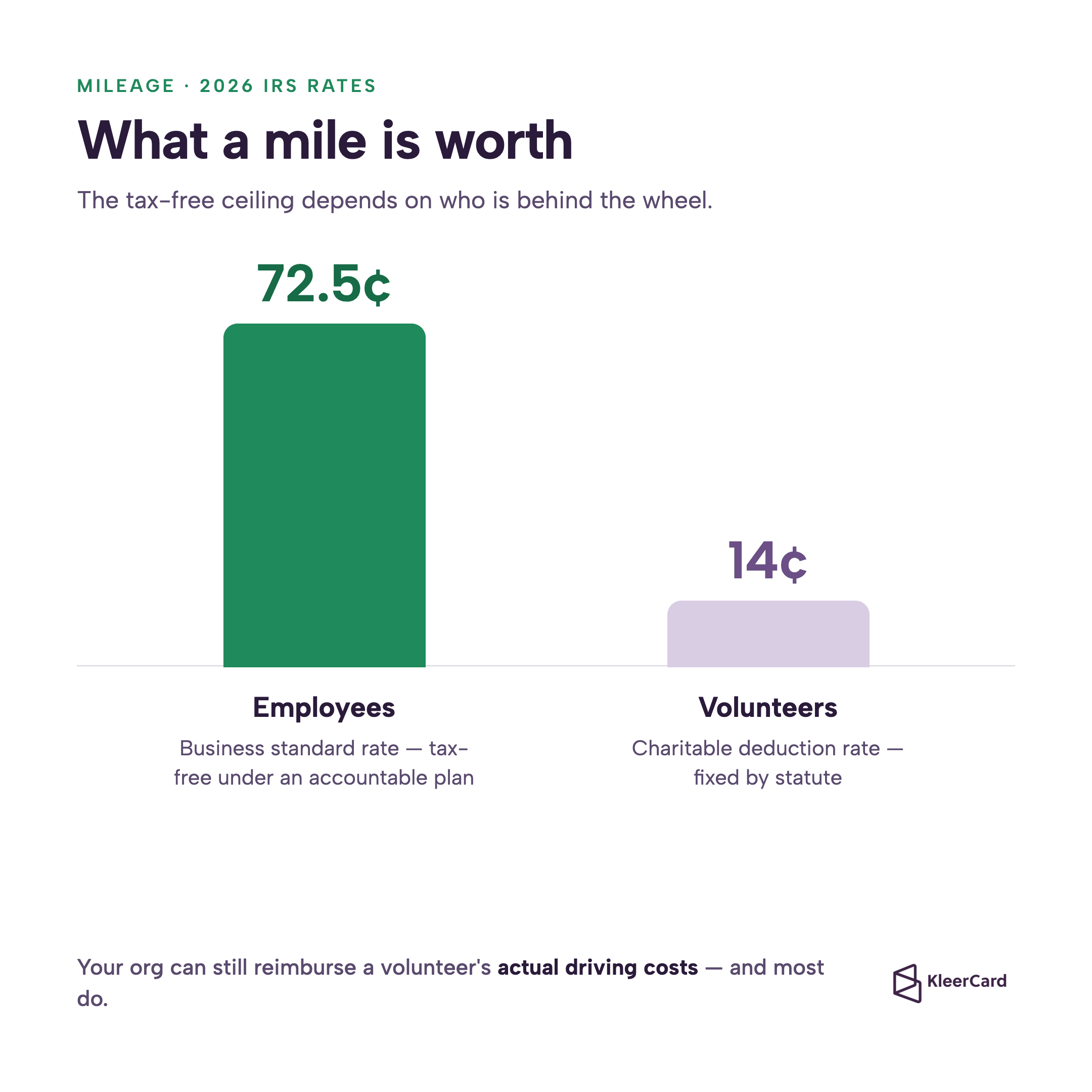
Mileage is the one reimbursement a card cannot replace, so your policy has to handle it well. The IRS standard business mileage rate for 2026 is 72.5 cents per mile. That rate is the tax-free ceiling when you reimburse an employee for driving under an accountable plan.
Volunteers hit a distinction that trips people up. A volunteer who drives for your charity can deduct their own mileage only at the 14-cent charitable rate, which is fixed by statute. Your organization, though, can choose to reimburse a volunteer's actual driving costs, and most do.
A nonprofit I work with in North Carolina runs heavy travel and reimburses volunteer mileage. They set each volunteer up as a vendor and send the money over ACH. A volunteer enters their miles, and the payment reaches their account a day or two later.
Turn everything above into an action list:
Use this outline as the skeleton for your own document. Fill each section with the specifics your board approves.
1. Purpose. State that the policy governs how the organization reimburses staff and volunteers, and that it operates as an accountable plan under IRS rules.
2. Who it covers. Name the groups: employees, clergy, contractors, and volunteers.
3. Eligible expenses. List reimbursable categories and any per-category limits.
4. Ineligible expenses. List what the organization will not cover.
5. Pre-approval. State the dollar threshold above which a purchase needs sign-off first.
6. Documentation. Require a receipt showing amount, date, vendor, and business purpose. Note the $75 receipt threshold and the recommendation to keep receipts for everything.
7. Submission deadline. Set the window, commonly 30 to 60 days from the purchase date.
8. Approval workflow. Map approvers to dollar amounts and roles.
9. Payment method and timing. State how reimbursements are paid and the target turnaround.
10. Mileage. State the rate you reimburse and how drivers log their miles.
11. Recordkeeping. State the retention period and where records live.
12. Adoption. Record the board's written adoption date and review schedule.
A policy on paper is only as good as the habits around it. A few practices matter more than the rest.
Keep reimbursements out of payroll. Running them through payroll forces an extra split at reconciliation. It also breaks the automatic checks finance relies on, because no payroll taxes apply to a reimbursement. Set the person up as a vendor instead, and track each payment on its own.
Pay fast. Many volunteers cannot float a cost for a month. Overnight ACH tells them finance has their back, and that trust is worth more than any line in the handbook.
Cut the number of reimbursements you process at all. Most reimbursements exist for one reason: the right person did not have a card in hand when they needed to spend. Our guide to nonprofit expense reporting goes deeper on the reporting side.
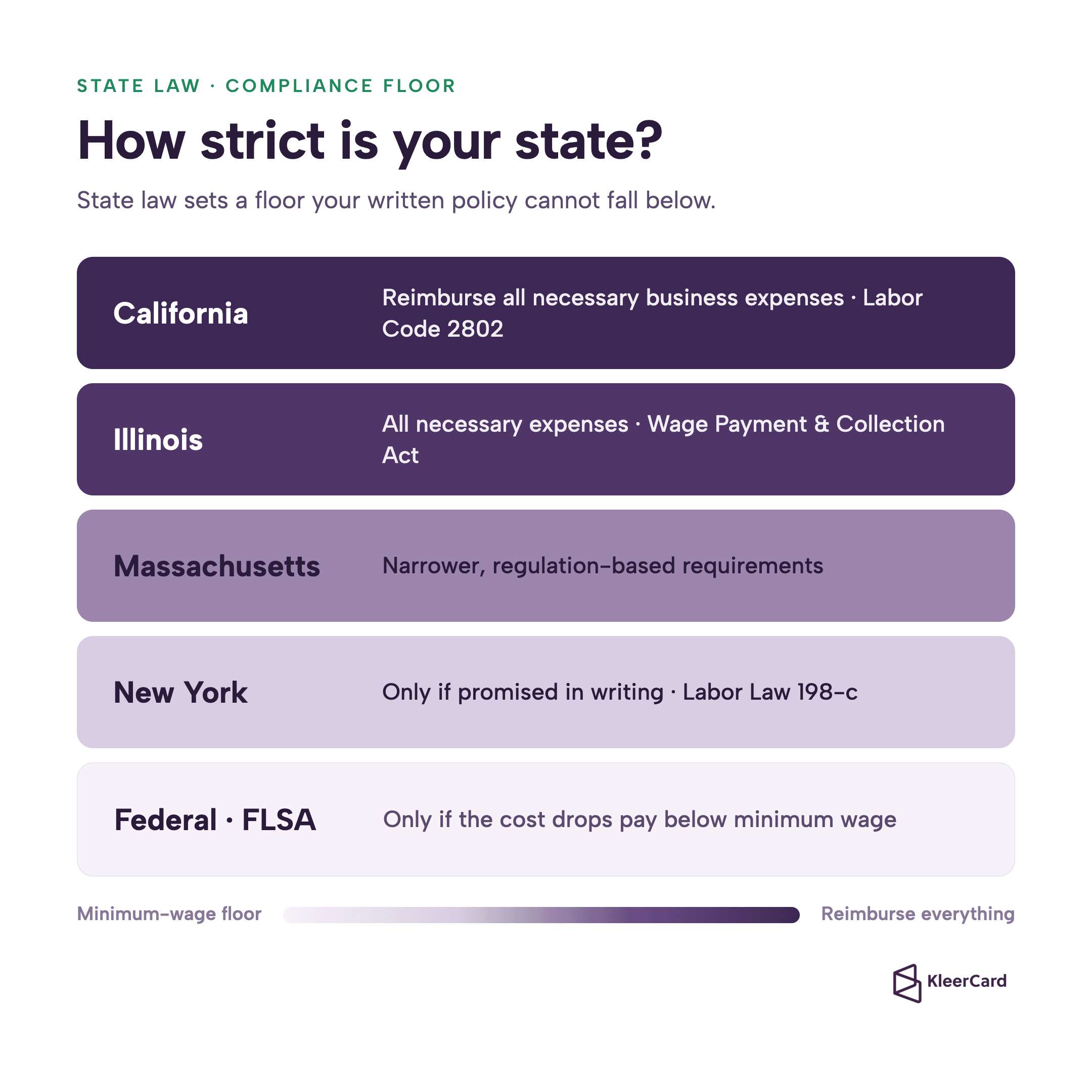
Federal tax rules are not the whole story. Under the Fair Labor Standards Act, reimbursement is required only when the unreimbursed cost would drop the employee's pay below minimum wage. Several states set a higher bar.
California requires employers to reimburse all necessary business expenses under Labor Code 2802. Illinois added a similar mandate to its Wage Payment and Collection Act. Other states, including Massachusetts, impose narrower or regulation-based requirements.
New York takes a different path. It requires reimbursement only when an employer has promised it in a written policy or agreement, which then becomes enforceable under Labor Law 198-c. Confirm your own state's rule before you finalize the policy, because state law sets a floor your policy cannot fall below.
The reimbursements you never have to process are the easiest ones to manage. A teacher or volunteer who carries a card with a set limit buys what they need and uploads the receipt on the spot. No form to fill out, and no personal money on the line.
I have watched teachers front their own money for classroom supplies and wait as long as eight weeks to get it back. The same teacher with a budget loaded onto a card skips that entirely. Finance gets line-of-sight accountability too, because every charge ties to a named person who can answer a question about it.
A single shared checkout card feels like control, but it does not limit what any one person can spend. A teacher holding that one high-limit card could put a down payment on a car, and nothing in the system would stop it. A budget loaded onto each person's own card aligns permission to spend with the ability to spend.
Chasing receipts takes finance time that the right setup gives back. Our expense management built for nonprofits puts a limit and a receipt step on every card.
It should name eligible and ineligible expenses, your documentation rules, a submission deadline, an approval workflow, your payment method and timing, and a recordkeeping window. Add accountable plan language so the reimbursements stay tax-free.
Not when they run through an accountable plan that meets the three IRS requirements. A non-accountable plan turns the same payments into taxable wages on a W-2, with payroll taxes attached.
An accountable plan is an IRS-recognized reimbursement arrangement that keeps repayments out of taxable income. It has to meet three tests: a business connection, substantiation, and return of any excess. The IRS safe harbors are 60 days to substantiate and 120 days to return excess.
Yes, and the case is stronger than it is for most businesses. Donors and auditors expect documented, mission-aligned spending. Accountable plans also carry meaningful tax value for clergy pay.
No. A per diem pays a flat daily allowance for travel, while a reimbursement repays documented actual costs. Both can sit under an accountable plan.
The IRS sets no single deadline to pay, but the substantiation safe harbor is 60 days and excess advances should return within 120 days. Some states impose their own timing rules, so check yours.
A clear policy with accountable plan language keeps reimbursements tax-free and gets people paid quickly. Written rules make your spending defensible to a board or an auditor, and they end the back-and-forth that drains a finance office.
The best policy also shrinks the pile. Every routine purchase you move onto a card with a limit and a receipt step is one less reimbursement to process. If that fits your organization, our tools built for nonprofits handle the spending side. The reimbursements you still run stay rare and clean.


Speak to a member of our team and we can have you up and running in minutes, not weeks.