%202.svg)
A church treasurer and nonprofit finance veteran picks the best accounting software for nonprofits by size, from free tools to true fund accounting.
The right nonprofit accounting software comes down to your size and whether you track restricted funds. Small volunteer groups can start free, while grant-heavy organizations need true fund accounting.
I co-founded KleerCard after more than 20 years in nonprofit finance, and I still close the books for my church as its treasurer.
| Software | Best for | True fund accounting | Starting price | User rating |
|---|---|---|---|---|
| QuickBooks Online | Many nonprofits, $250K to $10M | No (classes and tags) | $38/mo, or $80/yr via TechSoup | 4.0/5 (G2, 3,000+ reviews) |
| Aplos | Small to mid-sized nonprofits and churches | Yes | $79/mo | 4.6/5 (276 reviews, G2/Capterra/Software Advice) |
| Sage Intacct | Large and multi-entity nonprofits | Yes | Custom quote | 4.3/5 (G2, 4,000+ reviews) |
| Blackbaud Financial Edge NXT | Enterprise nonprofits and institutions | Yes | Custom quote | 4.0/5 (G2, 120 reviews) |
| MIP Fund Accounting | Grant-heavy nonprofits, government, K-12 | Yes | Custom quote | 3.8/5 (G2, 36 reviews) |
| Xero | Small teams without restricted funds | No (tracking categories) | $27/mo, 25% nonprofit discount | 4.4/5 (G2, 1,300+ reviews) |
| Wave | All-volunteer and brand-new orgs | No | Free (Pro tier $16/mo billed annually) | 4.3/5 (G2, 300+ reviews) |
| MoneyMinder | Volunteer treasurers, PTAs, booster clubs | No (fund-style tracking) | $299/yr (free budget-only edition) | 4.9/5 (Capterra, 95 reviews) |
Pricing was re-verified in October 2026 against each vendor's pricing page. Ratings are as of June 2026 from G2, Capterra, and Software Advice listings.
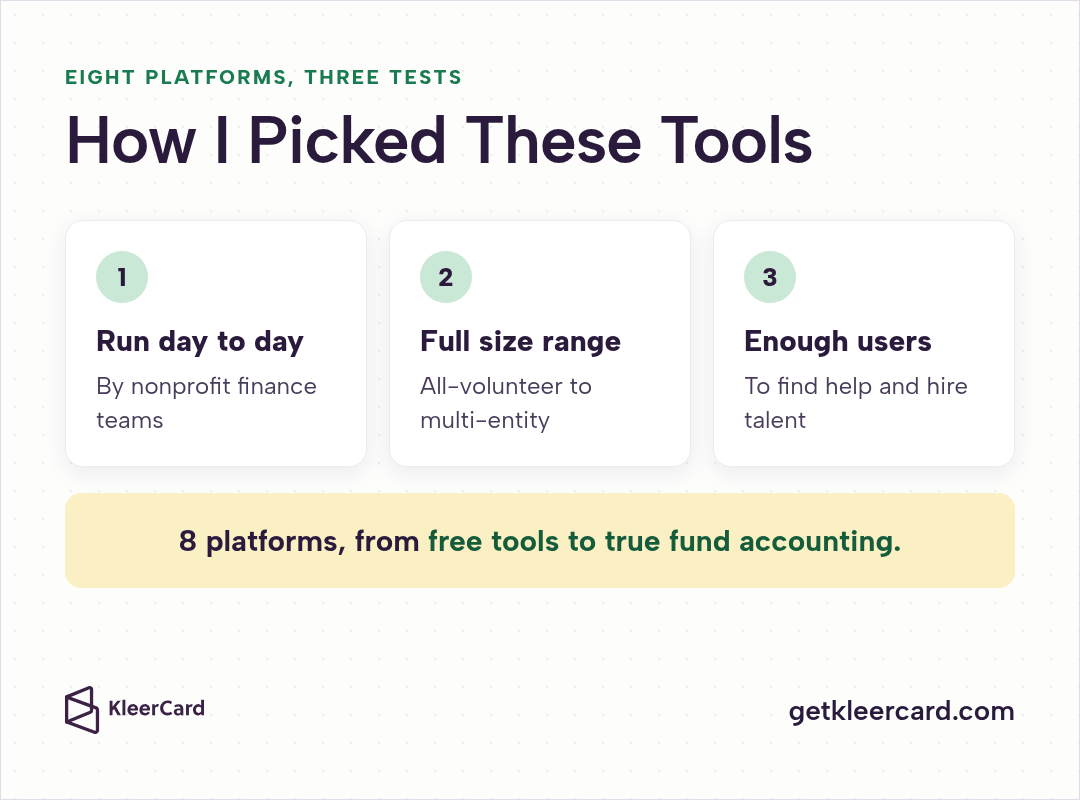
I narrowed to eight platforms that nonprofit finance teams run day to day, cover the full size range from all-volunteer to multi-entity, and have enough users that you can find help and hire talent.
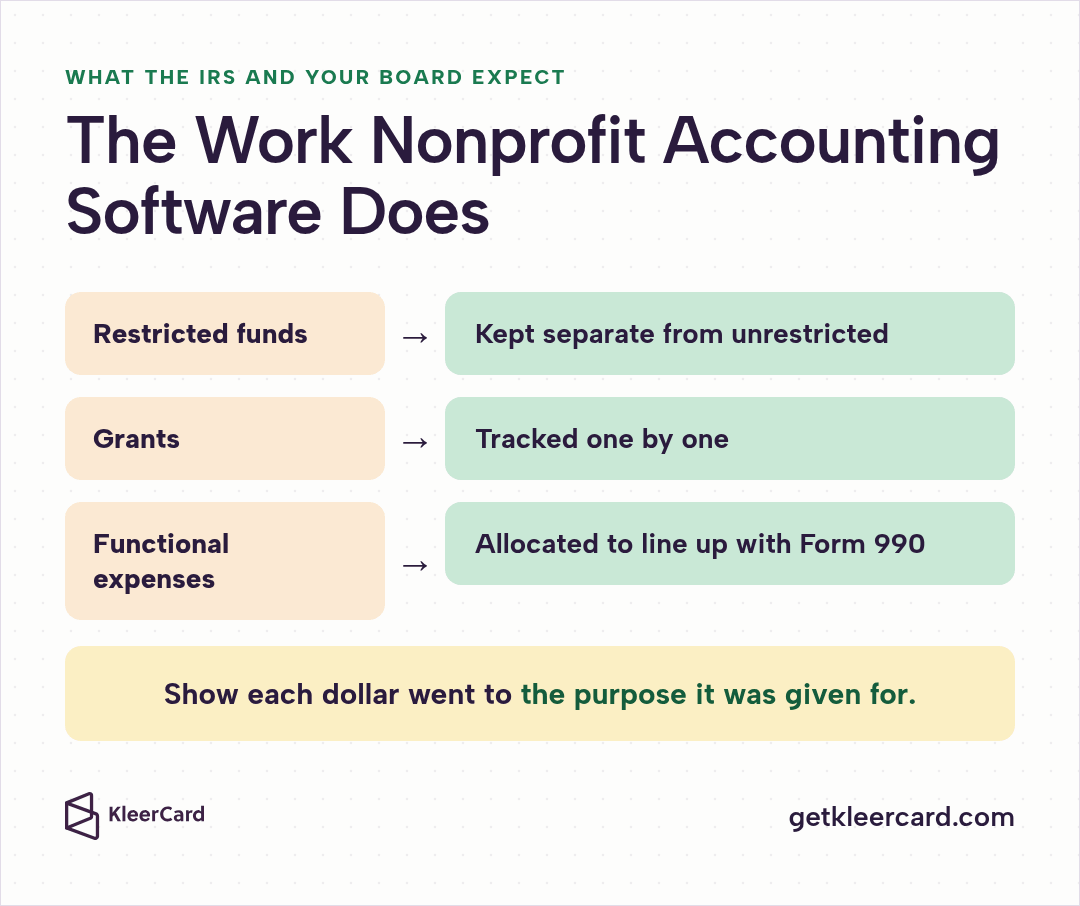
Nonprofit accounting software tracks money the way the IRS and your board expect a nonprofit to track it. That means separating restricted funds from unrestricted and tracking grants. Your reports also allocate functional expenses in a form that lines up with IRS Form 990.

In a for-profit business, the main bookkeeping question is whether you made money. In a nonprofit, you also have to show that you spent each dollar on the purpose it was given for.
Accountants call that fund accounting. It's the main difference between software built for nonprofits and general software you have to adapt.
Before you compare features, decide whether you need true fund accounting.
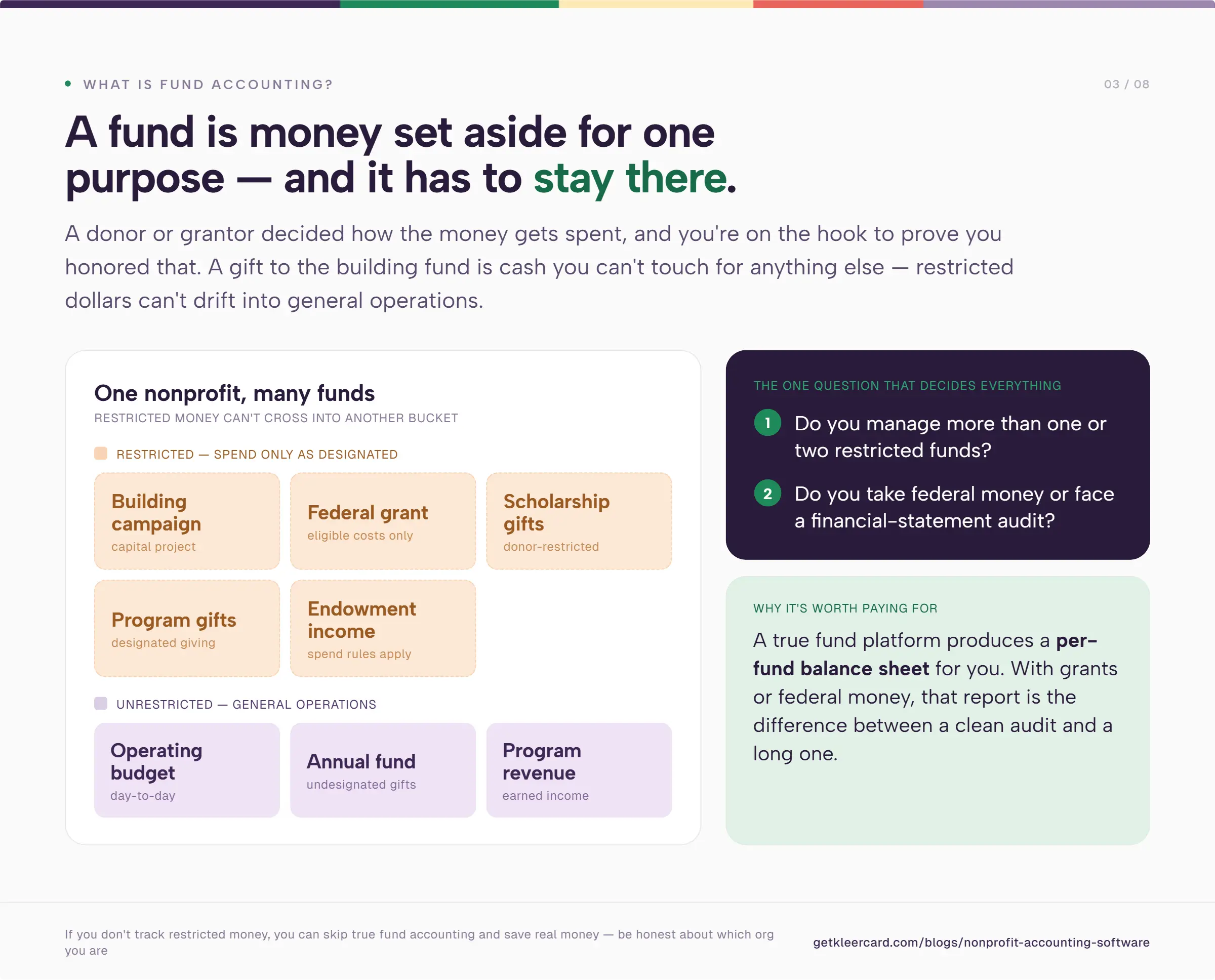
A fund is money set aside for a specific purpose, like a building campaign or a federal grant. The donor or grantor decided how it gets spent, and you're on the hook to prove you honored that.
Most general tools struggle here. I'm the treasurer at my church. Someone gives $1,000 to the building fund, and we don't spend it that month. In QuickBooks Online, that gift shows up as cash and as profit, even though it still belongs to the restricted purpose the donor named.
QuickBooks Online can't run a balance sheet for that one fund. Classes attach to individual transaction lines, but a balance sheet also needs data from the top of each transaction (the header) that classes don't reach, so a true balance sheet by fund isn't possible in the online version. Every month I export the balance sheet to a spreadsheet and subtract the restricted funds by hand.
For my church, the cost and other features QuickBooks offers make this worth it.
A true fund accounting platform produces that per-fund balance sheet for you. If you manage more than one or two restricted funds, or you take federal money, you'll need that report. Without it, an audit takes a lot longer.
If you don't track restricted money, you can skip true fund accounting and save real money. Plenty of small nonprofits run fine on a general tool. Count the restricted funds you actually hold before you decide.

QuickBooks Online is the tool most nonprofits already know, and the one most accountants can support without a learning curve. You can find help for almost any question on YouTube in seconds. It also carries the deepest pool of reviews among these tools, around 3,000 on G2 at about 4.0 out of 5.
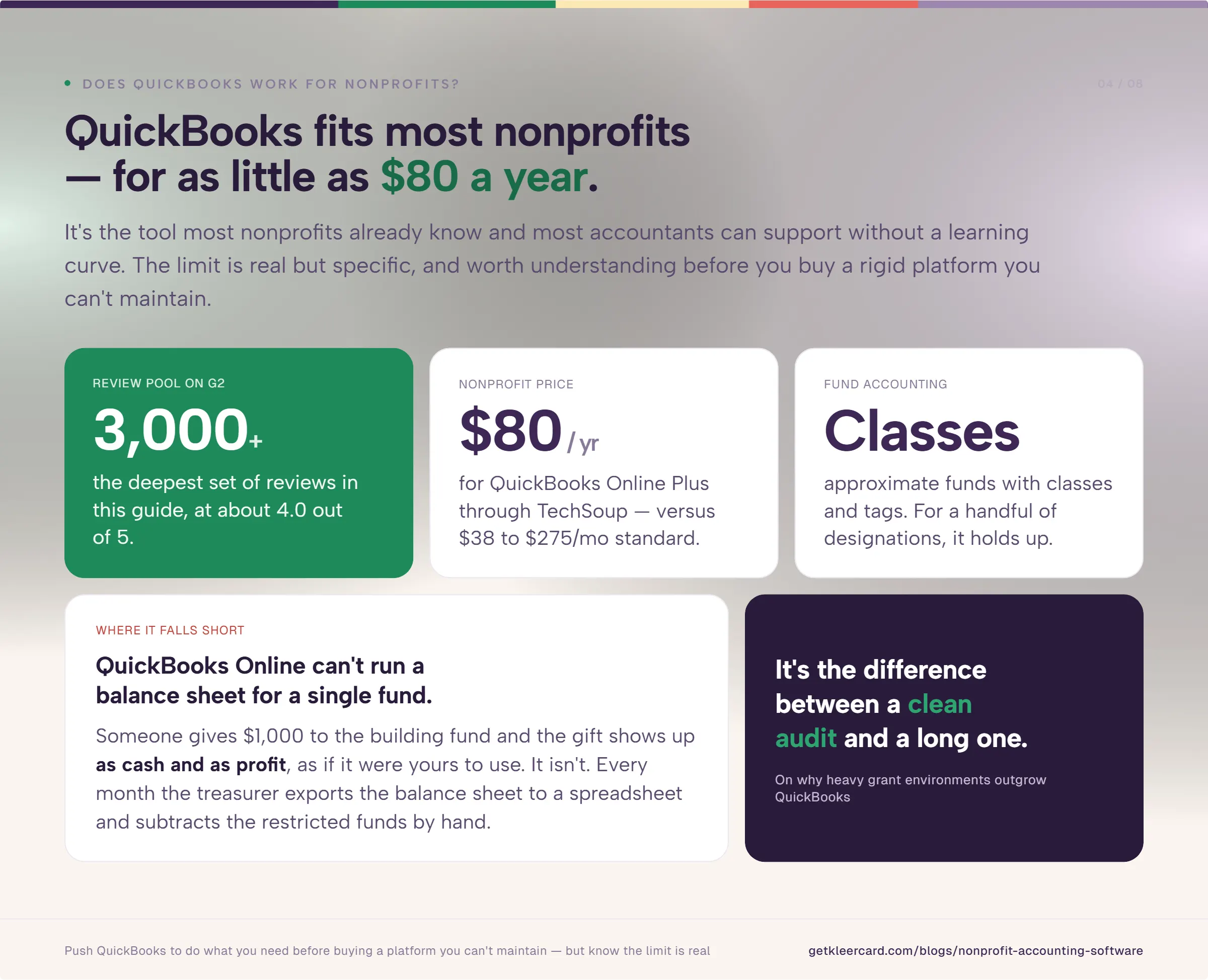
It has no native fund accounting. You approximate it with classes and tags, assigning each transaction to a program or grant. For organizations with a handful of fund designations, that workaround holds up well.
Standard pricing runs from $38/month for Simple Start to $140/month for Plus and $340/month for Advanced, per Intuit's current rates.
Eligible 501(c)(3) organizations can get QuickBooks Online Plus for an $80 annual admin fee through TechSoup, and Advanced for $170. That's one donated subscription per organization, and payroll isn't part of the TechSoup offer.
I'd rather see an organization push QuickBooks Online to do what it needs than buy a rigid platform it can't maintain. Organizations with many grants eventually need a true fund accounting platform for that per-fund balance sheet.
Aplos is usually the clearest pick for small to mid-sized nonprofits and churches that need real fund accounting without the cost and setup of an enterprise system. It was built for this audience, and your staff needs almost no accounting background to use it.
Users back that up, rating it 4.6 out of 5 across 276 reviews on G2, Capterra, and Software Advice.
It handles true fund accounting natively. The Aplos pricing page lists a Balance Sheet by Fund and an Income Statement by Fund on the entry plan. That's the report QuickBooks makes you build by hand.
Pricing starts at $79/month for Lite with two users. Core at $129/month adds budgeting, accounts payable, and the third-party integrations the Lite plan leaves out. Advanced is $229/month for organizations above roughly $250K in revenue.
Its main limit is integrations. Because Lite leaves them out, teams that lean on a separate donor CRM usually need Core or higher. Many churches also run Aplos as their accounting software for churches, since the fund tools fit ministry budgets cleanly.
Sage Intacct is where nonprofits go when they outgrow QuickBooks but don't want the full Blackbaud ecosystem. It handles multi-entity consolidation and the dimensional reporting larger finance teams rely on.
Sage markets it as the first and only AICPA preferred financial management solution, and it supports FASB ASC 958 reporting for restricted funds. For federated nonprofits and organizations managing federal grants or single audits under 2 CFR 200, that depth is worth paying for. Reviewers rate it around 4.3 out of 5 on G2 across more than 4,000 reviews.
Sage pricing is quote-based. You get a custom quote from Sage based on your entities and module needs. Expect a meaningful jump from QuickBooks or Aplos, justified only if you need the consolidation and automation.
Blackbaud Financial Edge NXT is the enterprise fund accounting platform for large nonprofits, universities, and foundations with complex structures and strict audit requirements.
Its main advantage is the ecosystem. If you already run Raiser's Edge NXT for fundraising, adding Financial Edge NXT keeps your donor and financial data in one place.
I ran Blackbaud Financial Edge during my years in large nonprofit finance. Enterprise platforms like this usually need dedicated finance staff to run well, and that staffing is part of the real cost alongside the license. Its G2 rating sits at 4.0 out of 5 across about 120 reviews.
Blackbaud pricing is quote-based. Plan on a custom quote from Blackbaud and an enterprise implementation if you aren't already using its other products.
MIP Fund Accounting, now part of Momentive Software, is a true fund accounting platform built for grant-heavy nonprofits, government agencies, and larger K-12 organizations. It tracks unlimited funds and grants on a multi-dimensional chart of accounts, and it is FASB and GASB compliant.
It belongs on your shortlist if you manage many funding sources and need clean grant tracking with strong internal controls. It also offers an integrated payroll and HR suite, which appeals to organizations that want financials and people management in one system. Reviewers rate it 3.8 out of 5 on G2, where users praise its reporting depth but flag a steep setup.
MIP pricing is quote-based; you request a quote based on your modules and users. Like the other enterprise tools here, it carries an implementation and learning cost, so it pays off only when you actually manage many funds and grants.
Xero is a clean, affordable general accounting platform for small nonprofits that don't need fund accounting. Bank reconciliation is fast, every plan includes unlimited users, and it connects to a wide range of apps. Users rate it 4.4 out of 5 on G2 across more than 1,300 reviews.
It uses tracking categories to mimic fund designations, capped at two. Pricing starts at $27/month, and registered nonprofits qualify for 25% off through Xero.
Move up to Aplos or QuickBooks once restricted funds become an audit concern. Until then, Xero keeps small books tidy for little money.
Wave is free for its core bookkeeping, and for an all-volunteer group or a brand-new nonprofit, free is the right price. Wave's free Starter plan handles income and expense tracking, invoicing, and manual bank imports.
Since 2024, Wave has split into a free Starter tier and a paid Pro tier at $16/month billed annually. Automatic bank feeds and multi-user access moved to Pro, so the free plan now means uploading transactions yourself.
It has no fund accounting and no Form 990 tooling on any tier. Treat it as a starting point. Once you're tracking more than a fund or two, or heading into your first audit, you'll need to move to a platform built for nonprofits.
MoneyMinder is built for volunteer treasurers rather than trained accountants. PTAs and booster clubs use it to track budgets and dues without learning double-entry bookkeeping.
It offers fund-style tracking and treasurer reports in plain language, with free and paid plans. It isn't a full general ledger (the complete record of every account), so a growing nonprofit with staff and grants will eventually need more. For a volunteer-run group, it removes a lot of pain.

Start with size and fund complexity before the feature list.

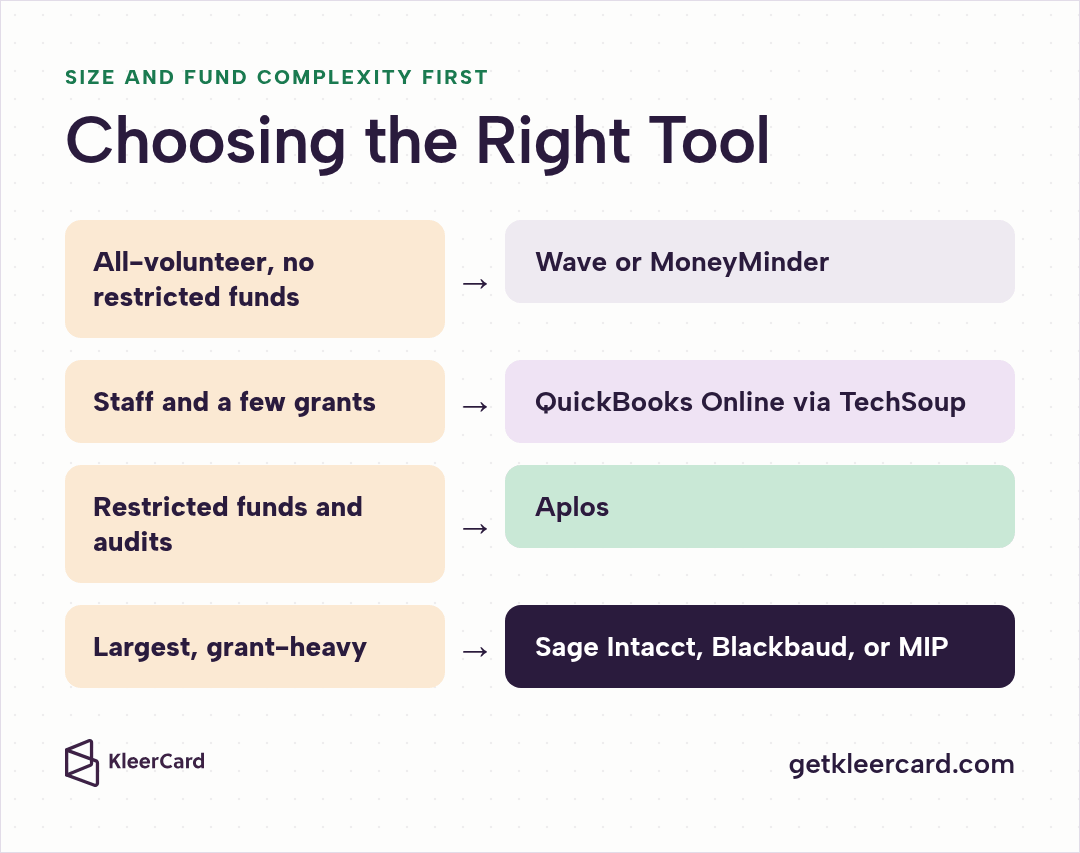
If you're all-volunteer with no restricted funds, Wave or MoneyMinder will do. If you have staff and a few grants, QuickBooks Online through TechSoup is usually hard to beat on cost. If restricted funds and audits sit at the center of your work, Aplos covers most organizations, and Sage Intacct, Blackbaud, or MIP covers the largest and most grant-heavy.
Most organizations find that standard software fits once the chart of accounts is set up carefully. Accounting is a structured way of thinking about revenue and expenses, and that structure is the same across organizations, even when the labels differ.
Where "special" turns into a real problem is the chart of accounts. People create separate accounts for missions meals, worship meals, and pastor meals, then can't answer a question about how much they spent on meals last year. Use one account for meals and add a dimension (a class or department) for the program. That's how you slice the same data later without rebuilding reports.
Some fund accounting platforms don't offer a real API (a direct connection other software can use), so you move data in and out with file imports. Before you commit, confirm how your other tools will connect. Ask whether "it integrates" means a live connection or a CSV export you reformat by hand.
There's one more option to know about, though you can't buy it yet. At KleerCard, we're building KleerFi Accounting, a fund accounting product built for nonprofits, to help keep every fund in balance and close the books each month. It's in its waitlist stage, and a launch date isn't set yet, so it isn't on this list today. If you'd like to follow along while your current books keep running, you're welcome to join the KleerFi Accounting waitlist.
Your accounting software is your system of record. It tracks what already happened.
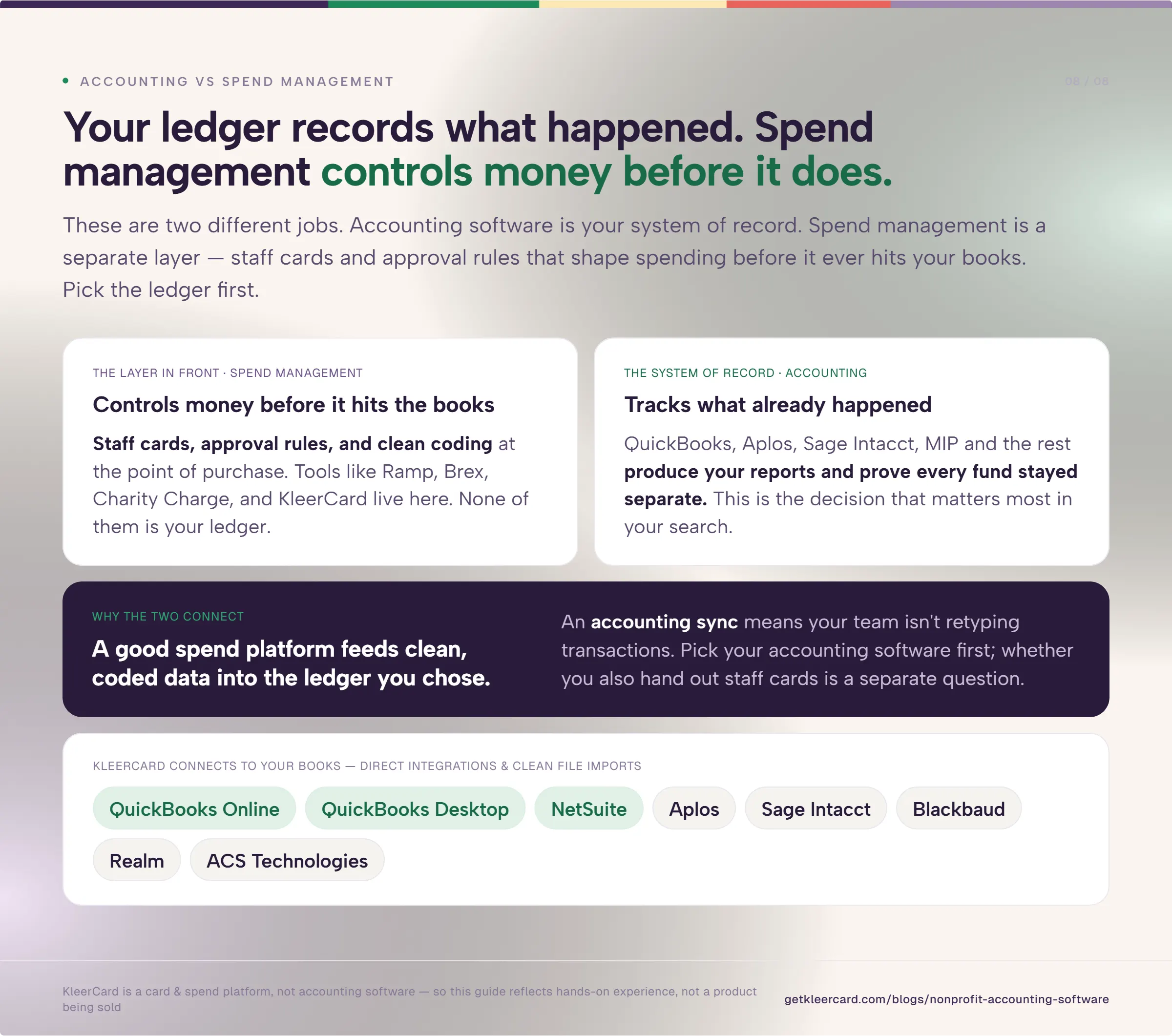
Spend management is a separate layer that controls money before it hits your books, with staff cards and approval rules. Tools like Ramp, Brex, Charity Charge, and KleerCard, the company I co-founded, live here. None of them replaces your accounting software.
A good spend platform feeds clean, coded data into the accounting software you chose. With an accounting sync, your team doesn't retype transactions.
Picking your accounting software is the decision that matters. Whether you also hand out staff cards is a separate question. If KleerCard fits how your nonprofit spends, you can see our pricing.

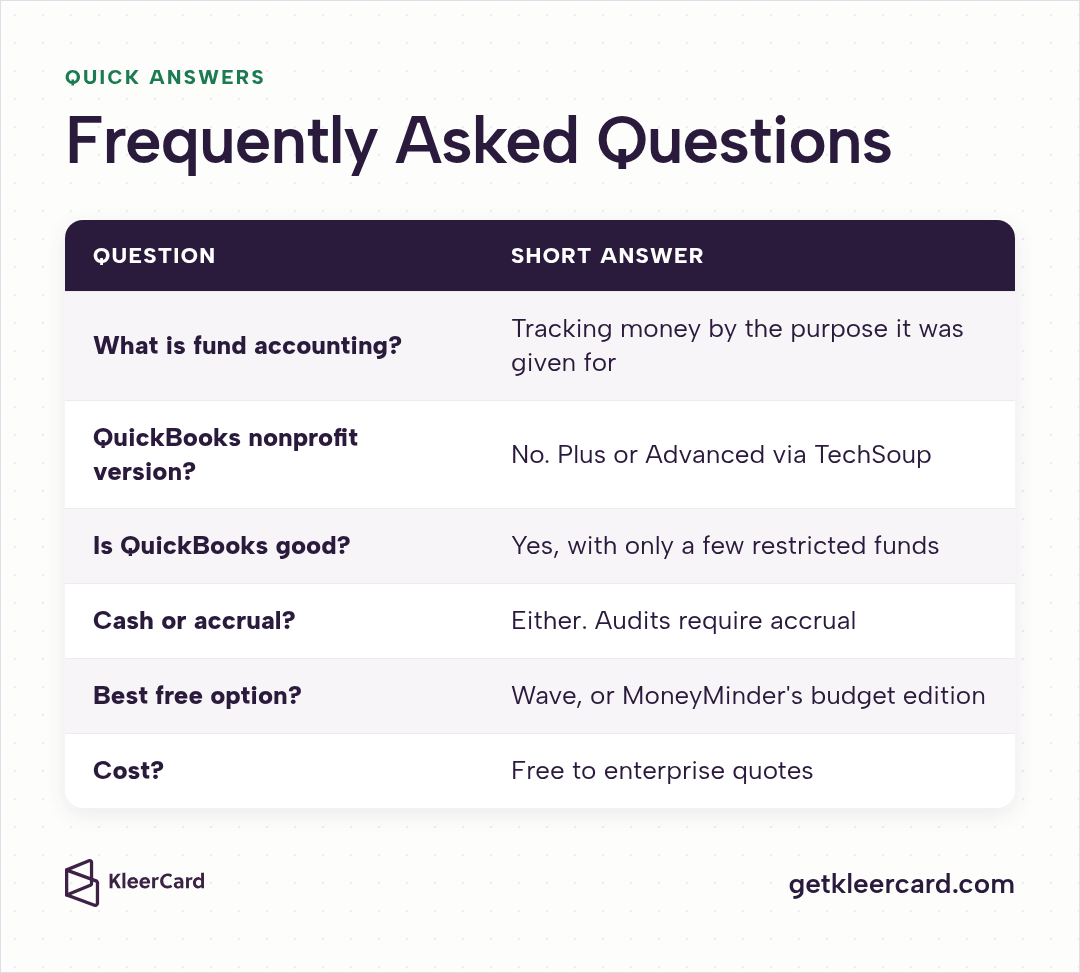
Fund accounting tracks money by the purpose it was given for, rather than by category alone. A nonprofit separates restricted funds, like a grant or a building campaign, from unrestricted operating money, and reports on each so it can prove every dollar was spent as intended. It's the main reason nonprofit accounting differs from for-profit bookkeeping.
QuickBooks doesn't sell a separate nonprofit edition of QuickBooks Online. Eligible 501(c)(3) organizations can get Plus or Advanced at a steep discount through TechSoup. Most nonprofits use classes and tags to track funds, since QuickBooks Online has no native fund accounting.
QuickBooks Online works well for the majority of nonprofits, especially those with staff, a familiar accountant, and only a few restricted funds. It's affordable through TechSoup and widely supported. Organizations with many restricted grants or federal funding usually outgrow it and move to a true fund accounting platform like Aplos, Sage Intacct, or MIP.
Nonprofits can use either, and many small ones start on cash basis because it's simpler. Accrual accounting is required for a financial statement audit and for organizations following GAAP, and most grantors and auditors expect it. Your accounting software should support both so you can switch as you grow.
Wave is usually the strongest free option for very small or all-volunteer nonprofits that only need basic bookkeeping, though its automatic bank feeds now sit behind a paid tier. For volunteer treasurers running a PTA or booster club, MoneyMinder offers a free budgeting edition, though recording transactions takes its $299/year plan. Neither replaces a true fund accounting platform once you take grants or prepare for an audit.
Costs range from free to enterprise quotes. Wave's core plan is free, Xero starts at $27/month, Aplos starts at $79/month, and QuickBooks Online runs $38 to $340/month, or $80 a year for eligible nonprofits through TechSoup. Sage Intacct, Blackbaud Financial Edge NXT, and MIP Fund Accounting are quote-based and priced for larger organizations.
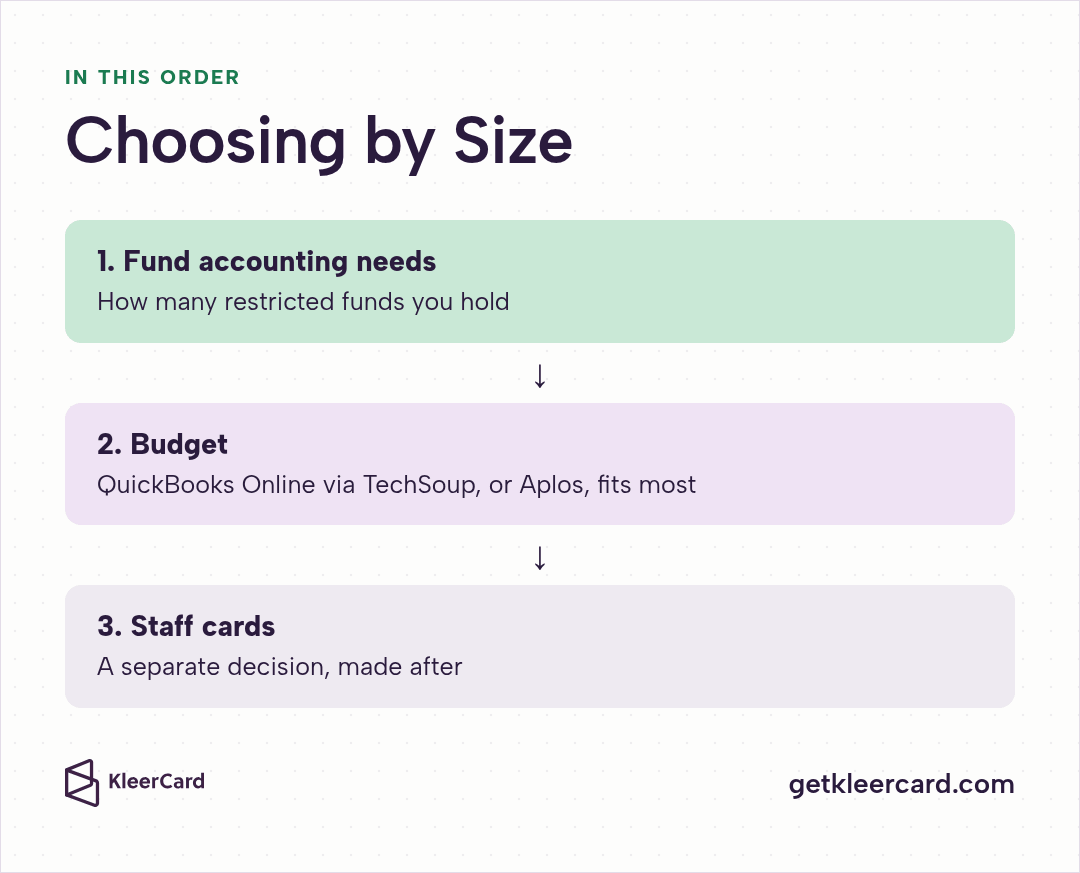
The right tool follows your fund accounting needs and your budget, in that order. Most nonprofits are well served by QuickBooks Online through TechSoup or by Aplos, and only the largest or most grant-heavy need Sage Intacct, Blackbaud, or MIP.
Choose the accounting software first, then decide separately whether staff cards make sense for your team.
About the author
Owen Hill is co-founder of KleerCard, a corporate card and spend platform built for nonprofits, churches, and K-12 schools. He graduated from the United States Air Force Academy and holds a doctorate, served as a financial analyst in the Air Force, and was Budget Director at Compassion International, a nonprofit with revenue near $1 billion. He later ran Switch Consulting, a fractional CFO practice for nonprofits, and has run Blackbaud Financial Edge, Microsoft Great Plains, and QuickBooks across those roles. He is an active church treasurer and sits on nonprofit boards. These picks reflect his hands-on experience with these platforms.


Speak to a member of our team and we can have you up and running in minutes, not weeks.