%202.svg)
A nonprofit annual report builds donor trust through impact and financial transparency. See what to include, how to write one, and real examples to model.
Donors give again when they can see where their money went and what changed because of it. A nonprofit annual report is how you show them.
Trust drives that decision. In the 2026 Give.org Donor Trust Report, more than two-thirds of donors said trust is essential before they give. Fewer than one in five said they highly trust charities. An honest annual report is one of the clearest ways to earn that trust.
No law requires you to publish one. Most nonprofits do anyway, because it keeps current donors close and brings new ones in.
I co-founded KleerCard, and I spent most of my career inside nonprofit finance. I earned a PhD in economics, served as a financial analyst in the Air Force, and ran budgets as a director at Compassion International. I advise nonprofits as a fractional CFO, and I serve as volunteer treasurer at my own church. The advice below is the version of this conversation I have with the organizations I work with.
A nonprofit annual report is a yearly, donor-facing document. It recaps your mission, your program impact, your finances, and the people who supported you over the prior fiscal year.
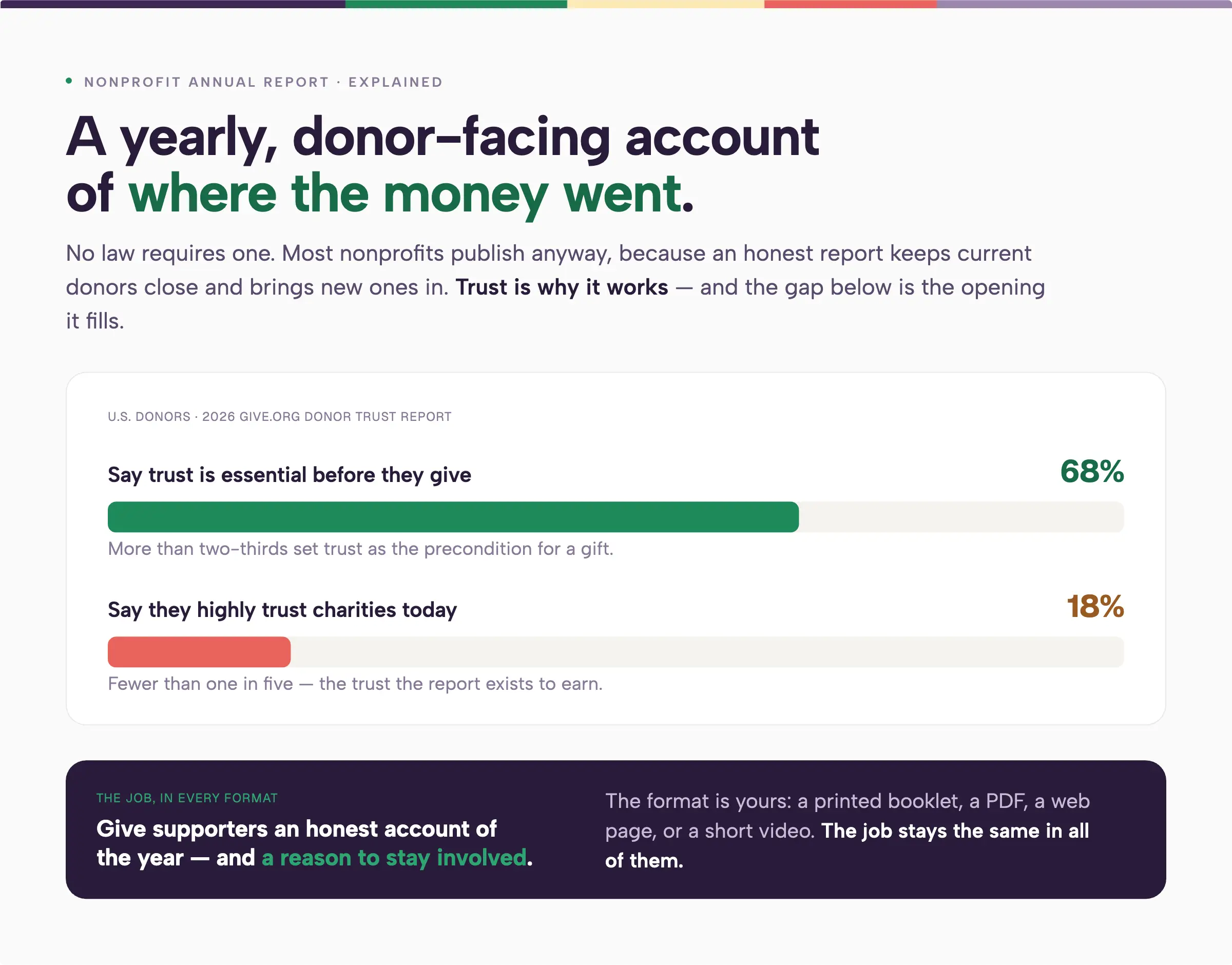
You are not required to produce one. Organizations publish them because they retain existing supporters and help acquire new ones. The report usually goes out at the close of a fiscal year or the start of the next.
The format is yours to choose. Some organizations print a booklet, others post a PDF, build a web page, or release a short video. The job stays the same in every format, which is to give supporters an honest account of the year and a reason to stay involved.
The phrase "annual report" gets attached to three separate documents, and mixing them up creates real compliance risk. Here is how they separate.
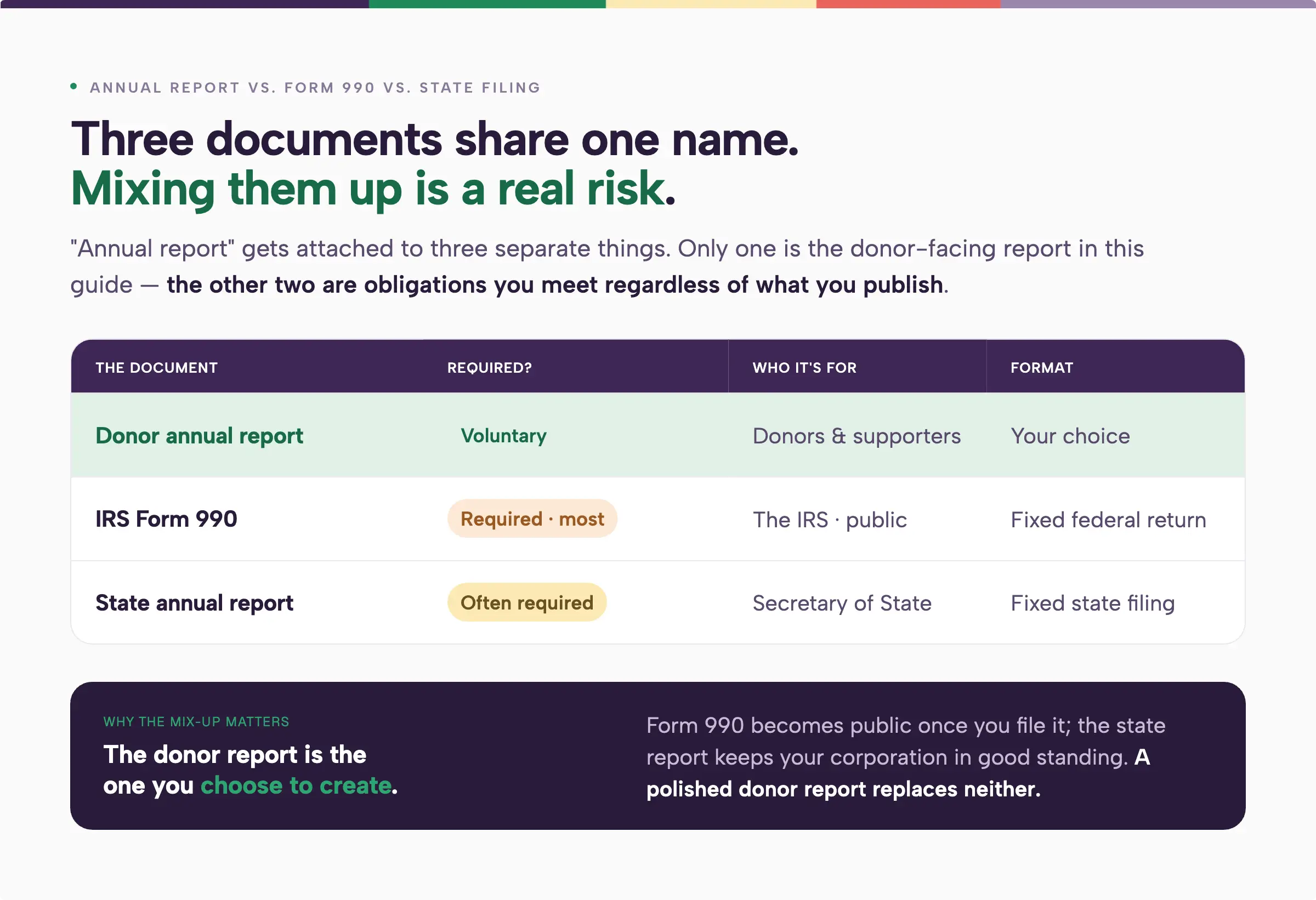
The first is the report in this guide. It is voluntary, donor-facing, and has no required format. You write it to communicate and to thank people.
The second is IRS Form 990, the federal information return most tax-exempt organizations file each year. It carries the title Return of Organization Exempt From Income Tax, and it becomes public once you file it. Smaller organizations may file the shorter 990-EZ or the 990-N e-Postcard, and many churches are exempt from filing at all.
The third is your state annual report, a filing many states require to keep your nonprofit corporation in good standing. You usually submit it to the Secretary of State, often with a fee and its own deadline, and the rules vary by state.
The donor-facing report is the one you choose to create. The other two are obligations you meet regardless of whether you publish anything for supporters.
A strong nonprofit annual report usually includes these elements:
Most of the report should sit on impact and finances. Lead with what changed because of the year's work, then show the numbers behind it.
Supporters care less about your activity than about the change that came from it. Pair a headline number with one specific story of a person or community you served. The number earns trust, and the story makes it stick.
Avoid listing everything you did. A year holds more than one document can carry, so organize around a handful of themes that point back to your mission.
The report is also a thank-you. Name your major donors, board members, and key volunteers, and credit specific programs to the supporters who funded them.
Add a general note of thanks to everyone who gave time or money at any level. Check with donors before you print their names, since some prefer to stay anonymous.
Most donors will not read a full audit, but they do read it as a measure of your candor. The goal is a section that satisfies the donor skimming for reassurance and the funder who wants the detail.
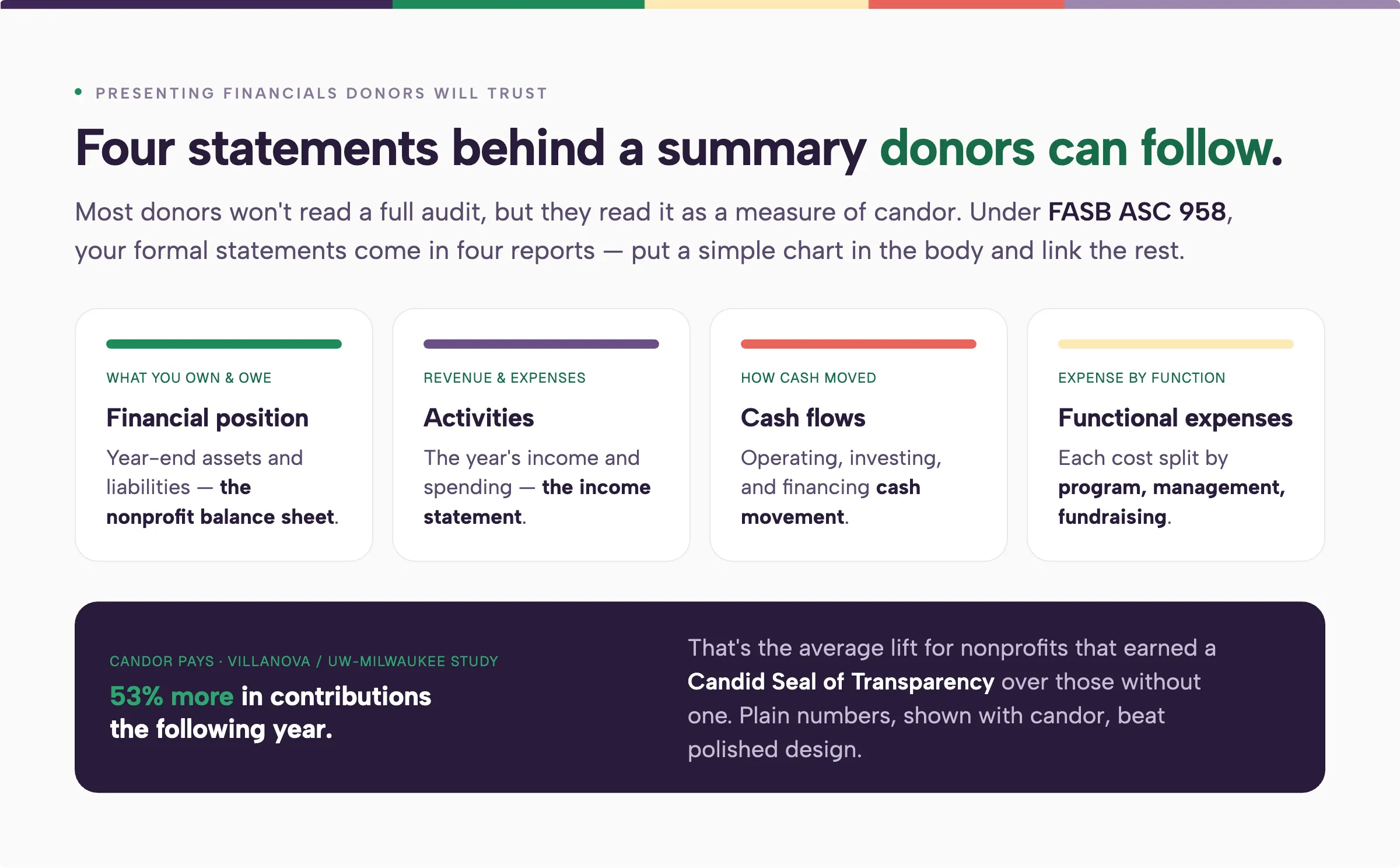
That candor tends to pay off. Nonprofits that earned a Candid Seal of Transparency averaged 53% more in contributions the following year than organizations without one. That finding comes from researchers at Villanova University and the University of Wisconsin-Milwaukee.
I have built nonprofit financials from a few seats. The treasurer chair taught me the most about what donors want here.
Say someone gives a thousand dollars to the building fund. That money shows up twice in the raw numbers. It sits in the bank, and it counts as revenue we did not spend, so on paper the year looks stronger than it is. The honest picture is different. That thousand dollars belongs to the building, and I cannot move it to payroll or to a family in need, even in a lean month.
A donor who gives for a purpose wants to see that you spent it on that purpose or held it for later. Your annual report is where you prove it. That habit of tracking restricted funds all year is what makes the report believable.
Under U.S. accounting standards, your formal nonprofit financial statements follow FASB ASC 958 and come in four reports:
Current standards sort your net assets into two classes, with donor restrictions and without. That split matters to anyone who gave for a specific purpose and wants to see their gift tracked to it.
For the report itself, keep it readable. Put a simple revenue-and-expense chart and your program-spending ratio in the body, then attach or link the full statements for donors who want more. A reader who can see that most of each dollar reaches the mission has the reassurance this section exists to give. If you want to go deeper on that ratio, our guide to nonprofit expense reporting and the breakdown of program versus admin spend both help.
Plain numbers, presented with candor, do more for donor trust than polished design. I would rather see a modest chart with a clear note than a beautiful graphic that hides where the money went. You can read more on that approach in our piece on nonprofit financial transparency.
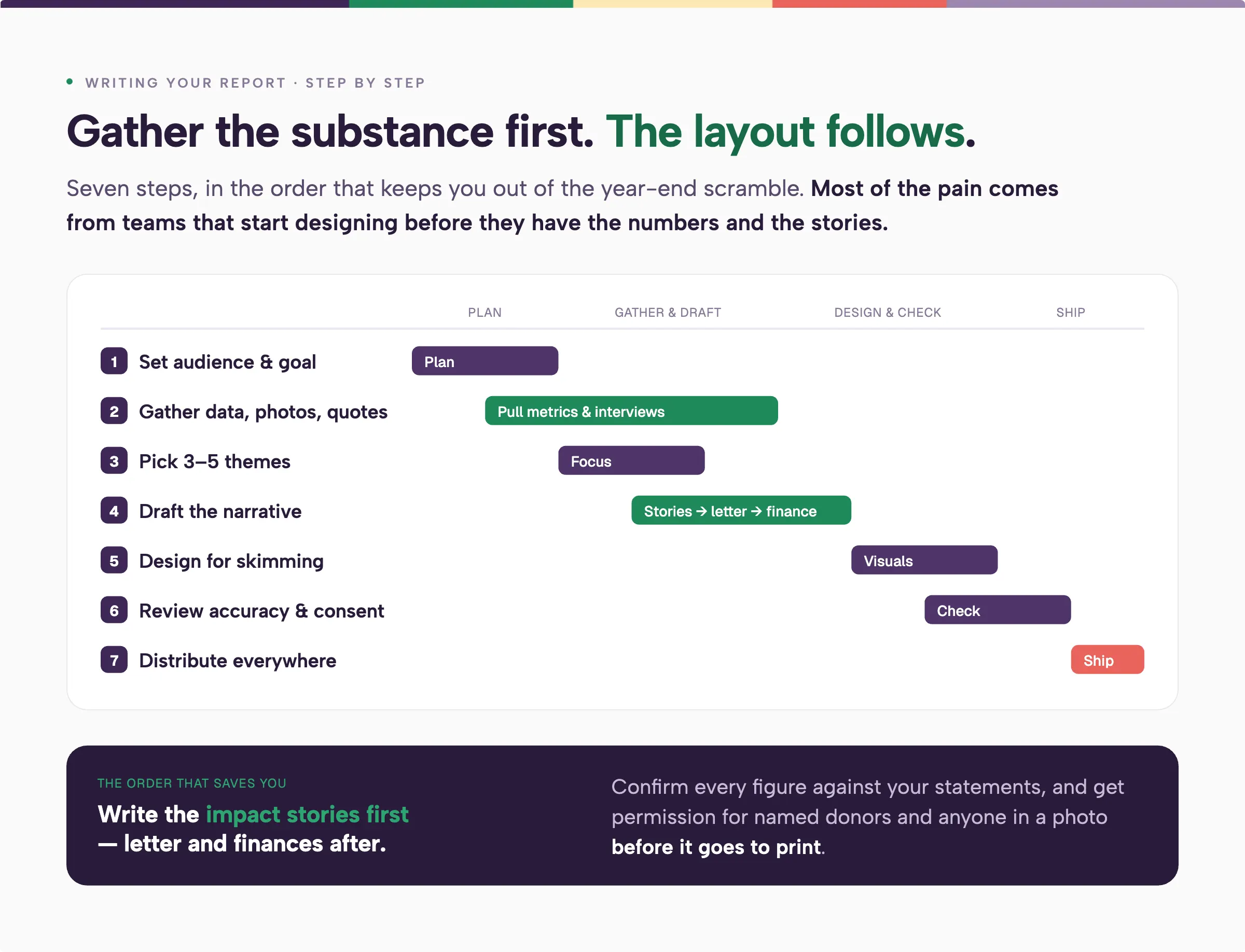
A clear plan early saves you the scramble later. Most of the pain I see comes from organizations that start designing before they have gathered the numbers and the stories.
The widest reach usually comes from combining a few formats. A printed piece works for in-person meetings and events. A PDF carries the depth of a booklet without the print cost, and a microsite adds interactivity, video, and expandable charts.
Match the format to the reader. Newer or smaller-dollar supporters often prefer a one-page summary or a two-minute video, while major donors and foundations expect the full report.
Let your capacity set the length. A short, sharp report that supporters finish beats a long one that nobody opens. If you have little time or budget, a punchy report with a few key metrics and one strong story does the job.
The first mistake people make is burying or skipping the financial section. Donors read it as a measure of your candor, so a vague or missing financial summary reads as something to hide.
The second is leading with internal activity instead of donor-felt outcomes. A list of meetings held and programs launched tells supporters what you were busy with, not what their gift changed.
The third is printing donor names without permission. One supporter who wanted to stay anonymous can sour the goodwill the report was meant to build. Confirm the list before it goes to print.
The fourth is treating the donor report as your only annual obligation. Form 990 and any state filing still come due, and a polished report does nothing to keep your status in good standing.
The last is starting the design before you have the substance. Gather your numbers and stories first, and the layout follows the content instead of fighting it.
The fastest way to calibrate your own report is to read a few real ones from organizations near your size and field. Many nonprofits post their reports on a public financials or accountability page, which makes them easy to find.
charity: water publishes its annual report next to its audited financials and Form 990, and frames the whole thing around impact and transparency. It runs a 100% model, posting that every public donation goes to clean water projects. That promise sits beside top ratings from Candid and Charity Navigator. The structure is worth studying even if your budget is a fraction of theirs.
Water Mission, a faith-based nonprofit, takes a similar approach, pairing impact stories with its audited financials and Form 990. It puts simple expense and growth charts right on the page and carries ECFA accreditation, which many church and ministry donors look for. For churches and ministries, it shows how a mission-driven report can stay warm and stay transparent at the same time.
The strongest open with an outcome and one clear number, then earn the detail with a short, plain-language note from the finance lead. And they prove a big budget is optional, since a two-page PDF with one story, one chart, and a thank-you can carry the whole job.
A nonprofit annual report is a yearly, donor-facing document that recaps your mission, program impact, finances, and supporters for the prior fiscal year. It works as a communication and stewardship tool, and it is not a tax filing.
No. The donor-facing annual report is voluntary. You do have to file IRS Form 990, which covers most tax-exempt organizations. Many states also require a separate annual report to keep your corporation in good standing.
The annual report is a communication piece you choose to write, with no set format. Form 990 is a mandatory federal information return that becomes public once you file it. People use "annual report" for both, so confirm which one a request means.
It should include a leadership letter, your mission and goals, and program impact told through data and stories. Add a readable financial summary, recognition of donors and volunteers, a look ahead, and a clear call to action.
Long enough to cover the year and short enough to be read. A large organization may produce a multi-page book, while a small one can succeed with a two-page summary or a postcard. Your capacity and audience set the length.
Most organizations publish at the close of a fiscal year or the start of the next, once the books are reconciled and final. Pick a consistent window each year so supporters know when to expect it.
The voluntary annual report is yours to share as you choose, and most organizations post it publicly to build trust. Form 990 is different, since it becomes a public document available through the IRS and third-party databases once you file it.
A nonprofit annual report is the clearest chance you get each year to show supporters that you used their money well. Lead with impact, back it with numbers donors can follow, and thank the people who made the year possible.
The financial section comes together quickly when your records stay clean all year, and it turns into a slog when they do not. That is the problem I co-founded KleerCard to fix. We give each spender a card with a built-in budget. Every transaction traces back to one named person and syncs into your accounting platform as it happens.
With the books clean month to month, the financial summary writes itself, and your restricted funds stay easy to track. If tighter spend visibility would help your team, that is the right place to start.


Speak to a member of our team and we can have you up and running in minutes, not weeks.