%202.svg)
A nonprofit audit reviews your financials for accuracy and compliance. Learn when one is required, what it costs, and how to prepare without the stress.
Most small nonprofits are not legally required to bring in an outside auditor. Many larger ones are, and many more choose to. Whether yours needs one depends on your size, your funding, and the state you operate in.
I have spent years inside nonprofit finances. I served as budget director at Compassion International, later ran a fractional CFO practice for nonprofits, and I am a church treasurer today.
I have closed plenty of books and kept plenty of records ready for review. The process intimidates a lot of finance leaders, and most of that pressure comes from records kept without a review in mind. You can fix that long before an auditor shows up.
A nonprofit audit is an independent examination of your financial statements, records, and internal controls by a licensed CPA. The auditor checks that your statements are accurate and follow generally accepted accounting principles, then issues a formal opinion. Most audits are voluntary or required by funders and state rules, rather than prompted by any suspicion of wrongdoing.
The deliverable is an audit report with the auditor's opinion. A clean opinion means your statements present your finances fairly. A qualified, adverse, or disclaimed opinion signals issues the auditor could not resolve.
Two points of confusion come up often. An audit is not the same as filing your Form 990, which is an annual information return to the IRS. An independent CPA audit is also separate from an IRS examination, which I cover later in this guide. For the foundation underneath all of it, start with nonprofit accounting basics.
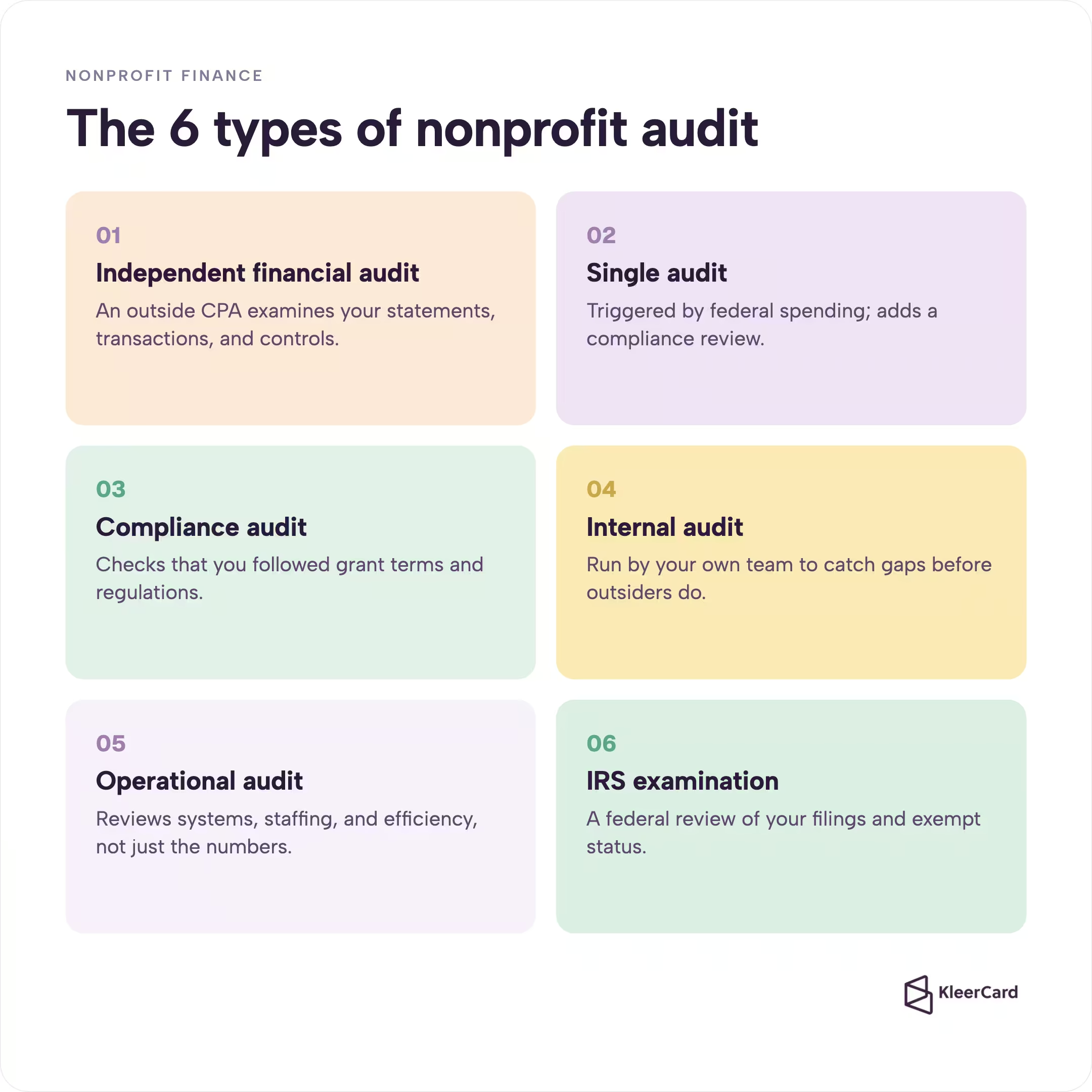
The word "audit" covers several different reviews, and they serve different purposes.
Most organizations spend their energy on the independent financial audit, so that is where I will focus.
Most small nonprofits are not legally required to have an independent audit. The requirement depends on your size, your funding sources, and your state. Five situations commonly trigger one:
Any one of these can obligate an audit even when the others do not.
State rules vary widely, and they usually key off annual revenue or contributions. Some states set the trigger near $250,000 to $500,000 in contributions. California requires an audit once gross revenue reaches $2 million under its Nonprofit Integrity Act. Government grants that require separate accounting are excluded from that calculation, per the California Attorney General's guidance.
Because the thresholds and conditions differ in every state, check your own before you assume anything. The National Council of Nonprofits maintains a 50-state audit requirements chart that breaks down what each state requires and under what conditions.
If you spend federal money, a different rule applies. A nonprofit that expends $1,000,000 or more in federal awards during its fiscal year must have a single audit under 2 CFR 200.501.
That number changed recently. The Office of Management and Budget raised the threshold from $750,000 to $1,000,000 in its 2024 Uniform Guidance update. The change is effective for federal awards issued on or after October 1, 2024. Plenty of guides still print the old $750,000 figure, so confirm against the regulation itself.
One trap sits in the transition. Awards issued before the change can still carry the $750,000 trigger, so an organization near the line should track its awards by issue date. The threshold counts federal awards expended, which includes federal money passed through your state or another nonprofit.
Funders set their own rules. Foundations and government grantmakers often require an audited financial statement before they release money, and some require one every year you hold the grant. Banks may ask for audited statements as a condition of a loan.
These requirements can put you in audit territory even when state and federal law would leave you alone.
A full audit is the most thorough and most expensive option. Many organizations reach for it when a lighter service would satisfy the requirement. A CPA can provide three levels of assurance.
A review costs a fraction of an audit and can stand in for one when a funder or state rule allows it. Some organizations audit every few years and run a review in the off years. Before you commit to a full audit, read exactly what the grantmaker, lender, or state rule asks for. A review or compilation is sometimes enough.
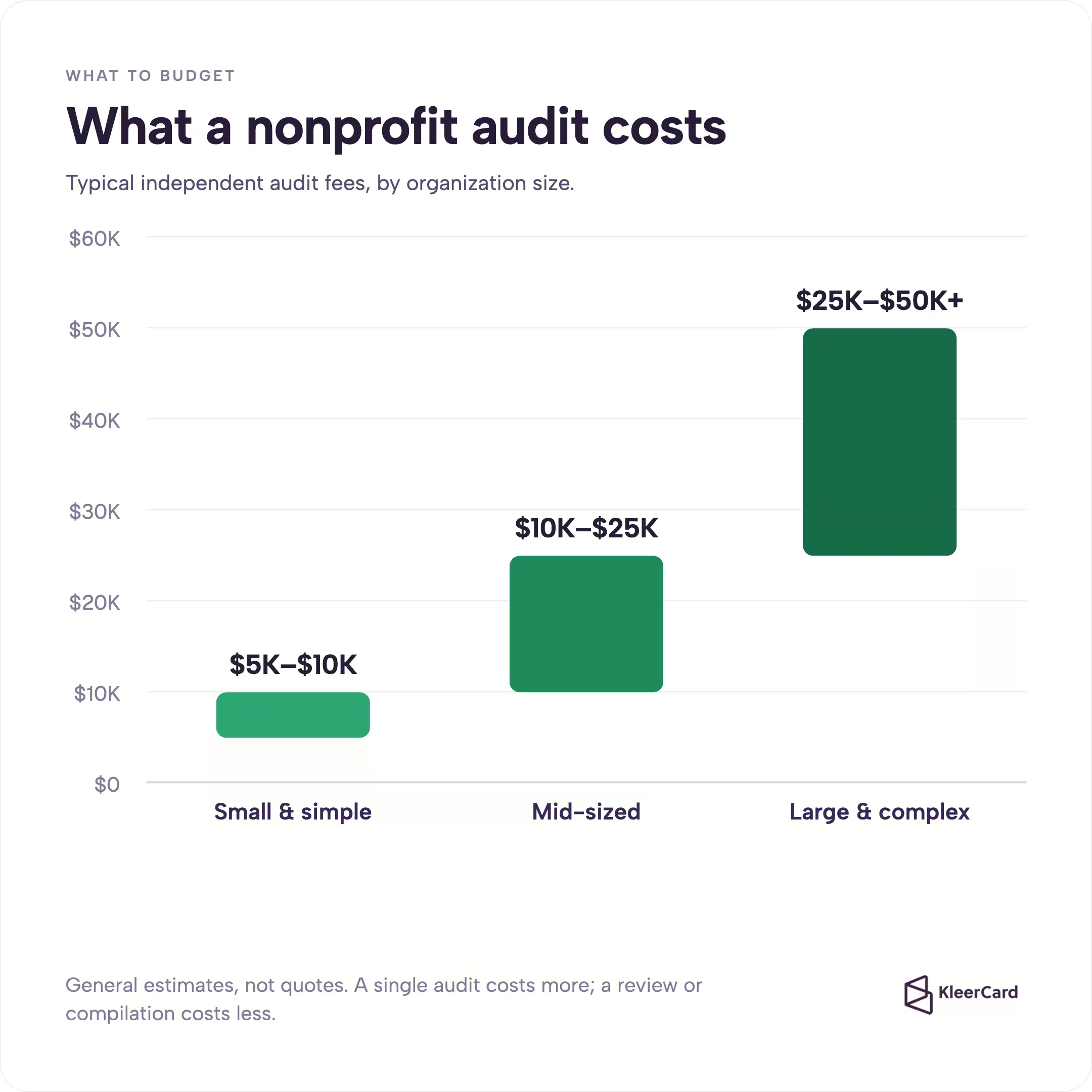
Audit fees depend on your size, your transaction volume, the number of funding sources you manage, and the state of your records. The ranges I see and that other nonprofit finance sources commonly report look like this:
Treat these as general estimates rather than quotes. A single audit adds to the base fee because of the extra compliance work. A review or compilation costs considerably less for organizations that qualify.
The biggest lever you control is the condition of your books. Auditors bill for hours, and disorganized records add hours. Clean, reconciled, well-documented books shrink the engagement and the invoice.
Your audit report is most useful when the firm behind it knows your world. Look for a CPA firm with a dedicated nonprofit practice that understands nonprofit accounting standards. If a single audit applies to you, the firm also needs to meet Government Auditing Standards, often called the Yellow Book.
A short process keeps you honest:
One note on independence. Your bookkeeper or accountant can recommend firms, but the person who keeps your books should not perform your audit. The value of an audit comes from an outside set of eyes.
Once you hire a firm, it sends a Provided by Client list, usually called a PBC list. It spells out every document the auditor needs. Compiling it early is the difference between a calm audit and a slow one. A typical PBC list asks for your:
Beyond gathering documents, a few habits make fieldwork go faster. Reconcile every account. Review your restricted fund balances and confirm each gift was spent on its stated purpose.
Organize receipts and invoices so each one ties to a transaction. Resolve any discrepancy you already know about before the auditor finds it.
I learned one reconciliation habit the hard way. A lot of teams run reimbursements through payroll, which forces you to split those transactions back out at reconciliation and muddies your records. I set up anyone I reimburse as a vendor and track those payments separately, which keeps the trail clean and the audit simpler.
Strong expense reporting practices do the same work all year. So does keeping your accounts synced and reconciled rather than catching up at year-end.
Once the auditor finishes, you get the report plus a management letter with recommendations. A report with recommendations is normal, and it is not a failing grade. Your job is to act on what the auditor found, quickly and thoroughly.
Schedule a leadership meeting soon after you receive the report. Walk through each recommendation, assign an owner, and set a date. Some items are quick fixes and others take real work, so a written plan keeps them from slipping.
Depending on your state and your funders, audited statements may become public records that donors and watchdogs can review. Treat the report as a tool for improving the next year.
An IRS audit is a different animal. Here the federal government, not a firm you hired, reviews your filings and your exempt status. It tends to start when something looks off. Common triggers include a missing or late Form 990, a reporting discrepancy, unrelated business income, questionable executive compensation, or political activity.
The IRS handles these as a correspondence examination by mail or a field examination on site. You have rights throughout, and the IRS exempt organizations audit process page lays out how it works.
Your best protection is unglamorous. File complete, accurate returns on time, and keep documentation that supports every number you report. The same clean records that make an independent audit cheap make an IRS inquiry painless.
The easiest audit is the one you started preparing for in January. Waiting until the week before fieldwork makes it harder. Year-round readiness means reconciled accounts, a receipt attached to every transaction, and restricted funds tracked against their purpose as the money moves.
I have watched the alternative up close. Early in my career I worked on enterprise accounting platforms like Blackbaud Financial Edge and Microsoft Great Plains. They were powerful, and they needed several full-time staff to keep the workflow moving.
The hard part was rarely the software. It was getting the information in. I remember closing the books at month-end, mostly done, then waiting on a traveling CEO. He was sitting on a stack of card charges I could not code.
The data could not be trusted until that workflow finished, and that lag is exactly what auditors trip over.
That experience shaped how we built KleerCard. We put the documentation where the spending happens. We give each card a real budget, and the charge declines when someone tries to spend past it. The transaction shows up in real time with its receipt attached.
The result is a full transaction trail an auditor can follow without a scavenger hunt. At one private Christian school we work with, K-12 with about 540 students, the finance office used to chase down roughly five receipts a week. Since moving to per-person cards with receipts captured at the point of sale, they have lost fewer than five in an entire school year. They reconcile weekly now, so month-end takes a few minutes instead of a long slog.
A receipt-tracking workflow that captures the receipt as the charge happens keeps your records audit-ready as you go. If that is the kind of system you want, the annual audit stops being an event you dread.
No. Most small nonprofits are not legally required to have an independent audit. An audit becomes mandatory based on your state's rules, your federal award spending, your bylaws, or a grantmaker or lender requirement.
A nonprofit needs an audit in any of these situations:
Most independent audits run from about $5,000 for small, simple organizations to $25,000 or more for larger or more complex ones. Single audits cost more because of the added compliance work, and a review or compilation costs much less for organizations that qualify. These are general estimates, so get a quote for your situation.
An audit provides reasonable assurance through testing and produces a formal opinion. A review provides limited assurance through inquiry and analytics, costs less, and does not produce an opinion. Some funders accept a review in place of an audit, so check before you pay for the higher level.
No. An independent financial audit is performed by a CPA firm you hire to review your statements. An IRS audit is a federal examination of your filings and exempt status. They serve different purposes and run on different processes.
An audit is not designed primarily to catch fraud. It gives reasonable assurance that your financial statements are free of material misstatement. Strong internal controls, rather than the annual audit, are your real defense against fraud.
The full process commonly runs two to six months, including selecting an auditor, preparing, fieldwork, and the report. Booking early in the off-season tends to speed things up.
Most of the difficulty in a nonprofit audit lives in the preparation, and the audit itself goes smoothly when your records are ready. Confirm whether you are required to audit, review, or compile, then build your records so they hold up long before fieldwork.
If you want spending records that stay audit-ready all year, see how KleerCard supports nonprofits.


Speak to a member of our team and we can have you up and running in minutes, not weeks.