%202.svg)
A nonprofit credit card policy sets the rules for who can spend and what proof each purchase needs. Here is what to include, plus a sample you can adapt.
A nonprofit credit card policy is a written document that sets the rules for using organization-issued cards. It covers who gets a card, what they can buy, spending limits, receipt requirements, and the consequences for misuse. A clear policy protects donor money and keeps your spending audit ready.
Most teams write their first one after a charge shows up that nobody can explain. Someone used a card for something it should not have covered, and there was no rule to point to. The policy turns those judgment calls into agreed standards before the awkward conversation happens.
Get a few core things right and the policy itself can stay short, because the card handles enforcement at the register.
A written policy does four jobs that an unspoken understanding cannot.
I once talked with a finance leader who was running twenty bank-issued cards across his organization. Every month brought the same friction: missing receipts, an occasional personal charge, and a hunt to collect documentation from staff and managers. None of that was a card problem. He had plenty of cards and no rules that told people how to use them.
Yes. A nonprofit can hold business credit cards, and most major issuers offer them to organizations with an EIN and basic formation documents.
The practical choices are a few card types:
Some cards, including nonprofit credit cards built for this sector, need no personal guarantee. No board member has to put personal credit on the line. If that is a sticking point for your team, start with cards that need no personal guarantee.
A working policy has six parts. The thread running through all of them comes from years of building nonprofit budgets and sitting in the church treasurer's seat. The cleanest control is matching what a person may spend with what their card can spend. Get that right, and most other rules stop getting in the way.
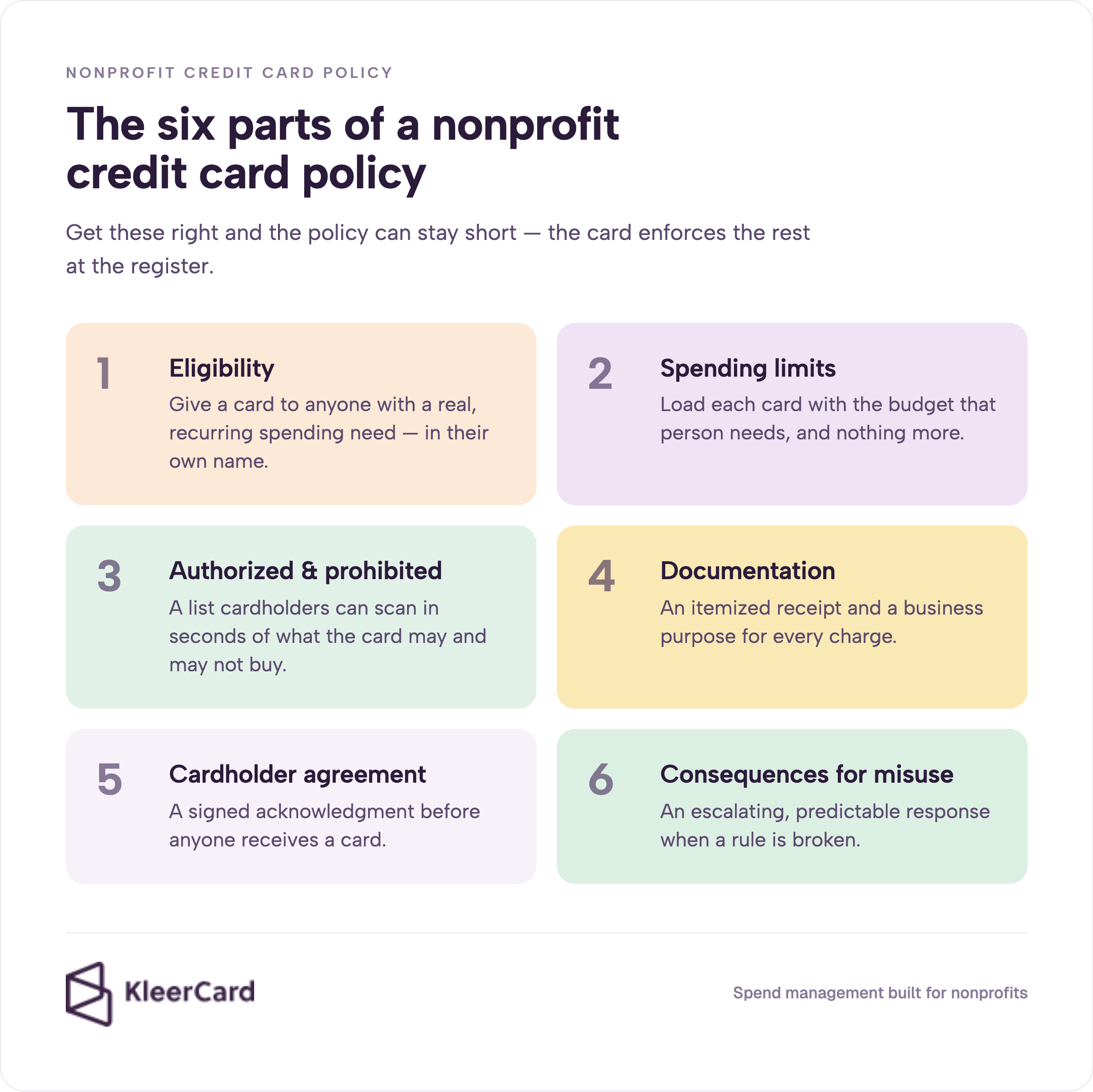
Name who qualifies for a card and who approves the request. Tie eligibility to a real spending need, not to a job title. A children's ministry leader buying supplies every week has a clearer case than a director who reimburses twice a year.
Give each regular spender a card in their own name. When one shared card floats around the office, finance cannot trace a charge back to a person. Giving each spender their own card is what makes that tracing possible, and I call it line of sight accountability. One card, one name, one clear owner for every transaction.
Most worry about credit cards starts with the limit. We picture a fixed monthly cap and treat it as the safeguard. A fixed cap does less than people expect.
A stronger approach is to load each card with the budget that person needs and nothing more. On our cards you can load a year, a quarter, or a single project, and the card cannot spend past it.
For someone new, you can even issue a card with a zero balance. They can buy nothing until a budget is requested, approved, and loaded.
Approval becomes the safeguard. The card spends once a budget is approved and loaded, and it declines anything before that.
Your policy should still name the standard limit types:
A high-limit card kept in a drawer feels like control. Staff check it out, use it, and return it. Whoever holds it could put a down payment on a Tesla, and nothing would stop them.
A budget sized to each person gives you control that holds at the register, while a locked drawer only looks safe. Many nonprofits run this backwards, adding friction that raises risk instead of lowering it.
Give cardholders a reference they can scan in seconds.
Refunds for returned goods go back to the card, never as cash to the cardholder. And any rewards, cashback, or rebates a card earns belong to the organization, so the policy should name the fund they record to.
Every charge needs a paper trail, and the IRS sets a clear floor. For travel, meals, gifts, and similar expenses, keep the itemized receipt on any purchase of $75 or more. Keep one for all lodging regardless of cost. For every purchase, record the amount, date, place, and business purpose, even when no receipt is required.
Many organizations apply that same $75 standard to all card spend, which keeps the rule simple and the audit trail consistent. The current rules sit in IRS Publication 463.
Turn that into two policy rules:
You can make this self-enforcing. Some organizations I work with ask us to lock a card after a few days when a receipt has not come in. It unlocks once the paperwork is current.
One school we work with went from chasing about five receipts a week to losing fewer than five across most of the school year. Staff photograph the receipt at the register now, before it has a chance to disappear. Another finance manager I spoke with had spent about two and a half hours every month keying card statements by hand. That lost time is the real cost of weak documentation.
Pair the rule with automatic receipt capture and the monthly chase mostly goes away.
Before anyone receives a card, have them sign a short agreement. It confirms they have read the policy, accept responsibility for any misuse, and will return the card when they leave or change roles. A signed page removes any later argument about what was understood.
Set an escalating response so enforcement stays fair and predictable:
Escalating steps keep enforcement predictable, so nobody feels singled out when a rule gets applied.
You do not have to hand everyone a card and a policy on the same Monday. The smoothest rollouts I have seen start small and expand once a group is comfortable.
A school we work with started with its hardest department first, the operations team handling maintenance, vehicles, and supply runs. Ironing out the messiest workflow first made everything after it easier, and that group was fluent within days.
Administrators came next, so they could coach their own people instead of fielding confused questions. Teachers, coaches, and support staff followed. The whole first layer was running within about two months.
The same staging works for a church or any nonprofit. Pick the team with the messiest spending, get them solid, and learn how they use the cards. Then adjust the policy where reality differs from the draft. The policy gets stronger each time because it reflects how people spend, not how you guessed they would.
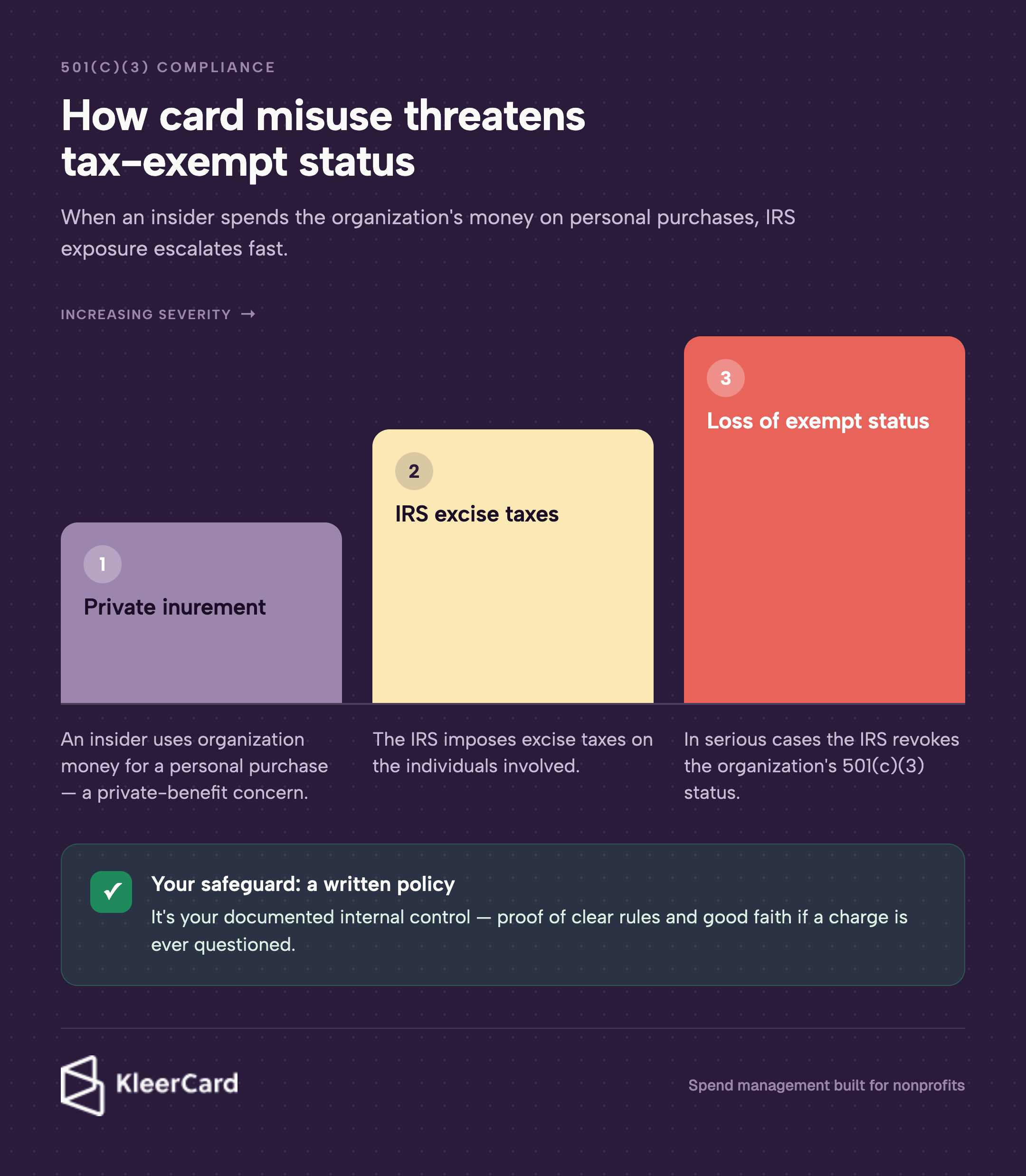
A 501(c)(3) has to operate for public benefit, and none of its earnings can benefit insiders. When someone with influence in the organization uses its money for personal purchases, that raises private inurement concerns. The IRS can respond with excise taxes on the people involved. In serious cases it can revoke exempt status.
A written policy is your documented internal control. It shows that you set clear rules, separated valid purchases from invalid ones, and acted in good faith. If a charge is ever questioned, that record protects the organization and the people who run it.
Two habits make the card do the enforcing, without buying enterprise software.
First, match authority to ability. When each card carries the right budget and the right settings, the policy holds at the moment of purchase.
A fuel-only card is a small, vivid example. Punch a hole in it and hang it on the van key ring. The policy is one line: under half a tank, stop and fill up. It buys gas and nothing else, so the next driver never finds the van near empty.
Second, keep approvals realistic. We built our controls for organizations whose approver might be at summer camp for five weeks with no cell signal. Finance can keep working while a sign-off waits.
We do not run linear manager-approval locks or build the tiered approval chains that route different dollar amounts to different approvers. Teams that need that level of enterprise workflow should know that up front and choose accordingly.
These two habits are the heart of good spending controls, and they make month-end expense reporting far less painful.
Use this as a starting point and tailor it with your CPA or board before you adopt it. Bracketed fields are yours to fill in.
[Organization Name] Credit Card Policy
1. Purpose and scope. This policy governs the use of all credit cards issued in the name of [Organization Name]. It applies to every employee, officer, and authorized volunteer who holds an organization card.
2. Eligibility and issuance. Cards are issued to individuals with a recurring business need to make purchases on behalf of [Organization Name]. Each request requires written approval from [approver title]. Cards are issued in the cardholder's name and may not be shared.
3. Spending limits and approvals. Each card carries a budget set to the cardholder's role and reviewed [monthly / quarterly / annually]. Purchases above [$ amount] require pre-approval from [approver title]. Cardholders may not split a purchase to stay under a limit.
4. Authorized and prohibited purchases. Cards may be used for approved program, travel, event, and vendor expenses. Cards may not be used for personal purchases, cash advances, gift cards, or alcohol unless the board approves an exception. Refunds for returned items must post back to the card. Any rewards or rebates earned belong to [Organization Name] and are recorded to [fund or account].
5. Documentation. Cardholders must submit an itemized receipt and a business purpose for each purchase within [number] days. A receipt is required for any purchase of $75 or more and for all lodging. The amount, date, place, and business purpose must be recorded for every purchase. Undocumented charges are the personal responsibility of the cardholder.
6. Lost, stolen, or misused cards. Cardholders must report a lost or stolen card to [contact] within 24 hours. Misuse may result in a written warning, repayment of unauthorized charges, card revocation, or termination, depending on severity.
7. Cardholder agreement. Before receiving a card, each cardholder signs an acknowledgment. It confirms they have read the policy, accept responsibility for misuse, and will return the card on departure or a role change.
_Cardholder signature: __ Date: ___
It can. Personal use of organization money by an insider raises private inurement concerns under section 501(c)(3). The IRS can impose excise taxes on the people involved and, in serious cases, revoke exempt status. A written policy and consistent documentation are the controls that show good faith.
Give cards to people with a genuine, recurring need to spend, and put each card in one person's name. Match the budget on the card to that person's role, so the limit fits how they spend.
For travel, meals, gifts, and similar expenses, the IRS expects a receipt on any purchase of $75 or more. Lodging always needs one, regardless of amount. For every purchase, keep a record of the amount, date, place, and business purpose, even when no receipt is required. The details live in IRS Publication 463.
A signed agreement is strongly recommended. It confirms the cardholder has read the policy, accepts responsibility for misuse, and will return the card on departure or a role change. The signature removes ambiguity later.
They can, when there is a clear need, such as a volunteer leading a mission trip or running an event budget. Issue a card with a fixed budget and the same documentation rules, so a short-term spender carries the same accountability as a staff member.
A credit card policy governs a line of credit, while a debit card policy governs cards tied to your bank account. The spending rules, documentation requirements, and consequences should look the same in both.
A credit card policy keeps donor money accountable and your books audit ready, without slowing the work down.
Write the parts that fit your organization, and have a CPA or your board review it. Then put it in front of every cardholder before they swipe. The sample above gives you a place to start.
If you want a card that enforces the policy for you, that is what we set out to build. KleerCard for nonprofits, churches, and schools includes right-sized budgets and receipt prompts. If all you need today is the policy, take the template and run with it.


Speak to a member of our team and we can have you up and running in minutes, not weeks.