%202.svg)
Learn the four core nonprofit financial statements, how to read/prepare them, key ratios, real examples, and how modern tools improve accuracy and donor trust.
Nonprofit financial statements aren’t just compliance paperwork. They’re the clearest window into whether your organization is actually stewarding donor dollars.
I’ve spent years helping churches, schools, and nonprofits get their spending under control. Every time we sit down with a board or finance team, the conversation eventually circles back to these four core reports. When they’re accurate and timely, decisions get easier. When they’re messy or months out of date, trust erodes fast.
In this guide I walk through exactly what the four statements are, why they matter more now than ever, how to prepare them, what to watch for in the numbers, and how modern spend-management tools can make the entire process dramatically cleaner.
If you lead or support a nonprofit, this is the practical reference I wish I’d had when I first stepped into the finance side of mission-driven work.
Every tax-exempt organization files Form 990 with the IRS, and those filings pull directly from your financial statements. Donors, grantmakers, Charity Navigator, and GuideStar all look at the same numbers.
In my experience the organizations that treat these statements as a living management tool—rather than an annual checkbox—build stronger donor relationships and make better program decisions.
The stakes have risen. Donors now expect real transparency on how funds are used. Boards carry fiduciary responsibility that includes understanding liquidity, restricted resources, and functional expense allocation. When statements are late or full of manual adjustments, it’s harder to spot risks early.
I’ve seen churches and schools turn around their financial health simply by getting cleaner, more frequent data flowing into these reports. Nonprofit spend management tools make that shift practical.
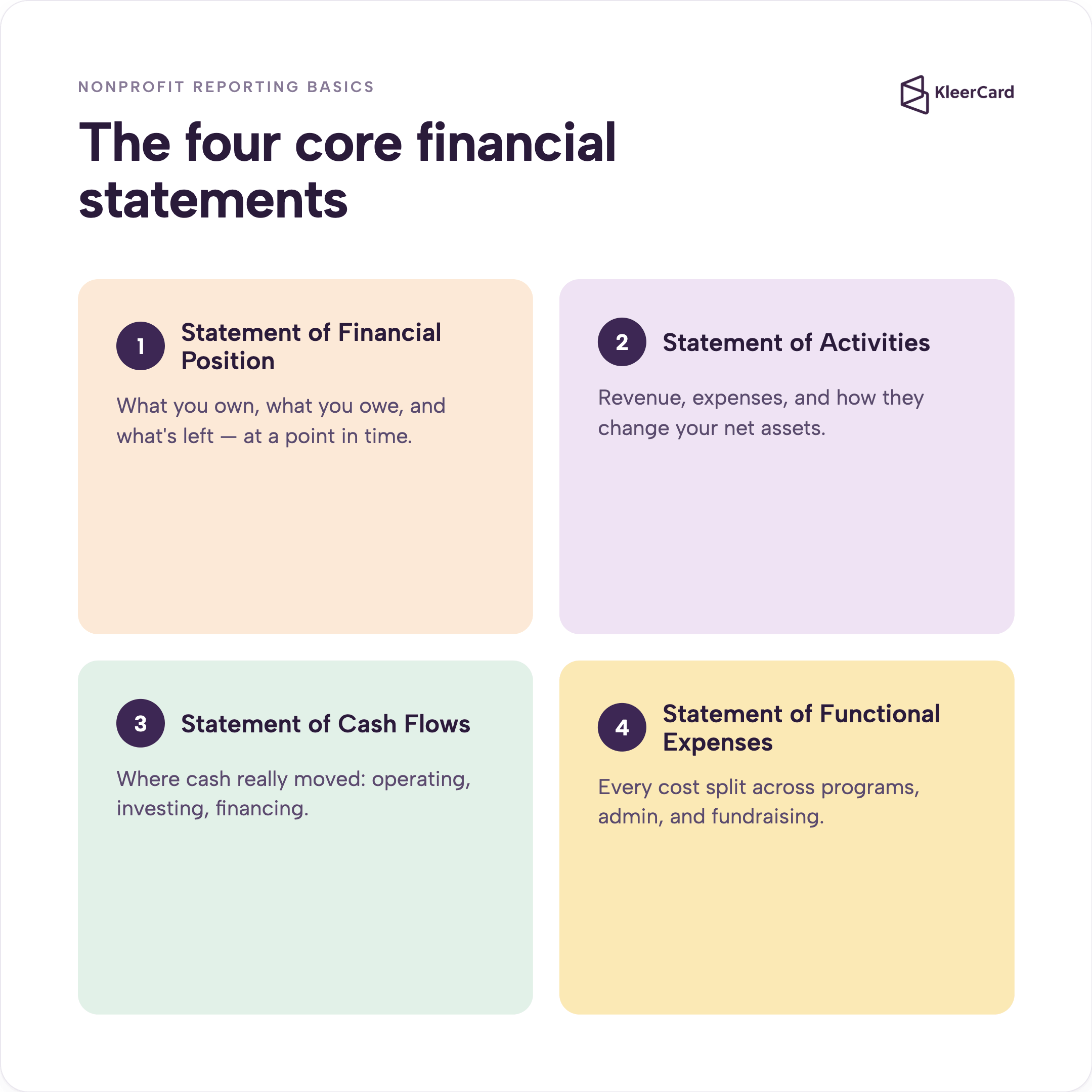
Nonprofits prepare four primary statements under U.S. GAAP. Each tells a different part of the story. Together they give a complete picture of financial health.
This is your nonprofit’s balance sheet—a snapshot of what you own, what you owe, and what’s left at a specific point in time. Assets appear in order of liquidity. Liabilities follow. Net assets are split into two categories required by ASU 2016-14: “with donor restrictions” and “without donor restrictions.”
In practice I look first at days of cash on hand and the current ratio. A healthy nonprofit usually maintains 90–180 days of operating reserves and a current ratio above 1.0. The net-asset split shows how much of your resources can be used right away versus how much is locked by donor intent.
Tracking restricted funds and grants accurately starts right here. When I help organizations implement better spend controls, this statement becomes far more useful because cash and receivables stay accurate week to week instead of month to month.
Think of this as the nonprofit version of an income statement, except it tracks changes in net assets rather than profit. It shows all revenue and expenses for the period and how those flows affect each class of net assets.
I always scan the revenue mix first—how diversified it is—and then the functional expense breakdown. A program expense ratio that consistently lands around or above 75% tells a strong story to donors, though startups or organizations making infrastructure investments may run lower for a season.
The real power comes when you can compare actuals to budget by fund and see exactly where restricted dollars were spent versus where they were supposed to be spent. That visibility is where many organizations struggle until they tighten their transaction workflows.
Cash tells the truth that accrual accounting sometimes hides. This statement breaks cash movement into operating, investing, and financing activities. For nonprofits, restricted gifts for long-term purposes often appear in financing activities.
I pay close attention to operating cash flow. Negative trends here—even when the Statement of Activities looks healthy—signal timing problems with receivables, delayed grant reimbursements, or expense spikes that aren’t yet reflected in net assets. Organizations that capture receipts and code transactions in real time see far fewer surprises on this report.
This matrix shows every expense line allocated across programs, management & general, and fundraising. It is required for many Form 990 filers and is one of the first places donors and rating agencies look.
Accurate allocation depends on clean source data. When cards are tied to specific departments or programs from the moment they’re issued, the functional split becomes almost automatic instead of a year-end guess. In my own church we run 21 cards across staff and volunteers; the functional breakdown is clear every week because the transactions carry the right coding from day one.
Start with the right foundation. Most nonprofits use accrual-basis accounting and fund accounting so they can track donor restrictions properly. Choose accounting software that supports both—QuickBooks Online works for many smaller organizations, while Shelby, Aplos, ACS Technologies, Realm, or Blackbaud handle more complex fund structures.
For help choosing the right platform, see our guide to the best accounting software for churches and nonprofits.
Gather your source data: bank feeds, credit-card transactions, payroll records, donor pledges, and grant agreements. This is where many organizations lose time and accuracy. I’ve seen finance teams spend hours each month chasing receipts and trying to match Amazon charges.
When you give people their own cards with built-in receipt capture and department-level coding, the source data arrives clean and categorized.
Run your reconciliations regularly—weekly if possible. Load transactions into your accounting system, allocate to the correct funds and functions, and review for variances against budget. Generate the four statements, add the required notes and disclosures (liquidity, restrictions, significant estimates), and have your finance committee or board review them on the schedule you set (monthly for finance, quarterly for full board).
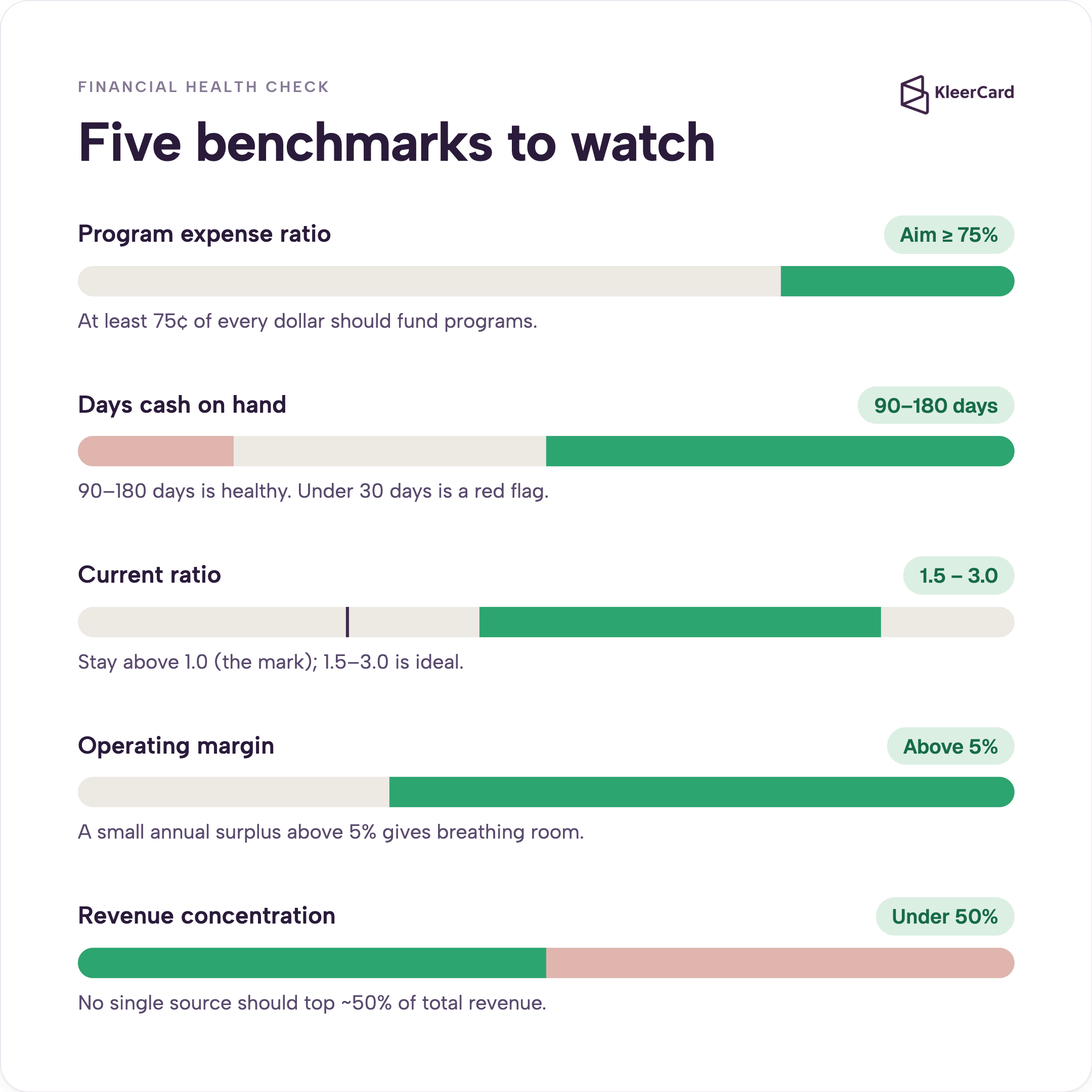
Look at these numbers every time you review statements:
These ratios become far more reliable when your underlying transaction data is timely and correctly coded.
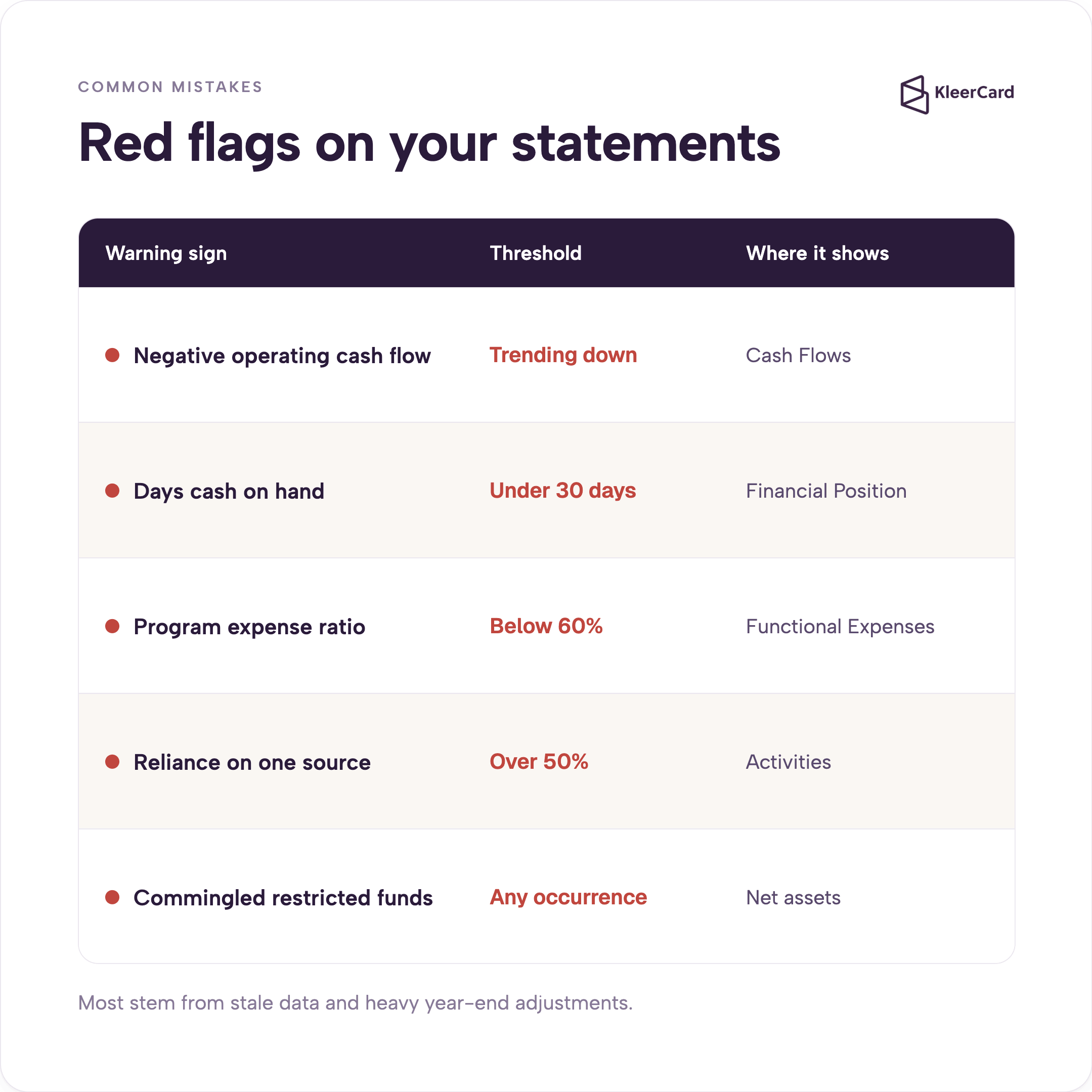
The most frequent issues I see are commingling restricted funds, inaccurate functional expense allocations, and stale data that forces heavy year-end adjustments. Red flags include negative operating cash flow, declining days cash on hand, program ratios dropping below 60% without explanation, or heavy reliance on a single revenue source.
Another subtle risk is treating precision as the same thing as usefulness. Bookkeepers sometimes chase hyper-granular coding that doesn’t actually change decisions. Align your chart of accounts and dimensions (funds, departments, programs) to the questions leadership actually asks.
Publicly available statements from organizations like Best Friends Animal Society, Trevor Noah Foundation, Oxfam, and Habitat for Humanity show the four reports in action. In my own church we manage 21 cards with only 2.5 paid staff. The statements stay clean because every transaction is captured and coded in real time.
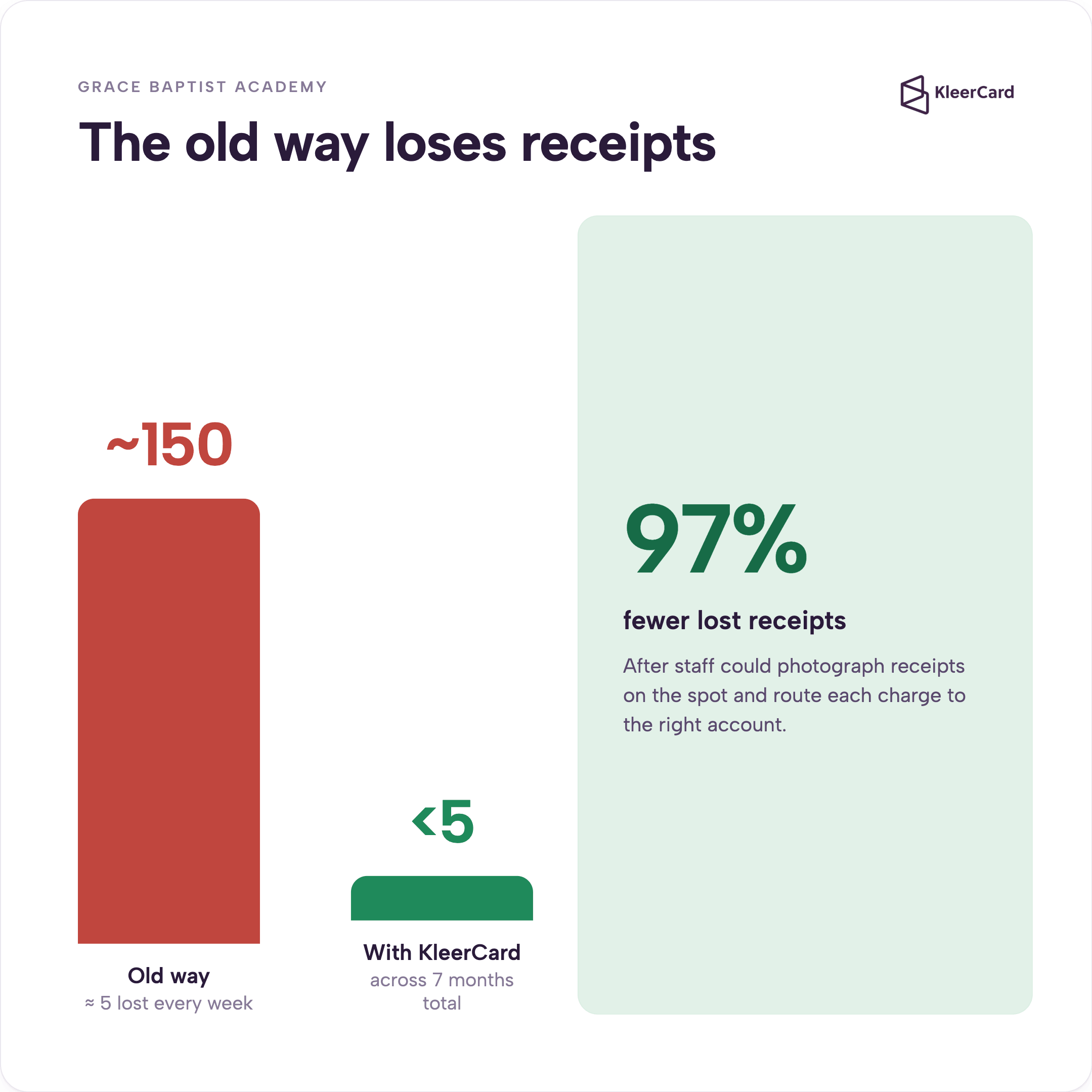
At Grace Baptist Academy, the finance team cut lost receipts from roughly five per week to fewer than five across seven months once staff could photograph receipts on the spot and route charges directly to the right accounts.
The biggest leap forward happens when transaction data flows into your accounting system automatically and accurately. Real-time card spend, receipt upload at point of purchase, and integrations with Amazon Business and your GL mean fewer manual entries and fewer month-end surprises.
Our expense management platform and seamless direct accounting integrations are built exactly for this. Amazon Business expense tracking further reduces the manual matching that used to eat hours every month. Finance teams I work with now check statements weekly instead of waiting until close. That cadence keeps the four core reports reliable and actionable all year long.
If you’re still chasing receipts or reconciling statements the old way, you’re carrying unnecessary risk and spending hours that could go to mission work. Tools built specifically for nonprofit spend management close the gap between daily activity and the numbers your board and donors need to see.
Nonprofit financial statements exist to show stewardship, not just compliance. When they’re timely, accurate, and easy to understand, boards make better decisions, donors trust more deeply, and programs stay sustainable.
The four core reports—Statement of Financial Position, Statement of Activities, Statement of Cash Flows, and Statement of Functional Expenses—give you everything you need once the underlying data is clean.
If your team is spending too much time on manual reconciliation or losing visibility into restricted funds, it’s time to modernize the front end of your financial process. Cleaner data at the transaction level makes every statement stronger.
Ready to get your spending data working for your statements instead of against them? Sign up for KleerCard or schedule a demo to see how real-time controls and integrations can simplify the entire reporting cycle.
The four core statements are the Statement of Financial Position, Statement of Activities, Statement of Cash Flows, and Statement of Functional Expenses.
Nonprofits focus on changes in net assets (with and without donor restrictions) rather than profit, and they must show functional expense allocation.
It simplified net-asset classes to “with donor restrictions” and “without donor restrictions,” making donor intent clearer on the face of the statements.
Not always, but most organizations with significant revenue or assets benefit from an audit or review for credibility with donors and grantmakers.
It delivers clean, coded transaction data in real time with receipt capture and accounting integrations, reducing manual work and improving accuracy across all four statements.
It shows how much of every dollar goes to programs versus administration and fundraising—information donors, grantors, and rating agencies rely on heavily.
Owen Hill is co-founder of KleerCard. He works directly with churches, schools, and nonprofits to replace manual receipt chasing and shared cards with real-time, coded spend data that feeds cleaner financial statements. His focus is practical tools that reduce admin burden while strengthening transparency and board oversight.


Speak to a member of our team and we can have you up and running in minutes, not weeks.