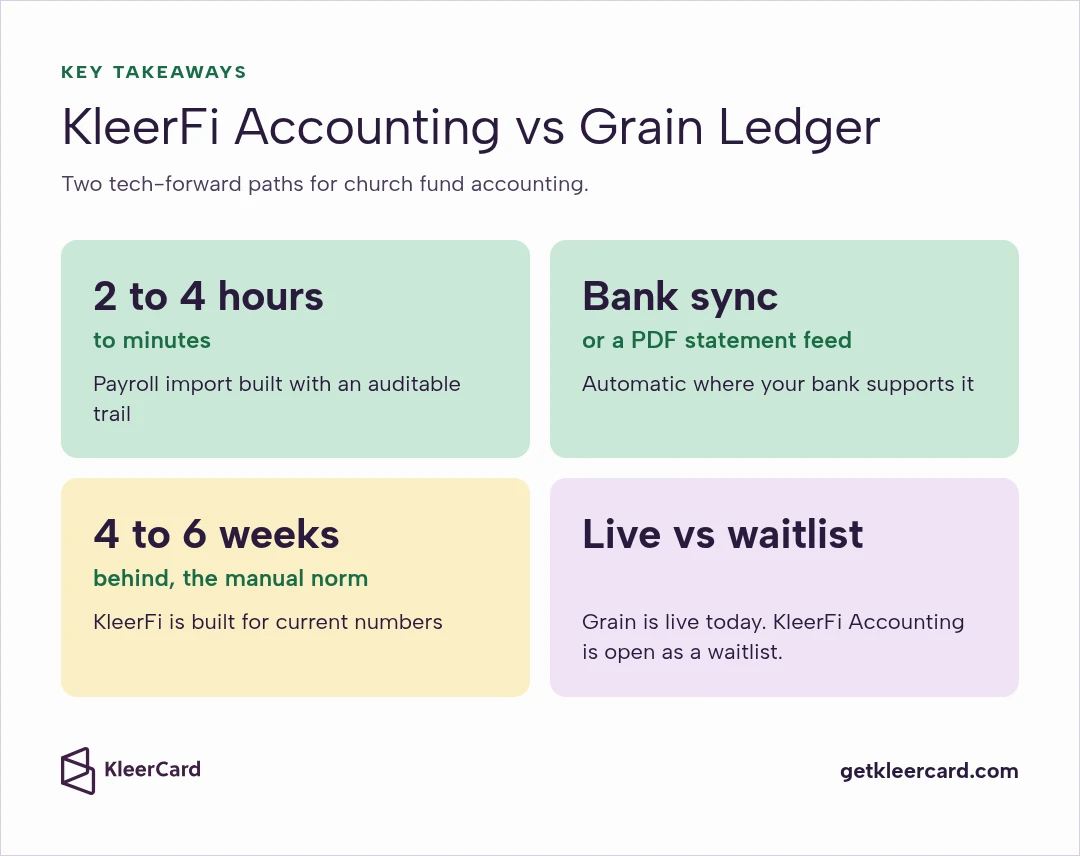
Compare KleerFi Accounting and Grain Ledger on fund accounting, manual entry, pricing, and availability. Grain is live today; KleerFi is on a waitlist.
For years, churches that need fund accounting have faced a hard choice. Legacy fund accounting tools such as Aplos, ACS, Realm, and Shelby (now called Amplify) keep funds clear, but some legacy tools lack bank feeds, so a lot of the work is typed in by hand. QuickBooks feels more modern, yet fund accounting is very difficult to do well there.
Grain Ledger and KleerFi Accounting both set out to give churches a better, tech-forward path. Grain Ledger is church fund accounting software that's live today. KleerFi Accounting is the fund accounting ledger KleerCard is building to cut manual entry, you can join the waitlist here.
Legacy fund accounting tools are trusted systems of record. Once the work is done, it's easy to see how much sits in an improvement fund versus the general fund, and to know restricted gifts are being spent the right way.
The cost of that confidence is manual entry. Some of these tools don't support APIs or direct connections, and some lack bank feeds, so payroll, donations, and expenses get typed in by hand. Aplos is the most advanced of the legacy group, and it's still a heavily manual process for many teams.
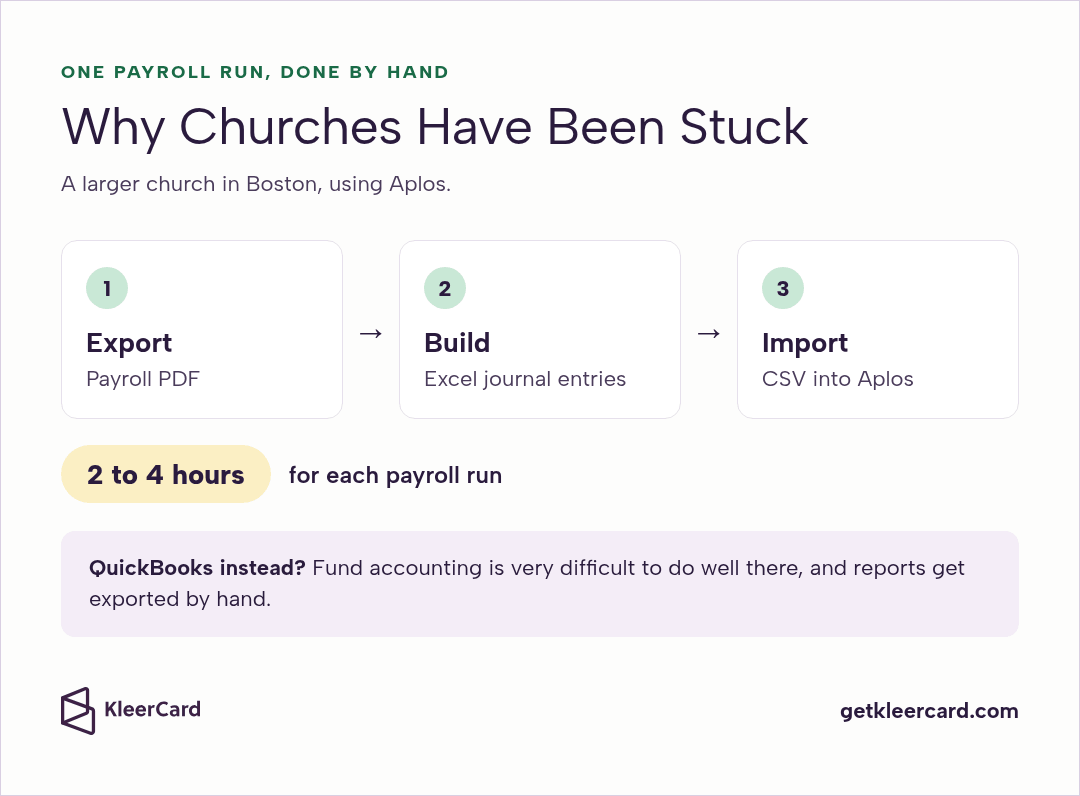
The administrator at a larger church in Boston spends 2 to 4 hours on each payroll run. He exports a PDF from the church's payroll provider, builds journal entries in an Excel worksheet he made, and then imports them into Aplos as a CSV.
QuickBooks brings a different set of pains:
For more on the reporting side, see why QuickBooks can't produce a true fund balance sheet. For a look at the two most common choices today, see Aplos vs QuickBooks for churches.
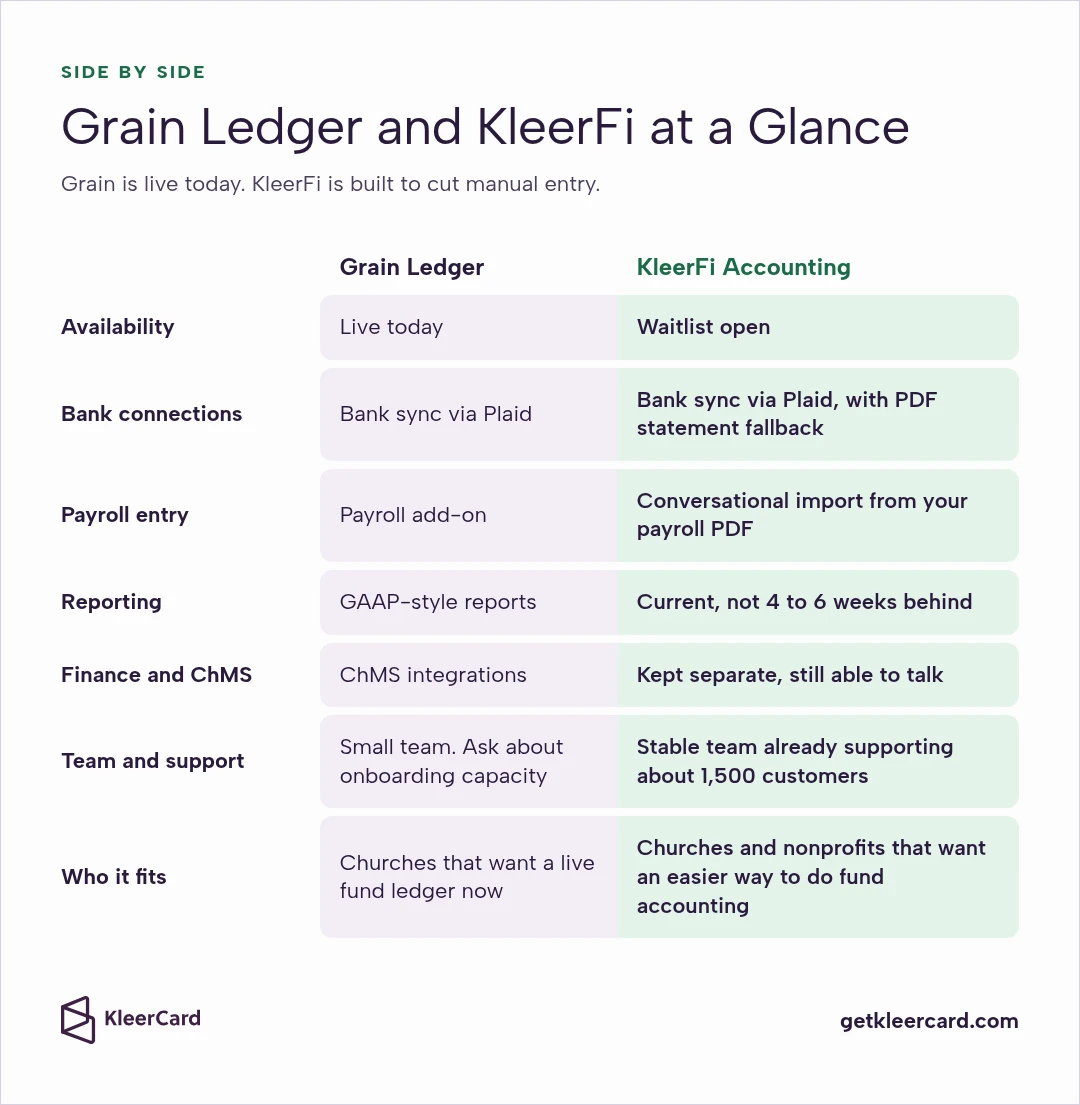
Grain Ledger is live today; KleerFi Accounting is on a waitlist and is built to cut manual entry.
| Dimension | Grain Ledger | KleerFi Accounting |
|---|---|---|
| Product job | Church fund accounting software | Church fund accounting ledger built to cut manual entry |
| Availability | Live today | Waitlist open |
| Fund accounting | Double-entry fund accounting with restricted gift tracking, per Grain's site | Built to keep fund balances clear |
| Manual entry and imports | Giving connections listed for Planning Center, Pushpay, Rock RMS, Subsplash, and OnlineGiving.org; Tithely listed as Coming Soon | Conversational payroll import from your payroll PDF, built to take minutes |
| Bank connections | Bank sync via Plaid | Bank sync via Plaid |
| Reporting cadence | Fund balances, budgets, and GAAP-style reports, per Grain's site | Built so your team sees current numbers, not numbers 4 to 6 weeks behind |
| Finance and ChMS | ChMS integrations listed on Grain's pricing page | Built to keep finance separate from your ChMS, with the two still able to talk |
| Pricing | Published on Grain's pricing page (see below) | Confirmed with you directly when available |
| Team and support | Small team. Ask about onboarding capacity for your timeline | Stable team already supporting about 1,500 customers |
| Who it fits | Churches that want a live fund ledger now | Churches and nonprofits that want an easier way to do fund accounting |
KleerFi is built so you can upload your payroll PDF and walk through it in a conversational way. It's built to create the journal entries, flag a new person and ask whether to add them, and check the entries against your bank statement before you post. You can still edit anything by hand.
It's built to turn 2 to 4 hours of manual work into an auditable trail you can finish in minutes.
Many churches bank with a local bank that was kind enough to give them their mortgage. Some of those banks aren't very tech forward and don't connect well to QuickBooks or other systems.
KleerFi Accounting's base sync is automatic for banks that support it. But we also built it so you can upload your PDF bank statement and turn it into a bank feed. You don't have to change banks just to work with your software.
When the process is manual, reports often feel 4 to 6 weeks behind. Reconciliation waits on the credit card statement, and then everything gets typed in and checked.
One church we know well hadn't closed September by mid-October. A church running VBS in early June may not know what it spent until August. Your team wants current information on how the church is doing, and KleerFi is built to give it to them.
KleerCard has about 1,500 customers and will process close to $300M in transactions this year, with a deep, experienced team in this space. We're building our accounting software based on the feedback we've heard from customers for years.

Grain shares our vision for a tech-forward church finance product, and we think its technology looks good.
Grain's public site describes double-entry fund accounting with restricted gift tracking, bank sync via Plaid, giving connections, bills and expense management with Ramp and Bill.com / Divvy card sync, budgets, and GAAP-style reports. Its pricing page also lists one-click QuickBooks migration.
These are good questions to ask any vendor. They also cover the three places where we see Grain and KleerFi differently.
A church switching systems often has a fixed date, such as moving to new books by January 1. If something goes wrong in the changeover, you need help quickly.
A small team can only onboard so many customers at once. So ask how quickly you'll reach a person, and who helps during your changeover.
In my view, Grain's feature list is almost too big for a finance platform. Some treasurers want a broad platform, and others want finance software focused on finance. It's worth deciding which fits your team or church.
A ChMS (church management software) is your church's CRM: emails, events, and calendar. Changes to a ChMS involve your pastoral staff. Changes to finance usually shouldn't.
If giving is tied to your ChMS, switching ChMS can mean moving your donation platform too. That means a pulpit announcement and asking every donor to set up recurring gifts again.
I see Grain as taking a broader, ChMS-style approach. Our approach keeps finance separate, so switching either system doesn't disrupt your giving or recurring gifts, and the two systems can still talk to each other. That view comes from working with over 1,000 churches and hearing how they want to manage their finances.

Prices change, so it's worth confirming each figure on the vendor's site before you commit.
Grain Ledger (October 2026, per Grain's pricing page):
KleerFi Accounting: Join the waitlist, and we'll confirm pricing with you directly when KleerFi is available.
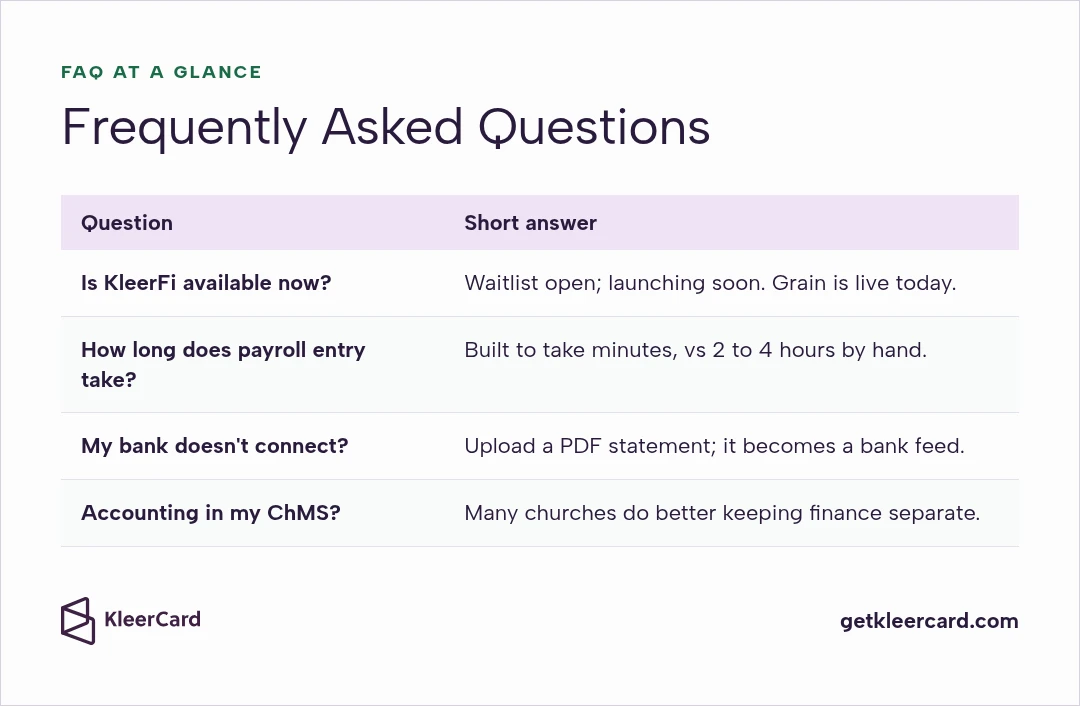
Grain Ledger is live today. KleerFi Accounting is launching soon. You're welcome to join the waitlist.
If you need a fund ledger this month, Grain or another live option fits that timeline.
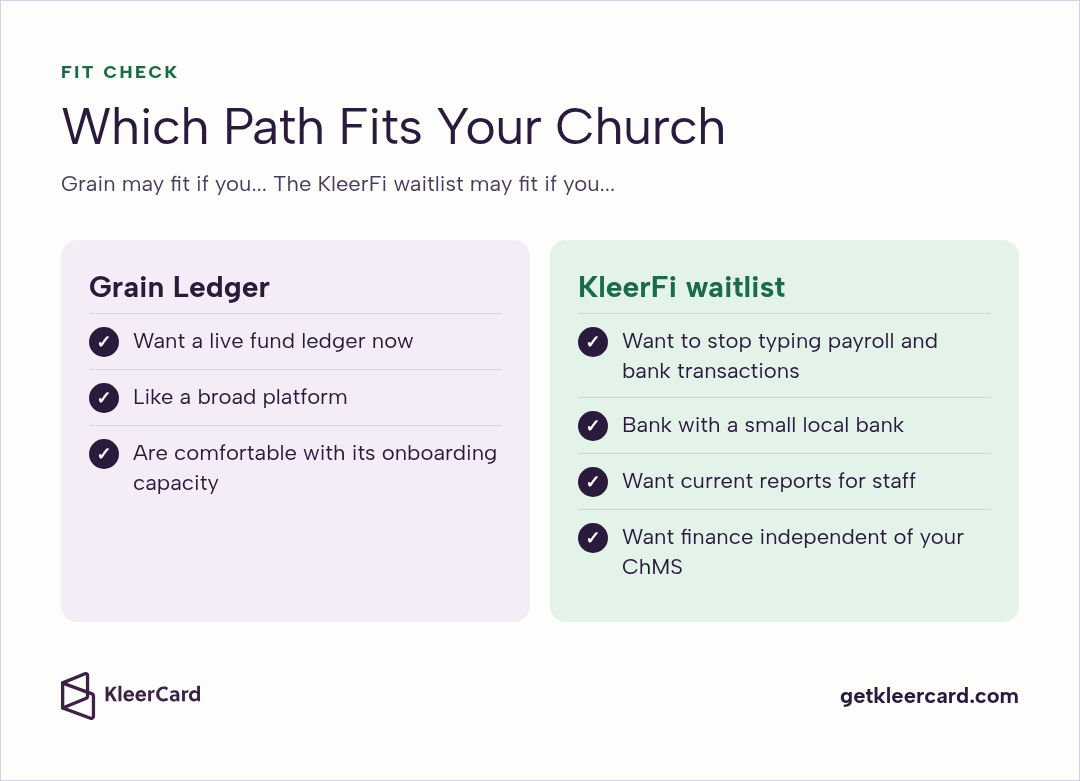
Grain Ledger may fit if you:
The KleerFi waitlist may fit if you:
To compare more options, see our guide to best accounting software for churches.
Grain Ledger is tech-forward fund accounting software for churches. Its public site describes double-entry fund accounting, restricted gift tracking, bank sync, giving connections, budgets, and GAAP-style reports.
KleerFi Accounting is the fund accounting ledger we're building at KleerCard to cut manual entry. It's built to include a conversational payroll import, bank feeds that auto-sync via Plaid or come from a PDF statement, and current reporting for your team.
KleerFi Accounting is launching soon, and its waitlist is open. If you need a system sooner, Grain Ledger is live today.
KleerFi's payroll import is built to take minutes, with an auditable trail, instead of the 2 to 4 hours a manual run can take.
Yes, KleerFi is built so you can upload your PDF bank statement and turn it into a bank feed.
Many churches do better keeping finance separate from their ChMS, so changing one system doesn't disrupt the other, though the right fit depends on your team. When giving is tied to your ChMS, changing ChMS can mean moving your donation platform and asking donors to set up recurring gifts again.
Grain's pricing page lists Starter as free for churches with up to $20,000 in monthly expenses, Growth at $70 per month, and Scale from $100 per month. Payroll is $50 per month plus $10 per employee.
We'll confirm KleerFi Accounting pricing with you directly when it's available. Joining the waitlist is the easiest first step.
Grain Ledger and KleerFi Accounting share a similar vision. Your choice comes down to a few questions. How much manual entry do you want to keep? How current do your reports need to be? What onboarding help does your timeline need? Should finance stand apart from your ChMS?
If you'd like a ledger built to take the typing out of your month, we'd love to have you on the KleerFi Accounting waitlist.


Speak to a member of our team and we can have you up and running in minutes, not weeks.