%202.svg)
Need a credit card for your Orthodox parish or diocese? Compare options that skip personal guarantees, give real-time parish visibility, and integrate with church accounting.
Orthodox parishes buy candles, icons, wine, building supplies, and feast-day food every single week. Priests and parish council members often put those costs on personal cards and wait for reimbursement. Treasures (often volunteers) then chase incomplete receipts across dozens of people.
A proper Orthodox church credit card fixes both problems at once. It gives local leaders the ability to spend while producing clean, automatic reports that keep the diocese informed without creating extra work.
I have spent years helping churches and nonprofits move off shared bank cards and personal reimbursements. And I am the Volunteer Treasurer at my Orthodox parish. In almost every case the real constraint turns out to be physical access to a card and the paperwork that follows. This guide shows what actually works for Orthodox dioceses and parishes in 2026.
You will see the decision criteria that matter, a clear comparison of the realistic options, and the setup that balances parish flexibility with diocesan stewardship.
Scroll down to see a comparison chart and our top picks.
KleerCard works well for the reality in most Orthodox jurisdictions: parishes run day-to-day spending while automatically keeping reports and data clean so they’re easy to report to the parish council or send to the diocese. Each parish gets its own cards with its own budget limits. The parish controls its spending. The diocese receives accurate, coded transactions without chasing receipts.
Orthodox financial life sits between two poles. Parishes need speed for liturgical items, feast-day hospitality, and emergency repairs. The diocese needs reports, consistent coding to restricted funds, and audit-ready documentation without becoming a bottleneck.
General business cards miss most of this. A purpose-built expense management platform built for churches and Orthodox parishes solves the visibility and fund-tracking problems at the same time.
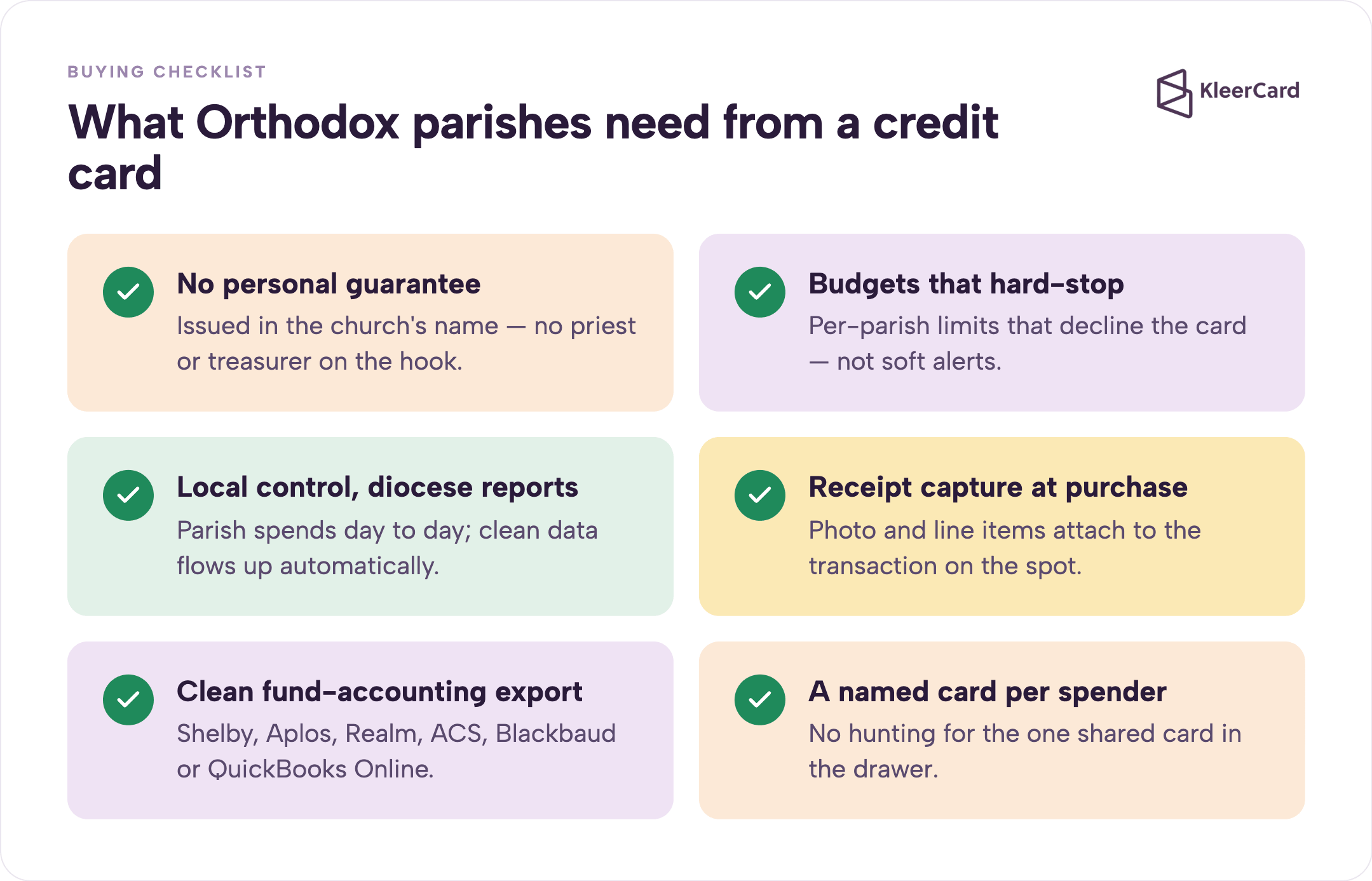
Cards must be issued in the church’s name with no personal guarantee from the priest, treasurer, or parish council president. Per-parish or per-ministry budgets have to stop spending the moment the limit is reached. Parishes get timely visibility and controls locally. Clean data then flows automatically to the diocese for oversight and reporting.
Receipt capture has to attach the photo and line items to the transaction automatically. And the data must export cleanly into the fund-accounting platforms Orthodox parishes actually run: Shelby, Aplos, Realm, ACS Technologies, Blackbaud, or QuickBooks Online with classes.
The person who needs to buy altar wine has to hunt for whoever holds the physical card that day. That person is often at another location or busy. Reloadable, named cards assigned to each spender or council member eliminate that friction. The parish controls its own spending within approved limits while automatically generating clean reports the diocese needs.
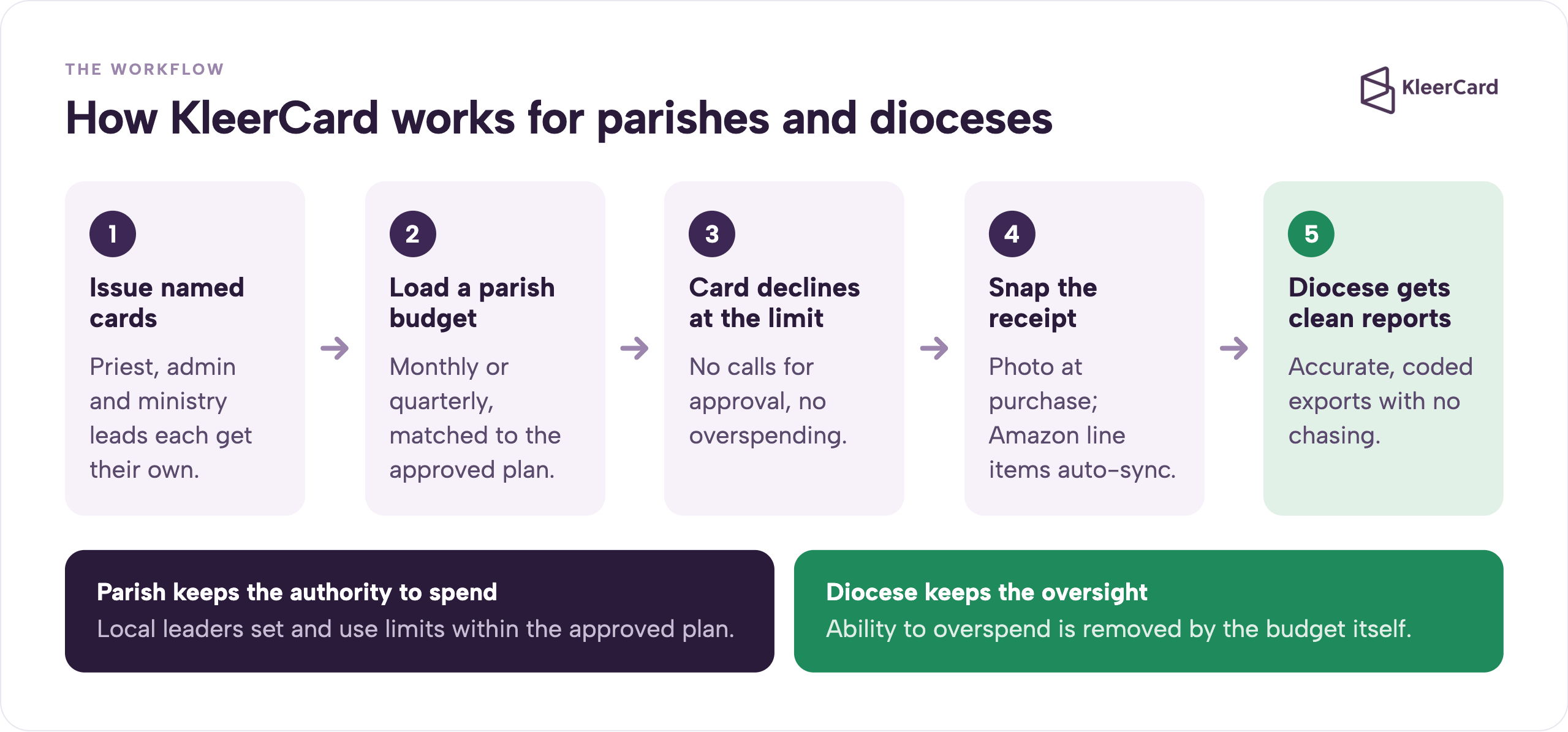
Issue physical or virtual cards to the priest, parish administrator, or designated ministry leads at each location. Load a monthly or quarterly budget that matches the parish’s approved spending plan. When the budget is gone the card simply declines.
No one has to call the priest for every small purchase. No one can overspend. Authority to spend and set limits stays with the parish. Ability to overspend is removed by the budget limit the parish itself establishes. This is the core of a nonprofit credit card with no personal guarantee built for Orthodox parishes.
Many parishes need temporary cards for a feast-day festival, a youth trip, or a building project. Create a single-use or time-limited virtual card, assign it to the volunteer or staff member, and turn it off when the event ends.
The same pattern works for summer camps or mission trips under diocese or parish oversight. At my parish, the summer camp director barely needs a card most of the year but becomes the heaviest spender leading up to summer camp. She simply has one in her name and uses it when the camp rolls around.
The cardholder photographs the receipt at the point of purchase. Amazon Business line items sync automatically when that integration is connected. The parish gets clean documentation automatically. The diocese receives accurate reports and exports without manual chasing.
I have watched month-end reconciliation move from lengthy manual statement processing to a few minutes of review once the weekly rhythm is in place. One organization that rolled out over 60 cards reported fewer than five lost receipts across seven months. Before that, staff were chasing roughly five lost or late receipts every single week.
The same pattern helps Orthodox parishes keep clean books locally while giving the diocese the reports it needs.
Orthodox churches routinely handle restricted gifts: building funds, scholarship funds, cemetery funds, specific ministry gifts. This follows Orthodox stewardship guidelines that emphasize intentional management of resources entrusted to the parish.
Map each card or each transaction to the correct fund or class in your chart of accounts.
I have seen too many charts of accounts explode because people create separate accounts for every parish’s supplies. The cleaner approach is one “liturgical supplies” account plus a parish dimension. You can still slice the data any way you need for reporting, but you stop rebuilding custom reports every time someone asks a simple question. This is exactly why fund accounting best practices for Orthodox parishes and dioceses emphasize dimensionality over fragmented accounts.
Priests and volunteers buy what the parish needs, submit a form, wait weeks, and sometimes lose the receipt. The diocese ends up with incomplete documentation and delayed books.
Named church cards with photo capture stop that loop. The receipt is already in the system before the person even leaves the store.
A parish keeps one or two high-limit cards in a drawer. Anyone who needs to spend must find the person who has the card. That person is often the priest, who is often busy.
I have heard the exact same story from schools and churches for years. A maintenance director who needed to fix a toilet first had to locate whoever held the card and coordinate to get it. Only then could he drive to Home Depot.
Or he could use his personal card for the purchase and submit a reimbursement. Which is still more work for the treasurer.
The constraint was never trust or money. It was physical access to a card. That delay sat between a real need and the fix. Practical spending controls for parish treasurers and diocesan finance teams eliminate exactly this kind of operational friction.
Parishes often order books, candles, and supplies on Amazon. When those charges hit a shared personal Amazon account the audit trail disappears and personal/business lines blur.
An Amazon Business account paired with controlled cards keeps every line item attached to the correct parish and fund. The hospitality director in one parish we work with can buy tablecloths and balloons for an event. The charge arrives already itemized and tagged to her card. She codes it to the right account without the finance office having to guess what event it was for.

Volunteer treasurers still spend hours each month collecting receipts from priests and parish secretaries. After cards with automatic capture, that work drops to near zero.
We check in weekly now instead of facing a monthly mountain. By the end of the month the credit-card work is already done.
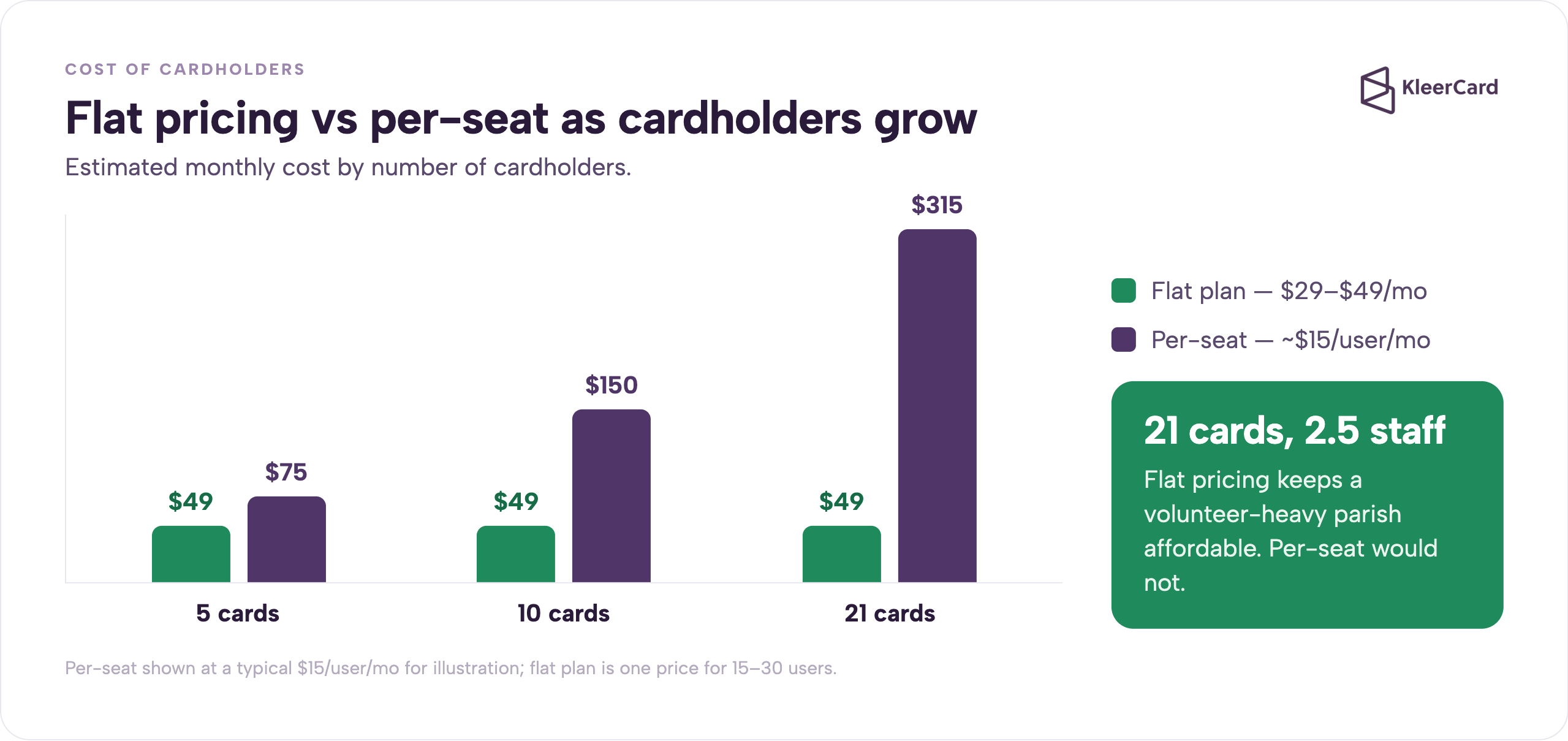
Start with two or three pilot spenders, usually the largest spenders. Issue cards, load budgets, and connect Amazon Business if relevant. Run one full billing cycle so the finance team sees the weekly reconciliation rhythm.
Expand to the remaining spenders once the workflow is proven. Add bill pay and reimbursements later if the parish still writes checks for larger vendor payments.
We usually recommend starting with the messiest department first so you iron out the workflow where it is hardest. Once that group is comfortable, the rest of the rollout moves quickly. Most teams finish the first layer in about two months. Virtual cards are live the same day. Physical cards arrive in five to eight days.
Typical implementation is three 30-minute calls. We sit down with the finance team and customize the setup rather than sending people to YouTube videos.
Yes. Several platforms built for 501(c)(3) organizations issue cards to the church’s EIN with no personal guarantee required from the priest or treasurer. KleerCard, Devote, and Charity Charge all operate this way. Traditional bank and credit-union ministry cards often still require one.
Assign each spender their own budget-loaded card. The finance team sees every transaction in real time on one dashboard, can pause or reassign any card instantly, and receives automatic receipt attachments. Authority to spend stays with the parish. Ability to overspend is removed by the budget limit.
The platforms that matter most for Orthodox parishes are ShelbyNext Financials, Aplos, Realm, ACS Technologies, Blackbaud Financial Edge NXT, and QuickBooks Online with classes for fund tracking. Choose a card platform that either offers a native integration or a clean, fund-ready CSV export that matches your software’s import format. For more information, see our review of church accounting software.
Reimbursements drop dramatically once named cards are in place, but they never go to zero. Mileage for clergy travel, one-off volunteer expenses, and emergency purchases still happen. Keep a simple vendor-based ACH reimbursement process for those remaining cases so they never run through payroll.
Most parishes complete a staged rollout in six to eight weeks: two weeks of pilot, then progressive expansion. Emergency cutovers when an old provider is shutting down can be done in two weeks with virtual cards first.

The right Orthodox church credit card is not the one with the highest cash-back rate. It is the one that lets a parish priest or council buy what the parish needs today while automatically producing the clean, coded records the diocese needs for oversight — with almost no manual chase.
If your current setup still depends on personal cards, shared drawer cards, or monthly receipt hunting, the fix is straightforward. Give every legitimate spender a right-sized, named card controlled at the parish level. The parish gets local visibility and spending discipline. The diocese gets accurate reports and exports.
I have watched the same transformation in schools, churches, and nonprofits of every size. The technology handles half of it. The other half is getting the right information in the first time. When both pieces work together, the finance office stops being the bottleneck and starts being the clear source of truth.
Sign up for KleerCard or schedule a short demo to see how parishes can control their own cards while automatically maintaining clean data that can be easily exported for the diocese. Most teams are live with pilot cards inside two weeks.
For more on how this works specifically for Orthodox multi-parish structures, see our Orthodox diocese and parish spend management page. You can also compare the full field of options in our best credit cards for churches guide or review credit cards for nonprofits with no personal guarantee.


Speak to a member of our team and we can have you up and running in minutes, not weeks.