
Grant accounting is how a nonprofit tracks each award in the books, from revenue recognition to budget vs actual and year-end close.
Grant accounting is the work of recording each grant in your books so the money is recognized at the right time, spent only on allowed costs, and reported back to the grantor without mixing it into unrestricted cash.
That's a ledger job. It's close to, and different from, grant management, which is the work of finding awards, applying, and staying on the funder's reporting calendar. If you need the operations side, see our nonprofit grant management guide.
I co-founded KleerCard after two decades in nonprofit finance, and I still keep the books for my own church. The grants I've watched closely weren't always large, but they were specific. A $15,000 foundation award for a summer program will make a mess of the year if it's booked as if it were a regular Sunday offering.
Grant accounting is how a nonprofit tracks the cash, revenue, expenses, and remaining balance of each grant award. You keep a file for the award, you tag spending to that award, and you can show a budget vs actual view when the funder or an auditor asks.
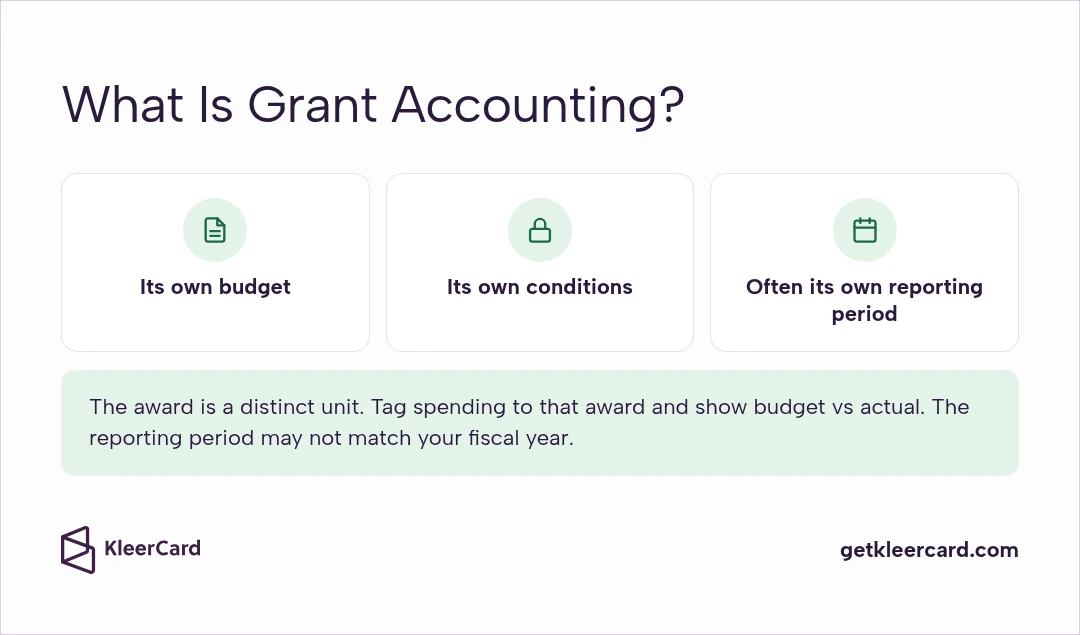
Ordinary nonprofit accounting already uses funds and net asset classes, which our fund accounting for nonprofits guide walks through. Grant accounting adds the award as a distinct unit: its own budget, its own conditions, and often its own reporting period, which may not match your fiscal year.
When it's working, you can answer three questions without opening a pile of email. How much of this award have we recognized? How much have we spent on allowed costs? How much is left, and is any of the cash still a liability because we have not met the conditions yet?
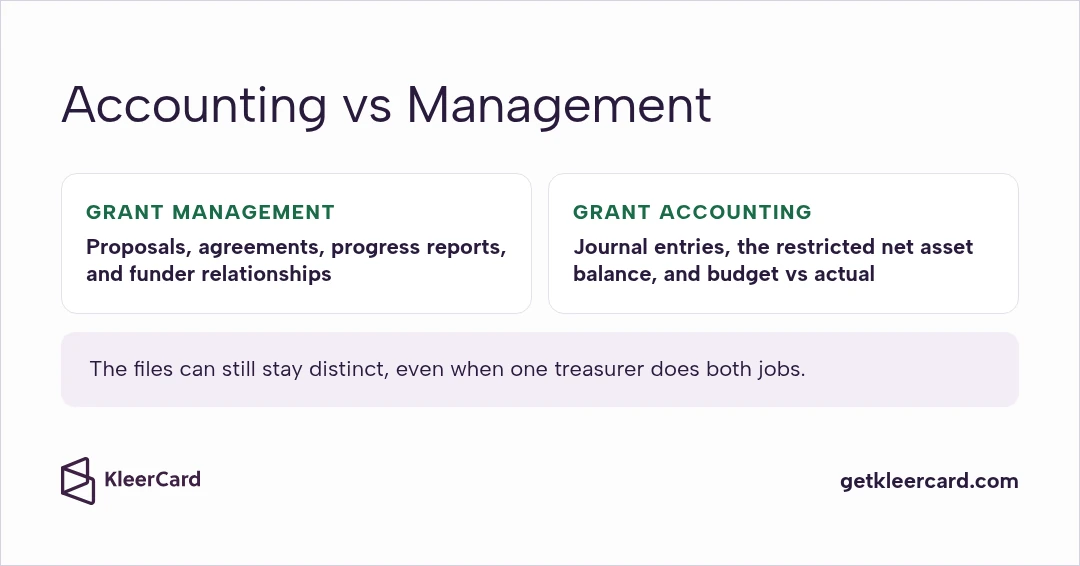
Grant management is the program and compliance calendar: proposals, agreements, progress reports, and funder relationships. Grant accounting is the set of entries that make those reports true.
A small organization often gives both jobs to the same treasurer. The files can still stay distinct.
The award agreement and the budget belong in the grant file. The journal entries, the restricted net asset balance, and the budget vs actual report belong in the books.
If those two jobs get blended into one messy folder, the program director updates a spreadsheet the bookkeeper never sees, and the bookkeeper posts expenses to one grants account as if every award were the same pot. That's how a mid-year surprise happens.
Most foundation and many government grants to a 501(c)(3) are contributions, not exchange transactions. Under U.S. GAAP, including FASB's contribution-versus-exchange guidance in ASU 2018-08, you look at whether the grantor retained a right of return, or a release from its obligation, if a barrier isn't met.
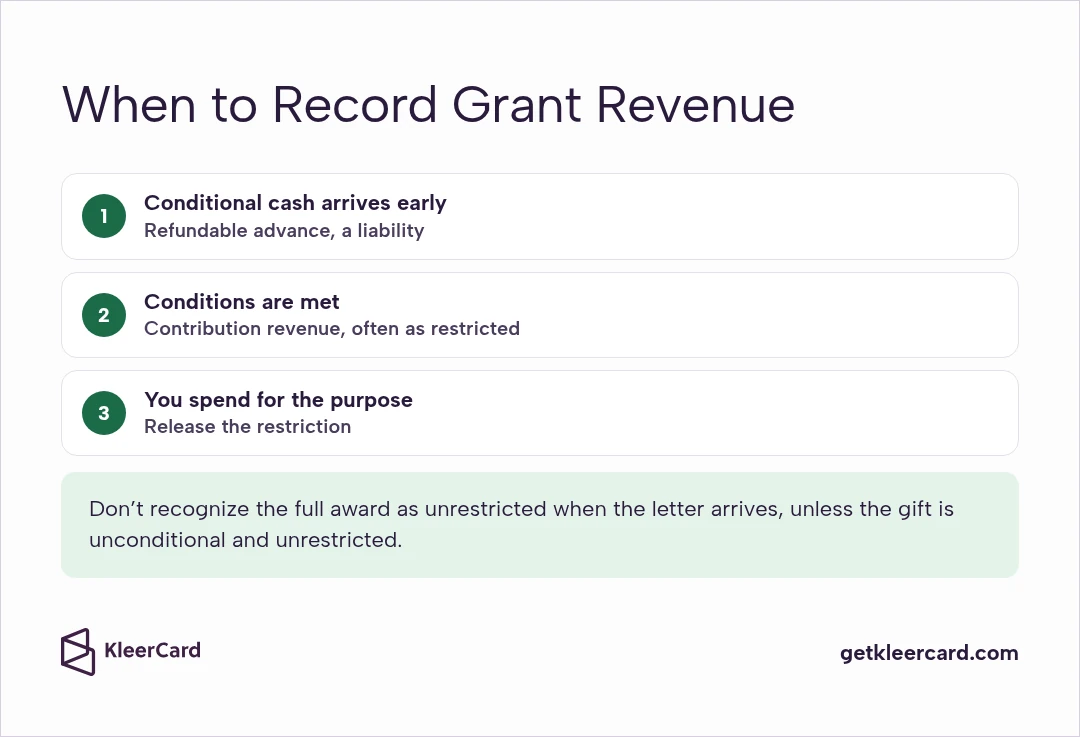
If those conditions exist, cash you receive early is a refundable advance, which is a liability, until the conditions are met. Then you recognize contribution revenue, often as restricted, and you release the restriction as you spend for the agreed purpose.
If the arrangement is truly an exchange, meaning you're providing goods or services of commensurate value back to the grantor, you recognize revenue as you provide those goods or services.
Don't recognize the full award as unrestricted revenue on the day the letter arrives unless the gift is unconditional and unrestricted. That's the mistake that later makes a clean audit feel impossible. However happy the award letter feels, the accounting still has to follow the conditions.
Governmental entities follow GASB, not FASB. If you're a church or a 501(c)(3), you're most likely on FASB. If you're a government or a public institution, use the GASB guidance that applies to you, not the pattern below as if it were universal.
A restricted grant increases net assets with donor restrictions until you spend in line with the restriction. Your budget vs actual report should follow the funder's categories, even if those labels differ from your chart of accounts. You may need a simple mapping: the funder's youth supplies line might live in two or three of your expense accounts.
Allowable costs are the ones the award permits, and, for many federal awards, the ones the applicable cost principles permit. A cost can be a real ministry expense and still be unallowable on a particular grant. Read the budget and the fine print before you code the invoice.
Indirect costs, sometimes called overhead, are real, and they need a documented method. Don't invent a rate. Use the rate in the agreement, or the rate you have been authorized to use.
For federal awards, an organization without a negotiated rate may elect the de minimis rate, which the 2024 revision of the Uniform Guidance raised to up to 15 percent of modified total direct costs (2 CFR 200.414(f)). If the award doesn't allow indirect costs, don't bury them in a program line to make the math work.
Time and effort documentation matters when salaries are charged to an award. A simple allocation that matches how people actually spent their time is more useful than a polished report that doesn't. For federal awards, 2 CFR 200.430(g) says salary charges must rest on records that accurately reflect the work performed, and budget estimates alone don't qualify.
KleerCard can help here on the spend side. Issue a card, or a virtual card, for a grant budget, set a limit that matches the remaining award, and keep receipts with the transactions. That doesn't replace the ledger, but it does keep grant groceries from landing on the unrestricted operating card.
For a wider view of restricted spending, see our guide to tracking restricted funds. KleerFi Accounting, our fund-accounting product, has a waitlist if you want that ledger work in the same family as the cards.

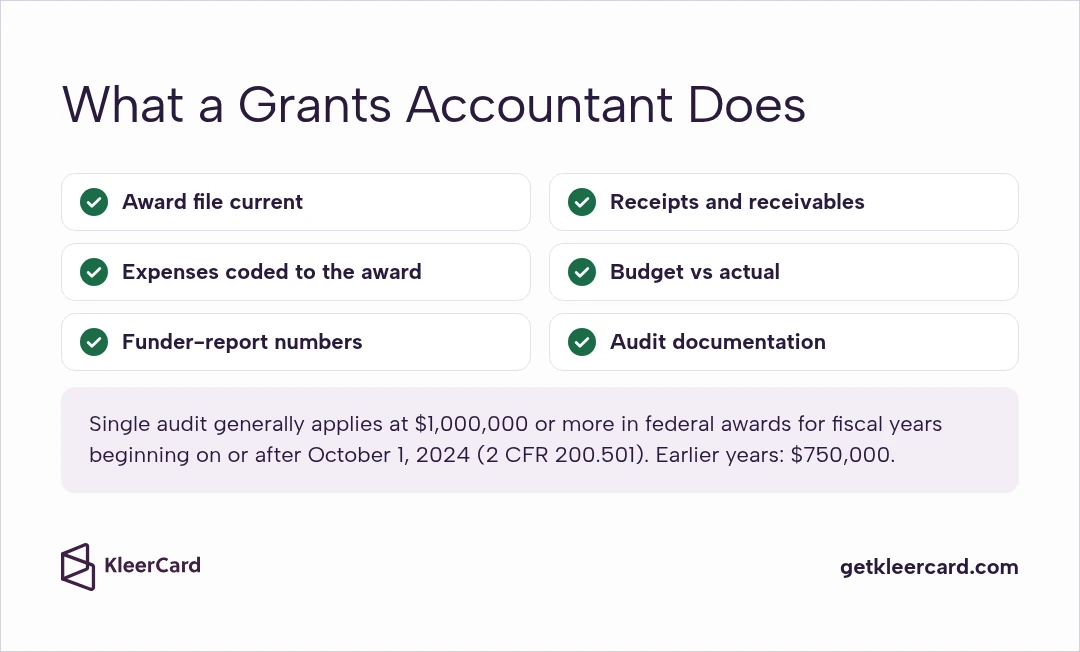
A grants accountant keeps the award file current, records receipts and receivables, codes expenses to the right award, reviews budget vs actual, prepares the numbers for funder reports, and gets the documentation ready for audit.
The work is specific but not mysterious. A small church or nonprofit can do it with a careful spreadsheet and a clean chart of accounts, then grow into nonprofit accounting software when the award count requires it. Church readers who want the broader fund picture can start with our church fund accounting guide.
In a larger shop, this person may also watch drawdowns, subrecipients, and the federal single-audit threshold. Under the Uniform Guidance as revised in 2024, a nonprofit that spends $1,000,000 or more in federal awards in a fiscal year beginning on or after October 1, 2024 generally needs a single audit (2 CFR 200.501). Earlier fiscal years used $750,000.
If you have federal awards, sit with your auditor or a grants specialist on the rules that apply to those awards.
When an unconditional restricted grant is awarded and cash has not yet arrived, you may record a receivable and restricted contribution revenue, if the award is unconditional, with an allowance for any part you don't expect to collect. When the cash arrives, debit cash and credit the receivable.
When cash arrives on a conditional award before the conditions are met, debit cash and credit a refundable advance. When the conditions are met, move that amount into restricted contribution revenue.
As you spend for the restricted purpose, record the expense and the cash or payable, and record a release of net assets from restriction. The release is what keeps the Statement of Activities honest: the restriction lifts as the purpose is fulfilled, not as the cash simply sits in the checking account.
Use your auditor's preferred account names. The pattern above shows the idea. On a federal award, get professional advice before you rely on it.
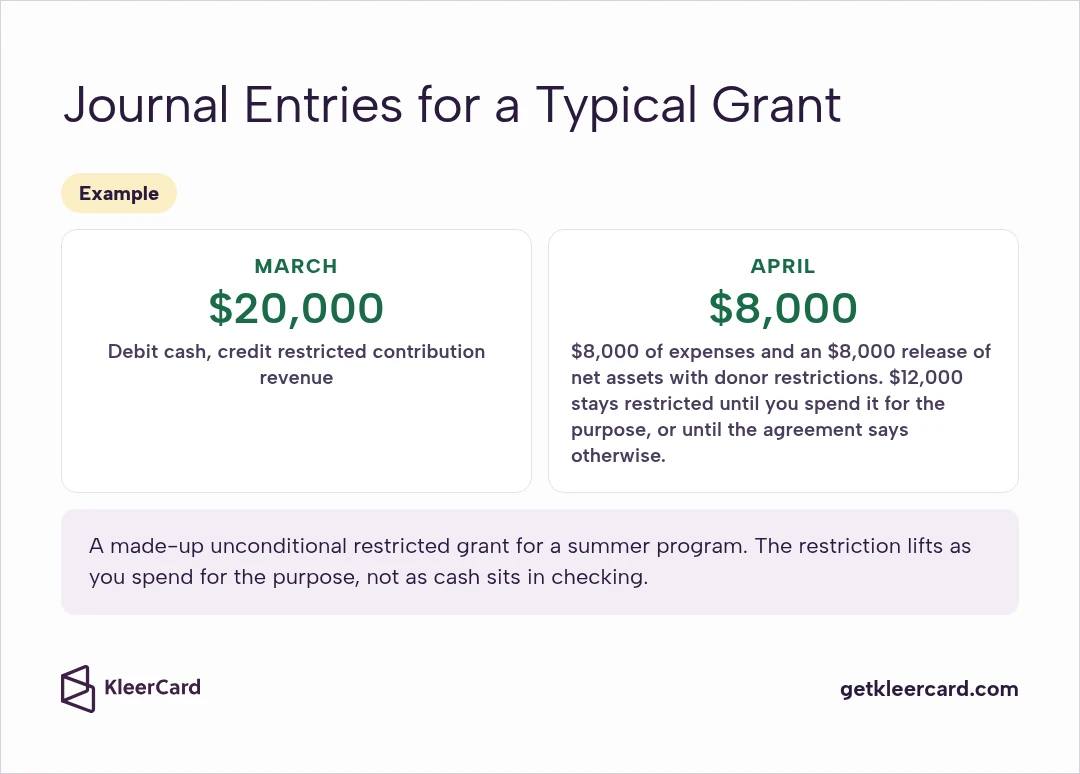
Take a made-up example. A foundation makes an unconditional $20,000 restricted grant for a summer program, and the cash arrives in March. You debit cash $20,000 and credit restricted contribution revenue $20,000.
In April you spend $8,000 on allowed program costs. You record the $8,000 of expenses, and you record an $8,000 release of net assets with donor restrictions. The remaining $12,000 stays restricted until you spend it for the purpose, or until the agreement says otherwise.
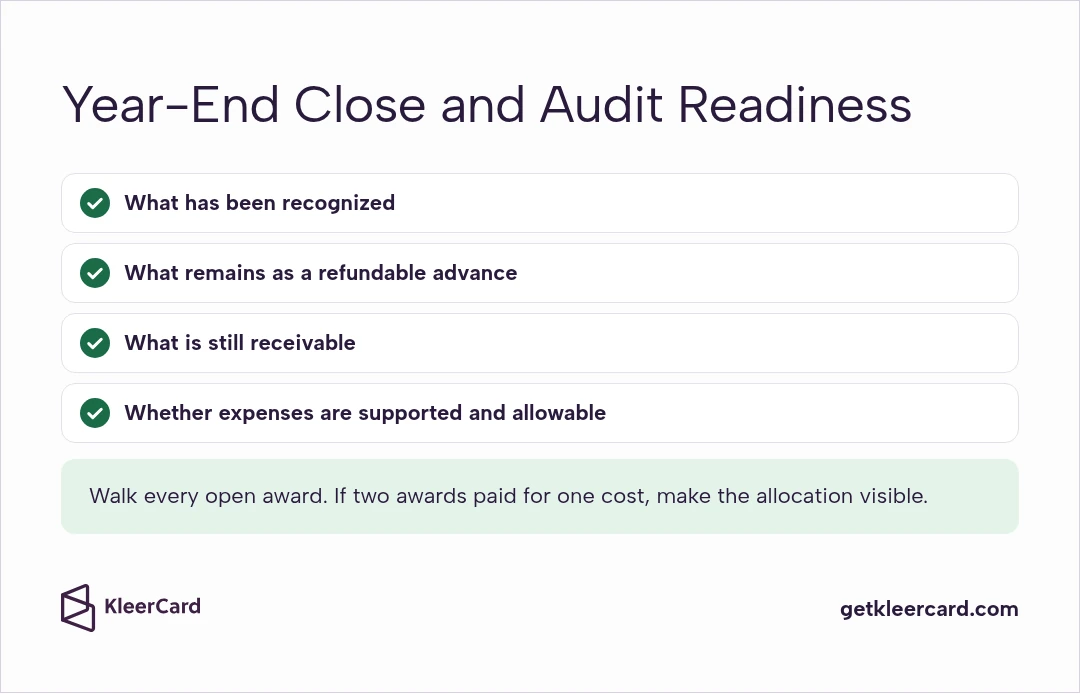
At year end, walk every open award. Confirm what has been recognized, what remains as a refundable advance, what is still receivable, and whether expenses posted to the award are supported and allowable. If a report to the funder is due in January, close the award's period before you write that report.
Keep the agreement, amendments, budgets, invoices, payroll allocations, and reports together. That packet is what an auditor of a routine nonprofit audit, or of a single audit when one applies, will ask to see. A tidy packet also helps the program director, who shouldn't have to reconstruct the year from memory.
And if two awards paid for one staff member or one van, make the allocation visible. A split that lives only in someone's head won't survive a question in March.
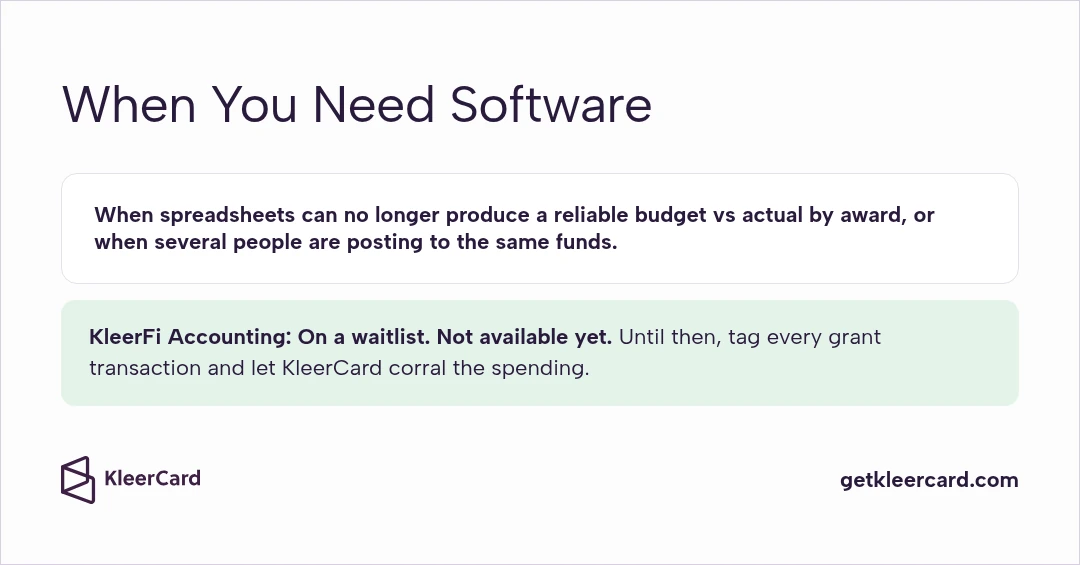
You need software when spreadsheets can no longer produce a reliable budget vs actual by award, or when several people are posting to the same funds. Nonprofit accounting software tools and grant-tracking add-ons exist for that job, including systems you may already be evaluating for the rest of the books.
KleerFi Accounting is on a waitlist. Until then, use the system you already have, tag every grant transaction, and let KleerCard corral the spending. For many small teams, that's enough while the award count still fits on one hand.
Grant accounting is the practice of recording each grant award in the books, including revenue recognition, restricted balances, allowable expenses, and budget vs actual reports for the grantor and for audit.
It's detailed, because each award has its own rules. A small organization can keep it manageable with a grant file, consistent coding, and a regular budget vs actual review. The work gets harder when conditions, federal rules, or a large award count are ignored at the start.
It depends on whether the award is conditional and whether cash has arrived. A common pattern is a refundable advance when conditional cash arrives early, contribution revenue when conditions are met or the gift is unconditional, and a release of restriction as you spend for the purpose.
A grants accountant is the person who keeps award-level books: coding, revenue recognition, budget vs actual, funder financial reports, and audit support. In a small nonprofit, that person is often the treasurer or bookkeeper.
Regular nonprofit accounting already reports on funds and net assets. Grant accounting adds award-level budgets, grantor conditions, and reports that have to match those terms, sometimes on a calendar that isn't your fiscal year.
If a new award is sitting on your desk, start with the agreement, the conditions, and a budget you can actually code to. Write the first entries to match those terms, not to match the excitement of the announcement.
If you want help keeping the related spending on budget, with receipts attached, we'd be glad to show you KleerCard. Join the KleerFi Accounting waitlist if you want the ledger side next.


Speak to a member of our team and we can have you up and running in minutes, not weeks.