Fund accounting for nonprofits, explained: how restricted and unrestricted money stay separate in one bank account, plus a worked grant example you can follow.
Fund accounting for nonprofits is a way of keeping books that tracks a separate balance for each pool of money you've promised to use a certain way, such as a grant, a building campaign, or general operations. All of that cash can sit in one bank account. The ledger keeps each fund's balance apart.
I've worked with nonprofit books from a few different seats. I was Budget Director at Compassion International, and I founded Switch Consulting, a fractional CFO practice for nonprofits. Today I also volunteer as treasurer for my church.
In every one of those roles, the question that mattered most was the same: is each dollar being used the way we said it would be?
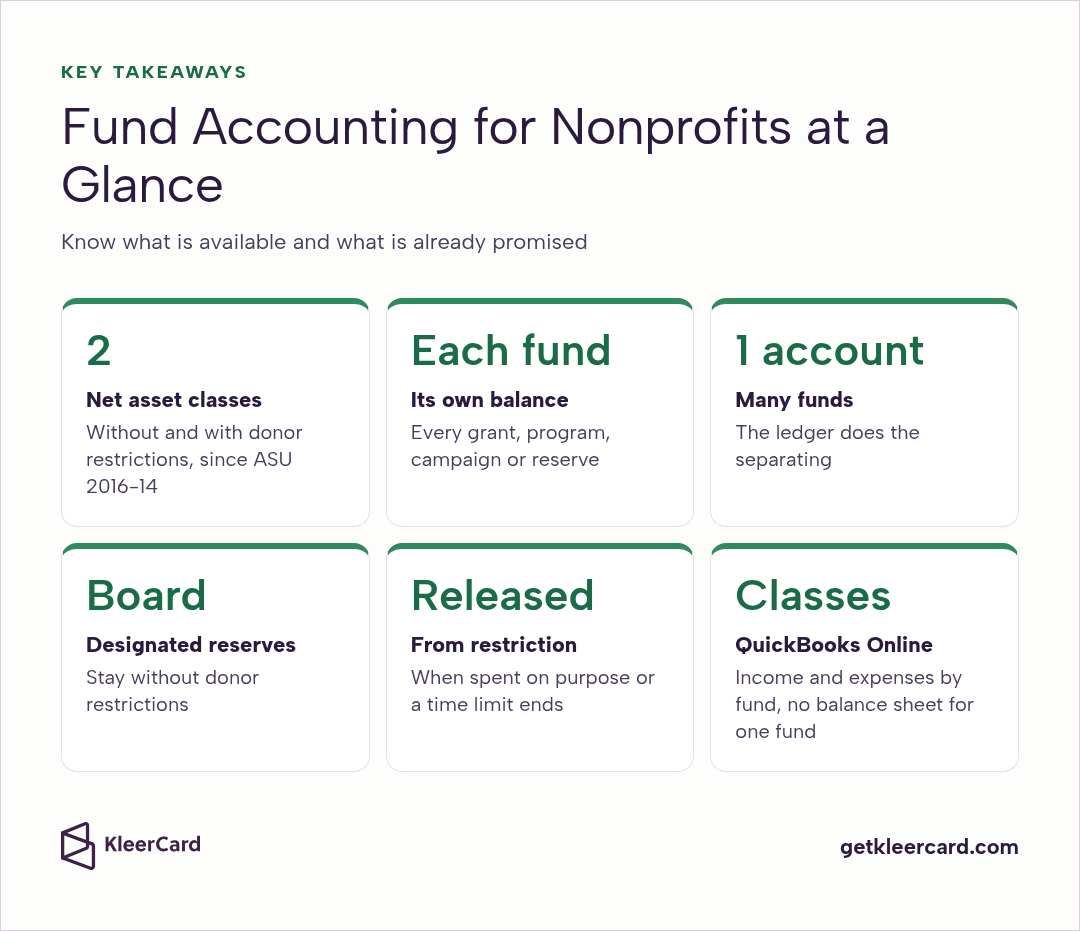
Fund accounting treats each fund as its own small, self-balancing set of books inside your organization's books. Every gift, grant, and expense gets tagged to a fund, so you can see how much came in for that purpose, how much went out, and what's left.
A for-profit business mostly needs one answer: did we make money? A nonprofit needs that answer for the whole organization and a second answer for every promise it has made to a donor or grantor.
Most nonprofits end up with a short list:
Keep the list as short as your promises allow. Every fund you add is one more balance someone has to keep accurate each month.
A lot of organizations try to separate funds by opening a checking account for each one. In my experience, a bank account per fund creates more work than it saves, because each account needs a board resolution and its own signers, those signers change whenever a treasurer rotates off, and online giving platforms often deposit into one account, leaving money to be moved between accounts by hand.
The cleaner approach is one operating account with the separation done in the ledger. Churches use this same model for church fund accounting.
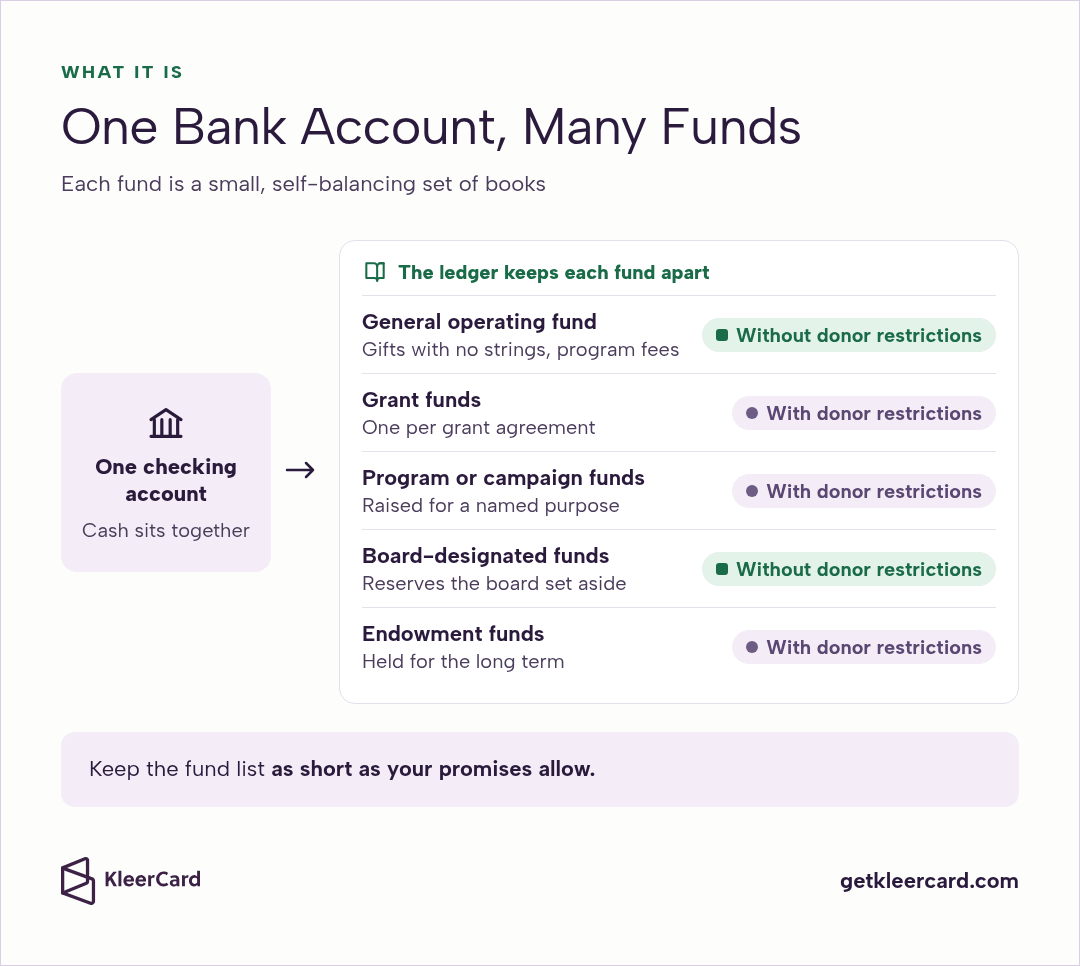
Fund accounting uses the same debits and credits as regular business accounting. What changes is the question the books are built to answer.
| Regular (for-profit) accounting | Nonprofit fund accounting | |
|---|---|---|
| Main question | Did we make a profit? | Is each dollar being used the way it was promised? |
| Equity section | Owner's or shareholders' equity | Net assets, split into without donor restrictions and with donor restrictions |
| Where money comes from | Sales of goods and services | Contributions, grants, and earned income, each tagged by restriction |
| How the ledger is organized | One set of books, with departments if useful | One set of books with a running balance for every fund |
| Who decides how money is spent | Management | Management, within each donor's or grantor's restrictions |
| Core statements | Balance sheet, income statement, and cash flow statement | Statement of financial position, statement of activities, statement of cash flows, and an analysis of expenses by nature and function |
| Annual federal filing | Income tax return | Form 990, 990-EZ, or 990-N for most tax-exempt organizations |
Fund accounting sits on top of the wider nonprofit bookkeeping and accounting basics, from cash vs accrual to the month-end close.
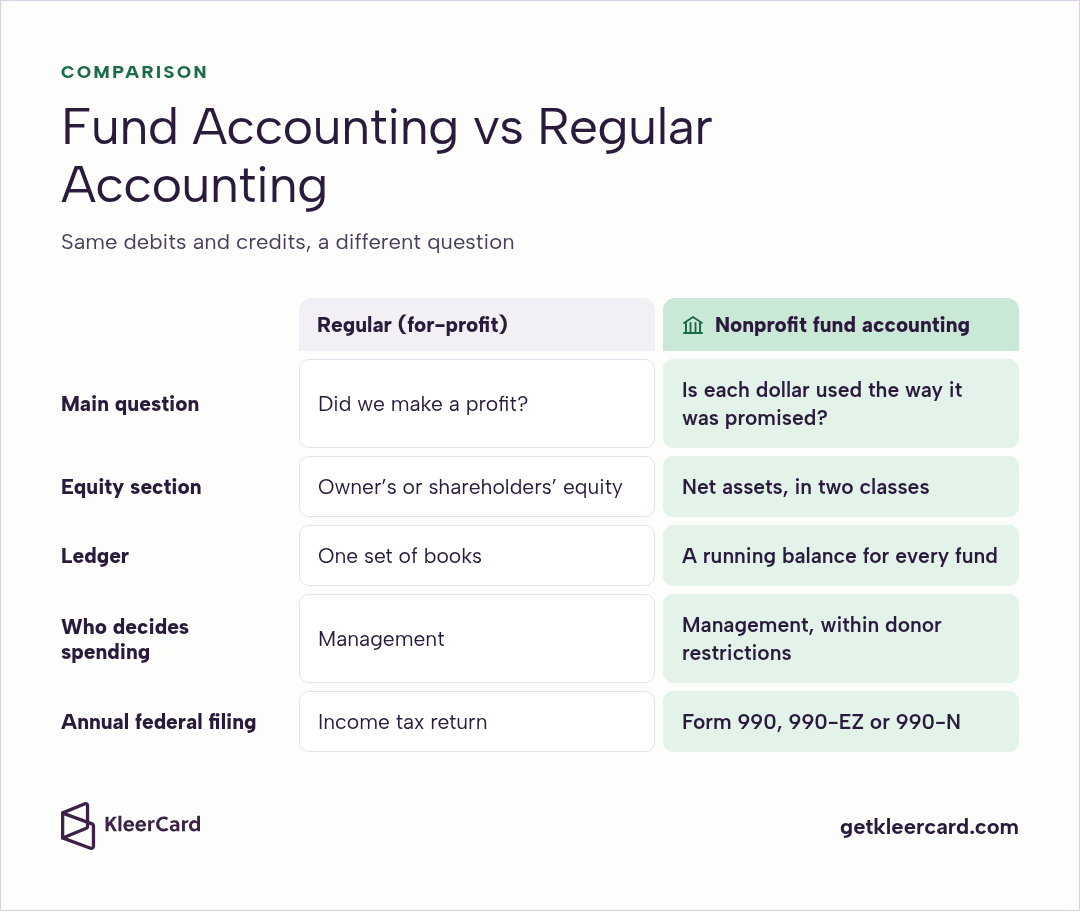
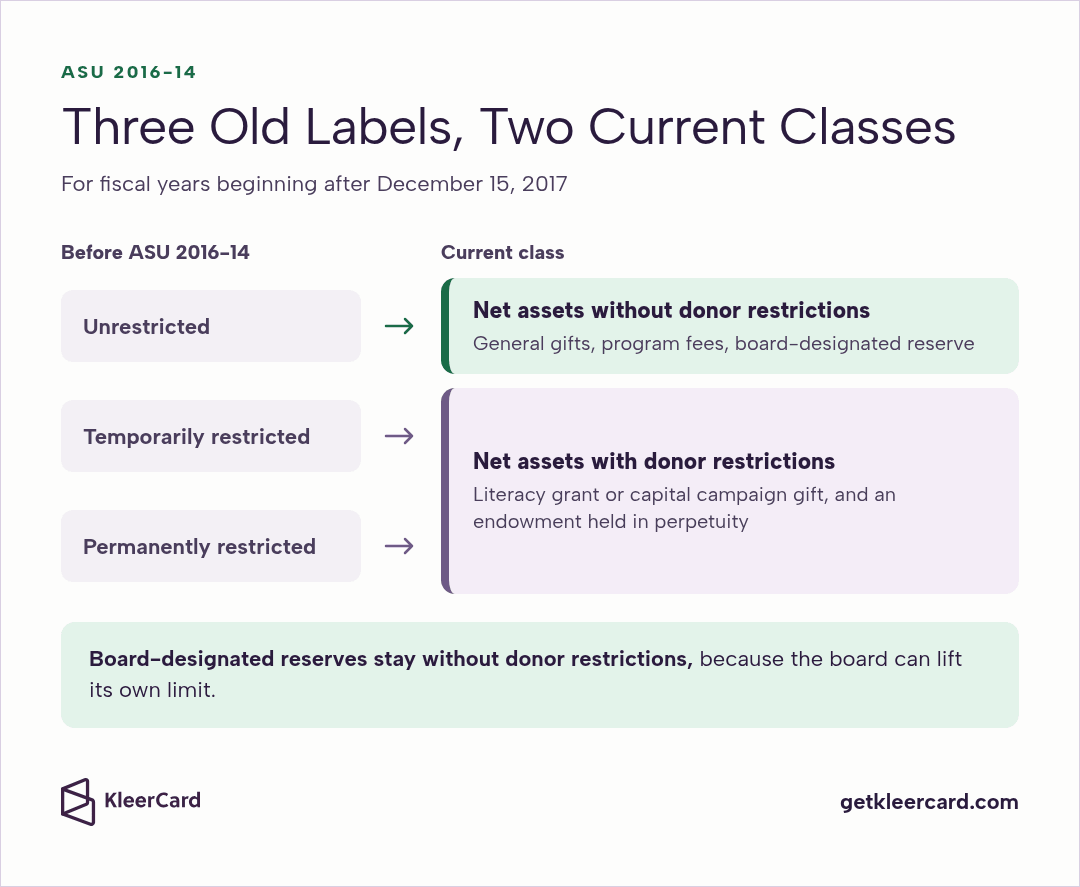
In 2016, FASB issued Accounting Standards Update 2016-14, which took effect for fiscal years beginning after December 15, 2017. It replaced three net asset classes with two: net assets without donor restrictions and net assets with donor restrictions. Your statement of financial position shows each class and the total.
Plenty of guides still use the older three labels. That's worth knowing when you read them, because audited GAAP statements use the two current classes, and so does Form 990 for organizations that follow FASB ASC 958.
This is money your organization can use for any purpose within its mission: general gifts, program fees, event proceeds, and investment income without a donor limit.
Board-designated reserves live here too. Your board may vote to set aside an operating reserve or a quasi-endowment, and that's a smart habit. Because the board set the limit, the board can lift it, so the money stays in net assets without donor restrictions.
ASU 2016-14 asks you to disclose the amounts and purposes of those board designations.
This is money a donor or grantor has limited by purpose, by time, or both. A grant for an after-school literacy program is purpose-restricted. A pledge to be paid over the next three years carries a time restriction until each payment is due.
An endowment gift meant to be held in perpetuity is restricted too, and it sits in this same class.
You can break this class into more detail, such as amounts to be held in perpetuity and amounts to be spent over time. ASU 2016-14 also asks you to disclose what makes up this class at year end and how the restrictions affect the use of resources.
| Older label (before ASU 2016-14) | Current class | Example |
|---|---|---|
| Unrestricted | Net assets without donor restrictions | General gifts, program fees, and a board-designated operating reserve |
| Temporarily restricted | Net assets with donor restrictions | A grant for a literacy program or a capital campaign gift |
| Permanently restricted | Net assets with donor restrictions | An endowment gift whose principal is held in perpetuity |
Inside your office, you can keep tracking each fund by name. On your financial statements, those funds roll up into the two classes. Set up the matching net asset accounts and a fund dimension when you build your nonprofit chart of accounts.
Here's one month at a small literacy nonprofit, with simple numbers so the arithmetic is easy to follow. The figures are illustrative.
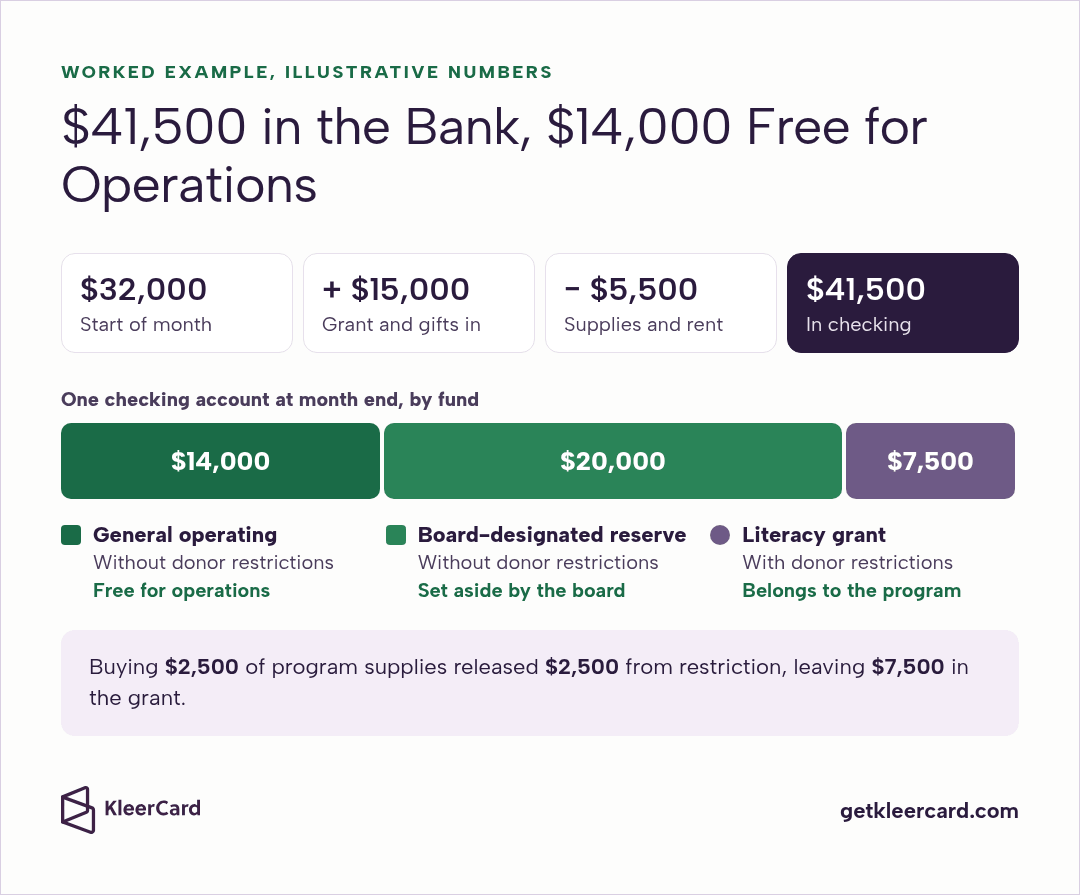
On the first of the month, the organization has $32,000 in its one checking account: $12,000 in its general operating fund and $20,000 in a board-designated operating reserve. During the month:
The $10,000 grant goes into its own fund and into net assets with donor restrictions. The cash lands in the same checking account as everything else. The ledger is what keeps it apart.
When the $2,500 of supplies is bought for the literacy program, the expense is recorded and tagged to the grant fund. Because the money was spent on the purpose the foundation set, $2,500 is released from restriction. On the statement of activities, that release moves $2,500 from net assets with donor restrictions to net assets without donor restrictions, where the expense is reported.
It's an easy step to miss, and skipping it leaves the restricted balance inflated after the money is already gone. A monthly release routine is a core step in how you track restricted funds.
| Fund | Net asset class | Start of month | Money in | Spent | End of month |
|---|---|---|---|---|---|
| General operating | Without donor restrictions | $12,000 | $5,000 | $3,000 | $14,000 |
| Board-designated reserve | Without donor restrictions | $20,000 | $0 | $0 | $20,000 |
| Literacy grant | With donor restrictions | $0 | $10,000 | $2,500 | $7,500 |
| Total | $32,000 | $15,000 | $5,500 | $41,500 |
The checking account shows $41,500. The fund table shows that only $14,000 of it is free for everyday operations. The $20,000 reserve is set aside by the board, and the $7,500 belongs to the literacy program.
| Without donor restrictions | With donor restrictions | Total | |
|---|---|---|---|
| Contributions and grants | $5,000 | $10,000 | $15,000 |
| Net assets released from restrictions | $2,500 | ($2,500) | $0 |
| Expenses (program supplies and rent) | ($5,500) | $0 | ($5,500) |
| Change in net assets | $2,000 | $7,500 | $9,500 |
Net assets without donor restrictions grow from $32,000 to $34,000, and net assets with donor restrictions grow from $0 to $7,500. Together, they match the $41,500 in the bank.
Fund accounting feeds every statement your board, funders, and auditor read.
On the IRS side, if your organization follows FASB ASC 958, Form 990 Part X reports net assets without donor restrictions on line 27 and net assets with donor restrictions on line 28. If your organization holds donor-restricted endowments or quasi-endowments, Form 990 Part IV directs you to Schedule D, Part V. The Form 990 instructions cover both.
Grant-funded organizations have one more reason to keep clean fund records. A nonprofit that spends $1,000,000 or more in federal awards in a fiscal year needs a single audit, or in limited cases a program-specific audit, under 2 CFR 200.501, and clean records by award make that work much easier. Knowing what to expect in a nonprofit audit helps you keep those records ready all year.

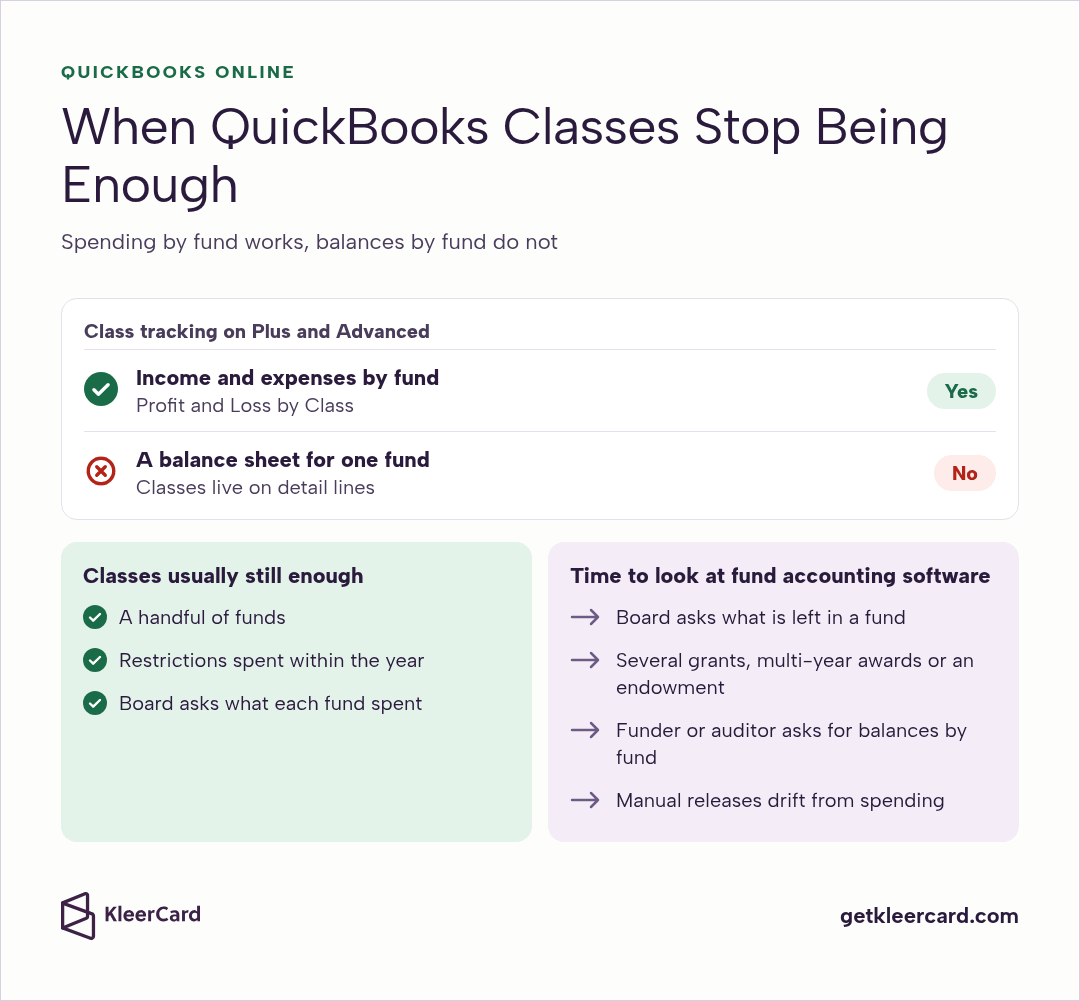
Many nonprofits start fund accounting in QuickBooks Online, and for a while it works. You turn on class tracking (available on QuickBooks Online Plus and Advanced), create a class for each fund, and tag every transaction. Profit and Loss by Class then shows income and expenses for each fund.
The limit shows up on the balance sheet. Intuit explains in its help article that QuickBooks Online can't filter a balance sheet by class, because the balance sheet reads from the header of each transaction while classes live on the detail lines.
So QuickBooks can tell you what the literacy grant spent this month, but it can't produce a balance sheet showing that grant's cash, payables, and remaining net assets on its own. That gap is why QuickBooks can't produce a true fund balance sheet without workarounds.
In the books I keep today, I export to Excel each month and subtract each restricted balance by hand so leadership can see what's actually available, which works as long as I remember to do it and do it right.
Classes are usually still enough when:
It's probably time to look at dedicated fund accounting software when:
Established fund accounting systems include Aplos, Sage Intacct, Blackbaud Financial Edge NXT, and MIP Fund Accounting.
When you compare nonprofit accounting software, weigh each option against your organization's size and the number of funds you manage.
We're also building KleerFi Accounting, and the waitlist is open if you'd like to hear when it's ready.
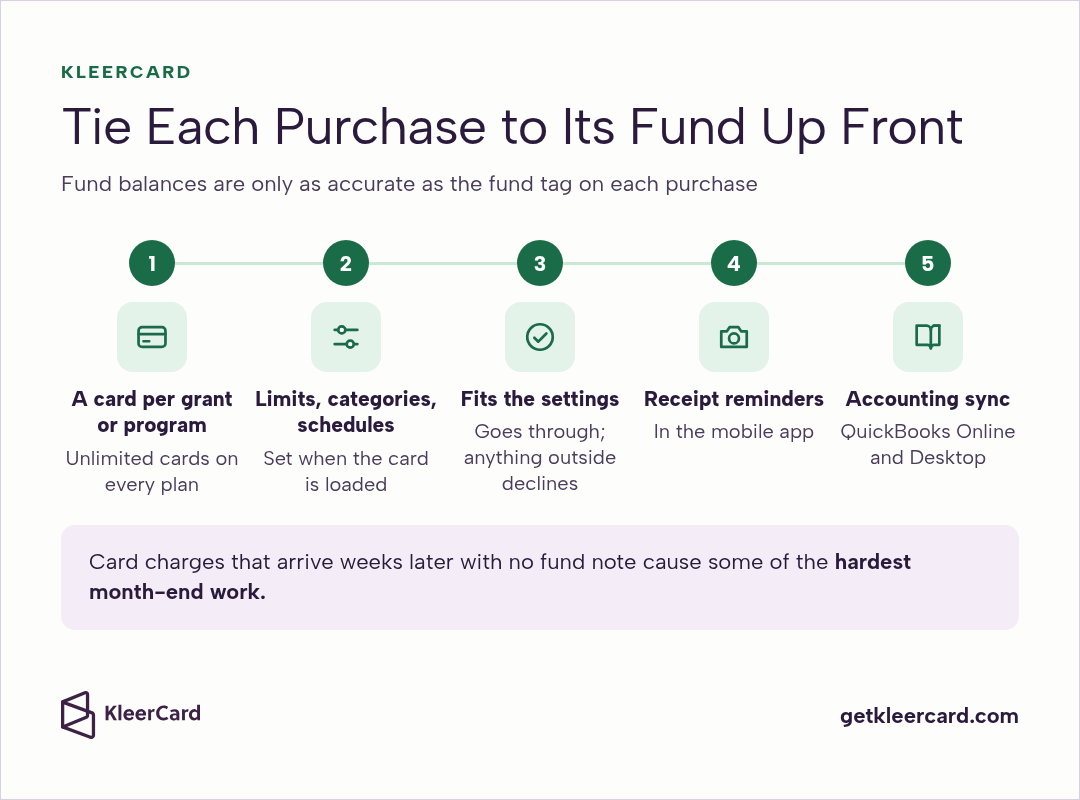
Fund balances are only as accurate as the fund tag on each purchase. Some of the hardest month-end work comes from card charges and reimbursements that arrive weeks later with no note about which grant they belong to.
With KleerCard, you can give each grant or program its own card. Limits, categories, and schedules are set when the card is loaded, so a purchase that fits goes through and anything outside those settings declines.
Cardholders get automatic reminders to upload receipts in the mobile app, and KleerCard syncs with QuickBooks Online and QuickBooks Desktop through accounting sync. Every plan includes unlimited cards, so each program lead can have one.
Grant-funded programs can set this up with grants and restricted funds spend tracking.
Fund accounting for nonprofits is a way of keeping books that tracks a separate balance for each pool of money with its own purpose, such as a grant, a campaign, or general operations. It shows how much came in, how much was spent, and what's left in each fund, even when all the cash sits in one bank account.
Fund accounting answers whether each dollar was used the way it was promised, while regular business accounting mainly answers whether the company made a profit. Nonprofits replace owner's equity with net assets, split into without donor restrictions and with donor restrictions, and track a running balance for every fund.
The two types of net assets are net assets without donor restrictions and net assets with donor restrictions, as set by FASB's ASU 2016-14. Board-designated reserves count as without donor restrictions, and both purpose-restricted gifts and donor-restricted endowments count as with donor restrictions.
QuickBooks Online can handle basic fund accounting with class tracking on its Plus and Advanced plans, which shows income and expenses by fund. It can't filter a balance sheet by class, so many nonprofits export to a spreadsheet each month or move to dedicated fund accounting software as their funds grow.
Every nonprofit that accepts restricted gifts or grants needs to track those dollars by fund, even with simple tools. A small organization that receives only unrestricted money can start with a plain set of books and add funds when its first restricted gift arrives.
Nonprofit accounting records income and expenses much like a business does, then sorts every dollar by donor restriction and by fund. The results roll up into a statement of financial position, a statement of activities, a statement of cash flows, an analysis of expenses by nature and function, and, for most organizations, an annual Form 990, 990-EZ, or 990-N.
Good fund accounting starts with a simple list: every grant, campaign, and reserve you've promised to handle a certain way. Give each one a fund, tag every dollar in and out, and release restrictions as you spend. The rest gets easier from there.
If tying everyday spending to the right fund would make your month-end smoother, we'd love to help. You can get started with KleerCard today, or schedule a demo and we'll walk through how it fits your funds.


Speak to a member of our team and we can have you up and running in minutes, not weeks.