%202.svg)
Find the best credit cards for PTAs and PTOs. Compare no-personal-guarantee options, prefunded budget cards, expense controls, and real school examples.
PTA and PTO boards change every year. One parent volunteers as treasurer. Another runs the fall festival. A third handles classroom supplies or teacher appreciation. Traditional bank cards force someone to put their personal credit on the line or share a single high-limit card that disappears into someone’s purse. Reimbursements pile up. Receipts vanish. Month-end becomes a scramble.
KleerCard and similar nonprofit platforms end that cycle. They issue cards to the organization itself, load only approved budgets, capture receipts at the point of purchase, and keep a clean record that survives the next board transition.
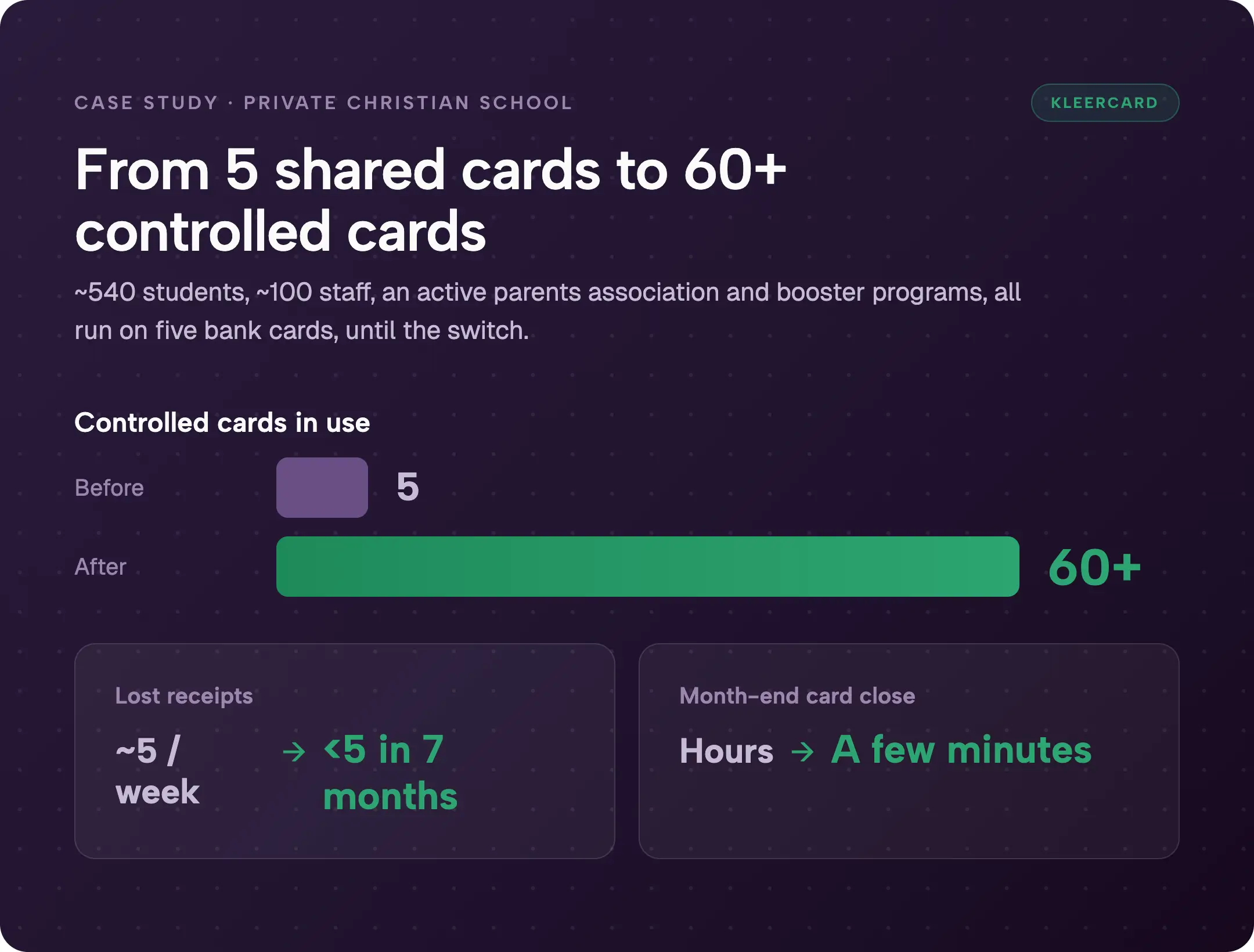
One private Christian school with roughly 540 students, about 100 staff, an active parents association, and booster programs moved from five shared bank cards to more than 60 controlled cards on KleerCard. Lost receipts fell from roughly five per week to fewer than five across seven months. Month-end close for card activity dropped from lengthy statement processing to a few minutes. The maintenance director no longer had to hunt for a shared card before buying a toilet part at Home Depot.
This guide shows which options actually work for parent-teacher groups, what PTA policies require, and how that same school made the change without losing oversight.
Most parent groups share the same constraints.
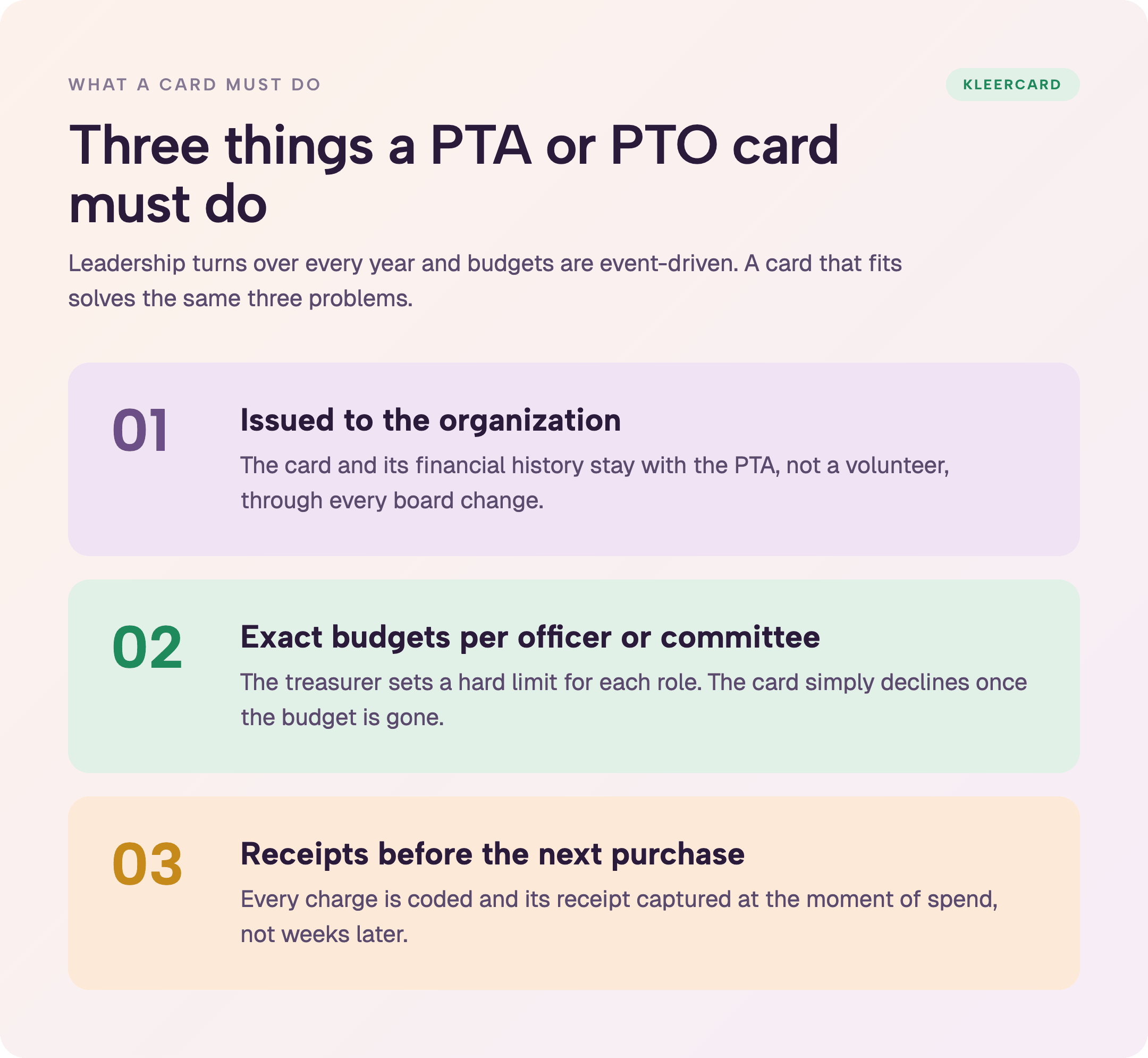
Leadership turns over annually. The card and the financial history must stay with the organization. Budgets are tight and event-driven. A carnival, teacher appreciation lunch, or classroom supply run needs a fixed limit that cannot be exceeded. Volunteers will not and should not front personal money. Parents and the school expect transparent reports. Many state and local PTA rules ban traditional revolving credit cards and require prefunded or tightly controlled spending cards.
A card that solves those problems does three things well. It is issued to the PTA or PTO itself. It lets the treasurer set exact budgets per officer or committee. It forces receipts and coding before the next purchase is allowed.
I have watched the same pattern play out in schools and small nonprofits for years after my time at Compassion International and Switch Consulting. When only a few people hold cards, the rest of the volunteers either hunt for the plastic or pull out their own wallets. The finance person then spends the next week chasing receipts and coding Amazon charges that simply say “Amazon.” The next board inherits a mess or has to start over.
The fix is better expense management design: organization ownership, hard budget limits, and capture of the receipt at the moment of spend. Platforms built for this workflow, including the KleerCard nonprofit credit card, make those three requirements the default.
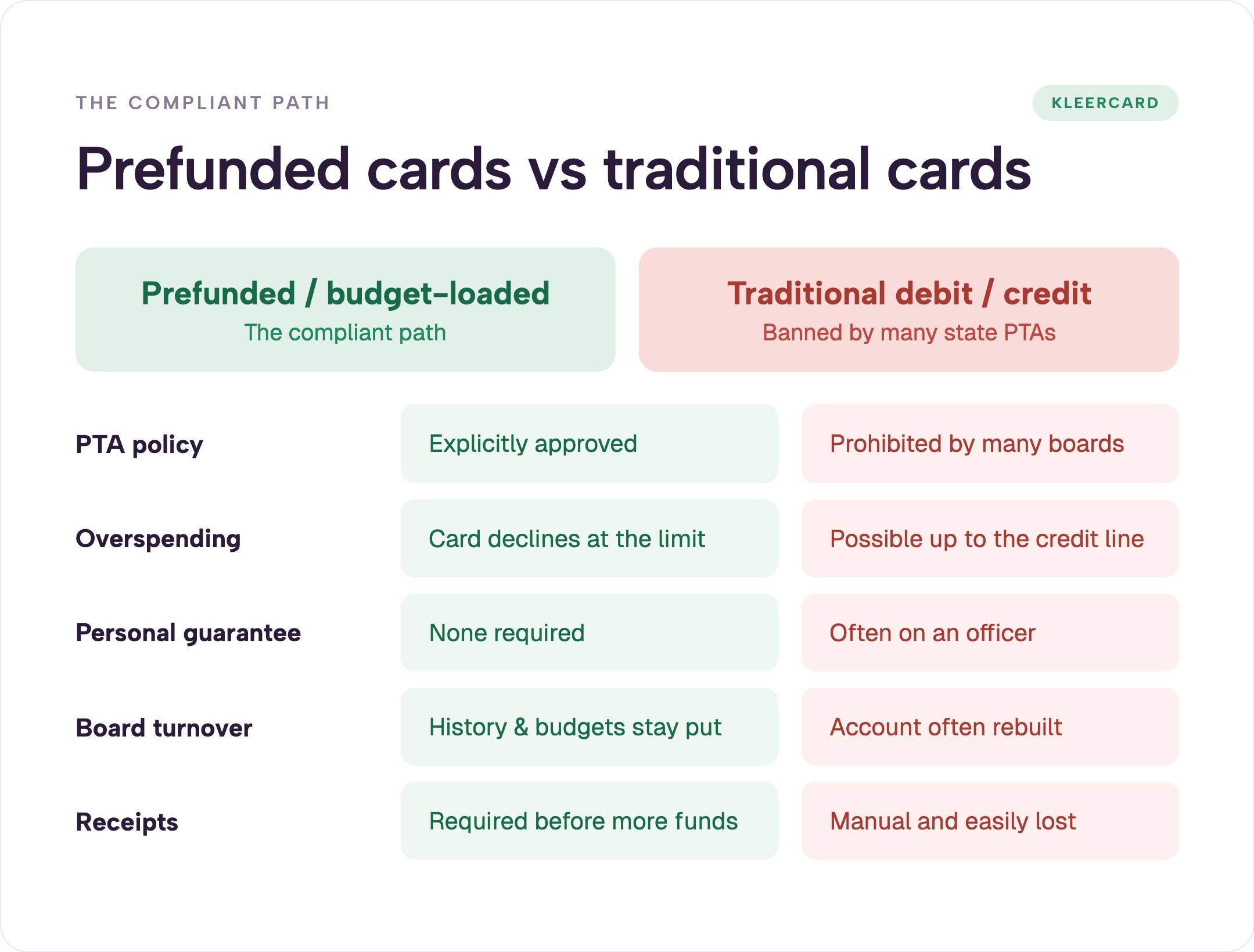
Utah PTA and similar organizations are clear. Traditional debit and credit cards are not allowed. Prefunded spending cards that draw from an approved budget and require receipts are the compliant path. Cardholders sign agreements. Receipts must arrive quickly or the charge becomes the volunteer’s personal responsibility. Bonding is often required.
Modern nonprofit platforms deliver the same control without the old prepaid friction. You load a specific dollar amount onto each card, or you set a $0 balance that requires a funding request before anything can be spent. The card simply declines once the budget is gone. No one can overspend. When the next board takes over, the history and the remaining budgets stay in place.
This model matches the spirit of prefunded rules while giving volunteers real Visa acceptance and real-time visibility. I recommend treating every card as a budget-loaded tool first. The primary control is the alignment of authority to spend with the ability to spend. Merchant category or time-of-day rules are secondary.
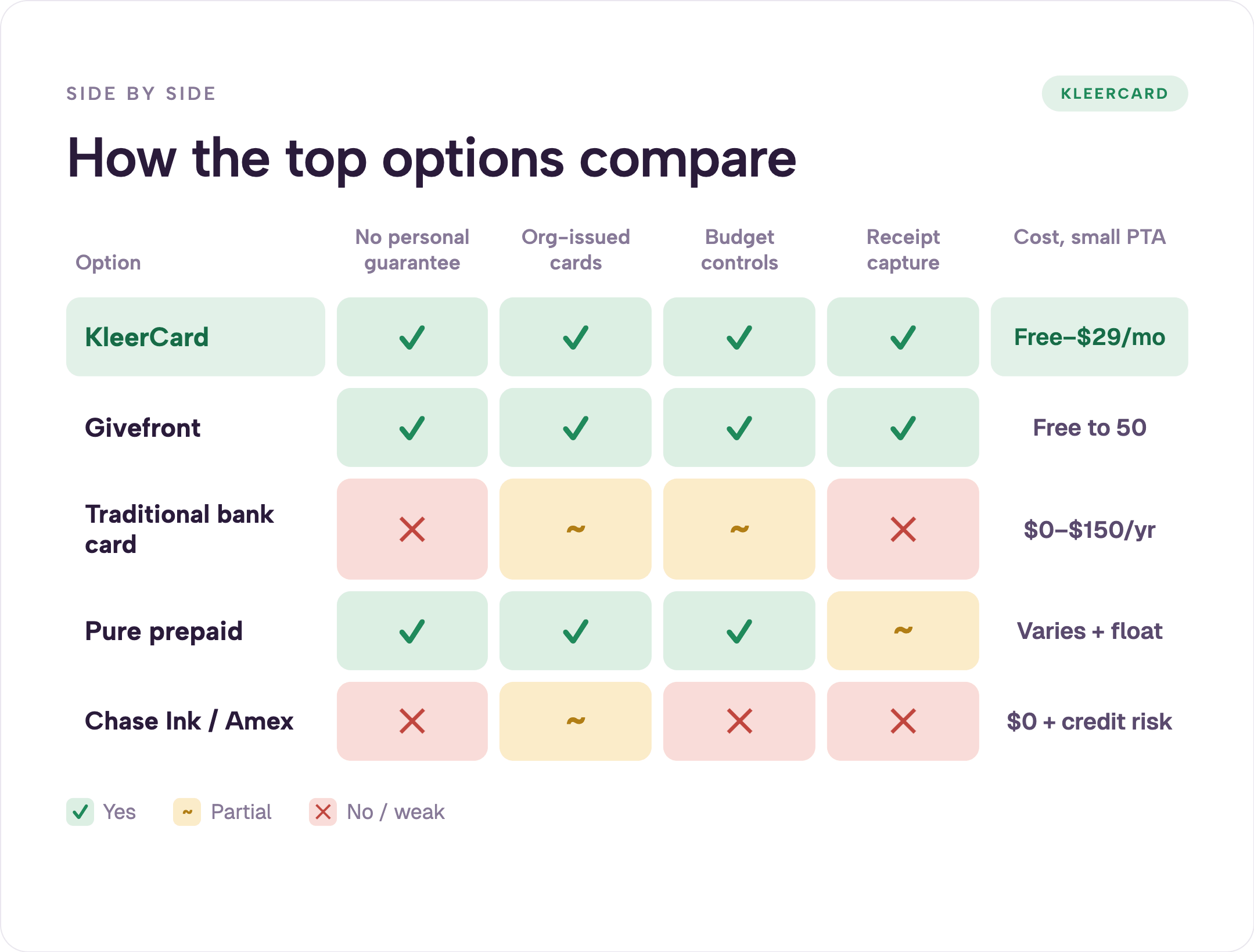
The table focuses on the criteria that matter most to volunteer boards: no personal guarantee, true organization ownership, hard budget limits, and automatic receipt discipline. For a closer look at how the controls and unlimited cards work in practice, see the KleerCard product page or schedule a demo.
KleerCard was built for exactly this environment. Cards belong to the organization. You can issue physical, virtual, and labeled loaner cards without per-seat fees that punish volunteer-heavy groups. Each card can carry its own budget. Missing receipts trigger automatic reminders and can lock the card. Amazon Business integration pulls line-item detail straight into the expense record. Many groups run comfortably on the free or $29 tier that covers 15–30 users. See the full pricing page for current details.
Givefront offers a free tier up to 50 users and emphasizes organization-issued cards with no personal guarantee. Full details on the free plan and card controls appear on their FAQs page. It is a legitimate option for groups that prioritize zero monthly cost and basic tracking. Confirm current application flow and integrations before committing, as availability has varied.
Traditional bank business cards usually require a personal guarantee from an officer. When that person leaves, the account often has to be rebuilt. Spend controls are weaker and receipt collection stays manual. Pure prepaid cards work for the strictest policy environments but force cash float and slower vendor payments. Chase Ink and Amex Blue Business Cash deliver solid rewards yet still lean on personal credit and employee-card models that fit poorly with annual board turnover.
Charity Charge is another no-personal-guarantee option for established 501(c)(3) organizations. Eligibility typically requires either five years of operation and $100,000 in annual revenue or two years and $500,000; see the Charity Charge eligibility requirements for the current thresholds. Smaller or newer PTAs often find the free or low-cost tiers of KleerCard or Givefront a better match.
For a deeper look at platforms that avoid personal guarantees entirely, see our guide to credit cards for nonprofits with no personal guarantee.
I have seen the same access problem play out in private Christian schools that also support active parents associations and booster clubs. One school with roughly 540 students and about 100 staff ran the entire campus on five bank cards. That included the parents association and the booster programs. Teachers and coaches spent hours hunting for the card. Many simply paid out of pocket and filed reimbursements. The finance office chased roughly five lost receipts every week. Month-end statement processing was lengthy.
After switching to KleerCard, the school issued more than 60 physical and virtual cards. Administrators held multiple cards per department, including labeled loaner cards for fine arts, athletics, and upper school. The maintenance director, who previously had to locate whoever held the card before he could buy a toilet part at Home Depot, now carries his own card with a weekly budget check-in. Lost receipts dropped to fewer than five across seven months. Month-end close for card activity now takes a few minutes because the team reconciles weekly.
The parents association and booster clubs operate their own cards under an administrator who controls funding. Officers and committee leads request funds or receive a loaner with a clear limit. The same pattern works for a PTA or PTO. One treasurer sets the budgets. Officers and committee chairs receive the cards they need. The next board inherits a clean system.
At the same private Christian school with roughly 540 students, an active parents association, and booster programs that moved from five shared cards to more than 60 controlled cards on KleerCard and cut lost receipts from roughly five per week to fewer than five across seven months,
Amazon was the single hardest category before the switch. A line on the statement said “Amazon” for some amount, and finance had to hunt for the order and the buyer. With the Amazon Business expense tracking integration, the receipt and line items arrive attached to the charge and routed to the cardholder for coding. Event supplies, classroom materials, and fundraiser items stop becoming mysteries. Official Amazon Business accounts also keep personal and organizational spending separated and support tax-exempt purchasing for verified nonprofits.
You can read the full account of how that school moved from five cards to more than sixty in how a private Christian school went from 5 cards to 60. The same mechanics apply directly to PTA and PTO event and supply spending.
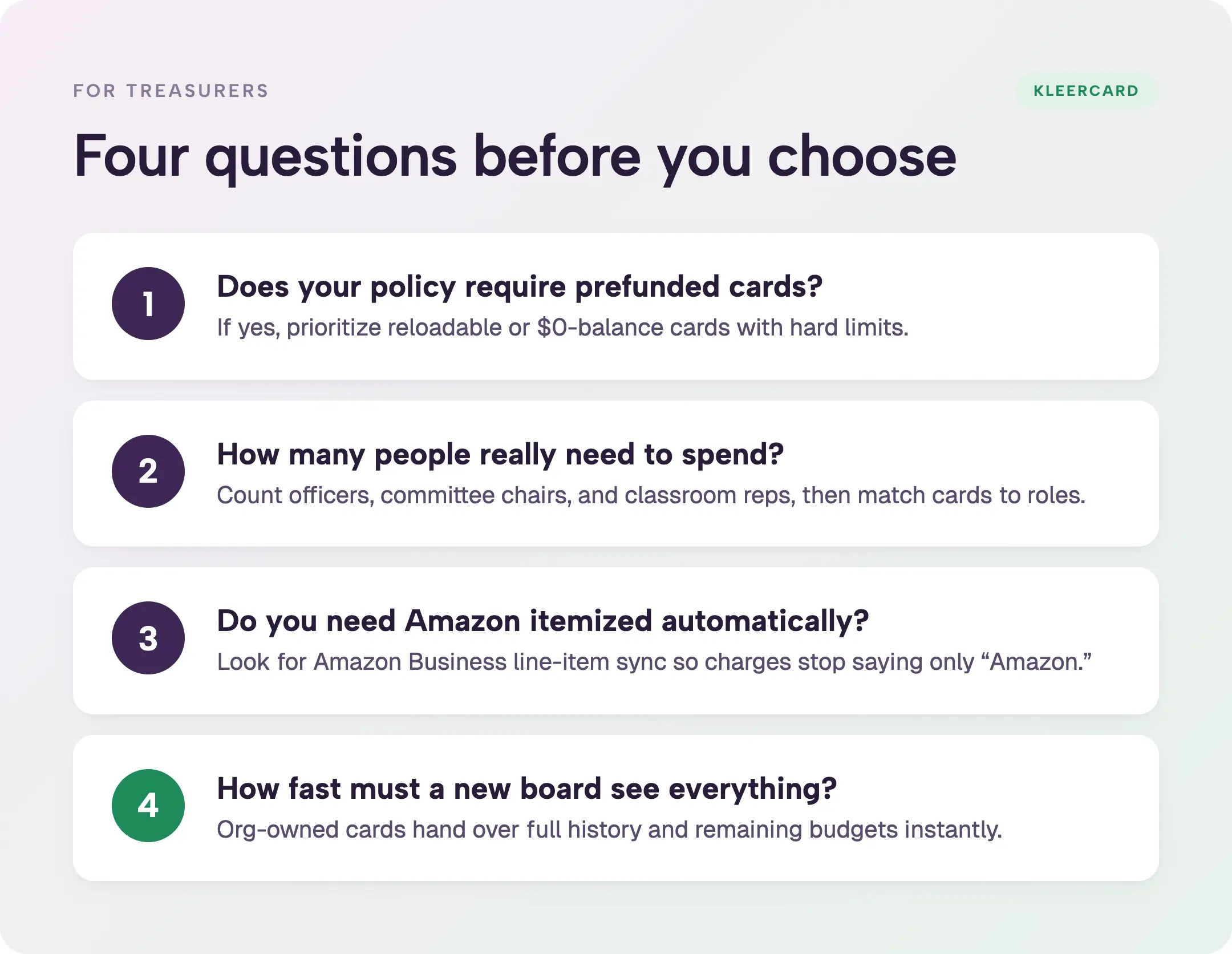
Start with these four questions.
If the answer to the first question is “prefunded only,” prioritize platforms that support reloadable or zero-balance cards with hard limits. If the group is small and cost-sensitive, compare free tiers carefully against the reliability of support and integrations. For groups that already use Shelby, QuickBooks, or similar school accounting tools, native sync saves hours every month. See solutions for nonprofits for how these platforms fit volunteer-led groups.
The same private Christian school with roughly 540 students, an active parents association, and booster programs faced exactly these questions. They started with five shared cards, chased roughly five lost receipts every week, and spent lengthy hours on month-end statements. After moving to KleerCard they issued more than 60 cards, dropped lost receipts to fewer than five across seven months, and finished card reconciliation in a few minutes. The staged rollout began with operations, then administrators, then teachers and parent-group leaders. That pattern works for most PTAs and PTOs.
I also look at volume of events and whether volunteers regularly front personal funds. When reimbursements become a monthly flurry of ten or twelve requests at the deadline, the card system is already too late. Line-of-sight accountability means every charge traces to one named person with a budget that matches their role. That is the opposite of the scarcity mindset that keeps groups stuck with one or two shared cards. You can schedule a demo to see the budget and receipt controls in action.
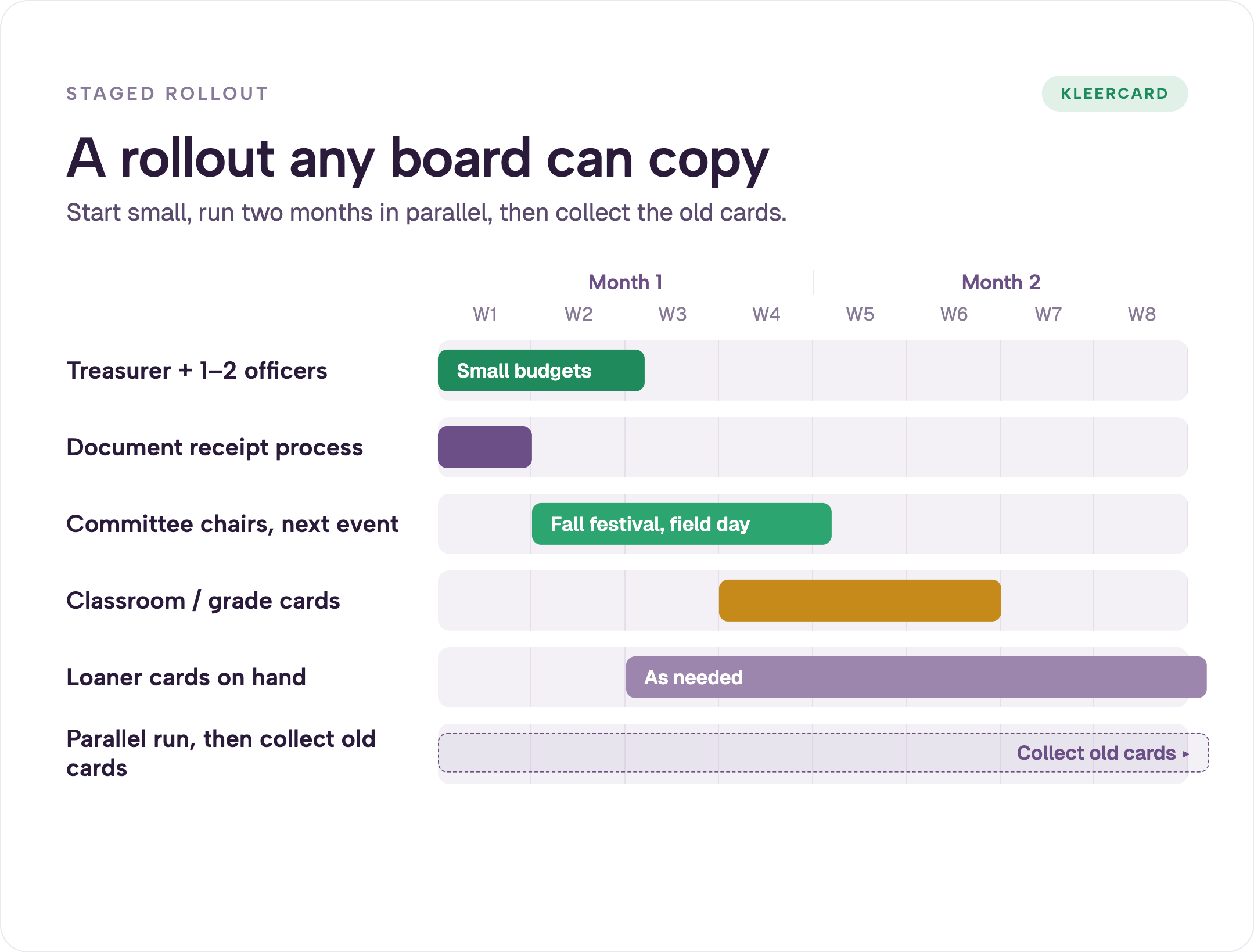
The private Christian school with roughly 540 students, about 100 staff, an active parents association, and booster programs that moved from five shared bank cards to more than 60 controlled cards on KleerCard provides the clearest model. Lost receipts fell from roughly five per week to fewer than five across seven months. Month-end card close dropped to a few minutes. The maintenance director finally carried his own card instead of hunting for a shared one. That school used a staged rollout that any PTA or PTO can copy.
Begin with the treasurer and one or two officers. Issue cards with clear, small budgets. Document the receipt and coding process in a one-page handout so every volunteer knows the expectation: buy, photograph the receipt immediately, upload it. Expand to committee chairs for the next major event: fall festival, teacher appreciation, field day. Add classroom or grade-level cards only after the first group is comfortable. Keep a few labeled loaner cards for one-off needs so no one has to share a high-limit card.
Two months of parallel running with the old system is ideal when possible. Virtual cards can go live in days while physical cards arrive. Once the new cards are in use, collect the old ones. You do not want two live systems running indefinitely. The white-glove setup process keeps the load light for a volunteer treasurer and includes the same staged approach the school used.
The school started with the operations department because it was the messiest. Maintenance, IT, and vehicle fuel caught on within days. Administrators came next so they could coach their own teams. Teachers and coaches followed. The same stair-step works for a PTA: officers first, then the big-event chairs, then broader classroom support. Full details of that rollout appear in the case study how a private Christian school went from 5 cards to 60.
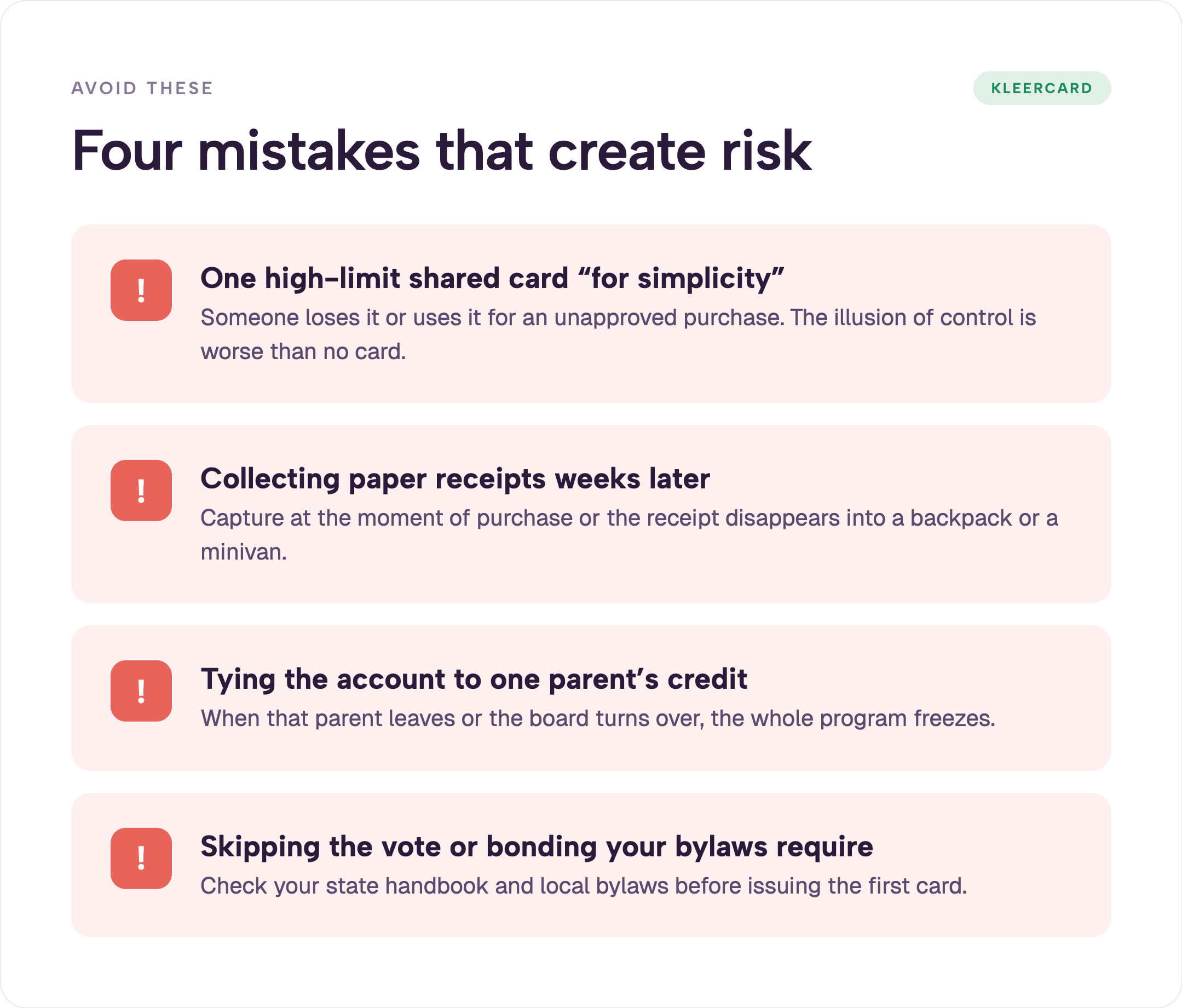
Issuing one high-limit shared card “for simplicity” is the most common error. Someone will lose it or use it for an unapproved purchase. The illusion of control is worse than no card at all.
Requiring every volunteer to submit paper receipts weeks later guarantees lost documentation. Capture at the moment of purchase or the receipt disappears into a backpack or a minivan. Automatic receipt tracking removes that friction and is one of the core features of modern expense management platforms.
Tying the account to one parent’s personal credit creates a single point of failure. When that parent leaves or the board turns over, the entire program freezes or requires a new application under a new name.
Skipping the membership vote or bonding requirements that many PTA bylaws demand can put officers at personal risk and create compliance problems later. Always check your state handbook and local bylaws before issuing the first card.
Yes. Several nonprofit-focused platforms issue cards to the organization itself. Underwriting is based on the group’s bank balances and activity rather than any individual’s credit score. This is the single most important feature for groups that turn over officers every year. More detail appears in the no personal guarantee guide. The private Christian school with roughly 540 students, an active parents association, and booster programs used exactly this model on KleerCard: more than 60 cards, no personal guarantees, and full continuity when board members changed.
Many state and local PTA organizations, including Utah PTA, explicitly prohibit traditional debit and credit cards. They permit only prefunded spending cards that are limited to approved budgets and require immediate receipt submission. Always check your own bylaws and state handbook before applying.
The treasurer loads a specific dollar amount, or leaves the card at zero until a funding request is approved. The card declines once the budget is exhausted. Receipts and coding are required before additional funds are released. This produces the same control and audit trail that prefunded rules intend. KleerCard’s reloadable and $0-budget cards were designed for exactly this policy environment.
Because the cards and the account belong to the PTA or PTO, the new officers inherit the full transaction history, remaining budgets, and reporting access. No accounts need to be closed or personal guarantees transferred. Continuity is built in. The same private Christian school that moved from five shared cards to more than 60 on KleerCard kept every transaction and remaining budget visible to the next set of administrators and parent leaders.
Yes. Platforms with Amazon Business integration pull item-level detail and the receipt into the expense record automatically. Classroom or committee cards can be limited to specific merchants or categories if desired. At the private Christian school with roughly 540 students, an active parents association, and booster programs that moved from five shared cards to more than 60 controlled cards on KleerCard and cut lost receipts from roughly five per week to fewer than five across seven months, Amazon had been the single hardest category. The same visibility that stopped the school from guessing which event needed tablecloths and balloons works for PTA fundraisers and teacher appreciation orders. See the Amazon Business expense tracking page for how the line-item sync works, and the official Amazon Business site for tax-exempt setup.
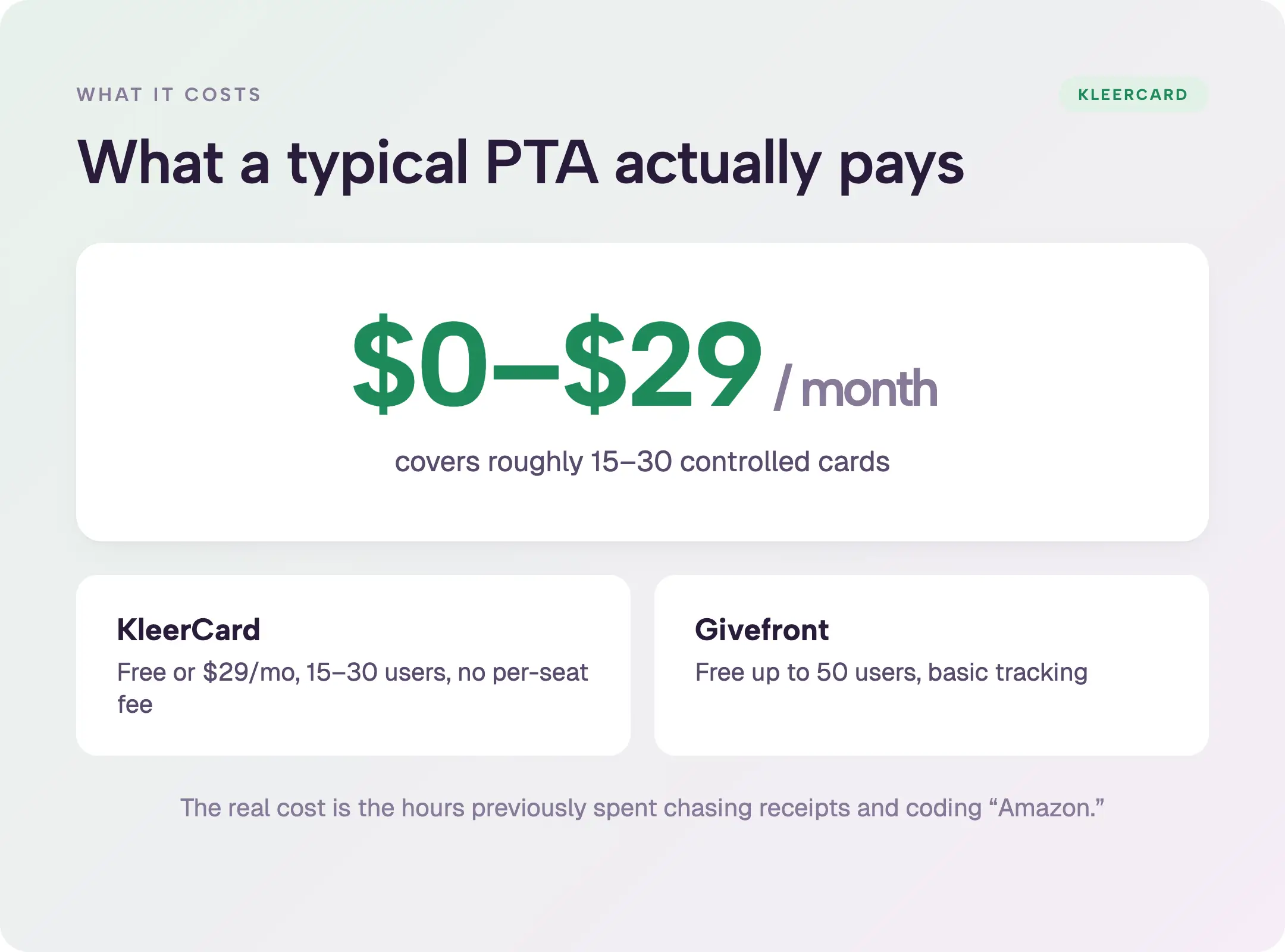
Free tiers exist for small groups. Most parent organizations operate comfortably on a $0–$29 monthly plan that covers 15–30 cards. The real cost comparison is the hours previously spent chasing receipts and processing bill pay and reimbursements. Our own church runs 21 cards with only 2.5 paid staff and stays well inside the lower pricing tiers. The private Christian school that scaled from five cards to more than 60 on KleerCard saw month-end card work drop to a few minutes, which more than offset any platform cost.
Choose the system that removes personal liability, enforces budgets at the card level, and keeps every receipt attached. Then start small. Give the treasurer and one committee chair controlled cards for the next event. Once the process feels routine, expand.
The private Christian school with roughly 540 students, an active parents association, and booster programs proved the model works: five shared cards became more than 60 controlled cards on KleerCard, lost receipts fell from roughly five per week to fewer than five across seven months, and month-end close for card activity shrank to a few minutes. KleerCard delivered the organization-owned cards, per-person budgets, Amazon line-item sync, and continuity that volunteer boards need.
The goal is simple. Volunteers spend only what has been approved. Receipts appear the same day. The next board inherits a clean set of books.
If you want to see how the controls, Amazon sync, and loaner-card model work in practice, schedule a demo or explore the nonprofit credit card product. Parallel guidance for other volunteer-heavy groups appears in best credit cards for small churches and the broader solutions for nonprofits. The white-glove setup option is available for any PTA or PTO that wants hands-on help with the first cards and policies.


Speak to a member of our team and we can have you up and running in minutes, not weeks.