%202.svg)
Compare the best credit cards for small churches under 200 members. See no-personal-guarantee options and real stories from churches with 3–15 cardholders.
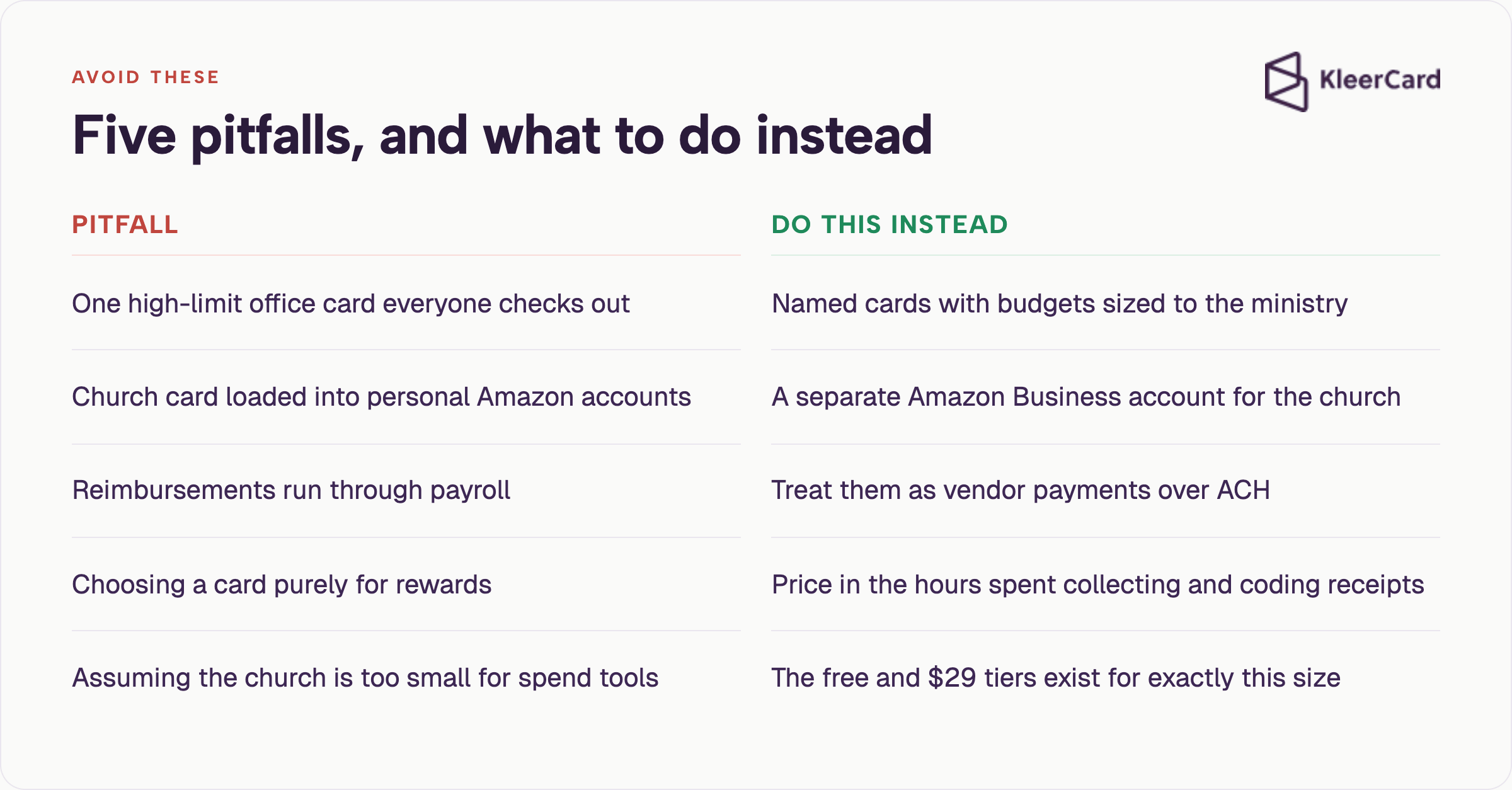
Small churches run on volunteers, limited staff, and donated dollars. Most still operate with one or two shared bank cards that live in a desk drawer. The result is constant hide-and-seek, personal reimbursements, and month-end receipt chases.
This guide focuses on churches under roughly 200 members or $500K in annual revenue. These are the ones that need 5 to 15 cards, not 50. You will see which cards actually fit that profile, what they cost at that scale, and how real small churches moved from paper or shared cards to controlled spend. For the full range of options across all church sizes, see our guide to the best credit cards for churches.
I co-founded KleerCard and serve as treasurer at my church. My church runs 2.5 paid employees and 21 active cards. Before founding KleerCard I spent years as Budget Director at Compassion International and later as a fractional CFO helping nonprofit finance teams through Switch Consulting. The lessons in this guide come from that experience and from the small churches KleerCard works with every week.
For most small churches that already run Aplos, Realm, Shelby, or QuickBooks Online, the $29 Standard plan is the practical starting point. See full pricing and plan details.
Access and visibility are the real issues for small churches, not trust.
When only five cards exist for an entire campus or a handful of ministry teams, staff and volunteers waste time locating the card, give up, and spend personal money. Finance then spends hours collecting reimbursements and matching receipts. That pattern shows up in churches of every size, but it hits hardest when there is only one part-time treasurer.
A private Christian school finance office that uses KleerCard started with five cards for more than 100 staff. Teachers and coaches regularly gave up and used personal cards because the shared card was always somewhere else on campus. Reimbursement batches of ten or twelve requests would arrive at the deadline. After the school issued individual and loaner cards with per-person budgets and mobile receipt upload, lost receipts dropped to fewer than five across seven months. Month-end credit-card work became a few minutes of checking.
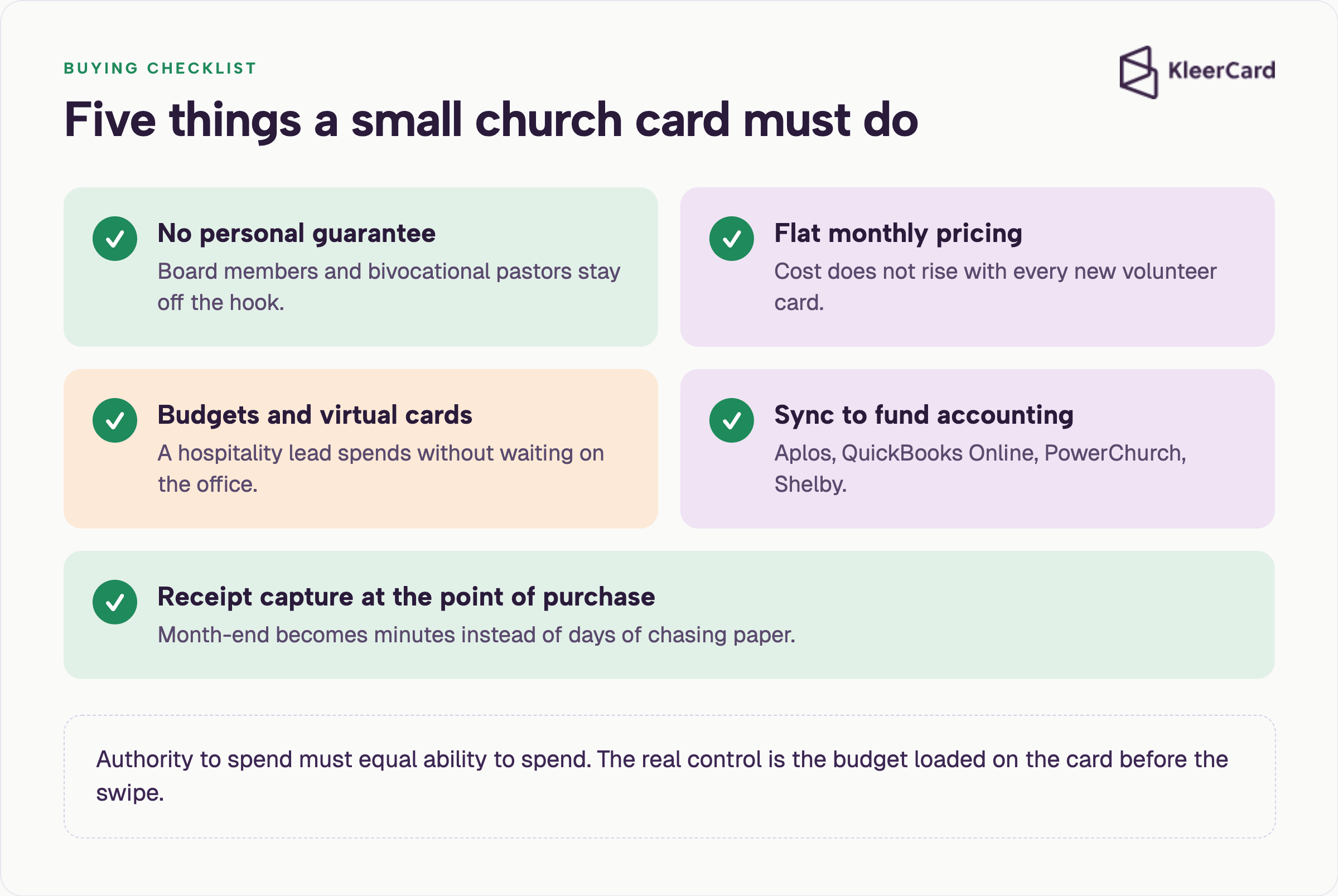
The features that matter at this scale are:
Authority to spend must equal ability to spend. A high-limit shared card in a drawer creates the illusion of control while leaving real risk. The real control is the budget loaded on the card before the swipe. If the budget is zero until approval, the card declines. Budget-loaded cards that decline when empty are cleaner than chasing paperwork after the fact. These are the same principles built into KleerCard and other modern expense management tools and the solutions built for nonprofits and churches.
.webp)
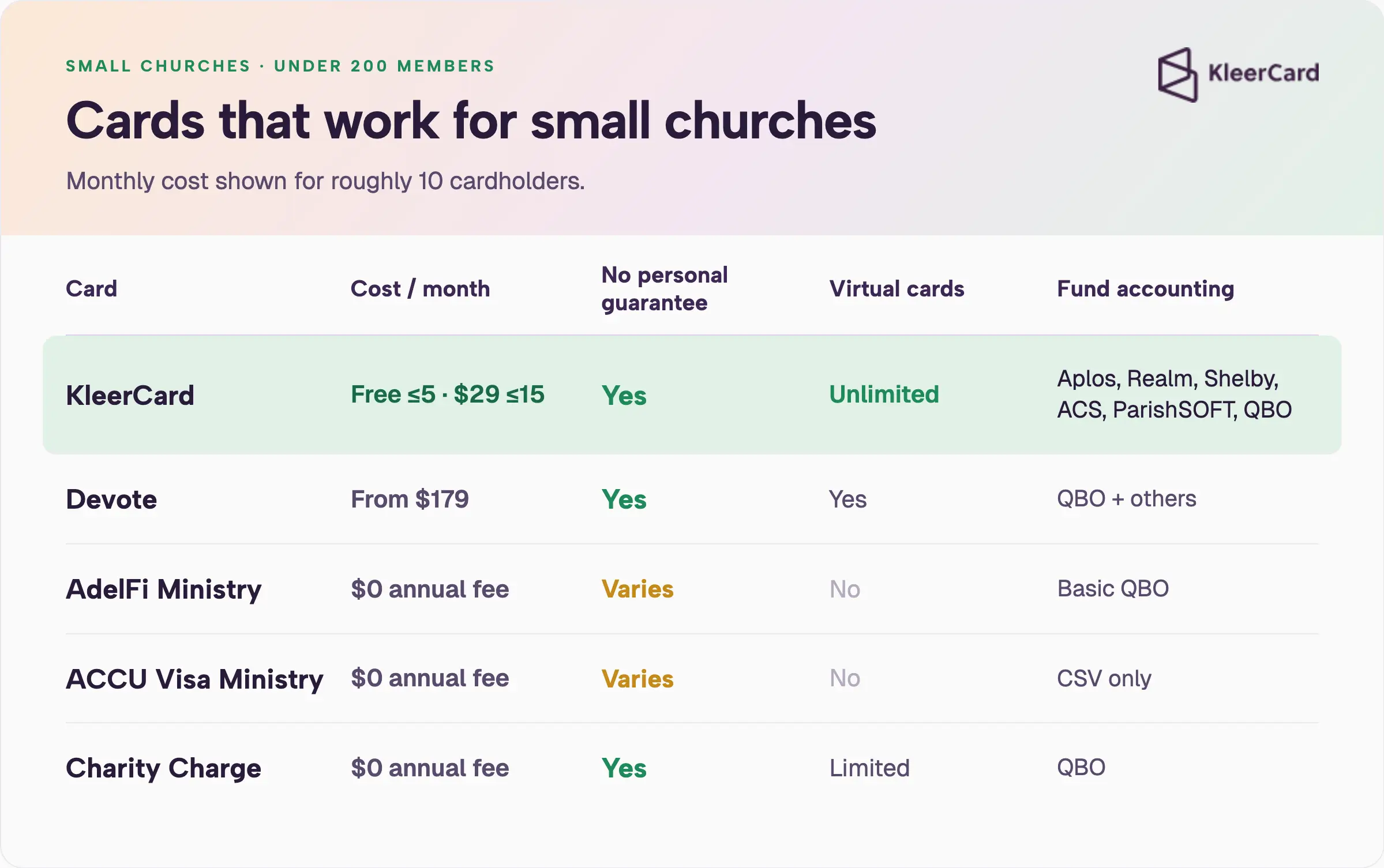
KleerCard is built for the exact profile most small churches fit: 5–15 cardholders, volunteer and staff mix, and fund-accounting software.
Pricing starts free for up to five users and $29 per month for up to 15. There is no per-seat fee. Virtual and physical cards are unlimited. Cards can be loaded with a fixed budget, set to $0 until funding is approved, restricted by merchant category or time of day, and auto-locked if receipts are missing.
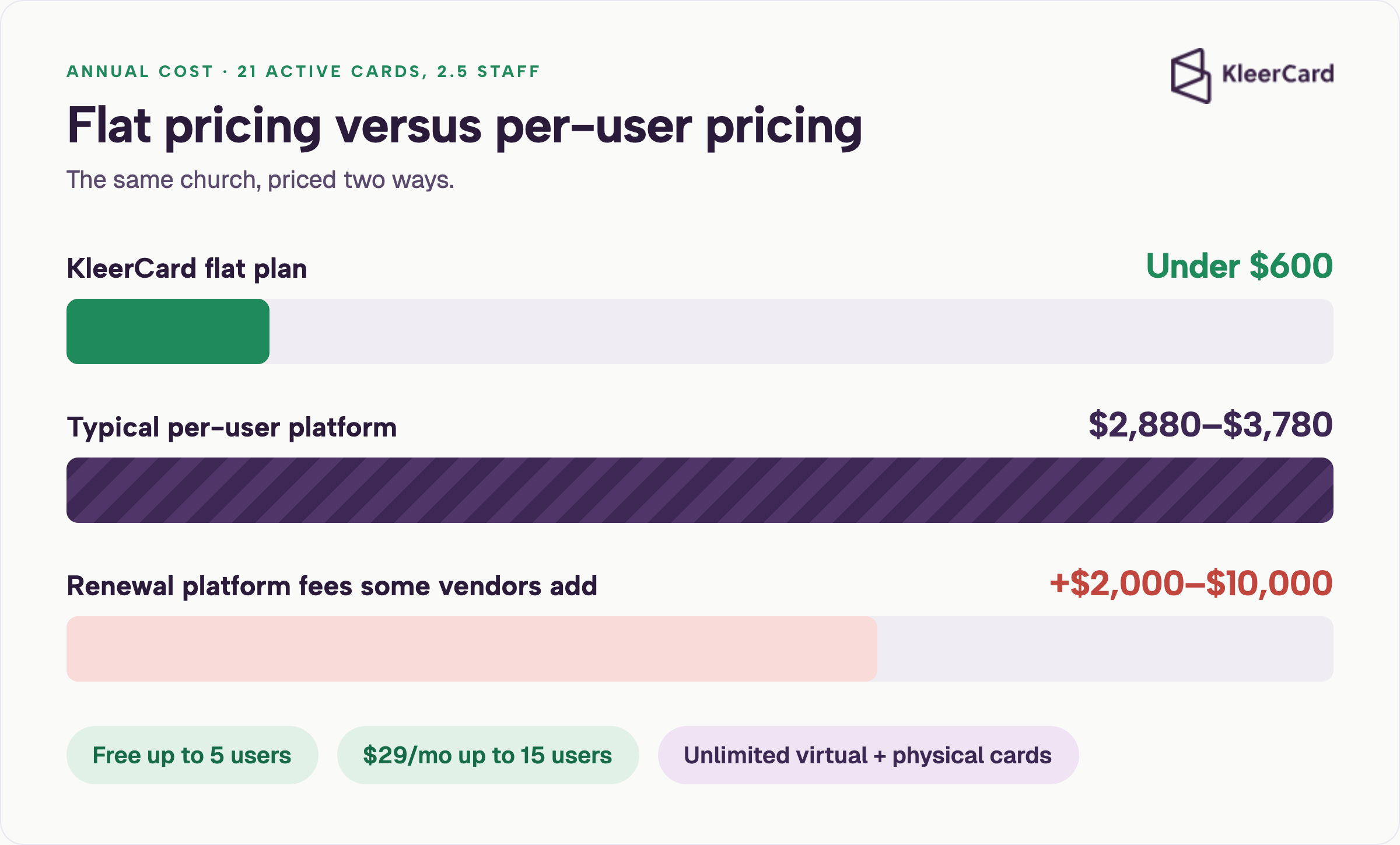
My own church runs 2.5 paid employees and 21 active cards. On a per-user platform that would cost roughly $2,880–$3,780 a year. The same setup on KleerCard stays under $600. That math is why volunteer-heavy small churches switch.
Real examples from churches in this size range:
Native integrations cover Aplos, Realm, ShelbyNext, ACS, ParishSOFT, Blackbaud, PowerChurch (via QuickBooks), and QuickBooks Online/Desktop. Month-end close that once took days now finishes in minutes for many users. Amazon Business charges can sync with line-item detail so the buyer codes the expense instead of finance guessing what the Amazon charge was for.
White-glove setup usually takes two or three 30-minute calls. Application is online and typically returns in 24–48 hours. Virtual cards can be issued the same day approval clears while physical cards ship in five to eight days.
Explore KleerCard for churches or apply for a free or Standard plan. For a closer look at the underlying product, see the nonprofit credit card overview. You can also schedule a short demo to walk through your specific setup.
Devote works well for churches that prefer to load funds in advance rather than carry a credit line. Virtual and physical cards are available with per-card limits and auto-lock. No personal guarantee.
Plans start at $179 per month and scale from there. The model requires active funding management. Integrations lean toward QuickBooks. It is a solid option when the board wants zero credit exposure and is comfortable pre-funding.
See our full Devote card review for a deeper look at the cash-secured model and current pricing, or check the official Devote pricing page.
No annual fee and 1.5% cash back through CURewards. Best for churches that already bank with AdelFi/CCCU and primarily want rewards rather than granular controls or virtual cards.
Personal guarantee requirements vary by underwriting. Controls are basic. Statement download to QuickBooks is available, but native fund-accounting depth is limited. Many churches keep the card for the faith-aligned banking relationship and the cash-back.
Confirm current terms after the 2025 merger on the AdelFi ministry credit cards page.
Tiered rewards on travel, hotels, and charitable donations. No annual fee. 360Control provides limits and reporting, but no merchant-category rules or virtual cards.
Personal guarantee can apply. Reconciliation is largely manual. Good fit only if the church already has an ACCU relationship and values points over automation. Read the full ACCU review if travel rewards are a priority, or confirm details on the official ACCU Visa Ministry Rewards page.
No personal guarantee and no annual fee. Designed specifically for 501(c)(3)s. Real-time controls and QuickBooks Online integration are available.
Eligibility often includes revenue or tenure thresholds (typically several years of operations plus minimum revenue). Virtual-card flexibility is more limited than KleerCard or Devote. Strong pure-credit option for established small churches that meet the criteria. See our Charity Charge review or confirm current thresholds and the Business versus Corporate product differences on the Charity Charge site.
Per-user pricing looks affordable until a small church needs cards for the youth pastor, the hospitality coordinator, three small-group leaders, the maintenance person, and a couple of seasonal volunteers. The annual cost then jumps by thousands of dollars. Some platforms also add renewal platform fees of $2,000 to $10,000 that hit fixed nonprofit budgets hardest.
KleerCard removes both problems. Pricing is free for up to five users or $29 per month for up to 15 users, with unlimited virtual and physical cards. A church that runs 2.5 paid employees and 21 active cards (staff plus volunteers) stays under $600 a year on KleerCard. The same headcount on a typical per-user platform costs $2,880–$3,780 before any platform fee. Flat monthly pricing plus unlimited cards lets finance issue a named, budget-controlled card to every legitimate spender without creating scarcity or surprise costs.
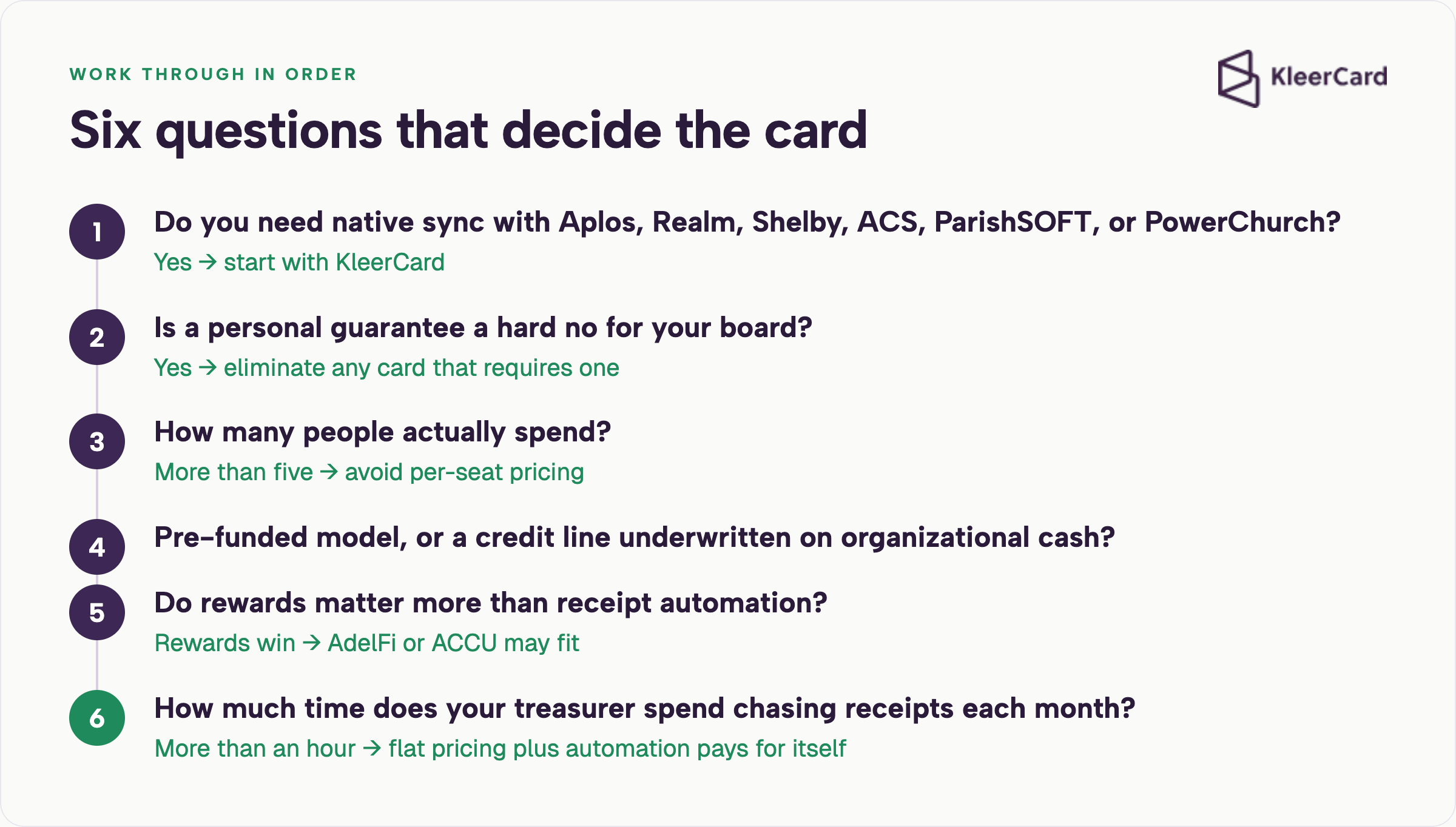
Work through these questions in order:
If the answer to the last question is more than an hour, platforms such as KleerCard that combine flat pricing with receipt automation pay for themselves quickly. One finance manager using KleerCard who previously spent 2.5 hours a month on manual statement entry into Shelby now finishes the same work in roughly 90 seconds.
Most small churches do not need a six-month project plan.
Recommended path:
Virtual cards can be live the same day while physical cards ship. Parallel running with the old bank cards for a few weeks reduces stress. Once the new cards are active, collect the old ones so no one is operating in two systems.
Churches that previously had only one shared admin card often see the biggest immediate relief. Named budgets remove the bottleneck without adding risk. One maintenance director at a multi-campus church using KleerCard used to spend time hunting for the shared card across two campuses just to buy supplies for a broken toilet. With his own named card and weekly budget check-ins, he uploads the receipt on the spot and moves on.
White-glove setup is available if you want a guided process. See white-glove setup for details.
For most small churches with 5–15 cardholders that use fund-accounting software, KleerCard’s Standard plan at $29 per month is the strongest fit. It requires no personal guarantee, supports unlimited virtual cards, and integrates with the platforms small churches already run (Aplos, Realm, Shelby, ACS, ParishSOFT, QuickBooks Online). Churches that prioritize cash-back and already bank with a Christian credit union often choose the AdelFi Ministry Card instead.
Yes. Several platforms underwrite against the organization’s cash assets or 501(c)(3) status rather than an individual’s personal credit. KleerCard, Devote, and Charity Charge are the most consistent no-personal-guarantee options for small churches. See the full list of credit cards for nonprofits with no personal guarantee.
Expect $0–$49 per month for platforms built for this size. Free tiers cover up to five users on some products. Avoid any pricing model that charges $12–$15 per user per month once you need more than a handful of cards.
Yes, if you have more than two or three regular spenders or seasonal needs (VBS, mission trips, camps). Virtual cards let you issue a budget-controlled card instantly without waiting for plastic or sharing a single physical card.
Look for native or simple integrations with Aplos, QuickBooks Online, Realm, Shelby, ACS Technologies, ParishSOFT, or PowerChurch. Manual CSV export works but adds monthly work that small teams usually cannot spare. For a broader view of church options, see the best credit cards for churches.
Fintech options commonly approve in 24–48 hours. Physical cards arrive in 5–8 days; virtual cards can be used the same day via Apple Pay or Google Pay. Credit-union cards often take one to three weeks.
If your current process still involves shared cards, personal reimbursements, or a treasurer spending hours on receipts every month, KleerCard and the other cards listed in this guide solve those problems at a price small churches can sustain.
Start with a pilot of a few cards. Most churches know within one billing cycle whether the change is worth making permanent.
See current KleerCard pricing and apply or schedule a short demo if you want to walk through your specific accounting setup first. For a complete comparison across all church sizes, read the best credit cards for churches in 2026.


Speak to a member of our team and we can have you up and running in minutes, not weeks.