%202.svg)
Compare the top Devote Card alternatives for nonprofits and churches in 2026. See pricing, no personal guarantee options, fund controls, and which fits your team best.
Nonprofits that outgrow shared personal cards or prepaid cards often land on Devote. Devote removes the personal guarantee and ties cards to funds, yet many teams later look for lower monthly cost, stronger accounting sync, or a true charge card that does not lock cash in advance. The practical triggers are usually Devote’s cash-secured model and platform fees that start at $179 per month.
This guide compares the practical alternatives available in 2026. You will see exact pricing, fund-level controls, virtual card limits, and which option fits churches, schools, and multi-fund nonprofits. For a pure product evaluation of Devote itself, see the full Devote Card review.
I co-founded KleerCard and serve as treasurer at my local church. Before that I spent years as Budget Director at Compassion International and later as a fractional CFO helping nonprofit finance teams through Switch Consulting. The recommendations below come from that work and from watching organizations evaluate these products in real operations.
About the author
Owen Hill is co-founder of KleerCard and volunteer treasurer at his church. He holds a degree in Economics and Operations Research from the United States Air Force Academy and a Ph.D. in Economics. He writes from direct experience managing ministry budgets, restricted funds, and monthly closes. Learn more about the KleerCard team.
.webp)
The best Devote Card alternatives for nonprofits in 2026 are KleerCard for fund-accounting depth and unlimited virtual cards, Charity Charge for no-fee revolving credit, and Givefront as a free option. All of the top options below carry no personal guarantee under standard underwriting.
Devote itself starts at $179 per month (Impact plan) and rises to $359 (Catalyst) or $719 (Visionary). Higher tiers add restricted-fund tracking and dedicated support. The card is cash-secured: organizations pre-fund the account. Confirm current plan details on the official Devote pricing page.
For the full set of cards that avoid personal guarantees, see our guide to credit cards for nonprofits with no personal guarantee.
Devote’s pre-funded model ties up operating cash that could otherwise sit in a high-yield account or cover payroll timing gaps. Devote’s monthly platform fees of $179 and up add up fast for organizations under $2 million in revenue.
Some teams also want tighter native connections to church accounting systems such as Aplos, Realm, or Shelby. Others need single-use virtual cards for short-term volunteers or event staff without creating permanent accounts.
From my years as Budget Director at Compassion International and as treasurer of a local church, the recurring pain points are the same: restricted funds that cannot be mixed, volunteers who need temporary spend authority, and month-end closes that drag on because receipts are missing.
Devote’s cash-secured model works cleanly when cash flow is predictable and the team is comfortable moving money into the platform ahead of spend. The same model becomes friction when grant reimbursements lag or seasonal giving creates temporary shortfalls. That is the practical reason many organizations eventually evaluate alternatives to Devote.
In the organizations I advised through Switch Consulting, Devote’s monthly fee plus the cash-secured requirement meant every dollar had to be loaded in advance. For churches running tight on unrestricted cash, that pre-funding created a practical drag that pure charge cards avoid. My own church’s 21-card setup would become expensive under any per-seat or high platform-fee model, which is why the fee structure matters as much as the features.
KleerCard was built specifically for churches, schools, and multi-fund nonprofits. Pricing starts at $0 per month (Free plan with deposit-backed spend limit), then $29 for Standard (up to 15 users) and $49 for Pro (up to 30 users). There is no per-user fee. See current KleerCard pricing for full details.
KleerCard gives unlimited physical and virtual cards. Virtual cards can be single-use, merchant-locked, time-window restricted, or recurring. Every transaction can be tagged to a restricted or unrestricted fund in real time. Receipts upload by phone with 99 percent OCR accuracy and automatic lock if the receipt is missing. These controls are the same ones that matter most when churches compare the best credit cards for churches.
Native integrations cover Aplos, Realm, Shelby, ParishSOFT, ACS Technologies, Blackbaud, PowerChurch (via QuickBooks), QuickBooks Online and Desktop, and NetSuite. Sales-tax refund automation runs for exempt organizations. Bill pay and reimbursements sit inside the same expense management platform.
KleerCard users and the organizations I have advised report concrete time savings. At Plum Creek Christian Church the month-end close went from 40 hours of collecting receipts and coding expenses to one hour. Hill Country Fellowship cut the same process from three days to seven minutes. Multi-campus teams have simplified accounts payable across more than 24 locations. Event teams have run 350-person gatherings on temporary virtual cards with a full audit trail.
No personal guarantee is required. Underwriting looks at organizational cash flow and reserves. White-glove setup issues the first cards and sets the accounting connections. Typical teams also report roughly two hours saved per user each month, plus the same amount for the finance staff.
My own church runs 2.5 paid staff and 21 active cards. On a per-seat model that would cost several thousand dollars a year. The Standard or Pro tier covers the same setup for a fraction of that.
KleerCard fits best when your team already uses fund accounting software or needs granular controls for volunteers and program staff. See KleerCard for churches and KleerCard for nonprofits for more on how the platform supports each audience. KleerCard is the nonprofit credit card built for the exact workflows most multi-fund teams actually run.
.webp)
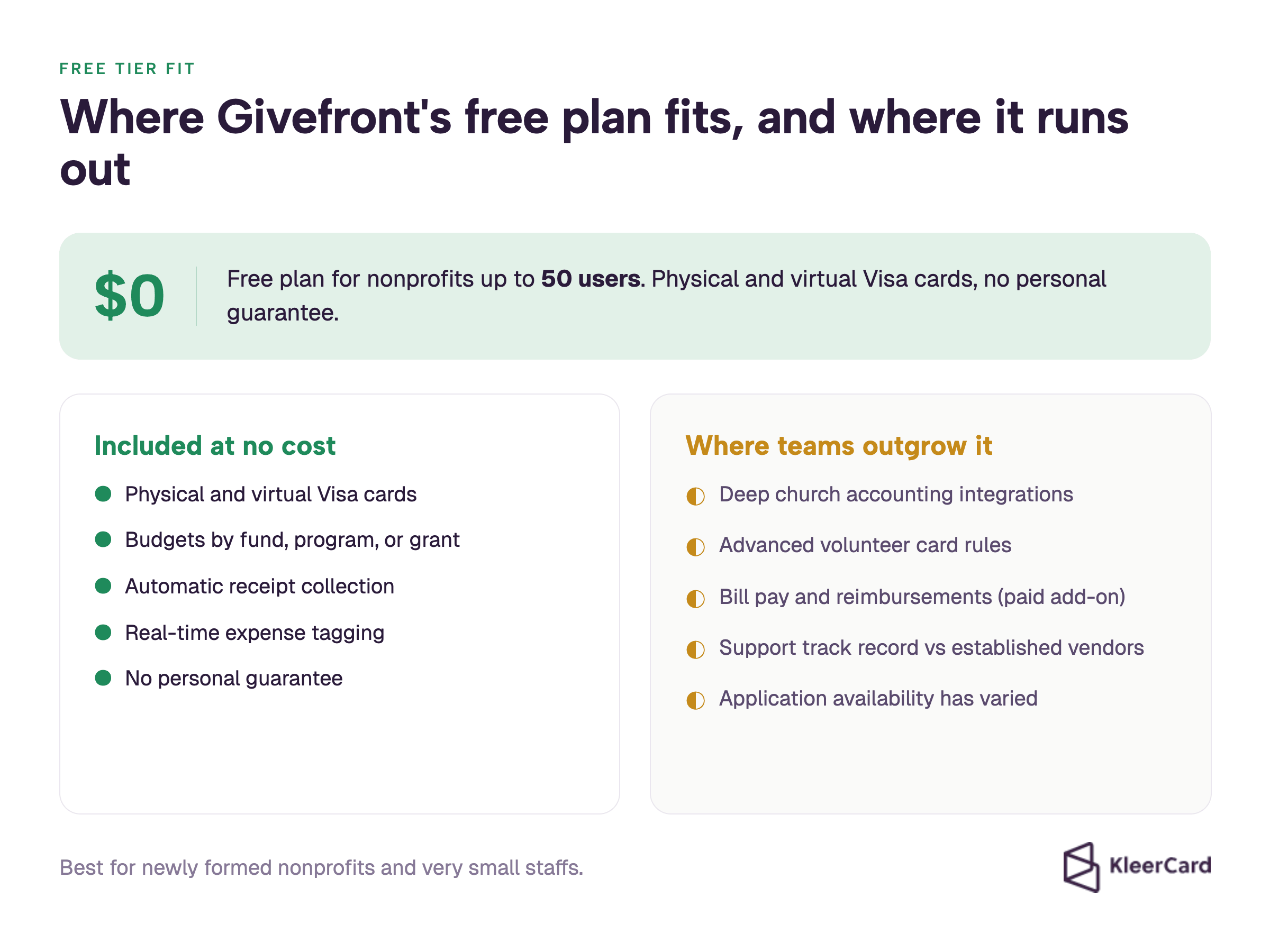
Givefront offers a free plan for nonprofits up to 50 users. Givefront issues physical and virtual Visa cards with no personal guarantee. Budgets can be tied to funds, programs, or initiatives. Receipts collect automatically and expenses tag in real time. Confirm current terms on the Givefront pricing page.
The platform is designed for organizations that want modern controls without a monthly platform fee. Larger teams can add paid bill-pay and reimbursement modules.
Givefront works well for newly formed nonprofits or very small staffs that have not yet outgrown basic tracking. Teams that need deep church-software integrations or advanced volunteer card rules usually move on to a paid platform once volume grows.
Application availability has varied in the past, so confirm the current flow on their site before planning a migration. Givefront fills the free tier that Devote does not offer, though the support track record is shorter than more established options. For small teams that simply need cards without a platform fee, Givefront remains one of the cleanest free options.
Charity Charge issues a Mastercard with no annual fee and no personal guarantee under standard underwriting. Eligibility typically requires $100,000 in revenue plus five years of operation, or $500,000 plus two years. Details are published on the Charity Charge Nonprofit Business Card page.
The platform supports multiple employee cards, real-time limits, and QuickBooks Online sync. Some versions offer vendor rebates. Virtual-card depth and native church accounting connections are lighter than KleerCard or Devote higher tiers.
Charity Charge suits established 501(c)(3) organizations that want a simple revolving credit product and already run QuickBooks Online. Mastercard acceptance can create friction at Costco and some international destinations, so confirm merchant coverage for your typical spend.
See our full Charity Charge Nonprofit Business Card review for the difference between the Business and Corporate products and current eligibility details.
AdelFi (formerly Christian Community Credit Union) offers a Ministry Credit Card with 1.5 percent cash back and occasional sign-up bonuses. See current options on the AdelFi ministry credit cards page. America’s Christian Credit Union provides tiered rewards on travel and charitable donations through its Visa Ministry Rewards card. AGCU serves Assemblies of God churches with a basic church card; details are on the AGCU ministry credit cards page.
All three carry $0 annual fees. Spend controls and virtual-card options remain limited compared with purpose-built platforms. Personal-guarantee requirements vary by underwriting. Reporting is usually statement download or CSV rather than live fund tagging.
Christian Community Credit Union and AdelFi completed a merger of equals effective December 1, 2025. Existing Ministry Card holders keep their accounts. New applicants should apply through the AdelFi channels as the brand transition continues through mid-2026. See the AdelFi merger hub for the latest status.
These credit-union cards fit churches that already bank with the credit union and prioritize rewards or relationship banking over advanced controls. They are less suited to teams that need single-use virtual cards, auto-lock for missing receipts, or native exports into Aplos, Realm, or Shelby.
For a side-by-side look at how these options compare on fund accounting and virtual cards, see the best credit cards for churches guide.
Three practical questions separate useful options from the rest when evaluating alternatives to Devote.
Eligibility floors also matter. Charity Charge requires either $100,000 in revenue plus five years of operation or $500,000 plus two years. Others underwrite on organizational financials alone and require no personal guarantee.For most churches and multi-fund nonprofits the combination of no personal guarantee, real-time fund tagging, and native church-software exports outweighs cash-back rewards. Clean audit trails and fewer hours chasing receipts are the actual payoff. If your current process still involves shared cards, paper receipts, or delayed coding of restricted funds, switching away from Devote is usually worth the short onboarding effort.
.webp)
The strongest practical alternatives in 2026 are KleerCard for fund accounting and volunteer controls, Givefront for zero monthly cost, and Charity Charge for established organizations seeking a simple no-fee charge card. Faith-based credit unions serve churches that already hold accounts there.
No. Devote underwrites the organization and does not require a personal guarantee or personal credit check. Most purpose-built nonprofit cards follow the same rule.
Devote’s Impact plan is $179 per month, Catalyst is $359 per month, and Visionary is $719 per month. Higher tiers add restricted-fund tracking and dedicated support. High-yield savings is free with any plan. Verify the latest numbers on Devote’s pricing page.
KleerCard usually wins for churches that use Aplos, Realm, Shelby, or similar systems because of native integrations and more granular virtual-card rules. Devote remains a solid choice for organizations comfortable with pre-funding and QuickBooks-centric workflows. See the full Devote Card review for the detailed product comparison.
Yes. KleerCard, Devote, Charity Charge, Givefront, Ramp (with cash minimums), and Brex (with higher cash minimums) all offer organizational underwriting without a personal guarantee. Always confirm current eligibility with the issuer. See the full list of credit cards for nonprofits with no personal guarantee.
Prioritize no personal guarantee, fund-level spend controls, native church accounting integrations, unlimited virtual cards for volunteers, and automatic receipt capture. Rewards matter less than clean audit trails and reduced month-end work.
The right Devote Card alternative depends on cash-flow preferences, accounting software, and how many temporary users need cards. For most churches and multi-fund nonprofits, a platform that combines no personal guarantee, real-time fund tagging, and deep software integrations delivers the cleanest operations. The evidence shows up in measured time savings: month-end closes that drop from days or tens of hours to minutes or a single hour once receipts and fund coding stop being manual.
Review the comparison table above against your current process. If fund accounting and volunteer controls matter most, start with the nonprofit credit card built for that exact use case.
Ready to see how a purpose-built card works with your books? Explore KleerCard or schedule a short walkthrough with the KleerCard team. You can also sign up when you are ready to start.
.webp)


Speak to a member of our team and we can have you up and running in minutes, not weeks.