%202.svg)
Church credit card application: documents, EIN vs unincorporated status, board resolution, what underwriters review, and how long approval takes.
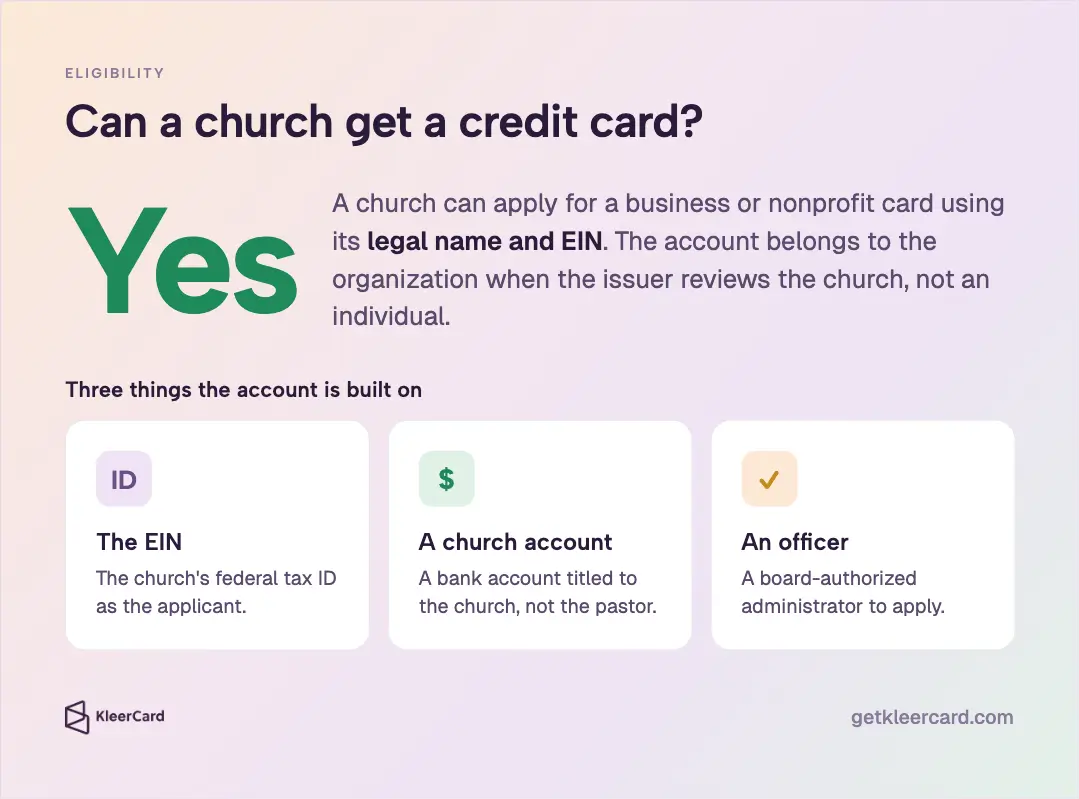
A church can apply for a credit card in the church’s own name. The application uses the organization’s EIN, a bank account titled to the church, and an officer the board has authorized. It does not use the pastor’s personal card.
This guide covers the documents issuers ask for, the difference between an EIN, an unincorporated church, and a determination letter, the board resolution, what underwriting reviews, and how long approval takes. If you already have those documents and need to compare products, use the best credit cards for churches.
I serve as treasurer at my church and review church applications in that work. I use the steps below when I look at whether an application is ready to submit.
Yes. A church can apply for a business or nonprofit credit card using the church’s legal name and Employer Identification Number. The account belongs to the organization when the issuer reviews the church instead of an individual.
Some issuers still attach the pastor’s or treasurer’s Social Security Number and ask for a personal guarantee. Others review the church and, for a registered 501(c)(3), keep liability at the organization. Confirm whether the church or a person is liable before anyone signs. Options that skip the guarantee are listed in credit cards for nonprofits with no personal guarantee.
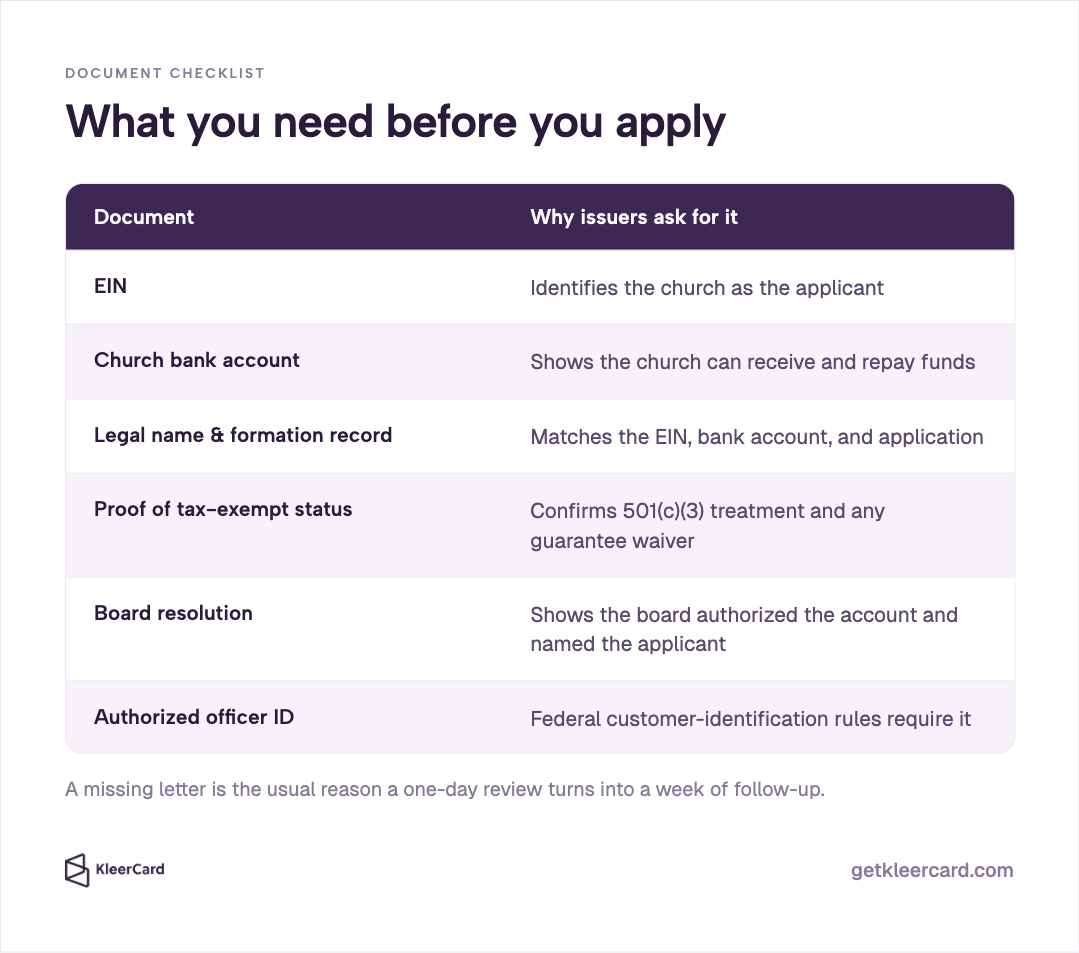
Gather the documents before you open an application. A missing letter is the usual reason a one-day review turns into a week of follow-up email.
| Item | Why issuers ask | If you do not have it |
|---|---|---|
| Employer Identification Number (EIN) | Identifies the church as the applicant | Apply with IRS Form SS-4 only after the church is legally formed |
| Church bank account | Shows the organization can receive and repay funds | Open an account in the church’s legal name. A pastor’s personal checking account does not substitute |
| Legal name and formation record | Matches the EIN, bank account, and application | Articles of incorporation, certificate of formation, or association bylaws, depending on how the church is organized |
| Proof of tax-exempt status | Confirms 501(c)(3) treatment for underwriting and any personal-guarantee waiver | IRS determination letter, or a current denominational group exemption letter plus the church’s own EIN |
| Board resolution | Shows the board authorized the account and named the applicant | Pass a short resolution before anyone submits |
| Authorized officer identity | Federal customer-identification rules require it | Driver’s license or other ID for the administrator named on the application |
Issuers recognize a determination letter faster than any other proof of exemption. Churches are not always required to obtain one.
Do not apply for an EIN before the church exists as a legal organization. The IRS warns that applying for an EIN starts the period in which filing duties can apply, because the IRS presumes the organization is already formed. That note is on the IRS page for obtaining an EIN for an exempt organization.
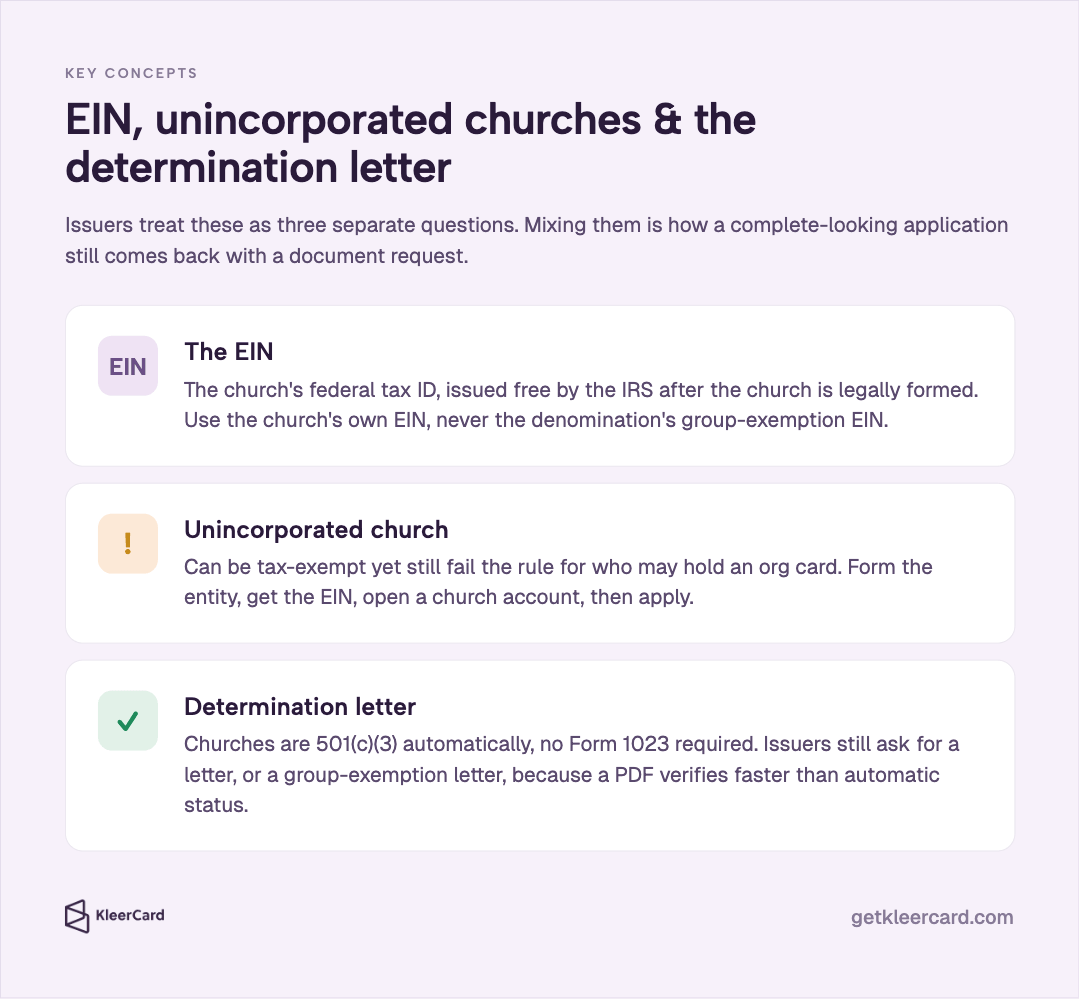
Issuers treat the EIN, the legal form of the church, and proof of exemption as separate questions. Mixing them is how an application that looks complete still comes back with a document request.
Banks, payroll processors, and card issuers identify the church by its EIN, the way they identify a person by a Social Security Number. A congregation that already pays staff, files employment taxes, or holds a church checking account almost always has one.
If the church does not have an EIN, form the organization first, then apply. The IRS issues an EIN for free. U.S. churches can get an employer identification number online and receive it in the same session. On Form SS-4, churches use the “Church or church-controlled organization” entity type. The current form and line instructions are in the IRS Instructions for Form SS-4.
A local church in a denomination should use its own EIN. Do not put the denomination’s group-exemption EIN on a card application.
A church can be tax-exempt as an unincorporated association and still fail the rule many issuers use for who may hold an organizational card. Many platforms will not open that account for a consumer, a sole proprietor, or an unincorporated partnership. An unincorporated new church with no formation record and no church bank account sits in that group.
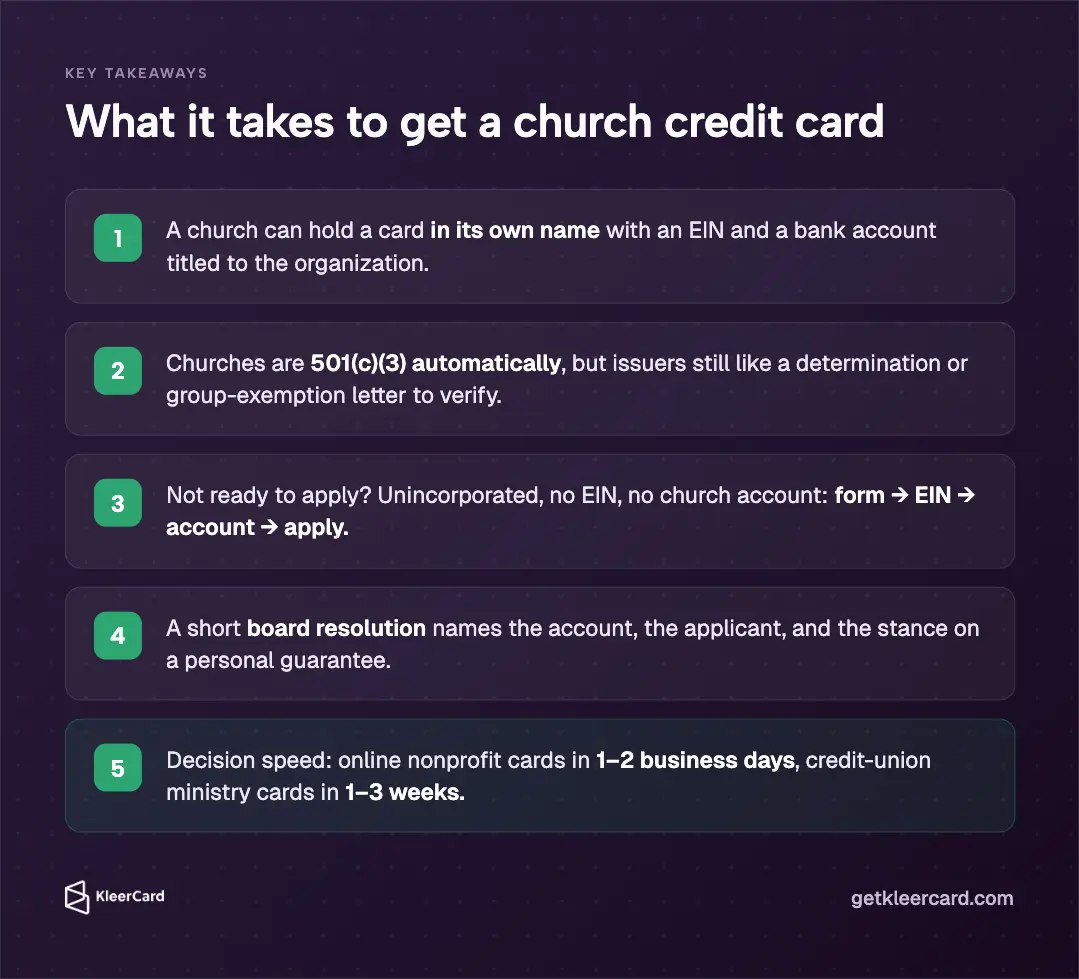
Form the organization first, get the EIN, open a church bank account, then apply for the card.
KleerCard publishes the same limit. U.S.-organized and registered organizations may apply. Unincorporated new churches and people applying in their own name may not. The current rules are on KleerCard eligibility. Other issuers use different wording and reach the same result.
Churches that meet the requirements of section 501(c)(3) are automatically considered tax exempt and are not required to apply for IRS recognition. The IRS states that directly on Churches, integrated auxiliaries, and conventions or associations of churches. Churches, including synagogues, temples, and mosques, are also listed among the organizations not required to file Form 1023.
That automatic treatment is why many established congregations have never requested a determination letter. The IRS description of what counts as a church is on Definition of Church. A longer walkthrough of church tax rules is in IRS rules for churches.
A church that wants a determination letter on file can still file Form 1023. The current filing rules are in the IRS Instructions for Form 1023. Issuers still ask for a letter because a PDF is easier to review than a claim of automatic exemption. Two substitutes usually work when there is no standalone determination letter:
If a personal-guarantee waiver depends on registered 501(c)(3) status, do not assume automatic church exemption is enough. Ask the issuer in writing before anyone accepts a credit line.
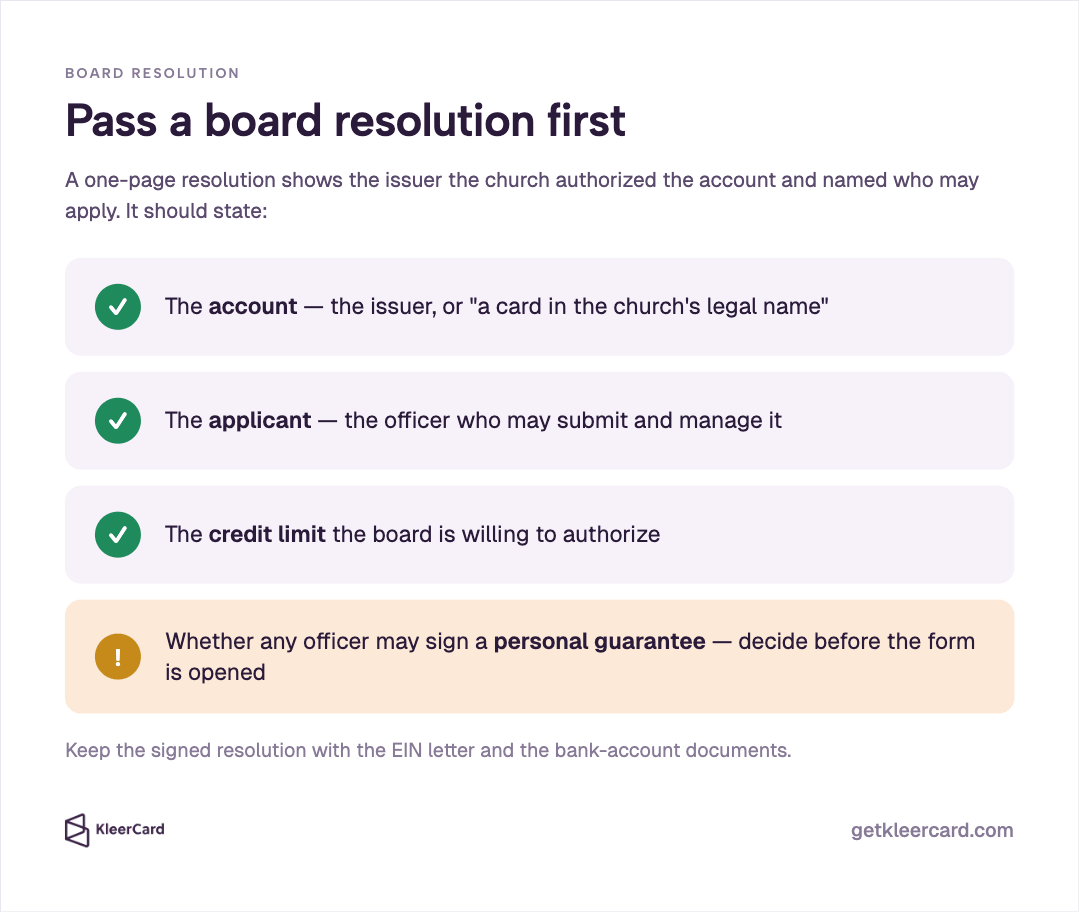
The board should pass a short resolution so the issuer can see the church authorized the account and named who may apply.
Name the issuer, or write “a credit card account in the church’s legal name.” Name the officer who may submit the application and manage the account. State the maximum credit the board is willing to authorize. State whether any officer is permitted to sign a personal guarantee. If the answer is no, put that in the resolution before anyone opens the form.
Boards that skip this step often meet the guarantee on the last screen of the form. By then the pastor or treasurer is the person looking at a personal-liability checkbox.
Keep the signed resolution with the EIN letter and the bank-account documents. Credit unions and some banks will ask for it up front. Online applications may not upload it on day one and can still request it during review.
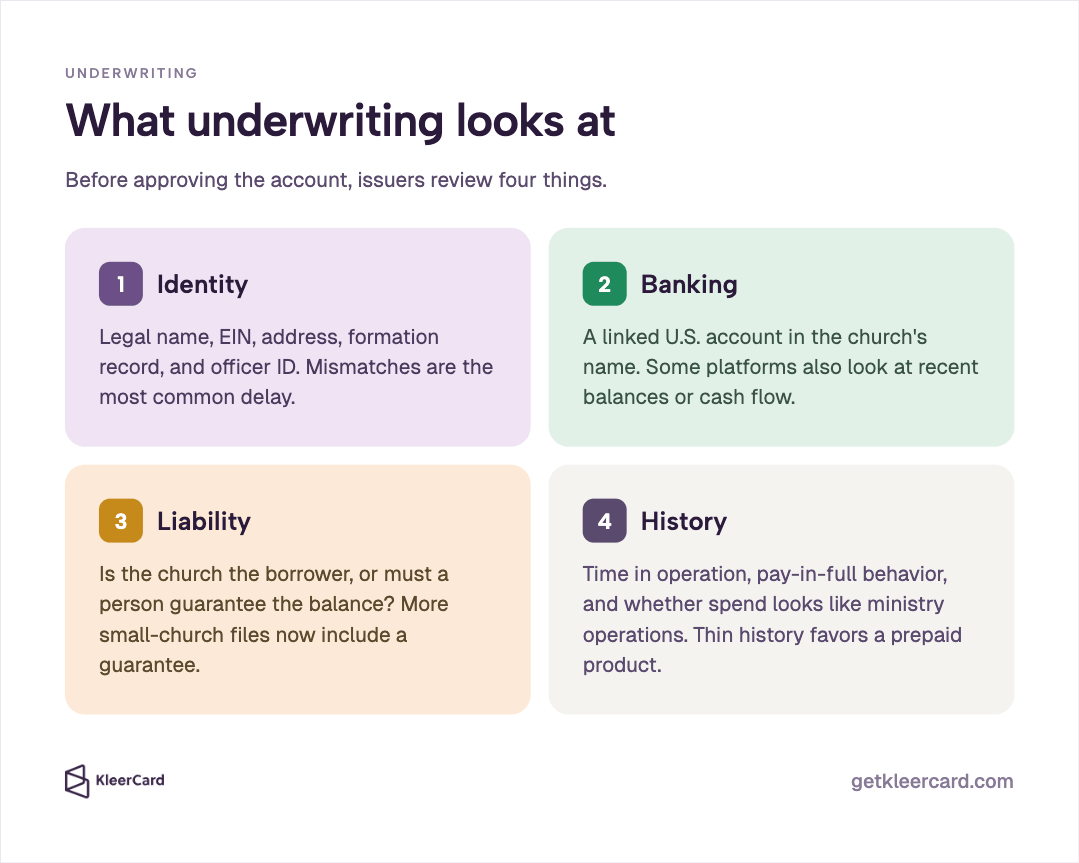
Before they approve the account, issuers review whether the church can hold the card and pay the balance. They usually look at four things.
Identity. Legal name, EIN, address, formation record, and the administrator’s identity. Mismatches between the EIN letter, the bank account title, and the application name are the most common delay.
Banking. A linked U.S. account in the church’s name. Some platforms also look at recent balances or cash flow. Ramp’s application rules require at least $25,000 in a linked U.S. business bank account. Charity Charge’s eligibility FAQ requires either five years in operation and $100,000 in annual revenue, or two years and $500,000. Brex reviews nonprofits case by case and asks for 501(c)(3) paperwork, articles of incorporation, and board documents rather than publishing a church cash floor. KleerCard does not publish a cash or revenue minimum. It still collects company data, including actual or anticipated revenue, during review.
Liability. Whether the church is the borrower, or whether a person must guarantee the balance. After several 2025 program changes, more bank and credit-union applications for smaller churches have included a personal guarantee. The other option is a nonprofit issuer that reviews the church instead of a person.
History. How long the church has operated, whether the account will be paid in full, and whether the spend looks like ministry operations rather than household use. Newer churches with thin operating history are more often approved for a prepaid or deposit-funded product than for an open credit line.
No major church-card program publishes a personal FICO cutoff as the approval rule. Programs that require a personal guarantee will still review the guarantor’s credit. Programs that do not require a guarantee still collect personal data on administrators because federal law requires financial institutions to identify the people who open an account.
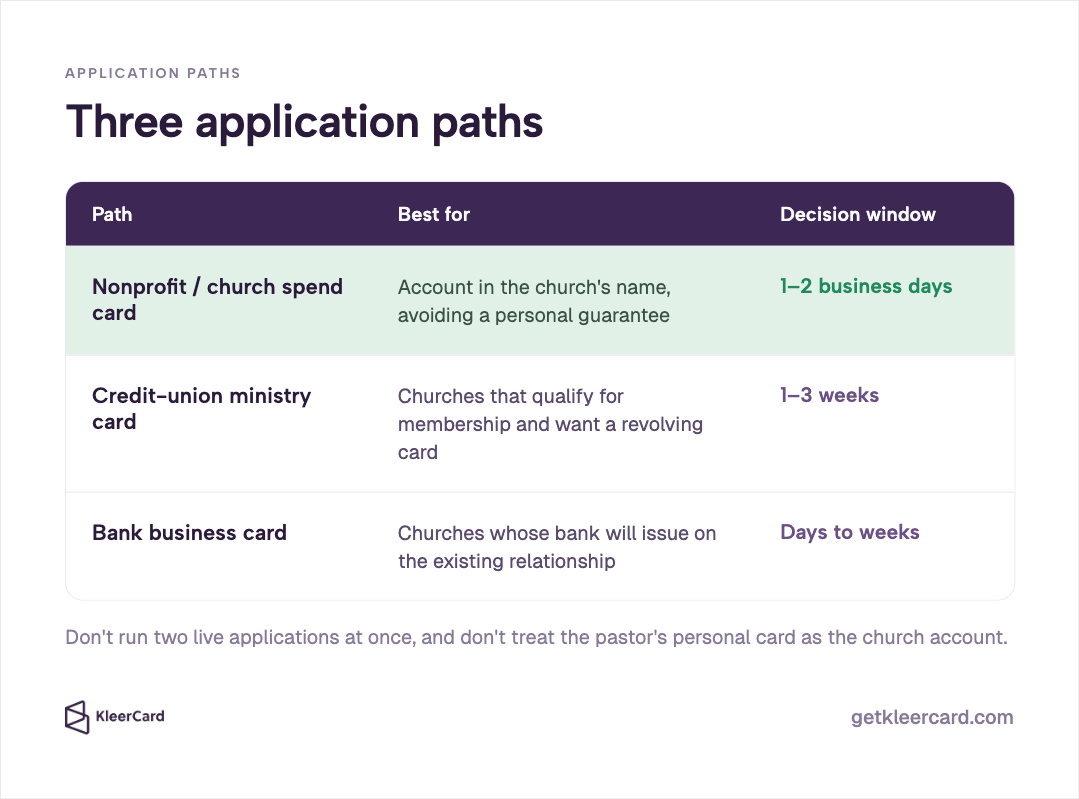
Pick a path before you fill out a form. The three paths ask for similar documents, but they review different things and take different amounts of time.
| Path | Who it fits | What the application usually includes | Typical decision window |
|---|---|---|---|
| Nonprofit or church spend card | Churches that want the account in the church’s name and want to avoid a personal guarantee | EIN, church bank account, officer identity, 501(c)(3) evidence when a waiver is offered | Often 1–2 business days after a complete application |
| Credit-union ministry card | Churches that already qualify for membership and want a traditional revolving card | Membership first, then EIN letter, governing documents, board authorization | Often 1–3 weeks after membership and documents are in |
| Bank business card | Churches whose bank will issue a card on the existing relationship | EIN, personal credit of the signer, and often a personal guarantee | Days to a few weeks, depending on the bank |
Do not treat the pastor’s personal card as the church account. Church purchases then sit on one person’s credit, and every receipt becomes a reimbursement.
Credit unions handle the steps in order. AGCU, for example, asks applicants to confirm the church qualifies to join, open a ministry account if they do not already have one, apply through the credit union’s card page, and submit the EIN letter, governing documents, and board authorization. That sequence is in the AGCU church credit card review. AdelFi ministry credit cards follow the same membership-then-documents pattern. America’s Christian Credit Union does as well.
Smaller congregations that only need a few cards and a simple bank relationship sometimes stay with the bank they already use. That works when the board has already accepted a personal guarantee. If the board has not accepted one, start with an issuer that reviews the church rather than opening a bank application you will have to abandon.
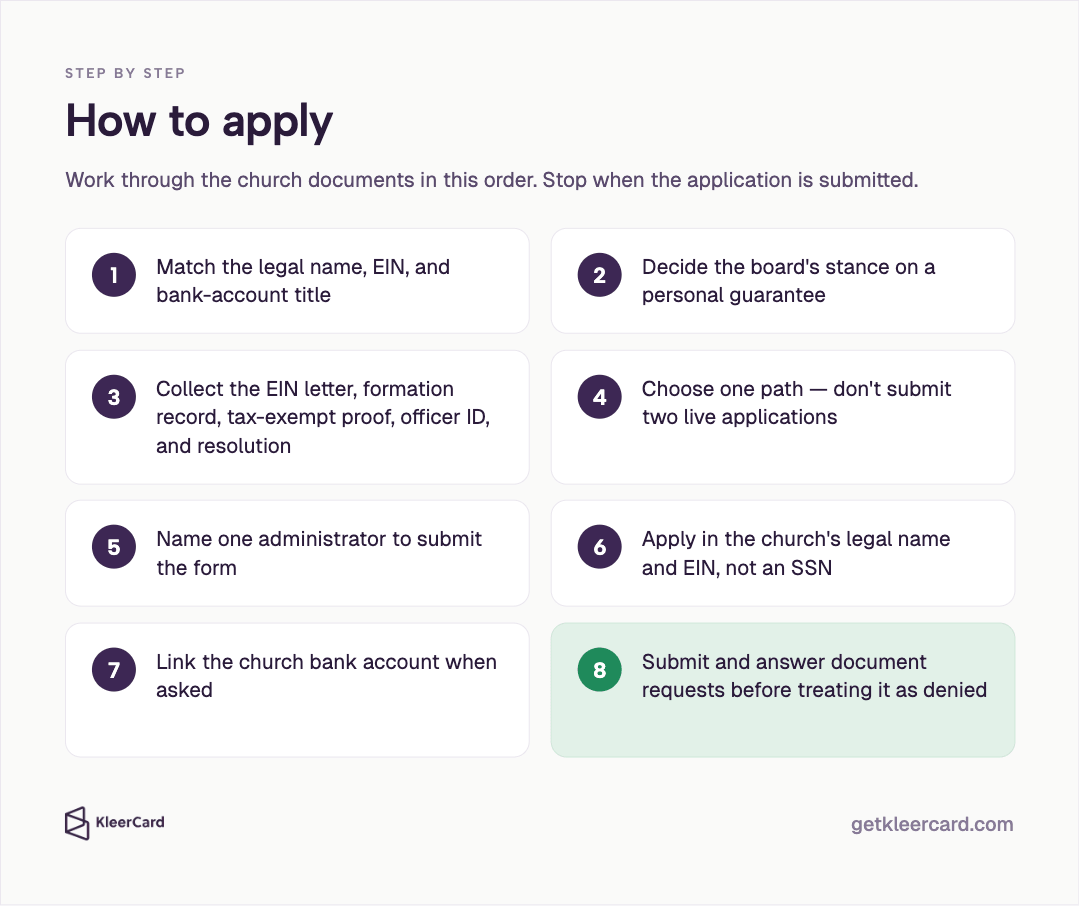
Work through the church documents in this order. Stop when the credit card application is submitted.
KleerCard applications start at sign-up. Other issuers use their own portals. You still follow the same eight steps.
Issuing cards to staff, setting limits, and connecting accounting software come after approval. If you still need to choose a product, go back to the best credit cards for churches.
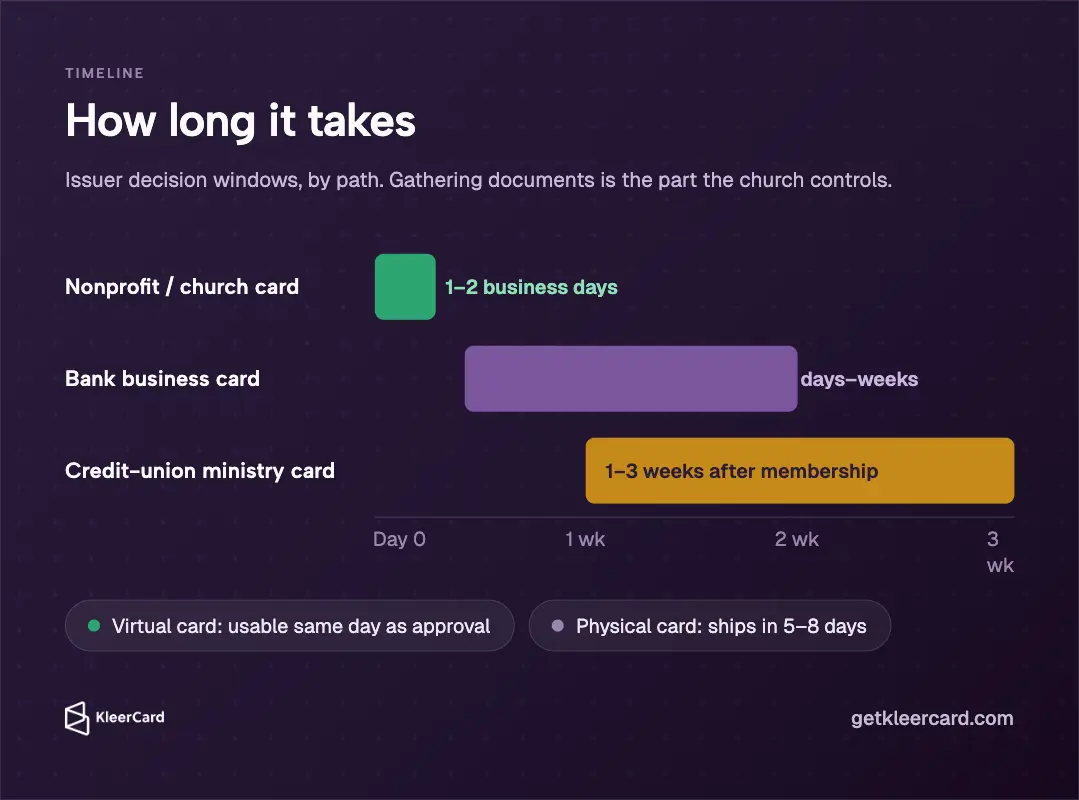
You wait three times: while you gather documents, while the issuer reviews the application, and while a usable card arrives.
How long it takes to gather documents is the part the church controls. A church that already has an EIN letter, a church checking account, and a signed resolution can apply the same day. A church that still needs an EIN or a bank account has not started the issuer’s review yet.
Issuer review depends on whether the church applied through an online nonprofit card program, a credit-union ministry card, or a bank business card. Online nonprofit card programs commonly return approval, denial, or a request for more documents in 24 to 48 hours. KleerCard says most complete applications come back in one to two business days, with longer review when identity checks or extra documents are needed. Credit-union ministry cards more often take seven to fourteen days after membership and the document packet are complete, and can run to three weeks.
Approval by email does not mean someone can swipe a card yet. Virtual cards, when the issuer offers them, can be issued the same day approval clears. Physical cards commonly ship in five to eight days for online programs and arrive by mail on the credit-union and bank programs.
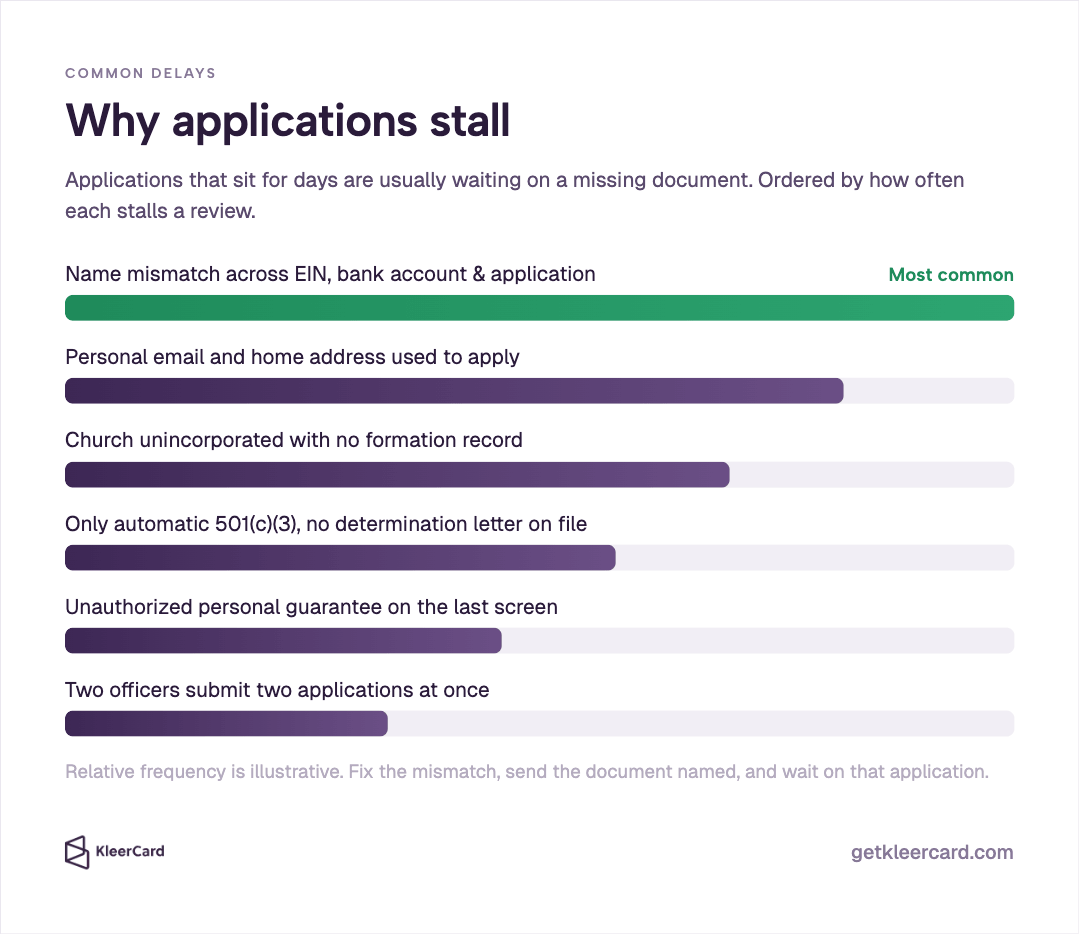
Church credit card applications that sit for days are usually waiting on a missing document.
The EIN, the bank account, and the application use three different names for the same church. The administrator applies with a personal email and a home address. The church is unincorporated and has no formation record. The issuer asks for a determination letter and the church has only automatic 501(c)(3) status. The last screen requires a personal guarantee the board never authorized. Two officers submit two applications at once.
Fix the mismatch, send the document the reviewer named, and wait on that application. Opening a second application does not speed the first one up.
Yes. Nonprofit and church cards can be issued to the organization and reviewed on the church’s EIN and financials. Bank business cards can also be titled to the church and still require a person to guarantee the balance.
Plan on the EIN letter, a church bank account, formation or governing documents, an authorized officer’s identification, and a board resolution. Many issuers also ask for an IRS determination letter or a denominational group exemption letter.
Not always. Churches that meet the IRS definition of a church are generally treated as 501(c)(3) organizations without filing Form 1023. Issuers still request a letter when they need a document they can verify quickly.
Usually not as an organizational account. Get an EIN, form the church as the issuer requires, and open a bank account in the church’s name before you apply. If the pastor applies in a personal name, the issuer opens a personal account.
It depends on the issuer. Some nonprofit cards waive the guarantee for a registered 501(c)(3). Many bank and credit-union cards still ask a pastor, treasurer, or board officer to sign. The board should decide that point before the form is opened.
Complete applications at online nonprofit issuers often return in 24 to 48 hours. Credit-union files more often take one to three weeks after membership and documents are in. Virtual cards can be usable the same day as approval. Physical cards follow by mail.
Match the church’s legal name, EIN, and bank account. Pass a resolution that names the applicant and states the board’s position on a personal guarantee. Then submit one application.
If the church is not yet formed, stop and form it. If the documents are complete, apply.


Speak to a member of our team and we can have you up and running in minutes, not weeks.