%202.svg)
Zero-based budgeting forces every nonprofit dollar to justify itself. Learn the process, the real challenges, and how spend controls keep the discipline alive between cycles.
Most nonprofit budgets start with last year’s numbers and add a few percent. That habit hides programs that no longer deliver, protects pet expenses, and leaves restricted funds mixed with unrestricted cash.
Zero-based budgeting starts every cycle at zero. Every program, every line item, and every dollar must earn its place again.
I have watched this play out across churches, private schools, and nonprofits for years, first while running finance processes at Compassion International and Switch Consulting and later through the day-to-day spend systems we build. The incremental approach feels safe until the finance office spends days chasing receipts or trying to explain why a restricted gift shows as available cash.
A private Christian school with 540 students and about 100 staff lived the classic incremental failure mode. Five shared cards served the entire campus across two locations. Staff hunted for the physical cards, teachers used personal cards and waited for reimbursement, and lost receipts ran about five per week.
After the school moved to more than sixty individual and loaner cards with justified limits, lost receipts fell to fewer than five across seven months. Month-end credit-card close dropped to a few minutes of review.
This guide shows the staged process that produced those results and the continuous controls that keep the zero-base discipline alive after the annual exercise ends.
You will leave with a clear definition, a comparison to incremental budgeting, an honest list of challenges, a practical step-by-step process, and the decision questions that force real justification.
Zero-based budgeting requires every expense and every program to be justified from a zero base each budgeting cycle. Nothing carries forward automatically because it appeared last year.
In practice this means three things for a nonprofit. Revenue projections start from current commitments and realistic forecasts, not last year’s totals. Expense requests start at zero and must show mission alignment, expected outcomes, and the lowest cost that still delivers those outcomes. Restricted funds and unrestricted funds are evaluated separately so restricted dollars cannot quietly subsidize other work.
Traditional incremental budgeting begins with the prior year and adjusts. Zero-based budgeting asks whether the activity should exist at all and at what level.
The method originated in the late 1960s with Peter Pyhrr at Texas Instruments. Nonprofits adopted it later because mission drift and restricted funding make automatic roll-forwards especially costly. You can read the core definition on the Investopedia zero-based budgeting page and the Aplos Zero-Based Budget glossary.
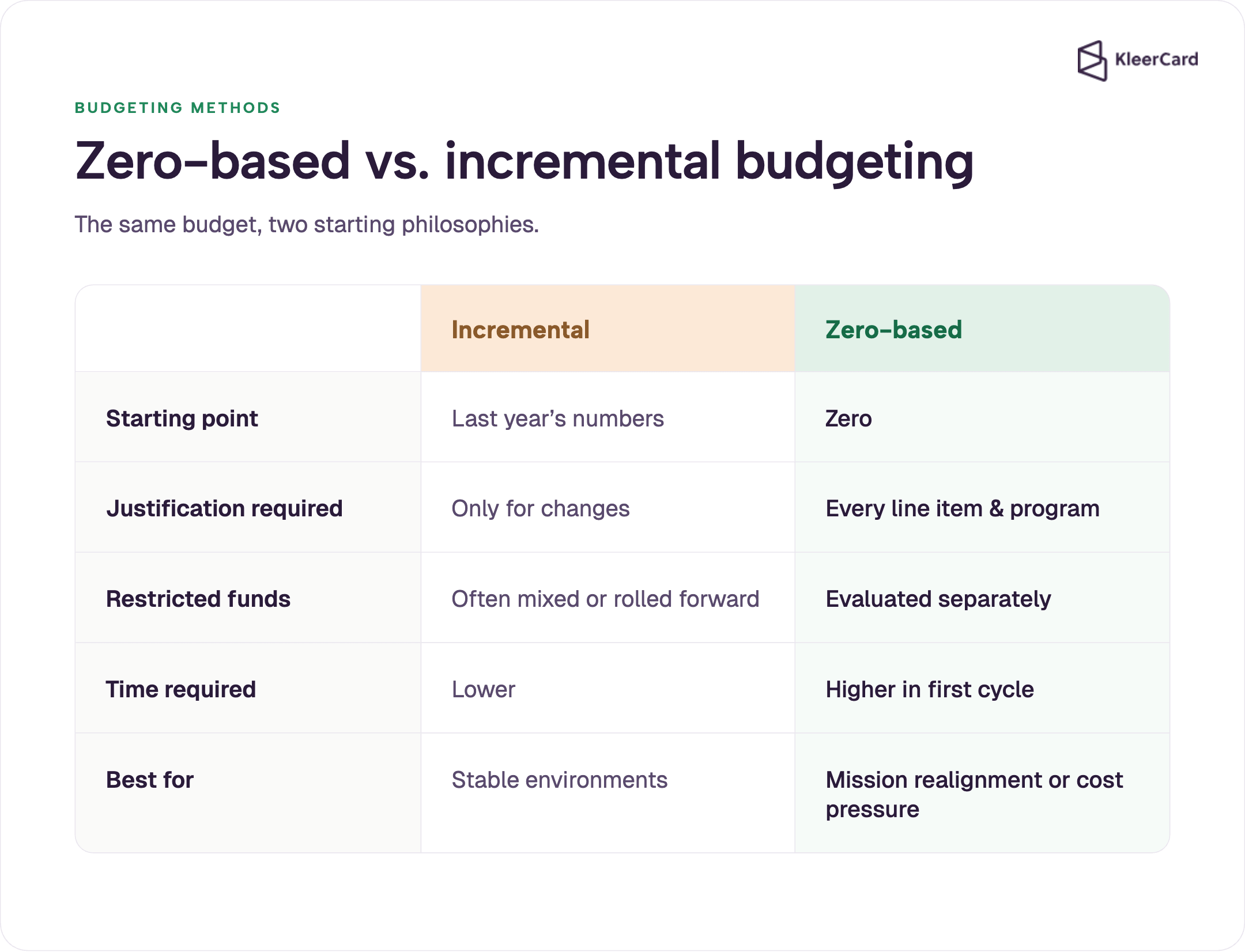
| Aspect | Incremental Budgeting | Zero-Based Budgeting |
|---|---|---|
| Starting point | Last year's numbers | Zero |
| Justification required | Only for changes | Every line item and program |
| Restricted funds | Often mixed or rolled forward | Evaluated separately |
| Time required | Lower | Higher in first cycle |
| Best for | Stable environments | Mission realignment or cost pressure |
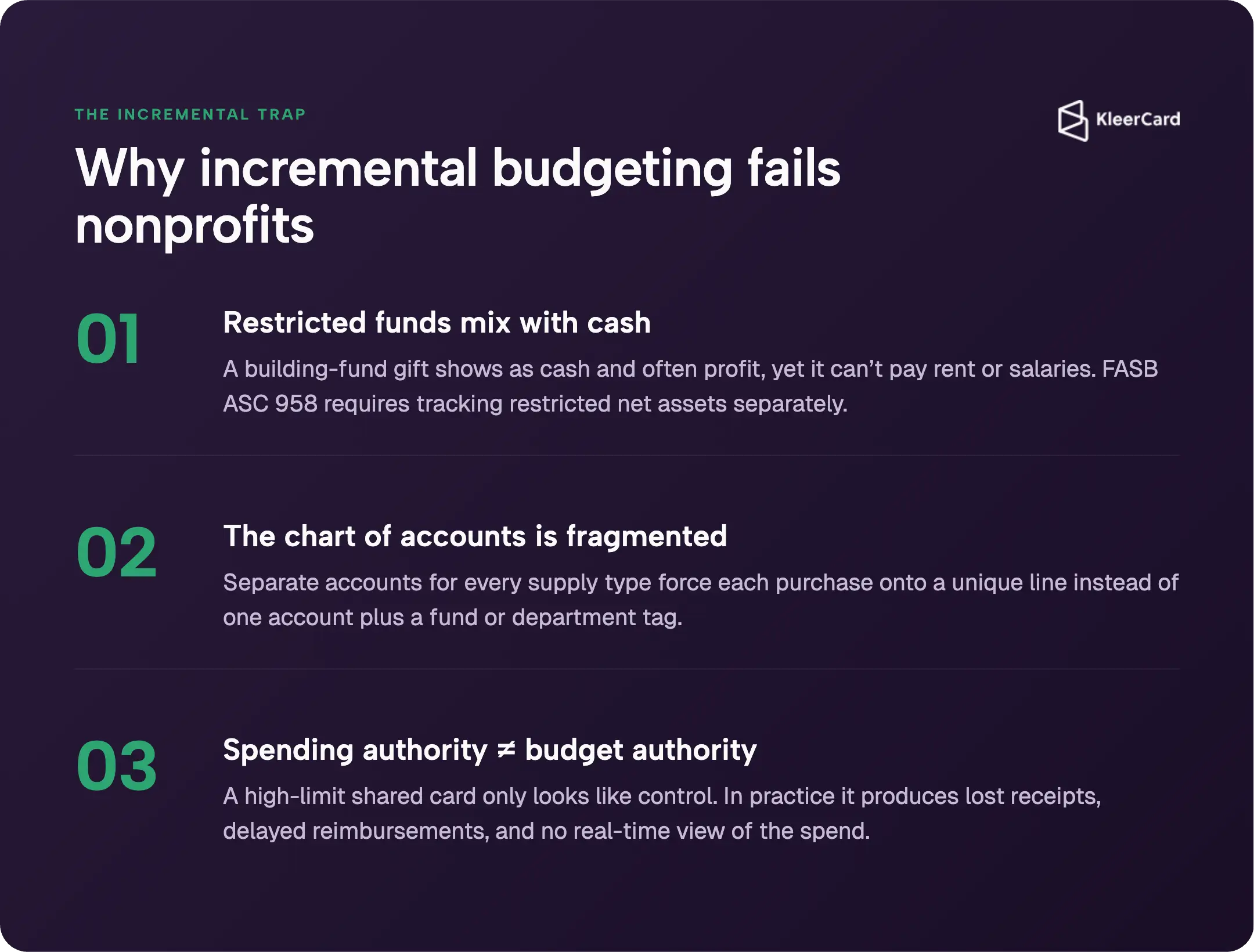
Incremental budgeting assumes last year’s activities remain the right activities. That assumption breaks for three structural reasons.
First, restricted funds create accounting and decision problems that incremental methods ignore. A gift restricted to a building fund shows as cash and often as profit, yet it cannot pay rent or salaries. Under FASB ASC 958, nonprofits must track net assets with donor restrictions separately from those without.
QuickBooks Online does not produce a true per-fund balance sheet natively; teams often use classes or sub-accounts as workarounds (see the QuickBooks fund accounting guidance). Incremental budgeting rarely forces the hard conversation about whether the restricted activity still belongs in the plan. I saw this exact friction repeatedly while working with Financial Edge, Great Plains, and QuickBooks Online setups at Compassion International and Switch Consulting.
Second, most nonprofit chart of accounts structures are fragmented. Schools often create separate accounts for elementary classroom supplies, middle-school supplies, and upper-school supplies. The result is that every teacher’s purchase must be coded to a unique line instead of one “classroom supplies” account with a school-level dimension.
When the chart of accounts is already over-specified, incremental changes simply lock in the inefficiency. The cleaner approach is dimensionality: one account plus a fund or department tag. That structure makes zero-based ranking far easier and supports cleaner reporting later. More on that appears in the guide to debits and credits and the nonprofit organization accounting overview.
Third, day-to-day spending authority is usually disconnected from budget authority. A school or church keeps a high-limit card in the office. Teachers and coaches must hunt for the card, so they front the cost and submit reimbursements. The high limit only creates the appearance of control while the actual process produces lost receipts, delayed reimbursements, and no real-time view of whether the spend was justified.
The private Christian school in the opening lived this. Five cards served the entire campus, including a separate children’s center. Staff played hide-and-seek for the physical cards across two campuses. Teachers regularly used personal cards and waited for reimbursement. Lost receipts ran about five per week, and month-end credit-card reconciliation was lengthy.
Those access problems were not solved by adding three percent to last year’s budget. They required a zero-base rethink of who needed spending authority and how much. The school later moved to more than sixty justified cards, and month-end close fell to a few minutes.
See the full how a private Christian school went from 5 cards to 60 account for the operational details. For teams that want practical controls without personal guarantees, the no personal guarantee options are worth reviewing early.
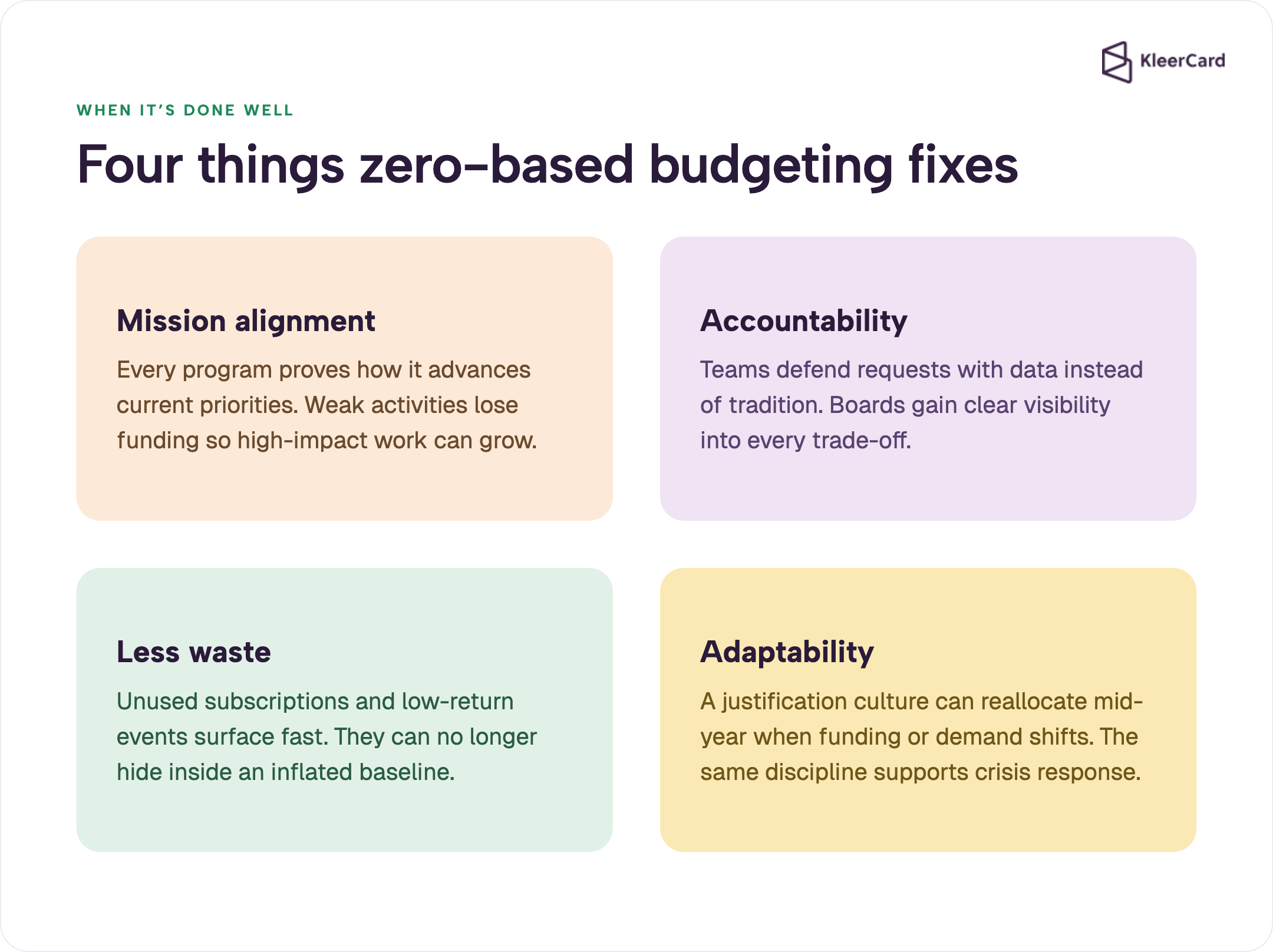
When the process is rigorous, four outcomes appear.
Mission alignment improves. Every program must show how it advances current priorities rather than historical ones. Under-performing activities lose funding so higher-impact work can grow.
Accountability rises. Finance, program, and development teams must defend requests with data instead of tradition. Boards gain clearer visibility into trade-offs.
Waste declines. Unused subscriptions, redundant software, and low-return events surface quickly because they can no longer hide inside an inflated baseline.
Adaptability increases. Organizations that have practiced justification culture can reallocate mid-year when funding or demand shifts. The same discipline that builds the annual budget supports crisis response.
The private Christian school saw a sharp drop in administrative friction after it moved from five shared cards to more than sixty justified limits. Lost receipts fell to fewer than five across seven months. Month-end close for the credit-card activity dropped to a few minutes because weekly checks kept the books current.
That change was not a formal textbook zero-based exercise. It applied the same core idea: every spending channel had to earn its existence and its limit. Administrators received a $5,000 self-loading limit so they owned their budgets. The lower-school principal planned classroom limits near $125 for the next rollout.
The full operational story is captured in the school case study. That same weekly rhythm supports a sustainable month-end close process and receipt tracking approach and pairs with practical expense management.
Zero-based budgeting is time-intensive. Building decision packages, collecting new estimates, and ranking priorities can consume weeks of staff time in the first cycle. Small finance teams feel this pressure most.
Staff resistance is common. Program leaders who have managed the same budget line for years may treat the exercise as a threat rather than a clarification.
The process can favor short-term measurable results over long-horizon work such as advocacy or relationship-building whose outcomes appear years later.
Full annual zero-based budgeting is rarely the right cadence for a lean nonprofit. Many organizations run a thorough zero-based review every two or three years and use lighter annual updates plus continuous controls in between. Treating zero-based budgeting as a permanent annual ritual often produces fatigue and superficial justifications. The GFOA zero-base budgeting paper discusses both the value and the practical costs of the full process.
Complex enterprise approval chains also clash with the method. If every request over a certain dollar amount must wait for a manager who is unreachable for weeks, the process stalls. Nonprofits that value flexibility over rigid linear approvals need a lighter control model. I have seen organizations stuck waiting on a camp director or traveling executive for five or six weeks.
Finance still has to close the books. The control model has to fit how the organization actually operates. For more on practical spend controls that avoid those bottlenecks, see the expense management approach and the no personal guarantee options many nonprofits need.
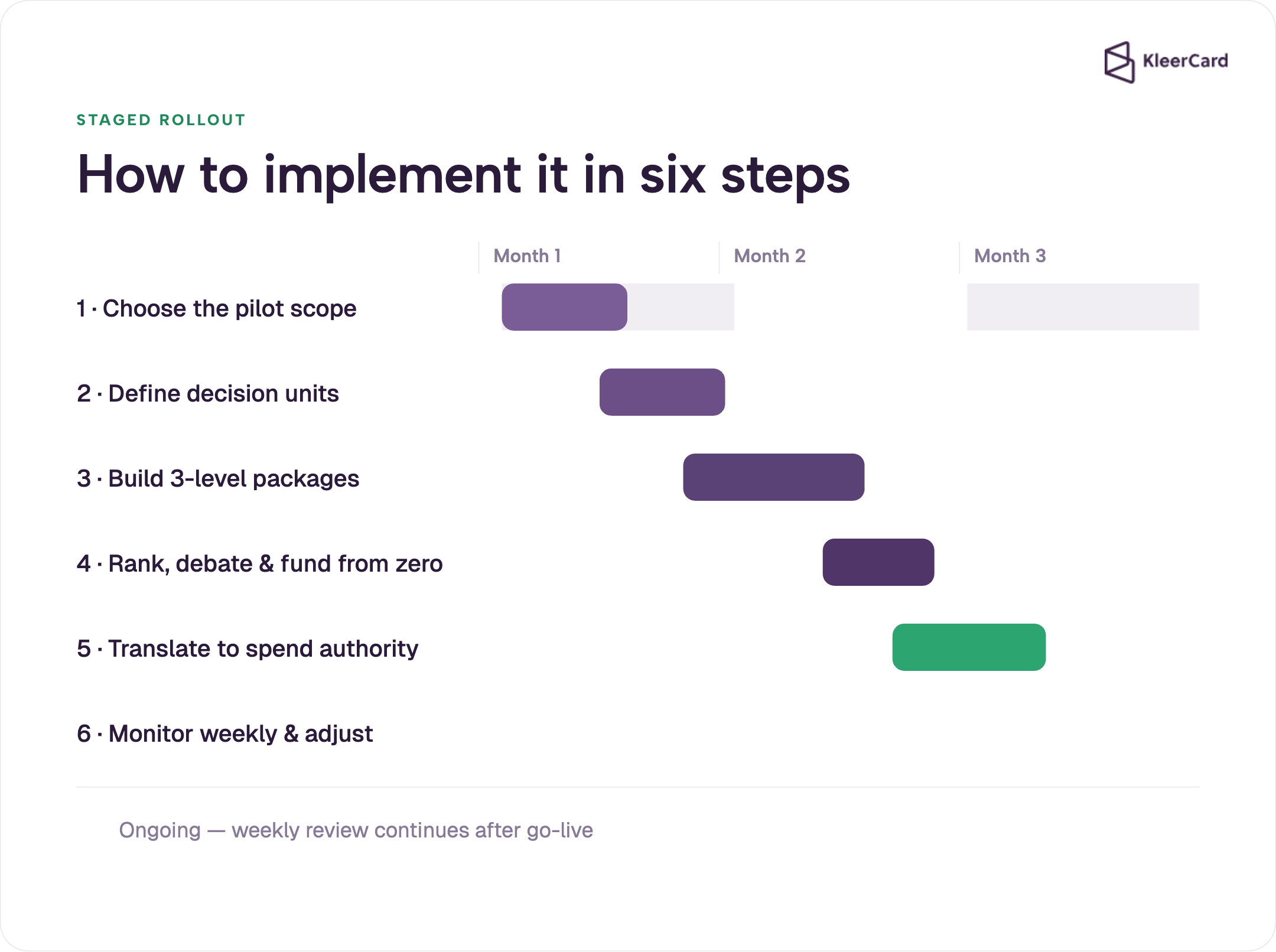
Start small. Attempting a full-organization zero-based rebuild in one cycle usually fails under the weight of data collection and politics. The private Christian school followed a deliberate staged path and reached full use of more than sixty cards within a couple of months for the first layers. White-glove setup support can accelerate the first pilot if internal bandwidth is tight.
Pick the department or program area that is most broken or most expensive. The school’s finance office began with operations (maintenance, IT, vehicles, janitorial). That group had the messiest card access and the most frequent Home Depot and fuel needs.
Four people received cards first. Once their workflow stabilized, the school expanded to administrators, then teachers and coaches.
Group work by the value it creates rather than by traditional department lines. Typical units for a school or church include classroom and instructional supplies, athletics and team events, facilities and maintenance, student activities and events, administrative and shared services, and restricted or grant-funded programs.
Each unit needs a clear owner, measurable outcomes, and known restricted-fund constraints.
For each unit create three packages. The minimum package is the lowest cost that still meets legal, safety, and core mission obligations. The current package sustains today’s activity with justified improvements. The growth package expands impact if additional resources become available.
Every package must list the specific line items, the expected outcomes, the metrics that will prove success, and any restricted funds that apply. A simple nonprofit budget template built around these three packages keeps the conversation concrete.
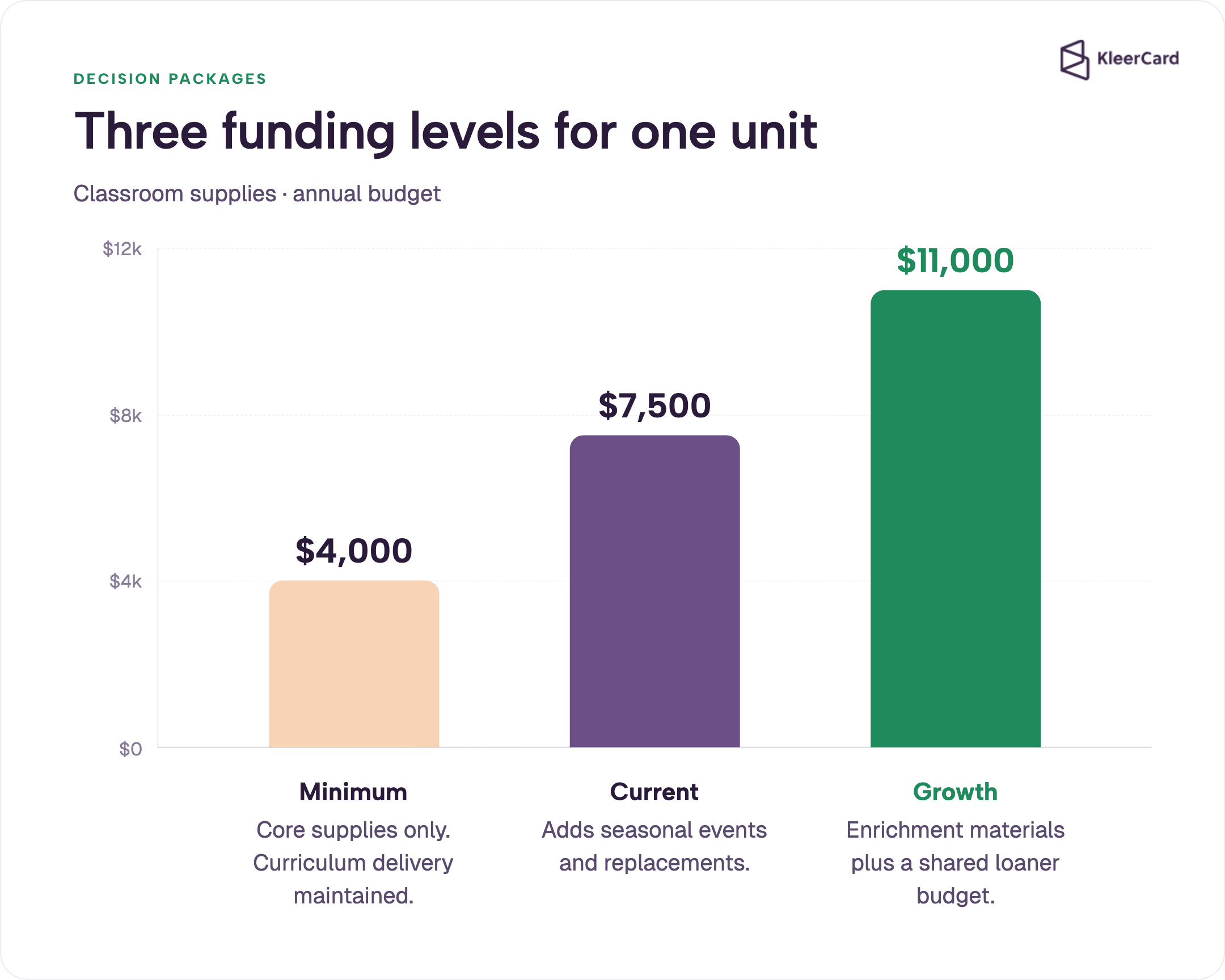
Here is a practical decision-package example for a classroom supplies unit:
| Package Level | Annual Amount | Key Justifications | Metrics |
|---|---|---|---|
| Minimum | $4,000 | Core supplies only; no events | Curriculum delivery maintained |
| Current | $7,500 | Includes seasonal events and replacements | Teacher satisfaction + low reimbursement volume |
| Growth | $11,000 | Adds enrichment materials and shared loaner budget | Expanded classroom activities without personal card use |
Leadership ranks the packages by contribution to strategic goals, risk of not funding, and dependency on other packages. Funding starts at the top of the ranked list and stops when projected revenue is exhausted. Packages that fall below the cut line are deferred or eliminated.
The budget is only useful if people can actually spend the approved amounts without friction. Assign each justified package a corresponding card limit, virtual card, or loaner card.
Administrators at the school received self-loading limits of $5,000. Above that amount the request routed to the head of school. Teachers were scheduled to receive classroom limits around $125 once the lower-school rollout began.
The principle is simple: the person who owns the budget line should have the ability to spend within that line without hunting for a shared card. This is the authority-to-spend equals ability-to-spend idea I return to constantly. High-limit shared cards only create the appearance of control. Right-sized limits create actual control.
Product-level tools that support reloadable and zero-budget cards make this translation practical. See the nonprofit credit card options and current pricing. Teams that want the controls live quickly can also schedule a demo.
Weekly reconciliation keeps the books close to real time. The school’s finance office checked card activity weekly so that month-end became a few minutes of confirmation rather than a multi-day chase. Lost receipts dropped because cardholders photographed and uploaded them at the point of purchase.
That weekly rhythm is the practical backbone of a sustainable month-end close process and receipt tracking approach. The same discipline supports bill pay and reimbursements when personal cards still appear and pairs with receipt tracking that forces capture at the moment of spend.
An annual or biennial zero-based exercise loses force if day-to-day spending reverts to the old high-limit shared-card model.
The practical enforcement layer is the reloadable or zero-budget card. A card can be issued with a fixed project budget, a quarterly classroom budget, or a zero balance that requires an explicit funding request before it works. Permission to spend becomes the control. If the card is swiped before funding is approved, the transaction declines. This is the same principle behind strong purchasing card programs recommended by the GFOA.
Reloadable limits also solve the access problem incremental systems create. The private Christian school’s maintenance director no longer walked campus looking for whoever currently held the card. He carried a justified limit, uploaded the receipt on the spot, and returned to fixing toilets and ordering supplies.
Access and visibility were the real issues, not trust or money. He simply needed a card that worked on the right campus.
Loaner cards labeled by department (Fine Arts Loaner 1, Athletics Loaner 5) give temporary access without diluting accountability. The dashboard shows exactly which card is assigned to which person or role.
Amazon and recurring vendors benefit from the same discipline. When every Amazon charge arrives itemized and tied to a named cardholder, the finance office no longer guesses which event the tablecloths and balloons belonged to. The buyer codes the charge to the correct account at the moment of purchase.
That visibility pairs naturally with Amazon Business expense tracking and clean expense management and receipt tracking. Organizations that still rely on personal cards for these purchases also face ongoing bill pay and reimbursements friction. Official Amazon Business for nonprofits resources explain the tax-exempt and reporting features that support this level of visibility.
These controls do not replace the formal zero-based process. They make the process sustainable by turning every justified budget into an enforceable spending limit. Organizations that keep high-limit shared cards after a zero-based exercise usually watch the discipline erode within a few months.
For schools and churches looking at practical card options that support this model, the best credit cards for small churches guide and solutions for churches page collect the relevant details. See also how KleerCard supports justified budgets and real-time visibility for nonprofits.
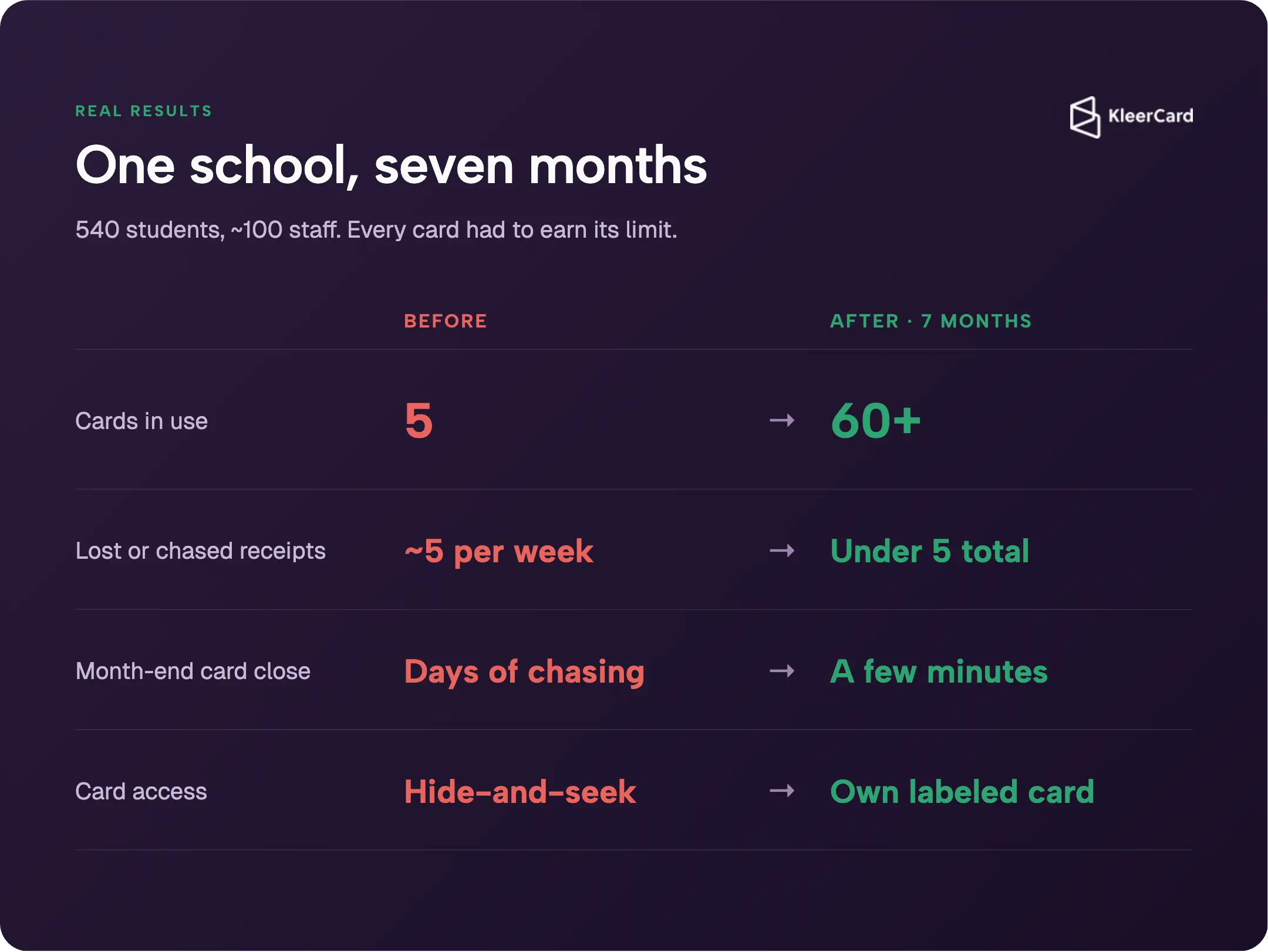
| Metric | Before | After (7 months) |
|---|---|---|
| Cards in use | 5 campus-wide | 60+ (physical, virtual, labeled loaners) |
| Lost or chased receipts | ~5 per week | Fewer than 5 total |
| Month-end credit-card close | Lengthy manual process | A few minutes |
| Teacher reimbursements | Batches of 10–12 at deadline | Lower-school teachers scheduled for individual cards with set limits |
| Card access friction | Hide-and-seek across two campuses | Individual or labeled loaner cards with weekly limit checks |
The school did not run a textbook zero-based budget exercise. It applied the same logic: every spending channel had to justify its existence and its limit, access was aligned with authority, and receipts were captured at the point of spend. The operational results followed.
The same pattern appears when schools and churches treat budget authority and spending ability as the same decision. The complete narrative is available in the how a private Christian school went from 5 cards to 60 case study. Teams ready to move can schedule a demo or review white-glove setup options.
Zero-based budgeting for nonprofits requires every expense and program to be justified from a zero base each cycle rather than adjusting last year’s numbers. The goal is to align every dollar with current mission priorities and to evaluate restricted and unrestricted funds separately. See the Aplos Zero-Based Budget glossary for an additional nonprofit-specific definition.
Traditional or incremental budgeting starts with the prior year’s figures and applies percentage changes. Zero-based budgeting starts at zero and forces justification of every line item and program. The question shifts from “why did this line change” to “why does this line exist at this level.”
Yes, when it is staged and paired with continuous controls. Full annual cycles are often too heavy for lean teams. A thorough review every two to three years, plus weekly reconciliation and right-sized card limits, delivers most of the benefit without constant disruption.
A private Christian school with a small finance office showed that the staged approach works. Similar patterns appear for best credit cards for small churches.
Not always. The method often surfaces waste and allows reallocation to higher-impact work. Some organizations increase investment in strong programs after cutting weak ones. The primary outcome is clarity and alignment, not automatic reduction.
Restricted gifts must be evaluated on their own terms. A building-fund gift cannot be treated as general operating cash. Because many accounting systems cannot produce a true per-fund balance sheet, the zero-based process must explicitly separate restricted packages and track remaining balances.
Dimensionality in the chart of accounts (one account plus fund or department tags) prevents the common mistake of creating duplicate accounts for every restricted purpose. More context appears in the nonprofit organization accounting guide and the debits and credits explanation.
Official guidance on net assets with donor restrictions is found under FASB ASC 958. Teams that need practical expense management controls to keep restricted and unrestricted spend visible can review the available options.
Most organizations benefit from a complete cycle every two to three years with lighter annual updates and continuous spend controls in between. Running the full process every year risks fatigue and superficial justifications. Continuous controls such as zero-budget cards and weekly receipt capture keep the discipline alive between full cycles. The GFOA zero-base budgeting resources offer additional perspective on cadence and alternatives. For ongoing receipt discipline, see IRS recordkeeping requirements.
Zero-based budgeting works for nonprofits when it is treated as a periodic deep review rather than an annual ritual, when decision packages force real trade-offs, and when day-to-day spending authority matches the justified budgets.
The private Christian school that moved from five shared cards to more than sixty justified limits showed what that combination produces. Lost receipts fell from roughly five every week to fewer than five across seven months. Staff could buy what they needed without playing hide-and-seek for a card.
Start with the messiest department. Define decision units around mission value. Build minimum, current, and growth packages. Rank them. Then give the approved owners the ability to spend within those limits and capture receipts at the point of purchase.
Aligning spending authority with budget authority turns zero-based budgeting from a theoretical exercise into an operating system that keeps every dollar accountable.
If your current process still relies on high-limit shared cards and month-end receipt chases, the practical next step is to align spending authority with budget authority. See how KleerCard supports justified budgets and real-time visibility for nonprofits and schools.
You can also schedule a demo, review white-glove setup, check current pricing, or explore the nonprofit credit card options that make the controls practical. For church-specific context see the best credit cards for small churches and solutions for churches pages.


Speak to a member of our team and we can have you up and running in minutes, not weeks.