%202.svg)
The bookkeeping mistakes that steal hours every month—and the practical fixes that stop the waste.
In my years supporting nonprofits and schools at Compassion International and Switch Consulting, and later working hands-on with Blackbaud Financial Edge, Microsoft Great Plains, and QuickBooks Online, I watched the same activities burn hours every week.
Bookkeepers optimized for precision that never changed a decision. Finance teams chased receipts that should have been captured at the moment of spend. Chart of accounts structures forced custom reports instead of simple re-slices. Shared cards created daily hide-and-seek.
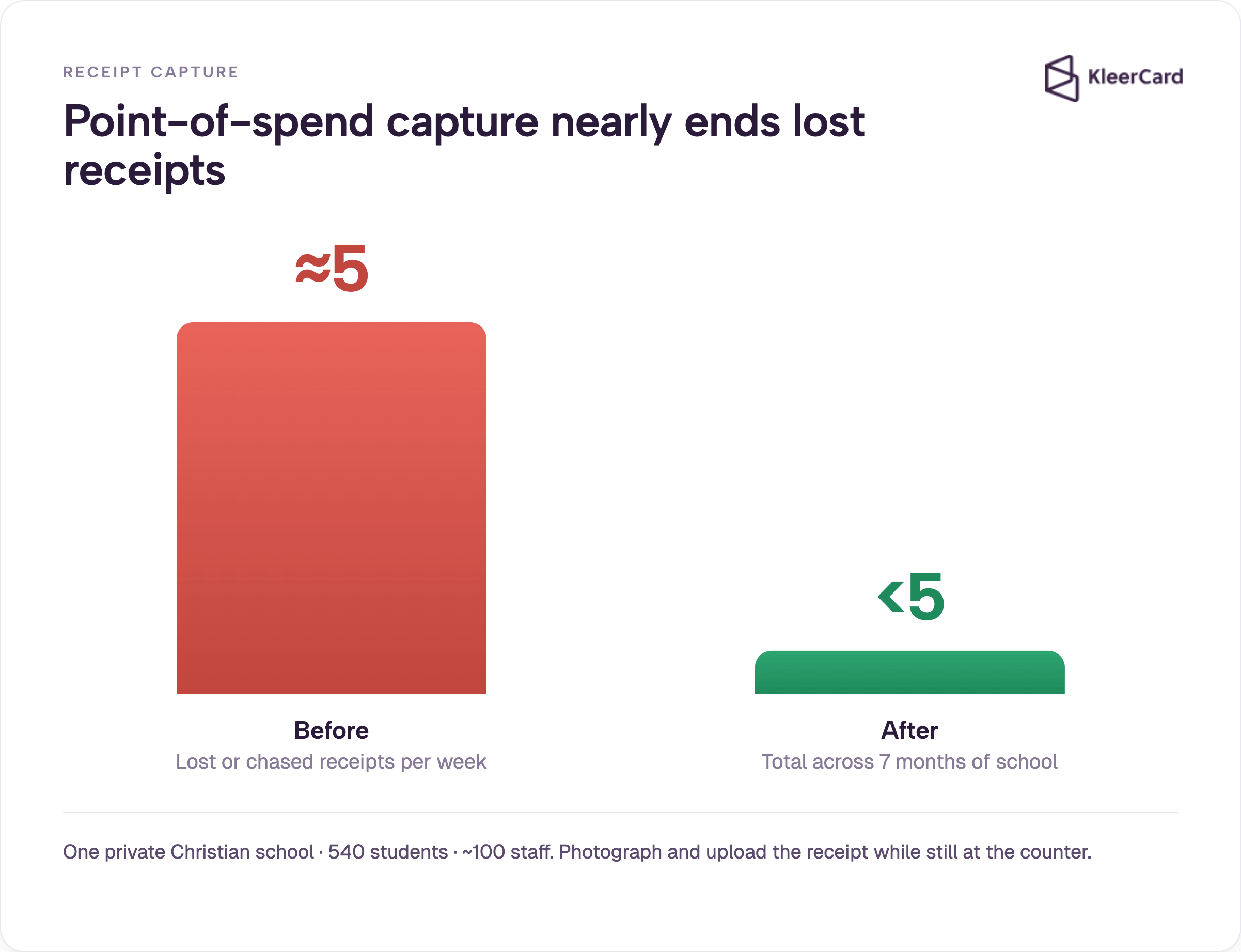
One private Christian school with about 540 students pre-K through 12th grade and roughly 100 staff offers a clear before-and-after. Before changing how spend and receipts worked, the finance office faced roughly five lost or chased receipts every week and a lengthy monthly credit-card close.
After shifting to point-of-spend capture and individual cards, lost receipts dropped to fewer than five across seven months of the school year, and month-end credit-card work shrank to a few minutes.
This article shares the bookkeeping mistakes that waste the most time, shows why they persist, and gives concrete fixes you can apply without waiting for a full system overhaul.
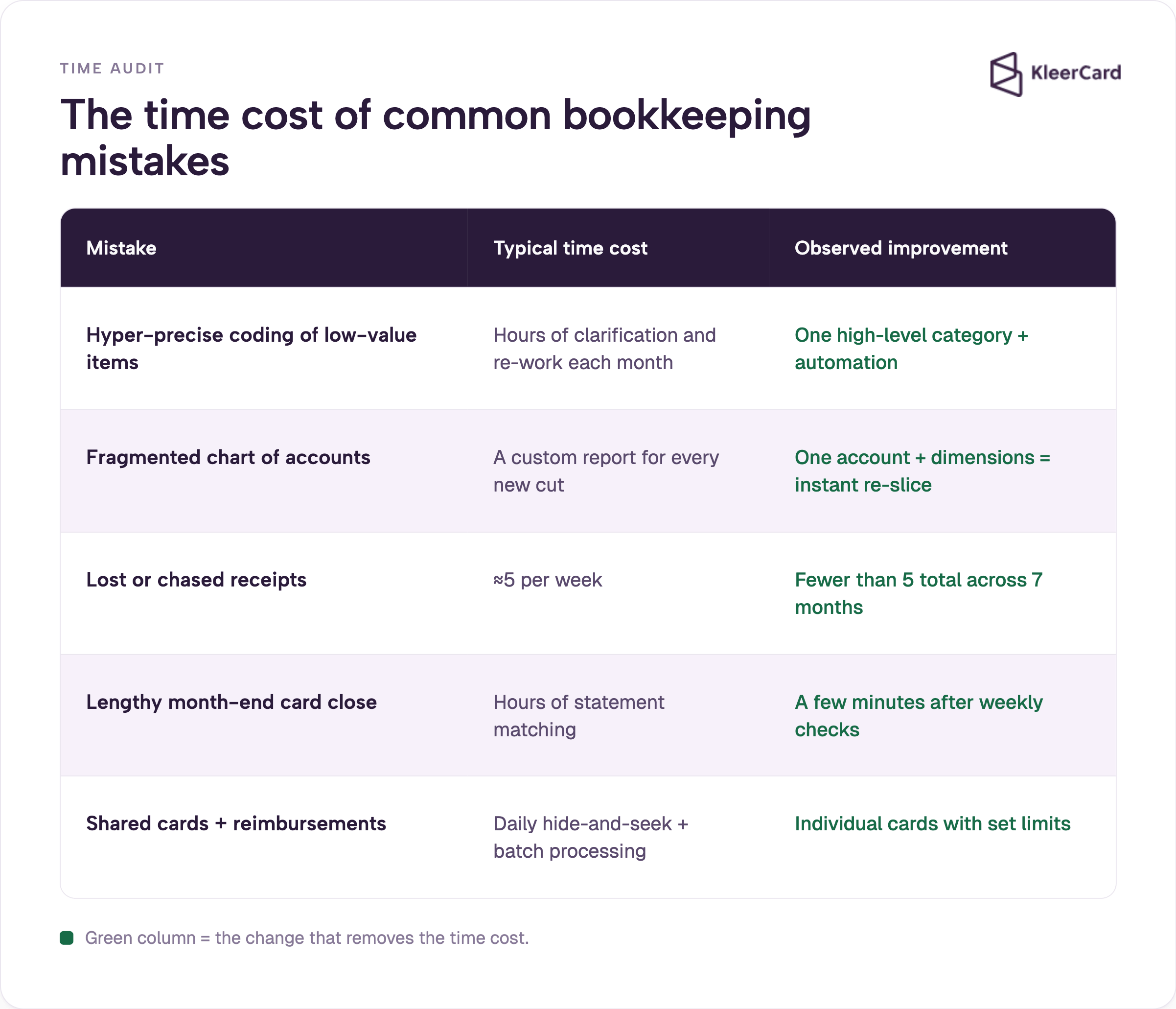
| Mistake | Typical Time Cost | Observed Improvement |
|---|---|---|
| Hyper-precise coding of low-value items | Hours of clarification and re-work each month | One high-level category + automation |
| Fragmented chart of accounts | Custom reports every time a new cut is needed | One account + dimensions = re-slice |
| Lost or chased receipts | ~5 per week | Fewer than 5 total across 7 months |
| Lengthy month-end card close | Hours of statement matching | A few minutes after weekly checks |
| Shared cards + reimbursements | Daily hide-and-seek + batch reimbursement processing | Individual cards with set limits |
Bookkeepers are paid for accuracy. That incentive produces a predictable waste of time.
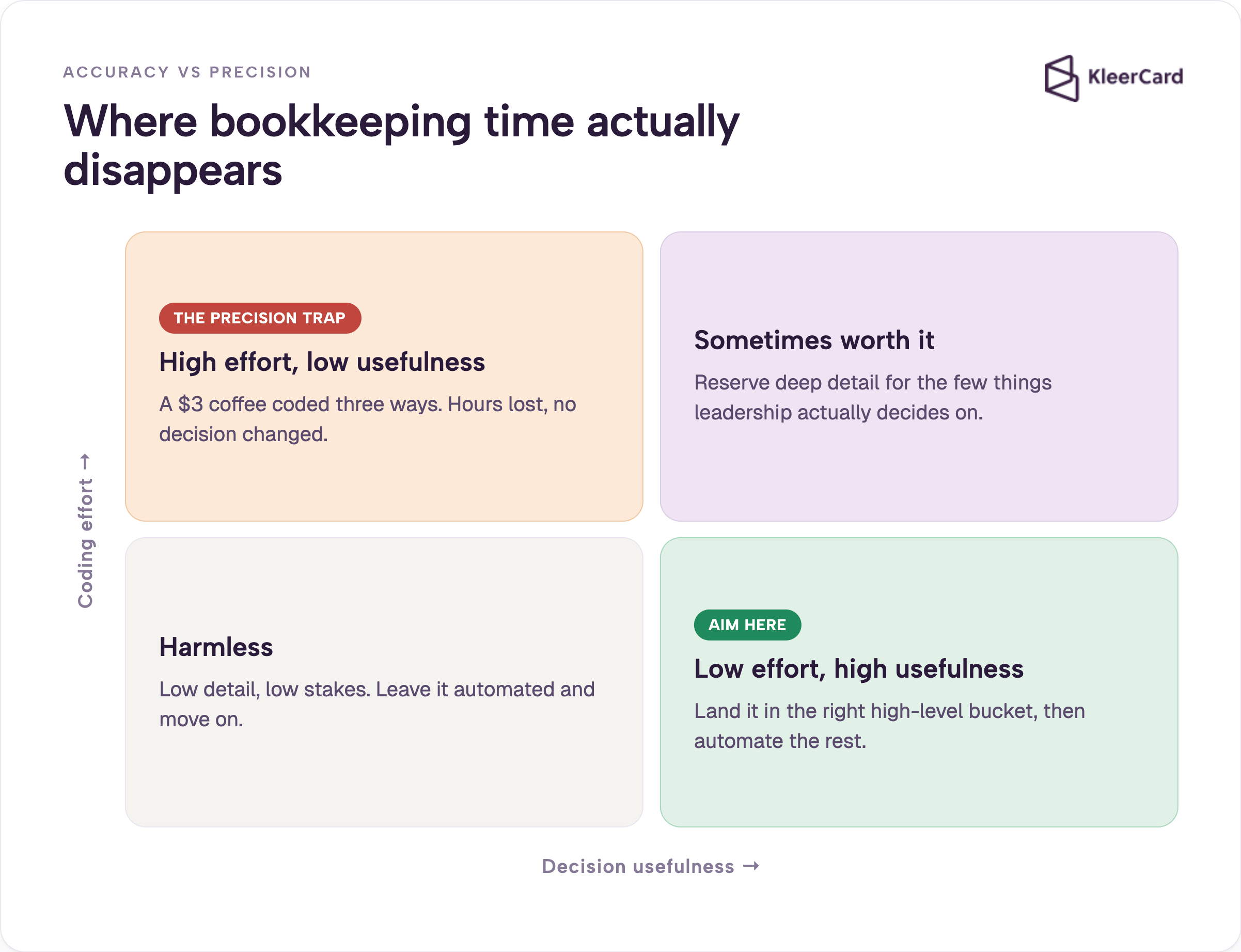
A $3 coffee gets coded to business development versus team meeting versus existing customer. The leader making decisions will never change course based on that level of detail. The precision is real. The usefulness is near zero. Hours disappear in clarification emails, follow-up questions, and re-coding.
There is a difference between accuracy and precision. Accuracy means the transaction lands in the right high-level bucket. Precision means the bucket is split into unnecessary sub-categories. Most time waste lives in the gap between the two.
In my work across nonprofit finance offices using Blackbaud Financial Edge, Microsoft Great Plains, and QuickBooks Online, I have watched this play out for years. The bookkeeper wants every last detail correct because that is how the role is measured. The executive or board is looking for patterns that support decisions. When those two goals stay misaligned, both sides spend time on work that does not move the organization forward.
The practical fix is alignment work done once. Ask the leader which high-level decisions the reports must support. Structure the chart of accounts and coding rules around those decisions. Then automate the rest. Restaurant charges become “business meals.” Software subscriptions become a single recurring category. The bookkeeper stops waiting for the leader to classify every small transaction, and the leader stops receiving low-value coding requests at month-end.
This is the same principle that shows up in clean debits and credits practice. Get the high-level category right, then move on. The same thinking underpins useful nonprofit organization accounting overall. It also reduces the friction that appears in day-to-day expense management.
Many organizations create near-duplicate accounts because they believe their ministry, school, or program is unique.
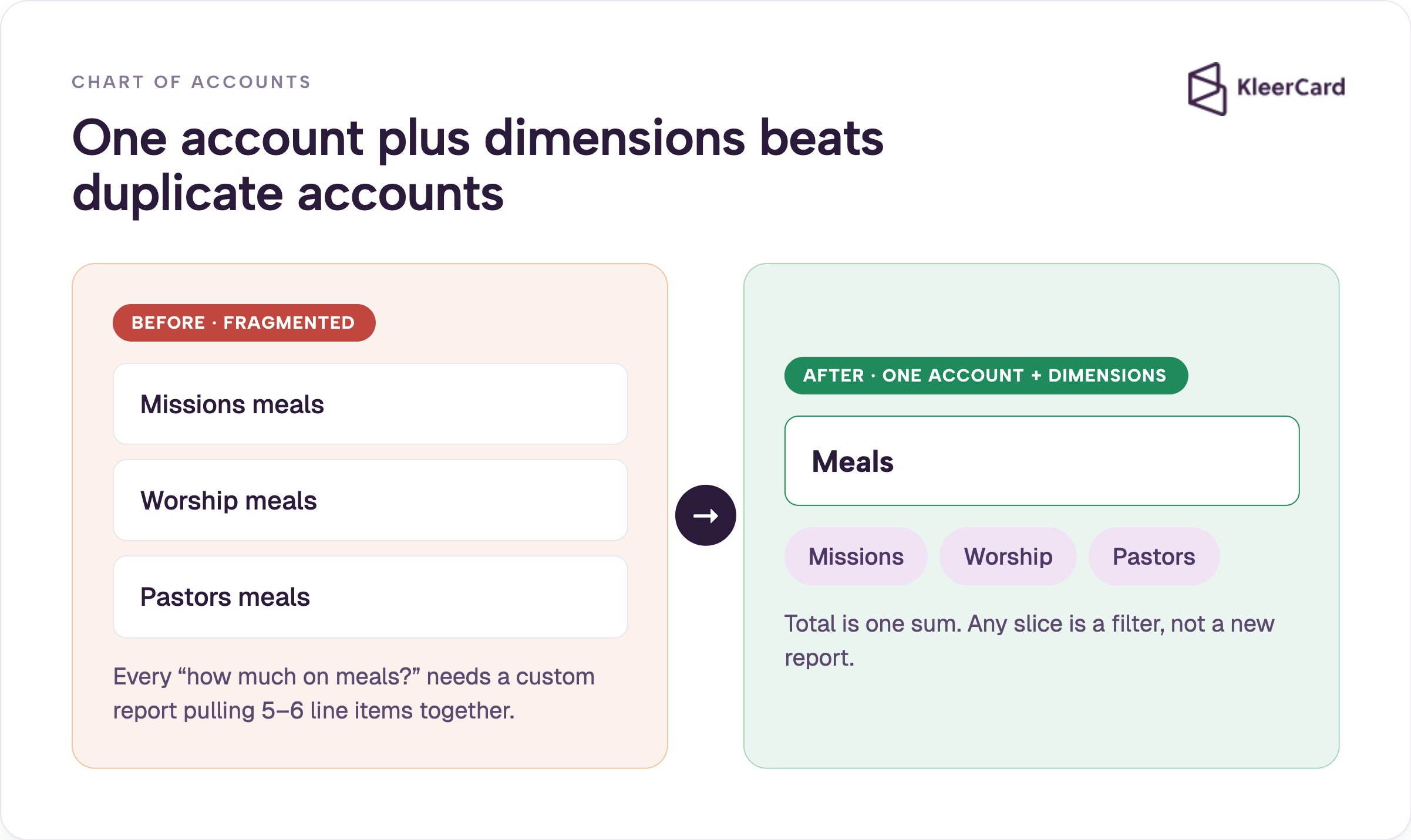
They end up with missions meals, worship meals, and pastors meals as separate accounts. Or elementary classroom supplies, middle-school classroom supplies, and upper-school classroom supplies. When leadership asks “how much did we spend on meals last year” or “how much went to classroom supplies in the upper school,” someone has to build a custom report that pulls five or six line items together.
The underlying data structure is the problem. Accounting is not special. The labels (departments, ministries, funds, classes) can differ by organization. The structure should stay the same.
The cleaner approach uses one account plus a dimension. In QuickBooks the dimension is often called a class. The same pattern works with departments, funds, or projects in other systems. Classroom supplies stay one account. The dimension tags elementary, middle, or upper school. Total classroom supplies is a single sum. The upper-school slice is a filter, not a new custom report. Official QuickBooks guidance on tracking transactions by class and on creating and managing classes confirms this structure.
When a customer tells me “we are special, we are unique,” that is usually a signal of an inefficient chart of accounts. The belief produces fragmentation. Fragmentation produces time spent rebuilding reports that a dimensional structure would deliver in one click.
This is the core of a workable nonprofit chart of accounts. One natural expense account plus dimensions keeps the list short and the reporting flexible. The same approach supports clean fund accounting without turning the chart into a maze. Organizations that keep the chart lean also find expense management and coding far less time-consuming.
Lost receipts are usually treated as a discipline problem. In practice the root is almost always process.
At the private Christian school with about 540 students pre-K through 12th grade and roughly 100 staff, the finance office previously faced roughly five lost or chased receipts every week. Teachers and coaches often fronted purchases on personal cards rather than hunt for one of the five campus cards. Reimbursement batches of ten or twelve requests would arrive at the deadline.
After the school moved to point-of-spend capture—photograph the receipt and upload it while still standing at the counter—lost receipts fell to fewer than five across seven months of the school year. Month-end credit-card processing, which had been lengthy, became a few minutes because the team already checked activity weekly.
The maintenance director at that private Christian school with about 540 students illustrates the access problem that sits underneath receipt chasing. Before the change he had no card in his own name. Fixing a toilet meant locating whoever currently held a card, sometimes across two campuses, before he could drive to Home Depot. Now he carries his own card, reviews the balance weekly with his director, and uploads the receipt on the spot. Access and visibility were the real issues, not trust or budget.
Point-of-spend capture removes the chase. Individual cards remove the logistics tax that drives people to personal cards in the first place. This is the same pattern that turns a multi-day month-end close process and receipt tracking into a short review. When documentation arrives with the transaction, the close stops being reconstruction. Supporting documents such as receipts are required under IRS rules for the period of limitations; see IRS Topic 305 Recordkeeping and the broader guidance on what kind of records to keep.
You can see the full before-and-after in the story of how a private Christian school went from 5 cards to 60. The numbers are specific to that campus, but the underlying friction is common across schools and churches that still run limited shared cards. Clean receipt tracking at the point of spend is the practical fix. The same campus later expanded the approach across departments, which is detailed in the school case study.
Five cards for a campus of one hundred staff produces predictable waste.
Administrators loan cards. Teachers give up and use personal funds. Finance processes reimbursement batches under deadline pressure. The same pattern appears in churches with limited ministry cards and nonprofits that share a single high-limit office card.
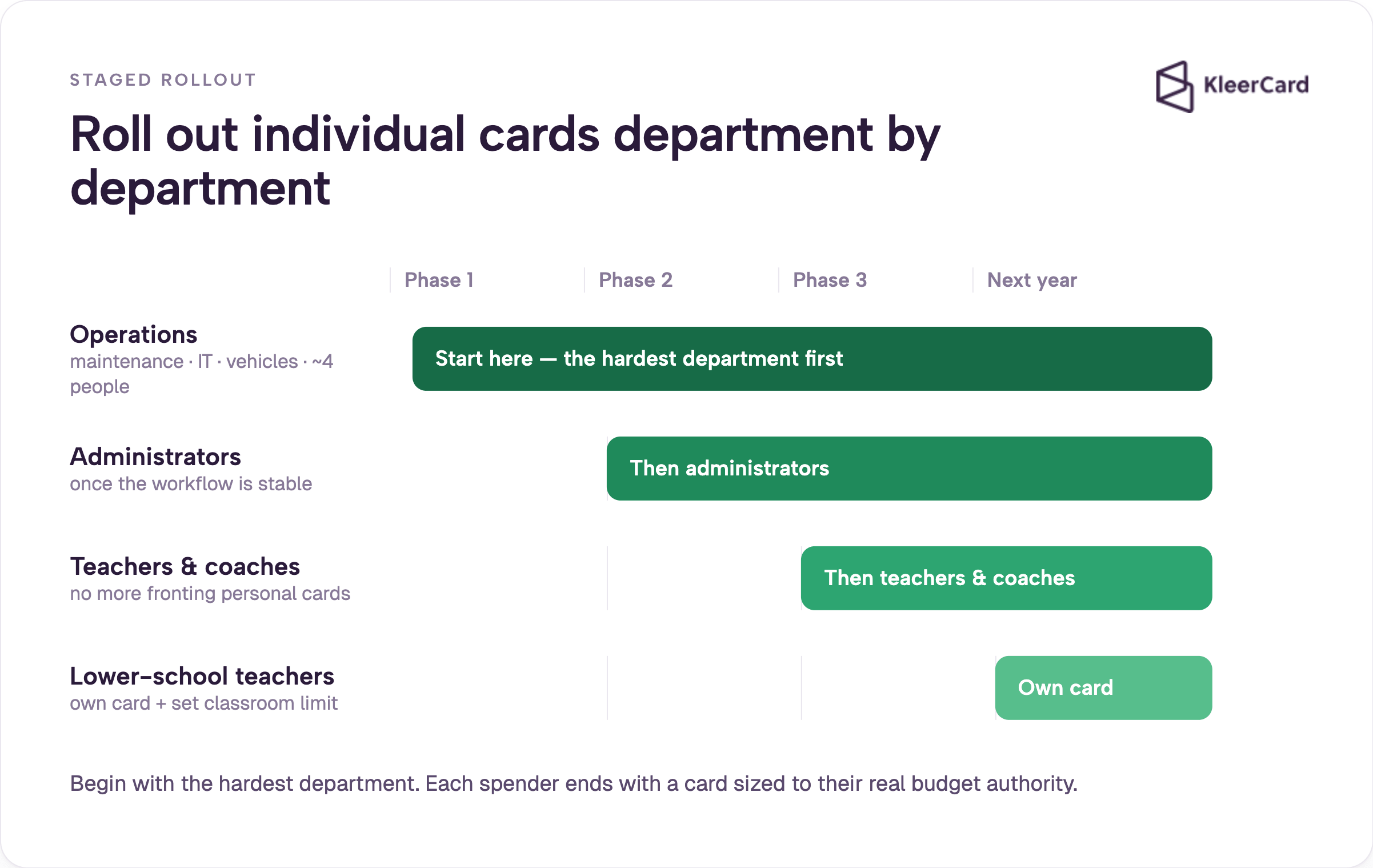
The private Christian school with about 540 students pre-K through 12th grade and roughly 100 staff shows a cleaner path through staged rollout. They began with the hardest department—operations (maintenance, IT, vehicles, Home Depot runs)—with about four people. Once that workflow was stable they expanded to administrators, then teachers and coaches. By the next school year lower-school teachers were each receiving their own card with a set classroom limit. Loaner cards were labeled and tracked on the dashboard (Fine Arts Loaner 1, Athletics Loaner 5, and similar). The summer camp director, who spends heavily only in summer, holds a card in her own name for that season.
Line-of-sight accountability replaces the old scarcity model. Every spender has a card sized to the budget authority they actually need. Reimbursements drop. The finance office stops playing hide-and-seek. GFOA guidance on purchasing cards similarly emphasizes defined scope, controls, and training so the cards improve efficiency rather than create new risk.
This is why controlled expense management and individual cards matter more than another high-limit card locked in a drawer. Real control is authority aligned to ability. When that alignment is missing, staff time and finance time both disappear into logistics and cleanup. Organizations looking for cards that support this model without a personal guarantee often start with the nonprofit credit card approach or the broader solutions for non-profits and solutions for churches. The same principles appear in best credit cards for small churches. See also the full how a private Christian school went from 5 cards to 60 for the rollout sequence.
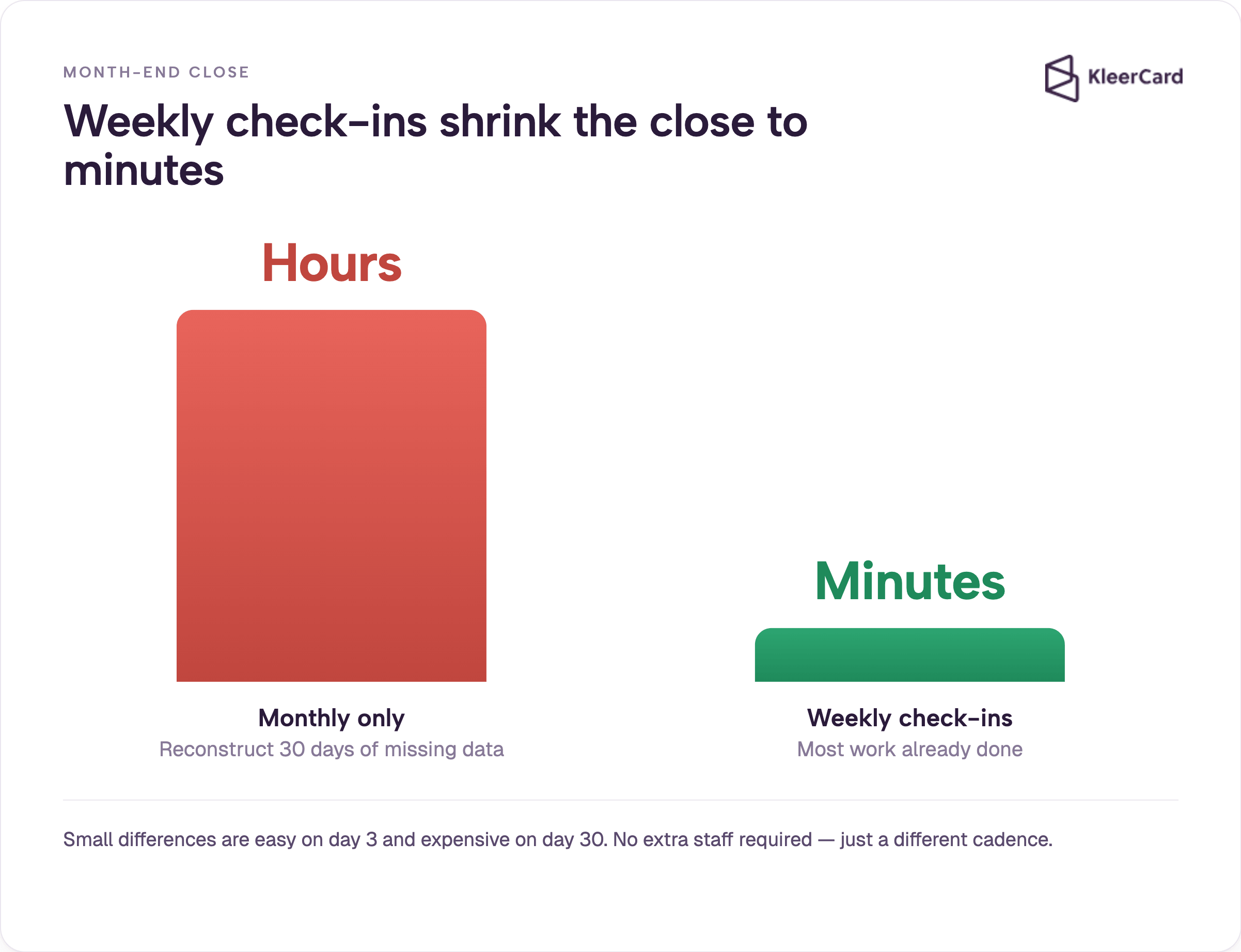
Lengthy month-end closes are usually the result of work that was deferred. The work itself is rarely complex.
When receipts are missing, coding is incomplete, and reconciliations have not happened for thirty days, the close becomes archaeology. Weekly check-ins reverse the pattern. Discrepancies surface while the context is still fresh. By the time the month ends, most of the work is already done.
At the private Christian school with about 540 students pre-K through 12th grade and roughly 100 staff, the finance team now reviews credit-card activity weekly. Month-end card processing takes a few minutes. The change did not require a larger staff. It required a different cadence and cleaner data at the point of spend.
The same weekly rhythm supports cleaner bank and card reconciliation overall. Small differences are easy to resolve on day three. They become expensive on day thirty. This is why the practical receipt tracking systems that force capture early also shrink the close window. The documentation work is already finished before the calendar flips. Teams that want to tighten this further often look at bill pay and reimbursements as a parallel process that stays out of payroll. The detailed process is covered in the month-end close process and receipt tracking guide.
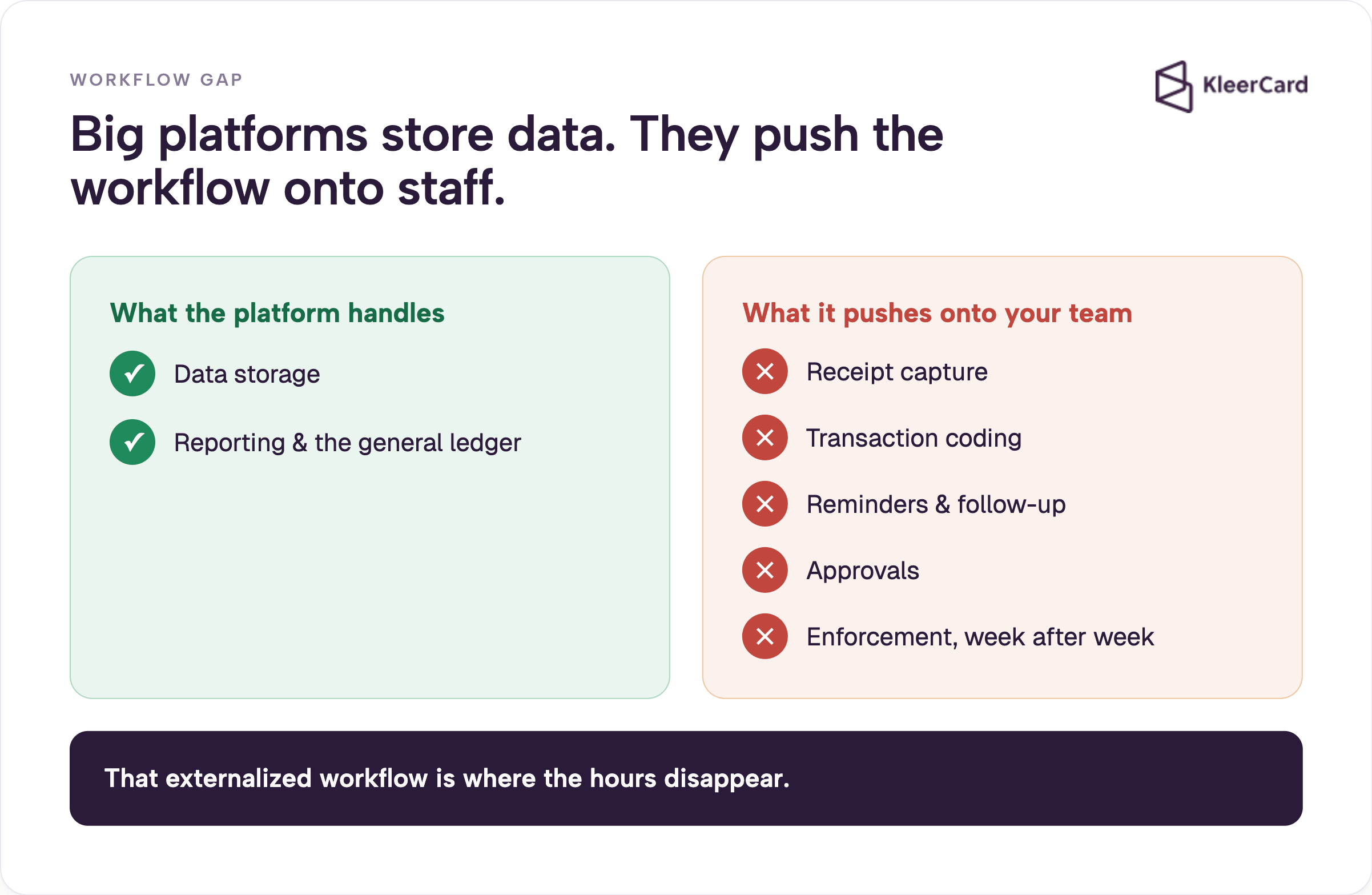
Large accounting platforms such as Blackbaud Financial Edge, Microsoft Great Plains, and QuickBooks Online store data well. Many of them do little to manage the workflow that gets clean data into the system.
Owen Hill, who has worked hands-on with these platforms at Compassion International, Switch Consulting, and with nonprofit and school finance teams, saw the same pattern repeatedly. Someone is traveling. Receipts sit on a sticky note or in an Asana task. The books are “mostly closed” while finance waits. Humans are not good at repetitive enforcement over weeks. The software that externalizes that enforcement onto people creates the very delays it is supposed to prevent.
These enterprise systems often required multiple full-time staff just to keep the technology running. The platform handled storage and reporting. The organization still had to invent its own policies, reminders, and follow-up processes for coding, receipts, and approvals. That externalized workflow is where the time disappears.
The practical response is to treat workflow as half the system. Capture, coding, receipt attachment, and basic enforcement belong at the point of spend or shortly after. The general ledger then receives data that is already usable rather than raw material that still needs weeks of cleanup. When the spend side and the accounting side work together, the hours previously spent on reconstruction become available for actual analysis and stewardship reporting. This is also why many organizations eventually look for white-glove setup support when they decide to change both the cards and the capture habits at the same time. The product approach is designed around that combined workflow.
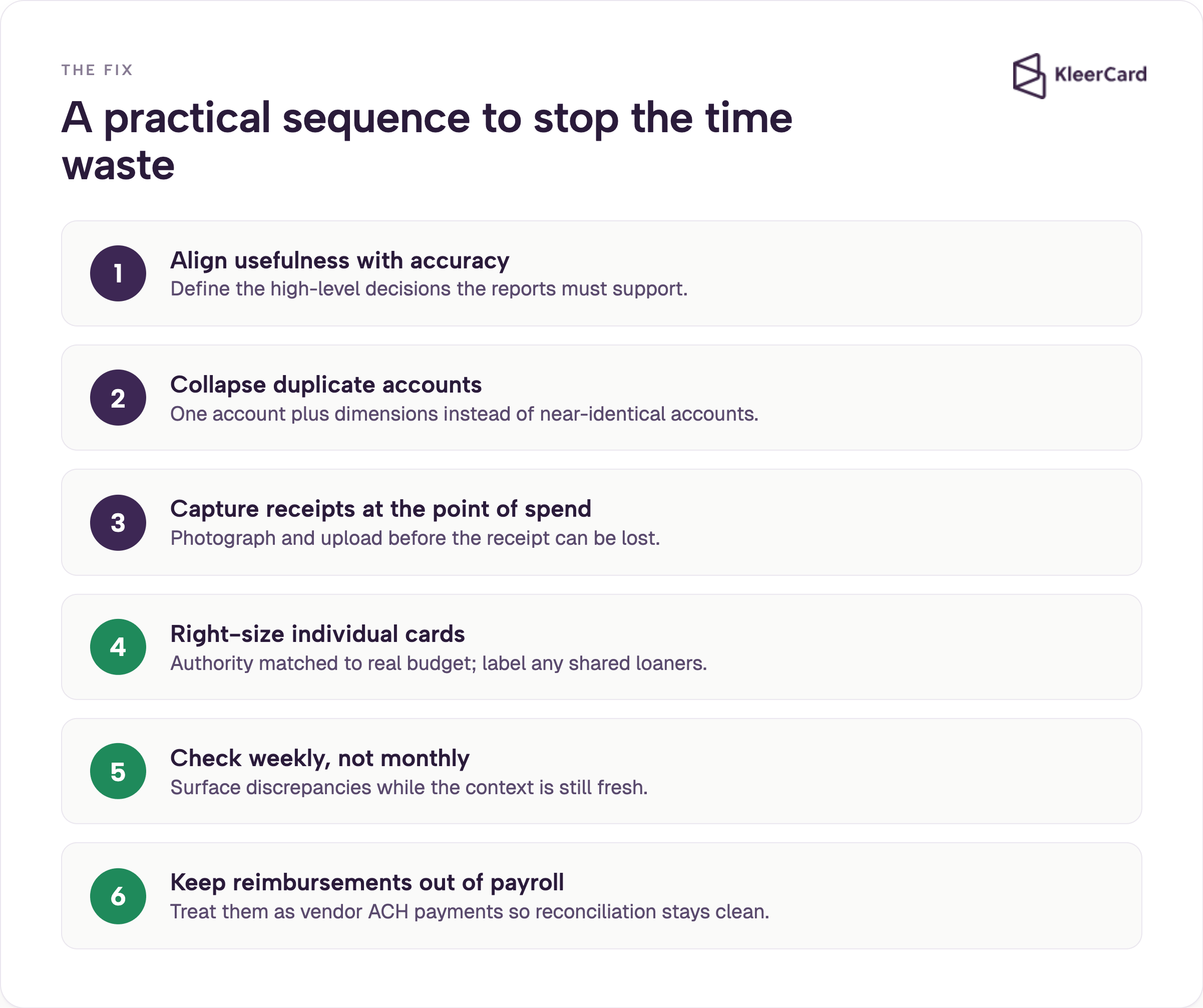
Start with the highest-friction department or the biggest source of lost receipts. Expand once the workflow is stable. The private Christian school with about 540 students pre-K through 12th grade and roughly 100 staff used an operations-first approach that remains a reliable template. The complete sequence used by that school is available in how a private Christian school went from 5 cards to 60.
Many of these steps become easier when the cards and the receipt system are designed to work together. Teams that want to see the weekly capture and budget controls in action can schedule a demo or review current pricing. Less time spent reconstructing what should have been captured cleanly the first time is the real objective. The product page shows how the cards and the workflow fit together for schools and nonprofits. White-glove setup is available for organizations that prefer guided implementation, and the same principles appear across solutions for non-profits.
The highest-impact time-wasters are hyper-precise coding of low-value transactions, fragmented charts of accounts that force custom reports, chasing receipts after the fact, shared-card logistics that drive reimbursements, and deferred reconciliation that turns month-end into a multi-hour project.
Correct numbers can still arrive late and expensive. Hours spent clarifying $3 transactions, rebuilding reports, locating lost receipts, and reconciling a month of deferred work do not appear on the profit-and-loss statement, yet they are real costs.
Capture the receipt at the point of spend with a photo and immediate upload. Pair that habit with individual cards so staff no longer need to hunt for a shared card. One private Christian school with about 540 students pre-K through 12th grade and roughly 100 staff reduced lost receipts from roughly five per week to fewer than five across seven months using exactly this combination. See the full school case study and the month-end close process and receipt tracking guide for the practical sequence.
Yes. When similar expenses live in multiple near-identical accounts, every new management question requires a custom report. A dimensional structure (one account plus classes or departments) lets the same data answer multiple questions without extra work. Official QuickBooks documentation on classes supports this approach.
Weekly is more effective than monthly for time savings. Small discrepancies are easy to resolve while the context is fresh. By month-end the heavy lifting is already finished.
Accuracy means the transaction is in the correct high-level category that supports decisions. Precision means the category is split into unnecessary detail that never changes a decision. Most time waste lives in the precision layer.
Bookkeeping mistakes that waste time are usually process and structure problems. They are rarely character problems. Precision without usefulness, fragmented charts of accounts, deferred receipt capture, and shared-card logistics all produce the same result: hours spent on work that does not improve decisions.
The fixes are practical. Align coding with the decisions that matter. Use dimensions instead of duplicate accounts. Capture receipts at the moment of spend. Give people cards sized to their actual budget authority. Check activity weekly instead of monthly. The private Christian school with about 540 students pre-K through 12th grade and roughly 100 staff demonstrated the scale of the improvement—lost receipts nearly eliminated, month-end reduced to minutes—without adding staff. The complete story is in how a private Christian school went from 5 cards to 60.
Clean books that arrive on time are more valuable than perfect books that arrive late. Start with the single highest-friction area and expand from there. Teams ready to make the shift can explore the product, schedule a demo, or begin with white-glove setup.
Owen Hill draws on years of hands-on work with nonprofit and school finance teams, including time at Compassion International and Switch Consulting, plus direct experience with Blackbaud Financial Edge, Microsoft Great Plains, QuickBooks Online, and related platforms. Across those systems I repeatedly saw bookkeepers optimize for precision on low-value items while leaders needed high-level usefulness for decisions. His focus is practical systems that reduce time spent on bookkeeping so mission work can move forward.


Speak to a member of our team and we can have you up and running in minutes, not weeks.