How nonprofit financial reporting works: which reports go to your board, funders, the IRS and your state, how often each is due, and how to stay on time.
Nonprofit financial reporting is the regular process of turning your books into reports for the people who oversee, fund and regulate your organization. That means your board, program leaders, funders, the IRS, your state, auditors and donors. Each audience needs different nonprofit financial reports on a different schedule.
Our co-founder, Owen Hill, was Budget Director at Compassion International, has served on two boards in Colorado Springs, and volunteers as treasurer for his local church. At KleerCard, we've come to believe the hard part of reporting is getting the right report to the right person while it can still change a decision.
It helps to think of reporting as a calendar: who gets which report, how often each one is due, what goes in a board report, and what to do when reports keep running late.
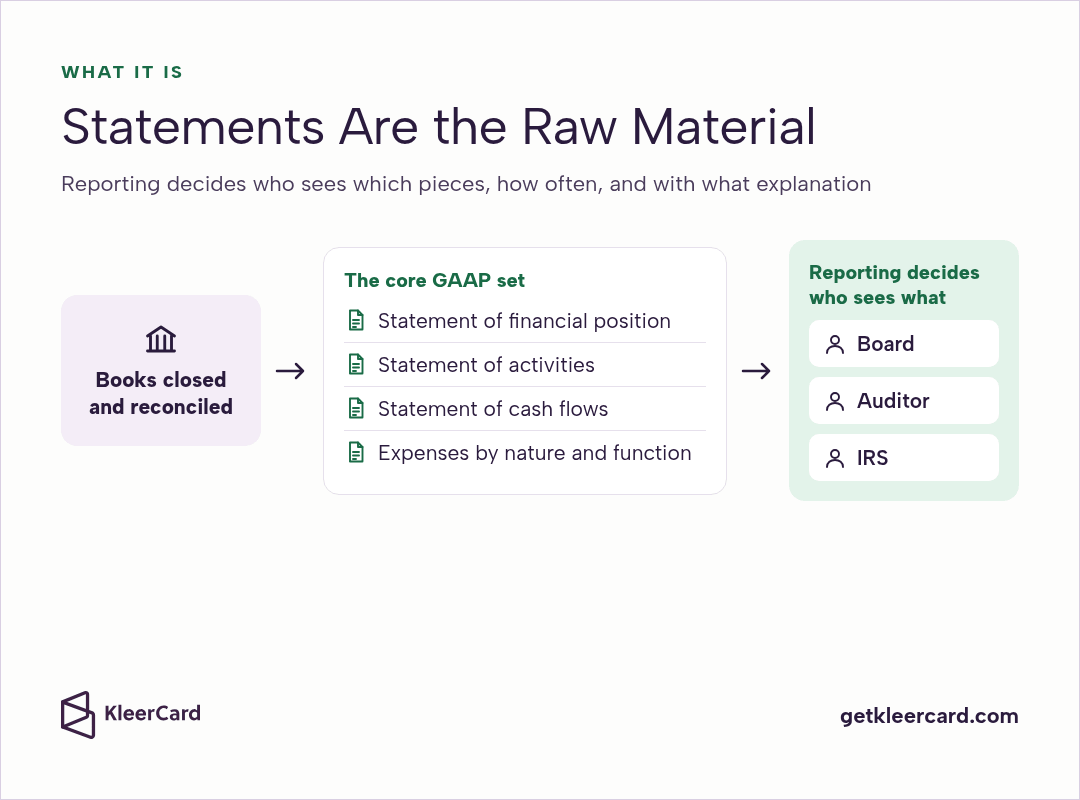
Nonprofit financial reporting is the work of producing financial information for the people who rely on it, in the form they need, on a schedule they can count on. The statements are the raw material. Reporting decides who sees which pieces, how often, and with what explanation.
Under GAAP, the core set is the statement of financial position, the statement of activities, the statement of cash flows, and an analysis of expenses by nature and function. Your board, an auditor and the IRS each draw on that same set, so the books behind it have to be closed and reconciled first.
What each statement shows, and how to read one, is covered in our guide to nonprofit financial statements. The routine that gets the books ready to report on, from recording gifts to the month-end close, is in how to do nonprofit bookkeeping and accounting.
Every audience asks a different question. The board asks whether the organization is healthy. A program director asks how much budget is left. A funder asks whether its grant was spent as promised, and the IRS asks for the annual return.
| Audience | What they need | How often | Deadline or trigger |
|---|---|---|---|
| Board and finance committee | Statement of financial position, statement of activities with budget vs actual, restricted and designated fund balances, cash on hand | Monthly or at least quarterly | With each board meeting packet |
| Program, ministry and budget leaders | Spending against their own budget lines | Monthly | Soon after each month closes |
| Funders and grantors | Grant budget vs actual, spending by restriction, often a narrative report | On each grant agreement's schedule | Set in the agreement; federal awards follow 2 CFR 200.328 |
| IRS | Form 990, 990-EZ, 990-N or 990-PF | Annually | 15th day of the 5th month after year-end |
| State | Corporate annual report, financial reports, charitable solicitation registration, state tax-exemption filings | Usually annually | Varies by state |
| Auditors | Year-end statements, schedules and supporting records | Annually, when an audit is required | Single audit: earlier of 30 days after the auditor's report or 9 months after year-end |
| Donors and the public | Annual report, plus the Form 990 on request | Annually | After the year-end close |
The board row matters most, because the board carries fiduciary responsibility for everything else on this list. The funder rows are the easiest to miss, because every grant can run on its own calendar.

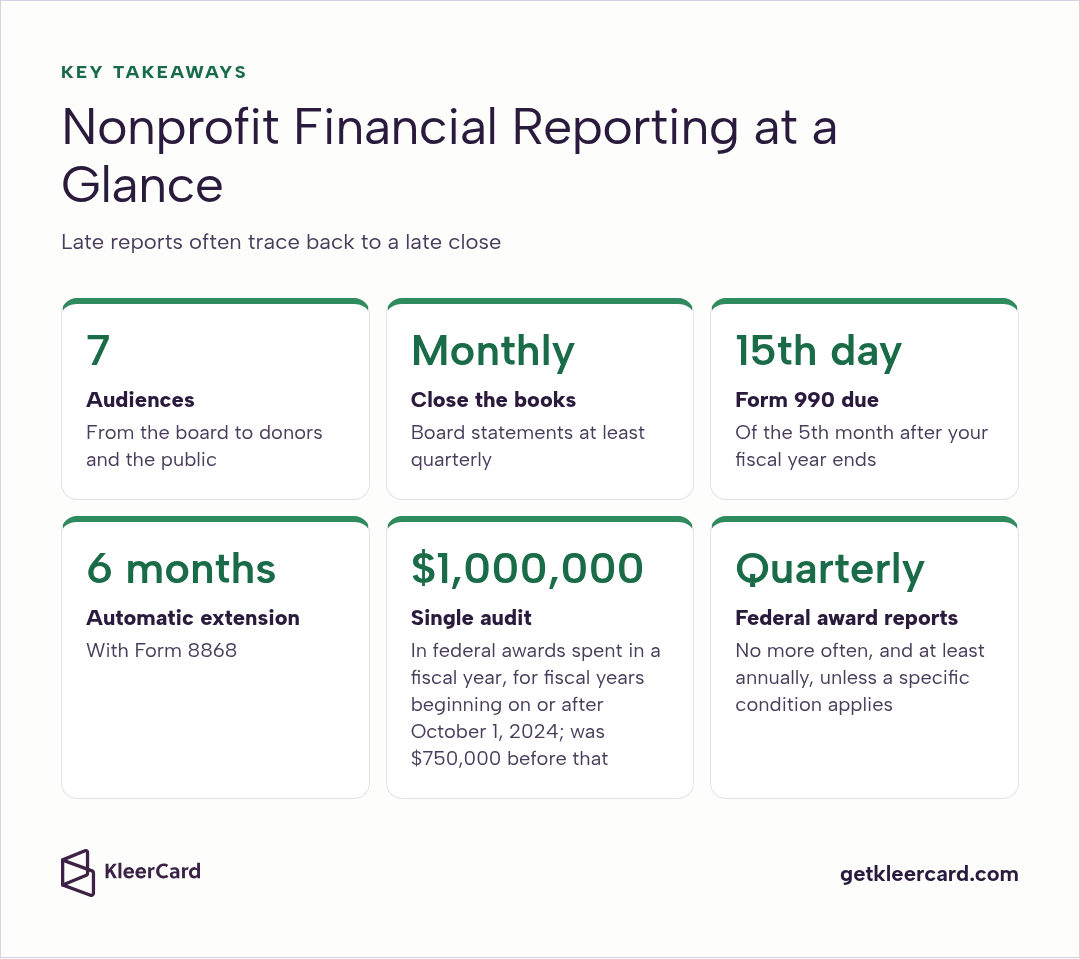
A nonprofit should close its books and produce internal reports every month, give the board statements monthly or at least quarterly, report to each funder on its grant's schedule, and file its annual IRS return each year.
Close the books, then send budget vs actual reports to program, ministry and budget leaders. If your board meets monthly, the board packet goes out from the same closed numbers.
A month is ready to report on once every bank and card account is reconciled, every expense has a receipt and a fund, and restricted releases are recorded. If the close isn't steady yet, start with the month-end close process.
Give the board and finance committee a fuller look: year-to-date budget vs actual, fund balances and cash. Some grants report quarterly too, and on a federal award the agency or pass-through entity can't collect financial reports more often than quarterly unless a specific condition applies.
This is also a good point to compare spending by function. Program, management and general, and fundraising totals feed both funder reports and the Form 990, and the statement of functional expenses guide walks through allocating shared costs.
Year-end brings the full statement set, the audit or review if you need one, the Form 990 series return, state filings, and the donor-facing annual report. The budget for next year often goes to the board in the same season.
Grant reports follow the agreement, so build them into the calendar the day a grant is signed. Under 2 CFR 200.328, federal annual financial reports are due within 90 days after the reporting period, quarterly or semiannual reports within 30 days, and the final report within 120 days after the period of performance ends. A subrecipient owes its final report to the pass-through entity within 90 days, and the closeout rule in 2 CFR 200.344 sets the same 120 and 90 day limits for all final reports.

A monthly board financial report should show where the organization stands, how this month compared with the budget, and what changed. Keep it short enough to read before the meeting.
The narrative is often the part boards remember. If a large one-time gift arrived this month, or a grant payment landed early, say so plainly. One sentence in the narrative keeps the board from reading a timing difference as a trend.
Start from the budget the board approved, so every line has a comparison. If you're rebuilding that budget, our nonprofit budget template is a good place to begin.

Grant financial reporting shows a funder that its money went where the agreement said it would. Grant agreements often ask for budget vs actual for the grant, spending by line item, and a short narrative alongside the numbers.
The work is far easier when each grant has its own fund or class from day one. Then the report is a filtered view of closed books, and nobody has to rebuild it from bank statements. How to track restricted funds covers that setup, and nonprofit grant management covers the rest of the grant cycle.
Federal awards add structure. Under 2 CFR 200.328, the agency or pass-through entity collects financial reports at least once a year and no more often than quarterly, unless a specific condition applies.
The government-wide form for those reports is currently the Federal Financial Report (SF-425). Your award's terms set which schedule applies to you.
When grant spending runs on cards, a card for each grant keeps that grant's spending separate from the start. Grants and restricted funds spend tracking shows how that works with KleerCard.

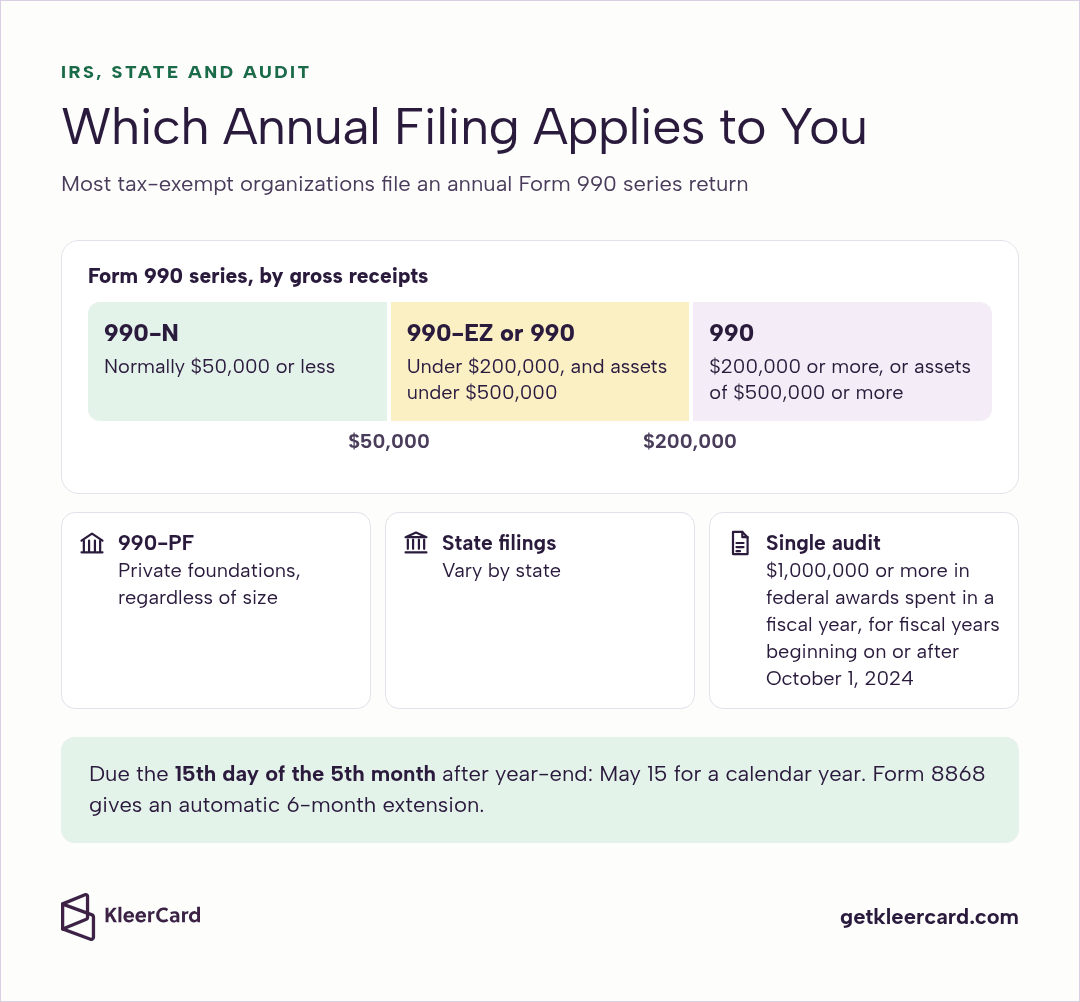
Most tax-exempt organizations file an annual Form 990 series return with the IRS. Many states add their own annual filings. An audit applies when a state, a funder or federal spending requires one.
| Requirement | Who it applies to | When it's due | Source |
|---|---|---|---|
| Form 990-N (e-Postcard) | Organizations with gross receipts normally $50,000 or less | 15th day of the 5th month after year-end | IRS |
| Form 990-EZ or Form 990 | Gross receipts under $200,000 and total assets under $500,000 | 15th day of the 5th month after year-end | IRS |
| Form 990 | Gross receipts of $200,000 or more, or total assets of $500,000 or more | 15th day of the 5th month after year-end | IRS |
| Form 990-PF | Private foundations, regardless of size | 15th day of the 5th month after year-end | IRS |
| State filings | Varies: corporate filings, financial reports, fundraising registration, state tax exemption | Varies by state | National Council of Nonprofits |
| Single audit | Organizations that spend $1,000,000 or more in federal awards in a fiscal year beginning on or after October 1, 2024 | Earlier of 30 days after the auditor's report or 9 months after year-end | 2 CFR 200.501, 200.512 |
For a calendar-year organization, the Form 990 due date is May 15. Form 8868 requests an automatic 6-month extension for the 990, 990-EZ and 990-PF.
Missing the return three years in a row brings automatic revocation of tax-exempt status, so the annual return belongs on the calendar even for the smallest organization.
Churches, conventions or associations of churches, and their integrated auxiliaries are among the organizations the IRS exempts from the annual return. Their boards, members and donors still count on regular reports.
State rules vary, and many state associations of nonprofits publish a summary for their state. Audits can also come from a state threshold or a funder's terms. Our nonprofit audit guide covers the triggers and how to prepare.
A tax-exempt organization must make its annual return and its exemption application available for public inspection. Each return stays available for three years from its due date, including extensions, or the date it was filed, whichever is later, under the IRS public disclosure rules.
Anyone can also look up filed returns through the IRS Tax Exempt Organization Search. So donors who want to see your 990 usually can.
The annual report is where you tell the story behind those numbers, in your own words. Our nonprofit annual report guide covers what to include and how to present the financials. For churches, church financial transparency covers sharing numbers with members.

Here's one example. A finance leader asks us whether their team can get financial information that doesn't feel 4 to 6 weeks behind. Often the delay starts upstream, in the close.
The bank reconciliation waits on manual entry, the entry waits on the credit card statement, and the statement waits on the end of the cycle. By the time the month is finally closed, the next one is well underway.
The fixes are small, steady habits:
Cards help when control lives on the card. With KleerCard, limits, categories and schedules are set when a card is loaded, so a purchase that fits goes through and anything outside them declines. KleerCard reminds cardholders to upload receipts, and card transactions sync with your accounting software through accounting sync. Every plan includes unlimited cards, so each program or ministry lead can have their own.
Faster reporting also depends on the books behind it. We're also building KleerFi Accounting. It's in development now, and you're welcome to join the waitlist.

A financial report for a nonprofit is any summary of your books prepared for someone who relies on them, such as a board report, a grant report, a Form 990 or an annual report. Each one draws on the same closed books and GAAP statements.
Most tax-exempt nonprofits file one Form 990, 990-EZ or 990-N with the IRS each year, and the right form depends on your gross receipts and assets. Many states require annual corporate filings and charitable solicitation registration. An audit applies when a state or a funder requires one, or when federal award spending is $1,000,000 or more in a fiscal year beginning on or after October 1, 2024.
Your board should get financial statements at least quarterly, and monthly if it meets monthly, so it's never deciding on stale numbers. Each report should include budget vs actual, fund balances and a short narrative of what changed.
Most tax-exempt organizations file just one Form 990 series return each year, sized to the organization: Form 990-N for gross receipts normally $50,000 or less, Form 990-EZ for receipts under $200,000 and assets under $500,000, and Form 990 at or above those levels. Private foundations file Form 990-PF.
Form 990 is due by the 15th day of the 5th month after your fiscal year ends, which is May 15 if your fiscal year matches the calendar year. Form 8868 gives an automatic 6-month extension.
A 501(c)(3) does have to make its annual Form 990 series return and its exemption application available for anyone who asks to see them, and filed returns appear in IRS Tax Exempt Organization Search. Audited statements and annual reports are often shared because a funder or state asks for them, or by the organization's choice.
Good reporting comes from a steady rhythm: close the month, send each audience its report, and keep the annual filings on the calendar from the first week of the year. Start with the board report and the next grant deadline, then build out from there.
If cleaner card spending would make your close easier, we'd love to help. You can get started with KleerCard today, or schedule a demo and we'll walk through how it fits your reporting calendar.


Speak to a member of our team and we can have you up and running in minutes, not weeks.