%202.svg)
No 1099-NEC for card payments. Processors file Form 1099-K. 2026 $2,000 threshold, Zelle rules, and a mixed-payment checklist for churches and schools.
No. You do not issue Form 1099-NEC or Form 1099-MISC for payments you make by credit card, debit card, stored-value card, or a third-party settlement network such as PayPal. The company that settles the charge files Form 1099-K under Internal Revenue Code section 6050W.
You still file a 1099-NEC when you pay a contractor by cash, check, ACH, wire, or Zelle and those non-card payments reach $2,000 in 2026.
The card-versus-check split is where churches, schools, and nonprofits get tripped.
A guest speaker is paid by Zelle, a camp vendor takes a card, and a plumber gets a check. Amazon charges already run on a ministry or school card.
January then becomes a hunt through the card feed, the check register, and Zelle to decide who needs a 1099-NEC.
I am Owen Hill. I co-founded KleerCard and serve as treasurer at my church. Before that I closed books as Budget Director at Compassion International and as a fractional CFO through Switch Consulting, working in Blackbaud Financial Edge, Microsoft Great Plains, and QuickBooks Online.
I am not a CPA. This article was last reviewed in August 2026 and is educational, not tax advice. Confirm the 1099-NEC filing list with your CPA before you send forms.
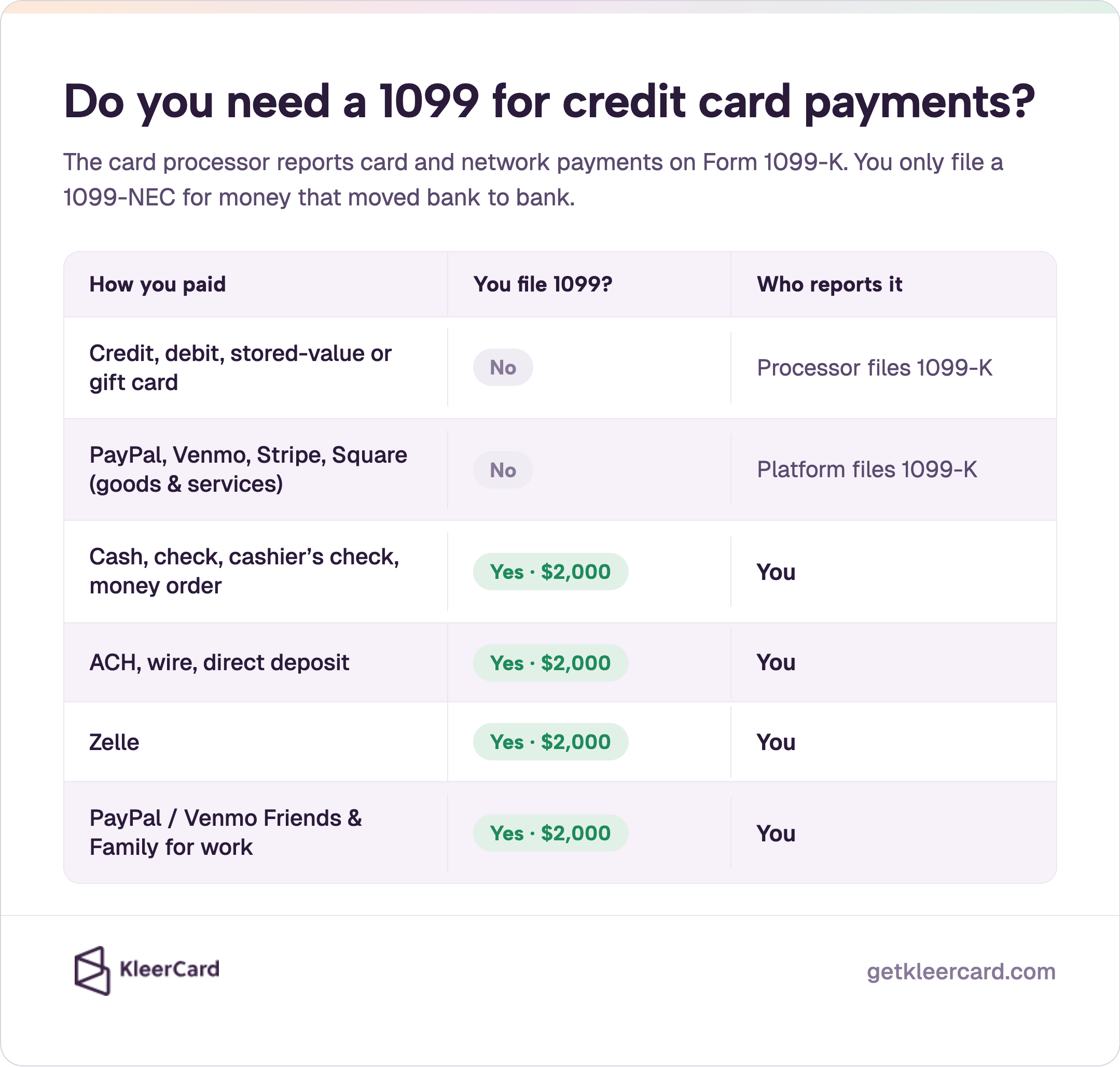
No. The IRS instructions for Forms 1099-MISC and 1099-NEC state that payments made with a credit card or payment card, and certain third-party network transactions, must be reported on Form 1099-K by the payment settlement entity under section 6050W.
Credit-card and network payments are not subject to reporting on Form 1099-MISC or Form 1099-NEC. Read the current IRS instructions for Forms 1099-MISC and 1099-NEC.
QuickBooks help text states the same exclusion. Credit card, debit card, and third-party system payments to 1099 vendors stay out of 1099-NEC and 1099-MISC calculations in the payments excluded from 1099-NEC and 1099-MISC help article.
The 6050W rule also covers debit cards, stored-value cards such as gift cards, and goods-and-services payments through a platform that settles funds. That group includes PayPal, Venmo business payments, Stripe, and Square.
You prepare a 1099-NEC or 1099-MISC only for the methods the card processor does not report: cash, check, ACH, wire, money order, and Zelle.
The practical test is whether the money moved through a card network or a platform that settles funds, or whether it moved bank to bank from your account. Only the bank-to-bank group stays on your 1099-NEC.
Form 1099-C is a different form. A credit card issuer sends Form 1099-C when it cancels a debt, not when you pay a vendor with a card.
| How you paid | Do you file 1099-NEC or 1099-MISC? | Who reports it |
|---|---|---|
| Credit card, debit card, stored-value or gift card | No | Card processor files Form 1099-K |
| PayPal, Venmo, Cash App, Stripe, Square (goods and services) | No | Platform files Form 1099-K if it hits the TPSO threshold |
| Cash, check, cashier’s check, money order | Yes, at $2,000 in 2026 | You |
| ACH, wire, direct deposit | Yes, at $2,000 in 2026 | You |
| Zelle | Yes, at $2,000 in 2026 | You |
| PayPal or Venmo Friends and Family used for work | Yes, at $2,000 in 2026 | You (the platform is not settling a goods-and-services payment) |
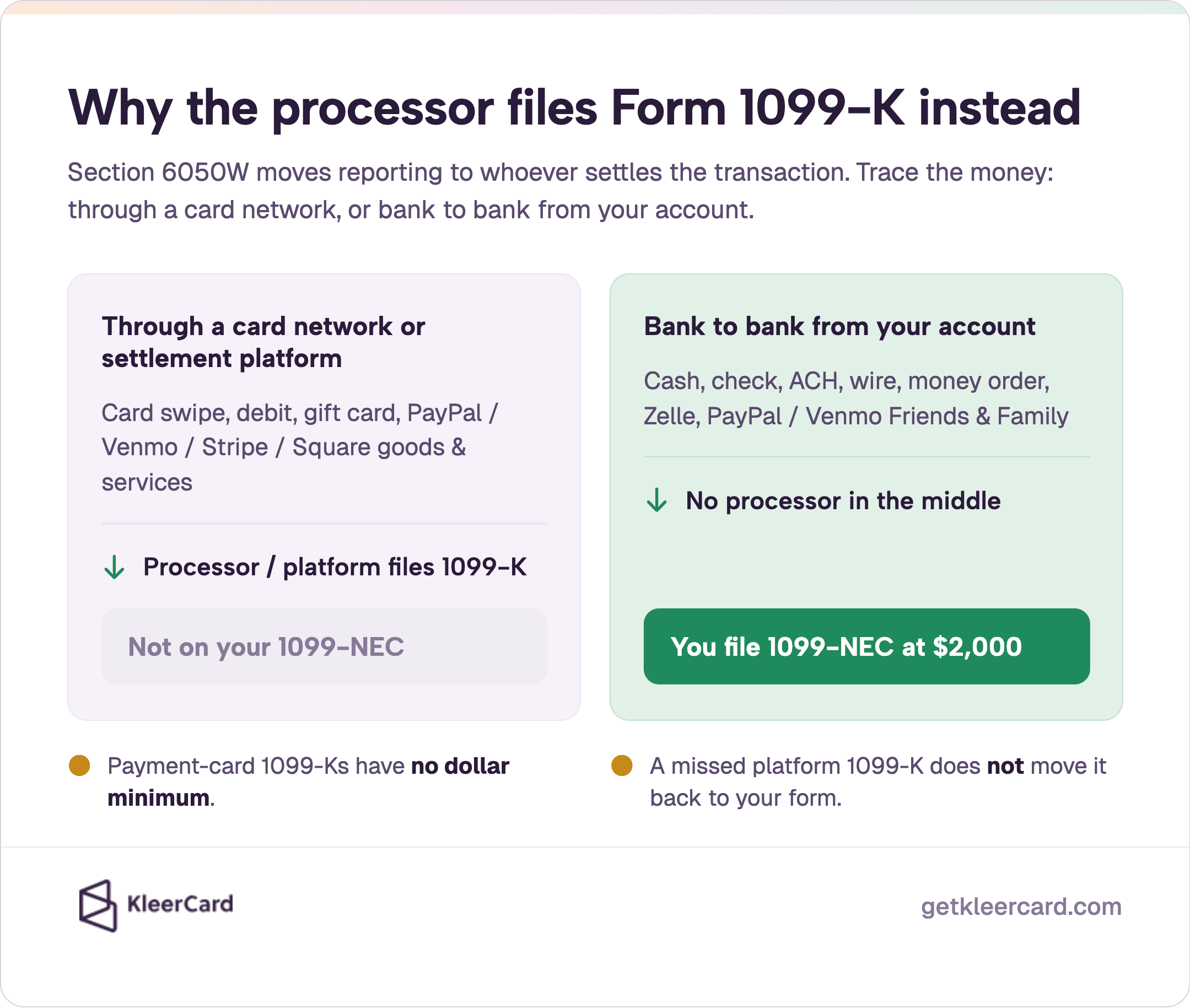
Section 6050W moved payment-card and third-party network reporting off the payer and onto the firm that settles the transaction. That firm is the payment settlement entity.
For a card swipe, the payment settlement entity is the merchant acquiring entity. For PayPal or Venmo goods-and-services, the payment settlement entity is the platform. Either way, you are not the filer.
Form 1099-K reports the gross amount of those card and network transactions to the IRS and to the payee. The official overview lives on Understanding your Form 1099-K. The Form 1099-K FAQs add the payment-card versus app split.
Two details matter for the church, school, or nonprofit doing the paying.
First, payment-card 1099-Ks have no dollar minimum. If a vendor accepts your card, their processor can issue a 1099-K for any amount.
Second, the third-party settlement organization threshold does not put the payment back on your 1099-NEC. The Instructions for Form 1099-K say the de minimis test is ignored when deciding whether section 6050W or section 6041 applies.
If the money moved through a payment card or a qualifying network, it stays off your 1099-NEC even when the platform never mails the vendor a 1099-K.
“PayPal never sent them a form, so I should” is the wrong instinct. The IRS does not want the same dollars on a 1099-K and a 1099-NEC.
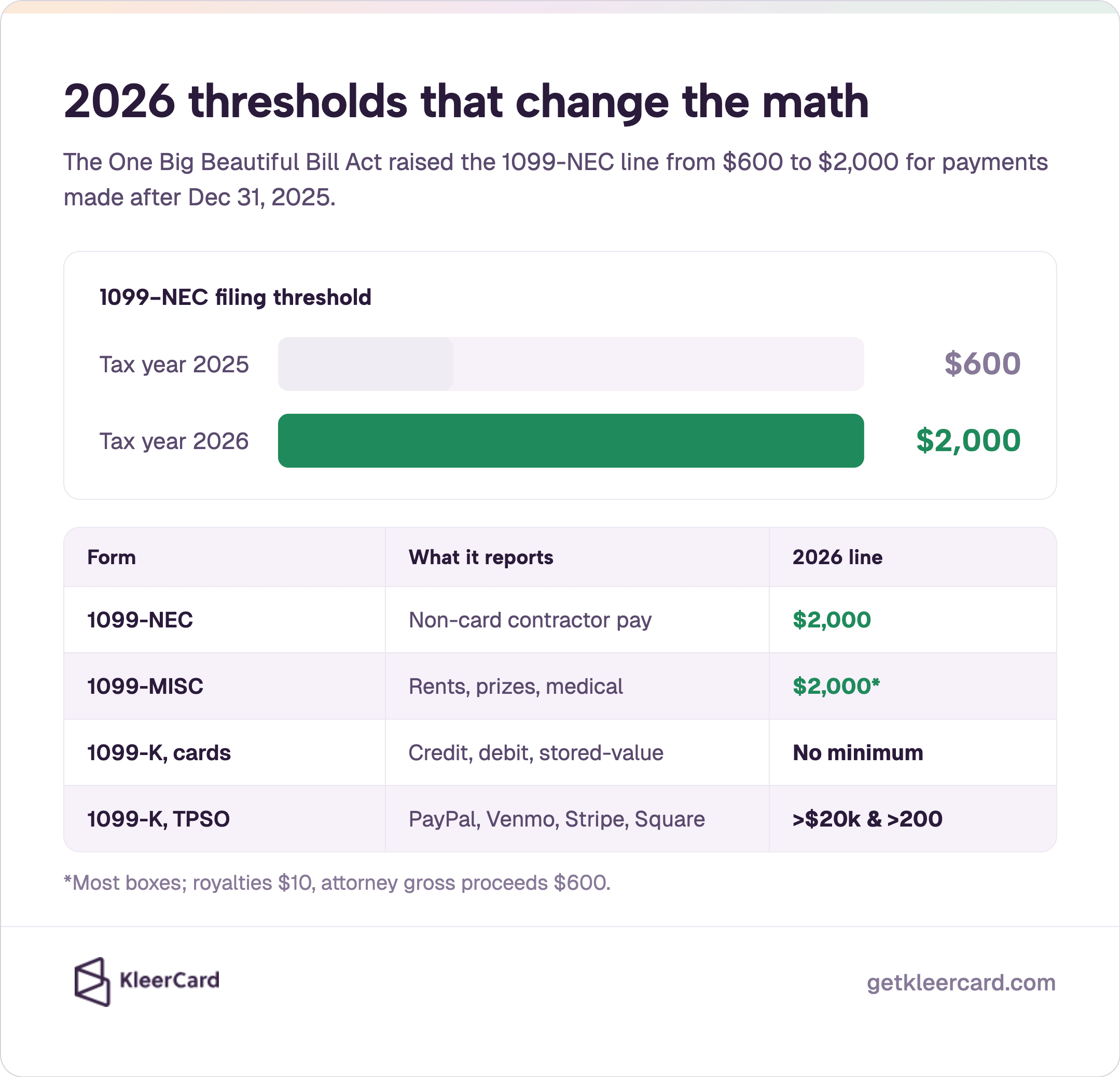
Two 1099 dollar lines changed recently. They apply to different forms and different payers. Keep them on separate lines.
The One Big Beautiful Bill Act, signed July 4, 2025, raised the Form 1099-NEC and most Form 1099-MISC thresholds from $600 to $2,000 for payments made after December 31, 2025. Starting in 2027 those thresholds index for inflation.
The One Big Beautiful Bill Act also restored the Form 1099-K third-party network threshold to more than $20,000 and more than 200 transactions. The current Form 1099-K FAQs record that restoration.
The $20,000 and 200-transaction line applies to PayPal, Venmo goods-and-services, Stripe, and Square. The TPSO line does not apply to a plain card swipe.
| Form | What it reports | 2026 federal line | Who files |
|---|---|---|---|
| 1099-NEC | Nonemployee compensation paid by cash, check, ACH, wire, or Zelle | $2,000 | The organization that paid |
| 1099-MISC | Rents, prizes, medical payments, and similar non-card amounts | $2,000 for most boxes; $10 for royalties; $600 for attorney gross proceeds | The organization that paid |
| 1099-K, payment cards | Credit, debit, stored-value | No minimum | Card processor |
| 1099-K, TPSO | PayPal, Venmo goods-and-services, Stripe, Square | More than $20,000 and more than 200 transactions | The platform |
Forms you filed for tax year 2025, due in early 2026, still used the $600 1099-NEC line. Forms you file for tax year 2026, due in early 2027, use $2,000. See About Form 1099-NEC for the current form page.
A copy of Form 1099-NEC goes to the recipient by January 31. The same January 31 date is the IRS filing deadline for 1099-NEC.
If you file 10 or more information returns of all types, you e-file. Some states set a lower 1099-K line than the federal TPSO rule, but the state 1099-K is still the platform’s job, not yours. Confirm your state with a CPA.
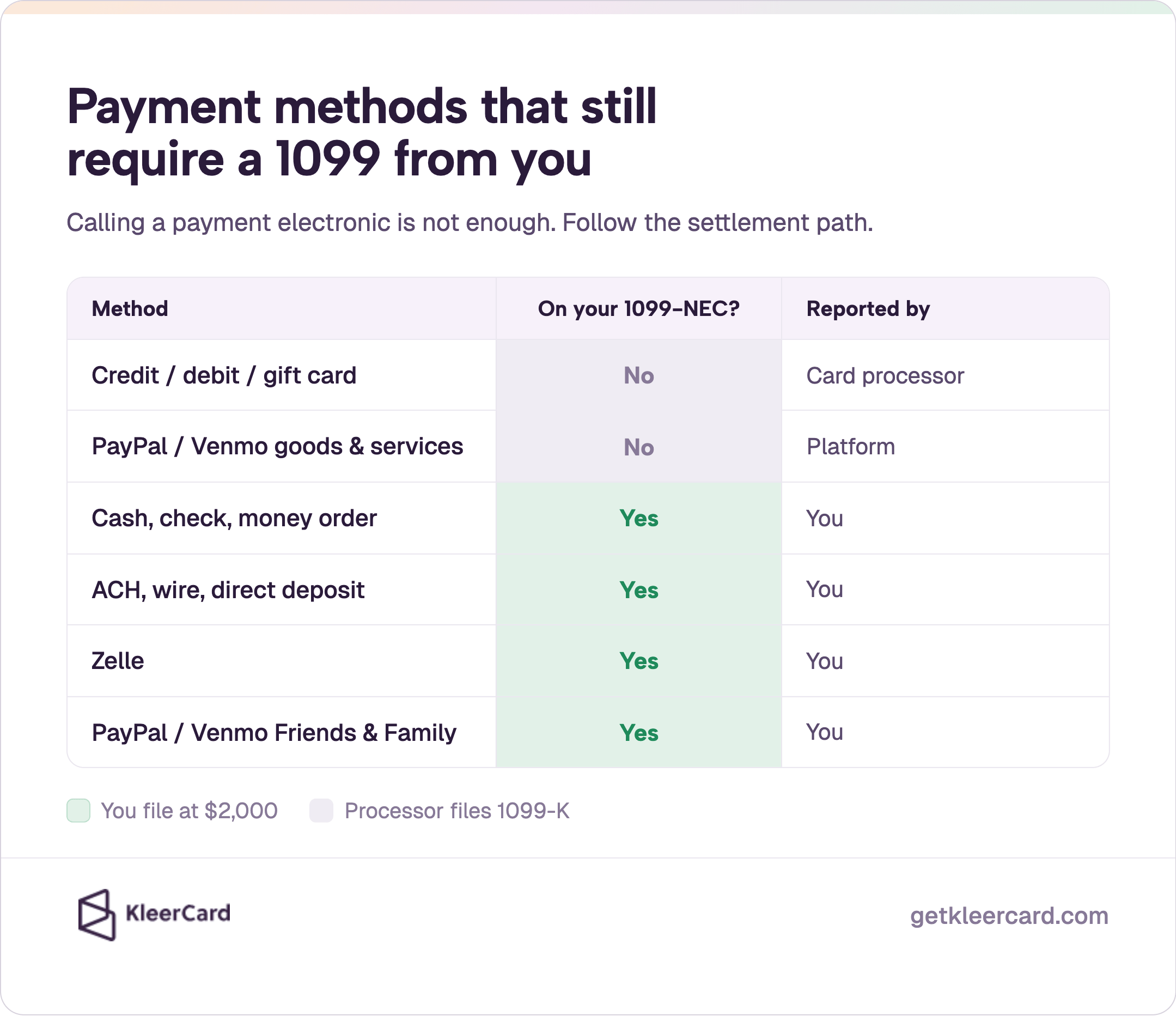
The 1099-NEC card exemption follows the settlement path. Calling a payment electronic is not enough.
ACH networks and wires move money bank to bank. IRS regulations treat a plain ACH network as a system that is not a third-party settlement organization. ACH and wire payments stay on your 1099-NEC once they reach $2,000.
Zelle is the method that surprises church and school offices. Zelle does not hold a wallet or settle a network payment. Zelle instructs one bank to push money to another bank.
Zelle’s own IRS FAQ says the 1099-K reporting law does not apply to the Zelle network. If you pay a guest speaker, referee, or contractor $2,000 or more by Zelle in 2026, you file the 1099-NEC.
Friends-and-family sends on PayPal, Venmo, or Cash App sit with Zelle and ACH when they are used to pay for work. The platform is not settling a goods-and-services transaction, so the 1099-K shift does not apply.
Corporations are usually off your 1099-NEC list. An LLC taxed as a C or S corporation is treated as a corporation. Collect a W-9 before the first payment so you know the entity type instead of guessing from the invoice letterhead.
Attorneys are the main exception. Legal fees still go on Form 1099-NEC. Gross proceeds paid to an attorney can go on Form 1099-MISC.
Backup withholding at 24% applies when a payee who should receive a 1099 from you never gives a valid TIN. Card payments do not create that duty for you. Check, ACH, and Zelle payments do.
I recommend separating true contractor payments from staff and volunteer reimbursements early. Reimbursements belong on an accountable plan.
Mileage is the usual case a card cannot cover. Mileage reimbursement should run as vendor ACH rather than through payroll, which is the pattern in an expense reimbursement policy that follows IRS Publication 463.
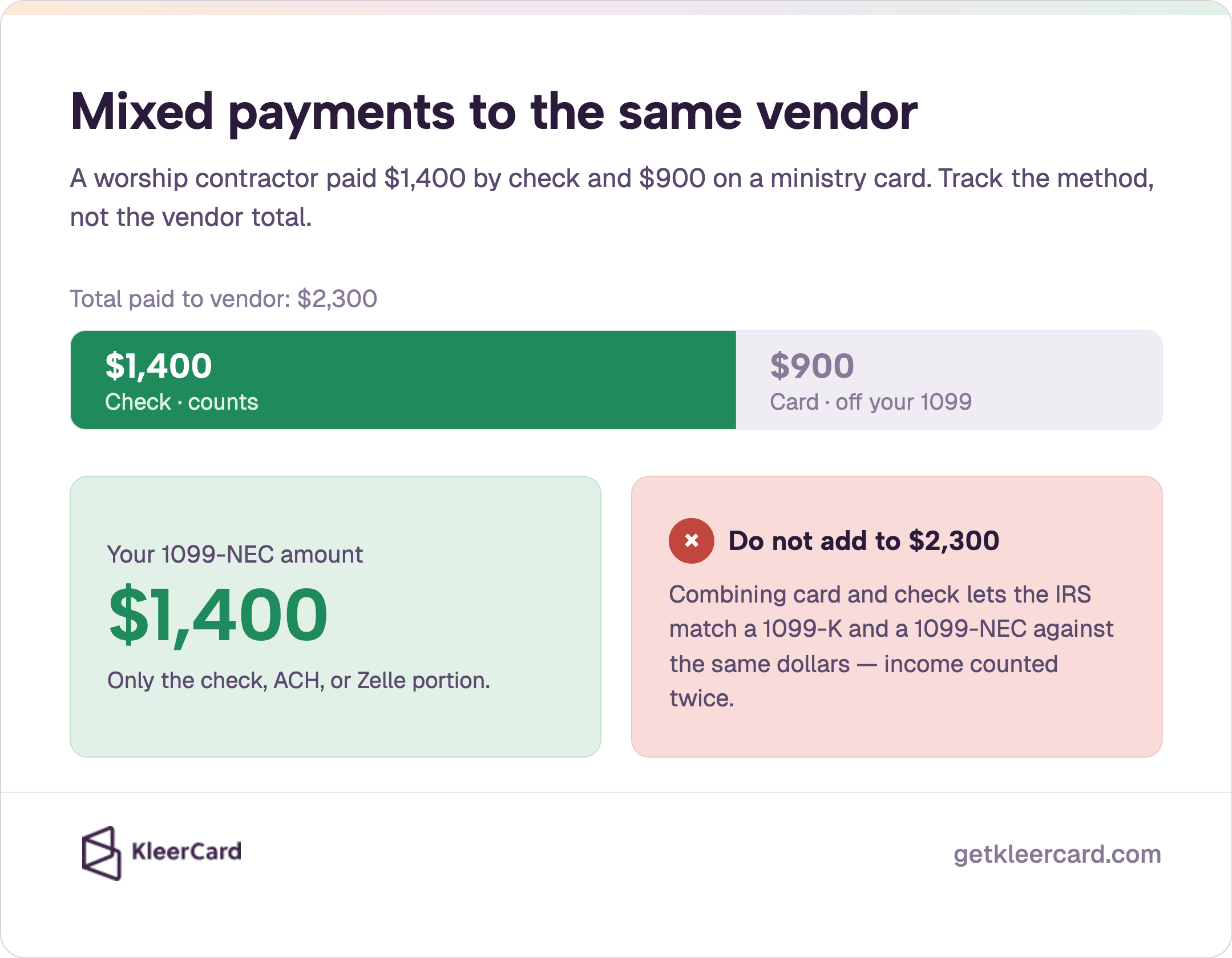
Track the payment method, not only the vendor total. A private Christian school we work with pays vendors by card and by printed check every week.
Classroom and event supplies move on cards. Vendor bills still go out as printed checks.
Say a worship contractor is paid $1,400 by check and $900 on a ministry card. Your 1099-NEC amount is $1,400. The $900 is the processor’s 1099-K problem.
Adding both together and issuing $2,300 puts the IRS in a position to match a 1099-K and a 1099-NEC against the same dollars. The contractor then spends spring explaining income they did not receive twice.
Amazon charges at the school arrive with line-item detail. Printed-check vendors remain on the school’s 1099-NEC list.
Card charges at that campus do not count toward the $2,000 1099-NEC line. Only the check, ACH, or Zelle portion does.
The finance office did not adopt card bill pay, so printed-check vendors did not leave the 1099-NEC workflow. Schools that want the same card-and-receipt setup can start from KleerCard for educators.
The campus story is the same one behind how a private Christian school went from 5 cards to 60. Amazon charges are easier to code when Amazon Business expense tracking lands the receipt with the card.
The clean habit is one running total per vendor, split by method, from January 1. At year-end you already know which names cross $2,000 on the non-card side.
Do not open a “card vendor” and a “check vendor” for the same person. That split is how the $1,400 check and the $900 card charge get added together in January.
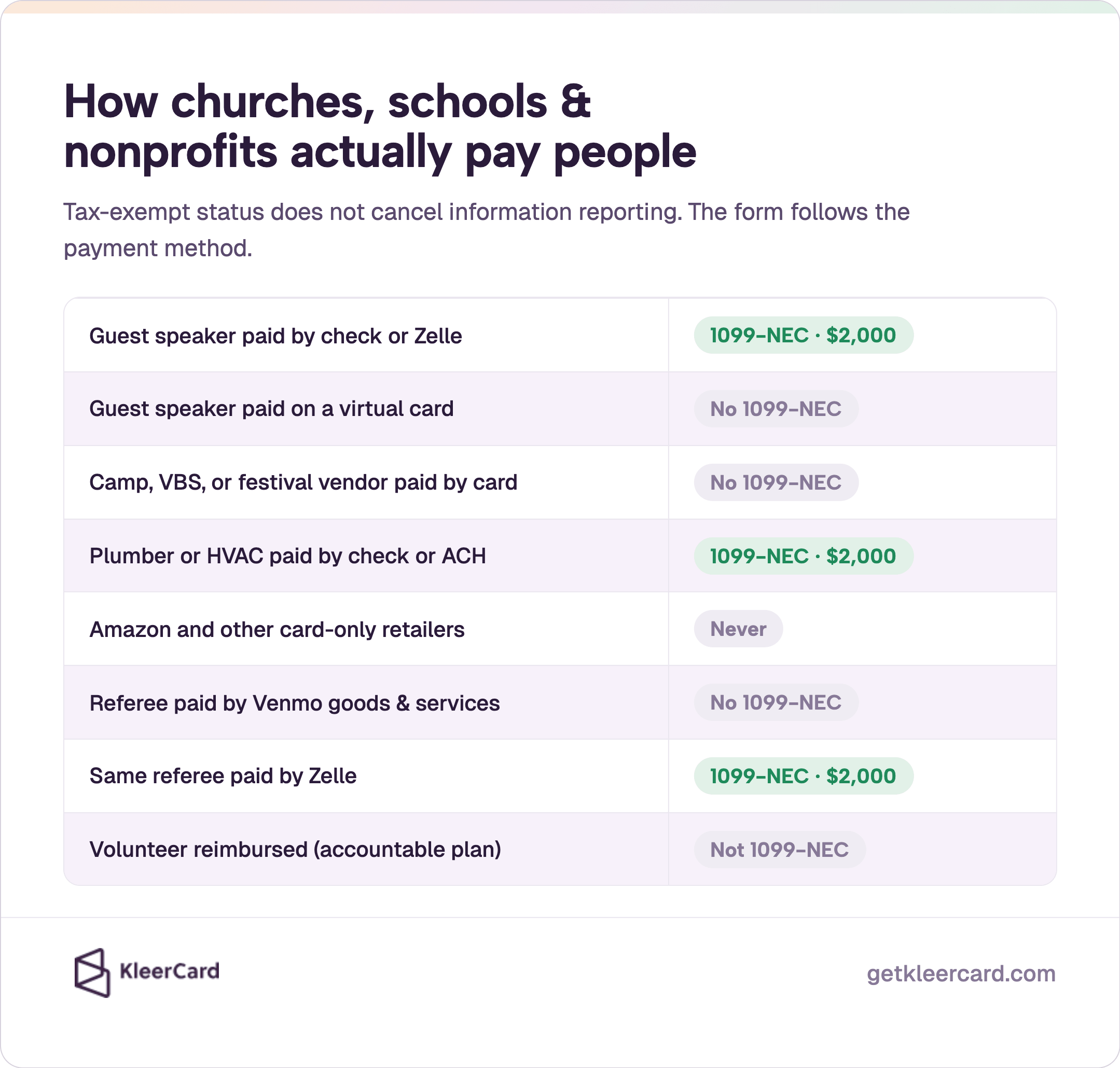
Tax-exempt status does not cancel information reporting. IRS 1099 instructions treat nonprofit organizations, including 501(c) organizations, as engaged in a trade or business for this purpose.
Churches still issue W-2s and 1099s. That 1099 duty sits next to the other IRS rules for churches. The same filing obligation applies to schools and nonprofits that pay contractors.
Typical payments and the form that follows:
A small church under 100 members in the KleerCard customer base issues virtual cards for contractor spend and a separate pre-funded card for a $350 fall festival. When a guest speaker or vendor is paid on those cards, the treasurer does not file a 1099-NEC. The processor files Form 1099-K.
Checks and Zelle payments to the same kinds of people still belong on that church’s 1099-NEC once non-card totals reach $2,000 in 2026. That is the pattern we see on credit cards for small churches.
My own church runs 21 active KleerCard cards. The point of those 21 cards is line-of-sight on who spent what. A side effect is that card-paid vendor activity does not go on our 1099-NEC.
Goods you buy are generally not 1099-NEC items even when you pay by check, because Form 1099-NEC reports nonemployee compensation for services. A supply invoice paid by check to a store does not become a 1099-NEC just because it cleared the bank.
A nonprofit credit card program changes the January 1099-NEC workload because more services land on named or virtual cards. The processor reports those card charges on Form 1099-K. The checks and Zelle payments that remain are the short list the church or school actually files.
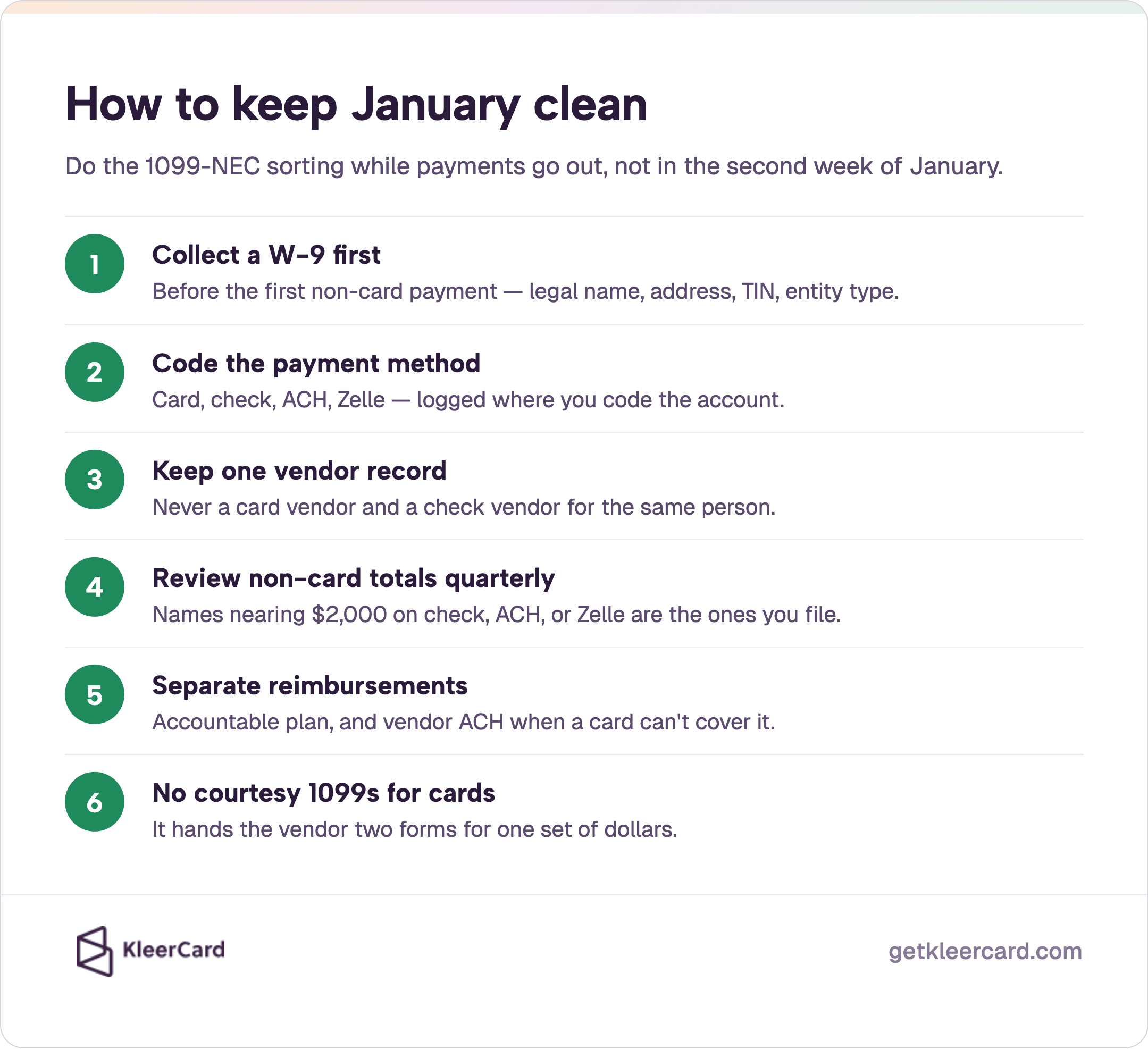
Do the 1099-NEC sorting while payments go out, not in the second week of January.
A school or church that still prints checks will always have a 1099-NEC list. Moving more vendor spend onto named or virtual cards shrinks that 1099-NEC list. Card spend does not erase the duty for the checks and Zelle payments that remain.
Expense management that tags the cardholder and the receipt at the point of spend also makes the card-versus-check split easier. Card activity already sits in one feed.
The payment-method habit shows up in month-end close and receipt tracking. Point-of-spend receipt tracking keeps card totals from landing in a January shoebox.
If you want the payment-method field sitting on the charge instead of a year-end export, schedule a short walkthrough.
The 1099-NEC question follows the payment method, whether you use credit cards built for churches or nonprofit cards with no personal guarantee. The payment-method field is easier to keep if spend, receipts, and bills live in one product.
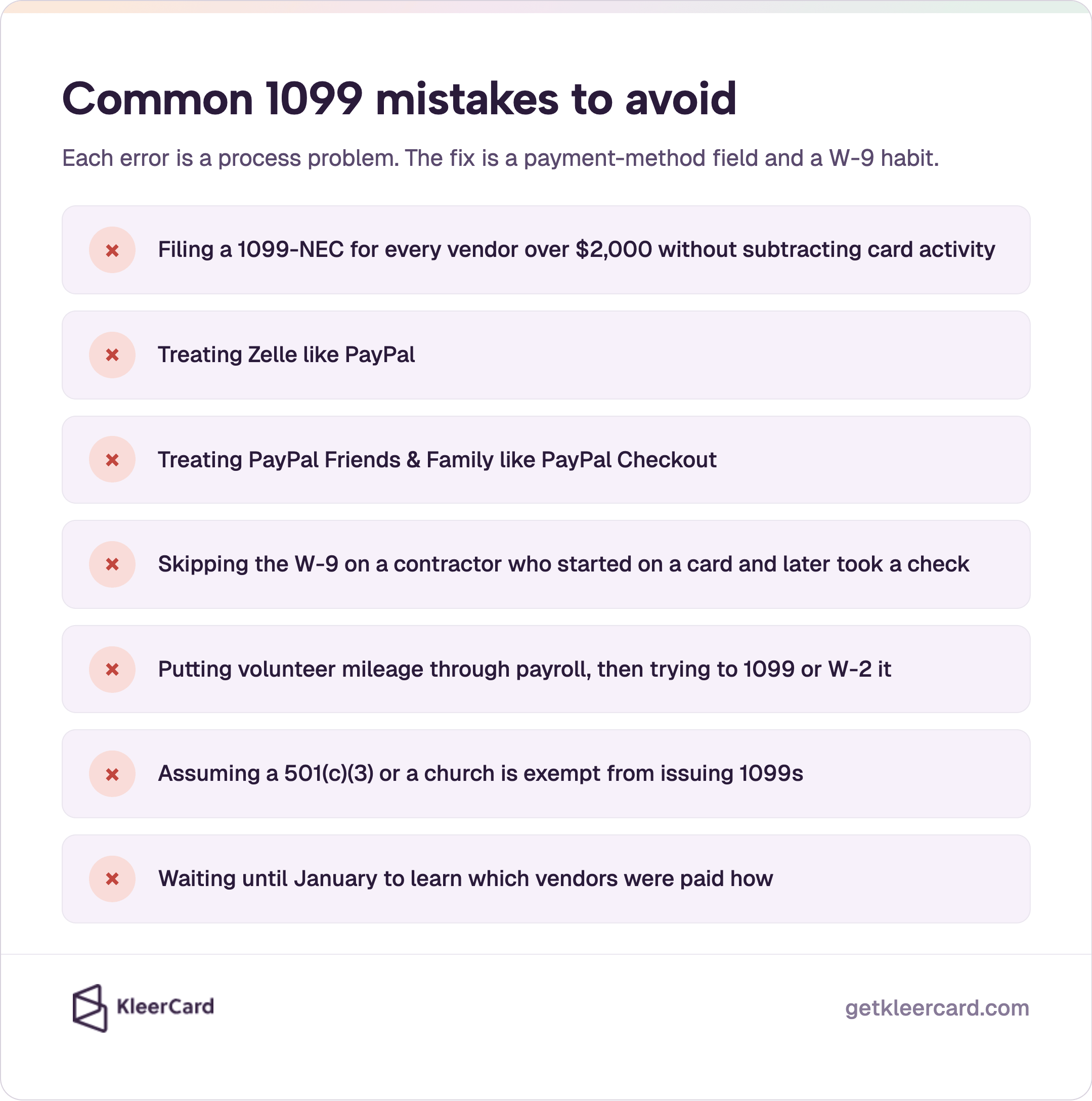
Each of those 1099 errors is a process problem. The fix is a payment-method field and a W-9 habit.
No. You do not file Form 1099-NEC or Form 1099-MISC for credit card, debit card, stored-value card, or qualifying third-party network payments.
The payment settlement entity reports those card and network amounts on Form 1099-K. You still file a 1099-NEC for cash, check, ACH, wire, and Zelle totals that reach $2,000 in 2026.
Only the check, ACH, wire, cash, or Zelle portion goes on your 1099-NEC. Leave the card charges off that 1099-NEC so the same income is not reported twice. Add the non-card amounts for that vendor for the calendar year and file if they reach $2,000.
No, not for a vendor you pay only by card. The processor files Form 1099-K, so you do not need their TIN for your 1099-NEC.
Collect a W-9 before the first check, ACH, or Zelle payment to that same person. A contractor who starts on a card and later takes a check still needs a W-9.
No, when the PayPal payment is goods-and-services and PayPal is settling the transaction. PayPal files Form 1099-K if the payee hits the TPSO threshold.
Yes, when you use PayPal Friends and Family to pay for work. A Friends-and-Family send is treated like a personal transfer, so it stays on your 1099-NEC at $2,000 in 2026.
Yes, when the Zelle total for services to one person reaches $2,000 in 2026. Zelle is not a third-party settlement organization and does not file Form 1099-K. Treat Zelle like a bank transfer.
$2,000 in nonemployee compensation paid by methods you must report. The 1099-NEC line was $600 for tax year 2025. Card and TPSO payments do not count toward your $2,000.
Payment cards have no minimum. The processor can issue Form 1099-K for any card amount.
Third-party settlement organizations such as PayPal and Venmo goods-and-services use more than $20,000 and more than 200 transactions. The TPSO line does not move the payment back onto your 1099-NEC.
The payment settlement entity. For a card that is the merchant acquiring entity or processor.
For PayPal or Venmo goods-and-services that is the platform. You do not prepare Form 1099-K for purchases you make.
No. Form 1099-C reports cancellation of debt. Form 1099-K reports payment-card and third-party network transactions.
Paying a plumber with a ministry card does not create a 1099-C. The plumber’s processor may issue a 1099-K.
Yes, when churches and nonprofits pay reportable amounts by reportable methods. IRS instructions include nonprofit organizations and 501(c) organizations in the group that must file.
Tax-exempt status does not remove the 1099 duty. Volunteer reimbursements under an accountable plan stay off the 1099-NEC.
The credit-card 1099 question has a short answer and a longer tracking problem.
You do not put credit-card payments on a 1099-NEC. The processor files Form 1099-K. You do file a 1099-NEC for check, ACH, and Zelle payments once those amounts hit $2,000 in 2026.
Churches, schools, and nonprofits pay vendors by card, check, ACH, and Zelle in a normal month. That mix is why January feels harder than the 1099-NEC rule itself.
Sort by payment method as you go. Collect W-9s on anyone who might take a non-card payment. Keep reimbursements on an accountable plan.
Move vendor spend onto named or virtual cards when the vendor can take a card. Leave the remaining checks on a 1099-NEC list you already trust.
If you want cards, receipts, and vendor payments in one place, see how KleerCard works for churches or schedule a short walkthrough. Nonprofit teams can start from KleerCard for nonprofits.
Pricing is public, and white-glove setup is available if you want help standing the cards and vendor records up. You can also sign up directly. Confirm the 1099-NEC filing list with your CPA before you send forms.


Speak to a member of our team and we can have you up and running in minutes, not weeks.