Ramp, BILL, Brex, Sage Expense Management and 7 more Expensify alternatives compared on pricing and fit, plus the best pick for nonprofits and churches.
The best Expensify alternative depends on what you actually need. For most general businesses, Ramp is the strongest all-round pick, with a $0 plan (as of October 2026) and deep automation. For finance teams that want to keep their existing credit cards, Sage Expense Management (formerly Fyle) is the closest fit.
For nonprofits, churches, and schools, KleerCard handles the needs general expense tools often leave out: fund accounting exports, volunteer cards, and flat pricing that holds up to seasonal staff.
I've compared all eleven on price, features, and the kind of organization each one serves, with KleerCard's trade-offs named as honestly as the rest.
The best Expensify alternatives in 2026 are KleerCard, Ramp, Brex, BILL Spend & Expense, SAP Concur, Zoho Expense, Rydoo, Emburse Professional, Payhawk, Sage Expense Management, and Pleo.
The first question to settle is usually this one. Do you want new corporate cards, or software that sits on the cards you already have? A few tools, such as Payhawk, offer both. If your cards work and only the expense reports hurt, look at the software tools. If the cards themselves are the problem, look at the platforms that issue them.
I'm Owen Hill, co-founder of KleerCard. Before KleerCard, I was Budget Director at Compassion International and ran a fractional CFO practice for nonprofits, and I volunteer as treasurer at my own church. In demos with churches and nonprofits leaving Expensify, I keep seeing the same pattern. The trouble usually starts with the card program underneath the software.
This list is a good fit if you run finance for a nonprofit, church, school, or denomination; handle restricted funds or designated giving; or need cards for staff, volunteers, and seasonal helpers without a personal guarantee.
General-business teams are covered too. A venture-backed startup will probably fit Ramp or Brex better, and if you only need software on top of cards that already work, look at Sage Expense Management, Zoho Expense, and Emburse Professional.
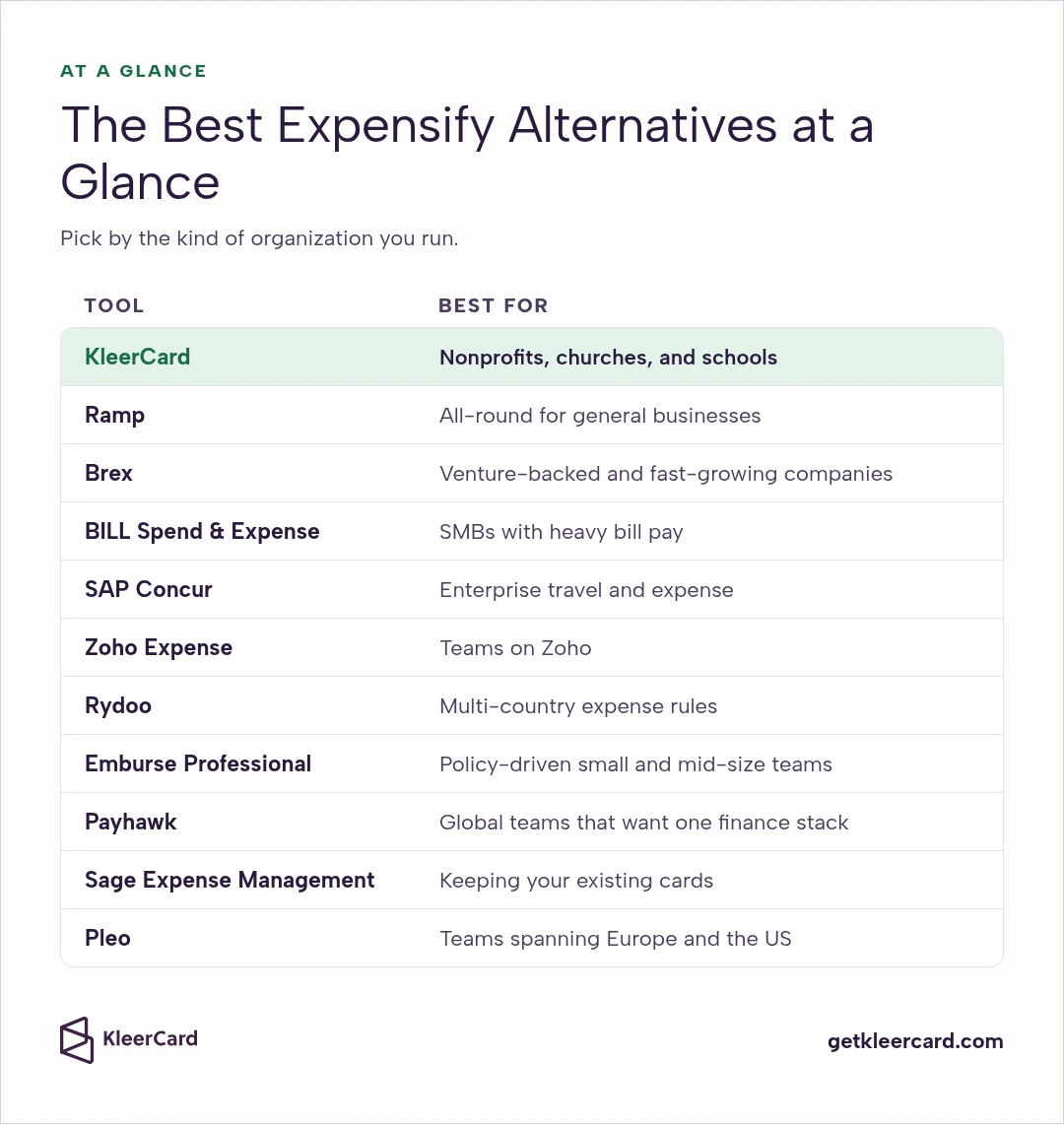
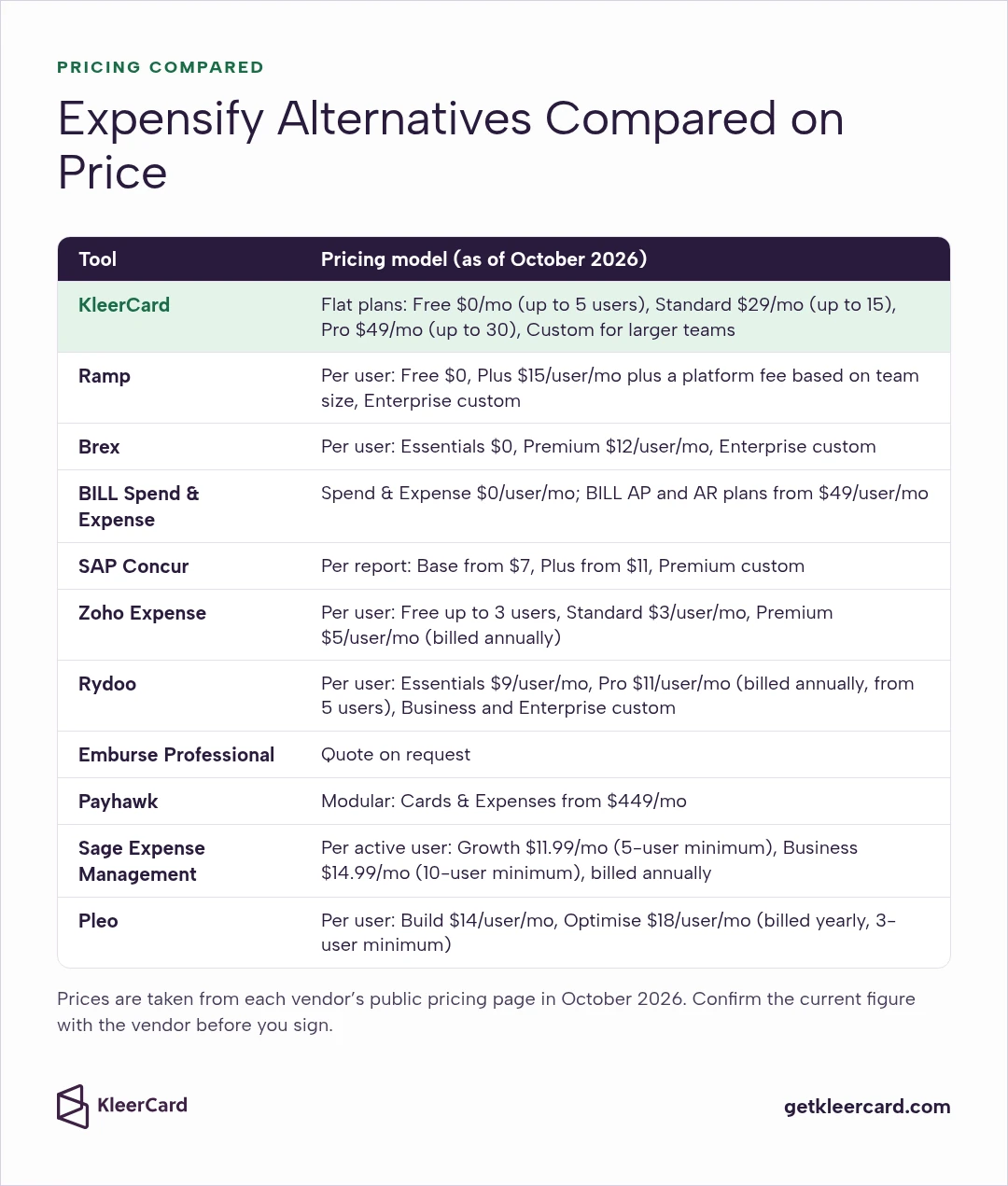
| Tool | Pricing model (as of October 2026) | Key feature | Keep in mind |
|---|---|---|---|
| KleerCard | Flat plans: Free $0/mo (up to 5 users), Standard $29/mo (up to 15), Pro $49/mo (up to 30), Custom for larger teams | Organization-issued Visa cards plus expense software and fund-accounting integrations | Built for mission-driven organizations rather than venture-scale startups |
| Ramp | Per user: Free $0, Plus $15/user/mo plus a platform fee based on team size, Enterprise custom | Corporate cards with deep AP and accounting automation | Plus adds a platform fee based on team size |
| Brex | Per user: Essentials $0, Premium $12/user/mo, Enterprise custom | Global cards and built-in travel booking | Now part of Capital One; built around a startup and mid-market operating model |
| BILL Spend & Expense | Spend & Expense $0/user/mo; BILL AP and AR plans from $49/user/mo | Free cards and budgets alongside BILL bill pay | Bill pay seats add up when several people approve |
| SAP Concur | Per report: Base from $7, Plus from $11, Premium custom | Mature policy engine and Concur Travel | More platform than most small teams need |
| Zoho Expense | Per user: Free up to 3 users, Standard $3/user/mo, Premium $5/user/mo (billed annually) | Zoho ecosystem plus the Zoho Prepaid Mastercard in the US | Ask how it connects to your fund-accounting system |
| Rydoo | Per user: Essentials $9/user/mo, Pro $11/user/mo (billed annually, from 5 users), Business and Enterprise custom | Per diems and local compliance across countries | Per-user pricing grows with seasonal staff |
| Emburse Professional | Quote on request (no public price) | Policy enforcement across expense, travel, and invoices | Pricing comes through Emburse's sales team |
| Payhawk | Modular: Cards & Expenses from $449/mo | Cards, expenses, AP, and travel in one platform | Priced for multi-entity finance teams |
| Sage Expense Management | Per active user: Growth $11.99/mo (5-user minimum), Business $14.99/mo (10-user minimum), billed annually | Real-time card feeds on the cards you already use | Software only, so the card program stays as it is |
| Pleo | Per user: Build $14/user/mo, Optimise $18/user/mo (billed yearly, 3-user minimum) | Pleo cards with strong receipt capture | Most of its customer base is in Europe |
Prices are taken from each vendor's public pricing page in October 2026. Plans change often, so confirm the current figure with the vendor before you sign.
KleerCard pairs an organization-issued Visa card with expense management software, built for nonprofits, churches, and schools. It works with the accounting systems ministries already use, including Realm, Aplos, ACS Technologies, ParishSOFT, Blackbaud, QuickBooks Online, QuickBooks Desktop, and NetSuite. For ShelbyNext Financials, KleerCard uses a file-based workflow: you export card transactions as a CSV or Excel file, then import it into Shelby.
What it does well
Pricing (as of October 2026): Free $0/month for up to 5 users, with the spending limit held on deposit in the KleerCard Wallet. Standard $29/month for up to 15 users and Pro $49/month for up to 30, both with a weekly credit line.
Custom plans for larger teams. No per-user fee and no platform fee. Amazon Business integration $19/month; bill pay $1 per ACH and $1.50 per check. See KleerCard pricing.
Keep in mind: We built KleerCard for mission-driven organizations, so a venture-scale startup chasing card rewards will get more from Ramp or Brex.
Where it fits after Expensify: KleerCard fits when the card program is what needs replacing. More than 1,000 mission-driven organizations use it.
At Hill Country Fellowship, Pearl saw month-end close go from 3 days to 7 minutes, and Jared, Executive Pastor at Plum Creek Christian Church, went from 40 hours of receipt collection and coding to 1 hour in the first month. For a head-to-head look, see KleerCard vs. Expensify for churches.
Ramp is a corporate card and spend management platform popular with growing companies, and its accounts payable and accounting automation are among the strongest on this list.
What it does well
Pricing (as of October 2026): Free $0/user/month. Plus $15/user/month plus a platform fee based on team size. Enterprise custom.
Keep in mind: Ask Ramp for the Plus platform fee at your team size before you compare plans.
Where it fits after Expensify: Ramp suits a for-profit team that wants integrated cards and AP automation. Nonprofits can compare options in Ramp for nonprofits: the best alternatives.
Brex built its name serving startups that traditional banks found hard to underwrite, and it has grown into a full spend platform. Capital One completed its acquisition of Brex on April 7, 2026, and Brex still operates under its own name.
What it does well
Pricing (as of October 2026): Essentials $0/user/month. Premium $12/user/month. Enterprise custom.
Keep in mind: Brex is designed around how startups and mid-market finance teams operate, with formal policies and multiple entities.
Where it fits after Expensify: A venture-backed company running Expensify across several business cards can consolidate onto Brex. Nonprofits can read Brex for nonprofits first.
BILL acquired Divvy in 2021 and now sells its card and expense product as BILL Spend & Expense, though many users still call it Divvy.
What it does well
Pricing (as of October 2026): Spend & Expense $0/user/month, with credit lines from $1,000 to $5 million. BILL AP and AR plans run $49, $65, and $89 per user/month, with Enterprise custom.
Keep in mind: Cards and bill pay are priced separately, so price the bill pay seats for every approver too.
Where it fits after Expensify: BILL is a natural step up for a growing SMB with real vendor-payment volume. Churches can compare in BILL Divvy alternatives for nonprofits and churches.
Concur is a long-standing enterprise choice for travel and expense because of its policy tools and travel integration.
What it does well
Pricing (as of October 2026): Priced per expense report. Base starts at $7 per report, Plus at $11, and Premium is custom.
Keep in mind: Concur is a full platform, so a small team may not need all of it.
Where it fits after Expensify: Concur is a real upgrade for organizations with heavy travel and formal policies.
Zoho Expense is part of the wider Zoho suite, with some of the most accessible pricing on this list. US organizations can now pair it with the Zoho Prepaid Mastercard.
What it does well
Pricing (as of October 2026): Free for up to 3 users. Standard $3/user/month and Premium $5/user/month billed annually ($4 and $6 monthly).
Keep in mind: If your church or nonprofit uses a fund-accounting system, ask Zoho how expenses get into it before you commit.
Where it fits after Expensify: Zoho Expense suits a small business already on Zoho that wants a lower-cost tool.
Rydoo is a Belgian-built expense platform with a clean mobile app and strong multi-country support, and it now offers accounts payable automation as Rydoo Accounts Payable.
What it does well
Pricing (as of October 2026): Essentials $9/user/month and Pro $11/user/month billed annually ($12 and $14 monthly), from 5 users. Business and Enterprise are custom.
Keep in mind: Pricing is per user, so run the numbers at your peak seasonal headcount.
Where it fits after Expensify: Rydoo suits consulting firms and field teams that travel internationally.
Emburse renamed Certify to Emburse Professional, keeping the same technology under the unified Emburse brand.
What it does well
Pricing (as of October 2026): Emburse doesn't list a price on its pricing page. Request a quote from its sales team.
Keep in mind: Without a public price, you'll need a sales conversation to compare costs. Emburse offers implementation packages that range from self-service setup to a fully managed rollout.
Where it fits after Expensify: Emburse Professional is a solid upgrade for a growing company that wants more policy control.
Payhawk combines cards, expenses, accounts payable, procurement, and travel in one platform, and teams can start with one module.
What it does well
Pricing (as of October 2026): Modular. Cards & Expenses starts at $449/month, with AP, Travel, and Procurement priced separately.
Keep in mind: Payhawk is built for multi-entity, international finance teams, and its starting price reflects that scope.
Where it fits after Expensify: Payhawk is a strong fit for companies with entities in several countries.
Sage acquired Fyle in July 2025 and now sells it as Sage Expense Management. Like Expensify, it's software on top of the cards you already carry, which makes it the closest like-for-like swap on this list.
What it does well
Pricing (as of October 2026): Growth $11.99 per active user/month (5-user minimum) and Business $14.99 (10-user minimum), billed annually. Enterprise is custom.
Keep in mind: Your current card program and its limits stay exactly as they are.
Where it fits after Expensify: It's the smoothest move for a team that likes its cards and wants different expense software.
Pleo is a Danish-built card and expense platform used by more than 40,000 companies across Europe, and it now publishes US pricing.
What it does well
Pricing (as of October 2026): Build $14/user/month and Optimise $18/user/month, billed yearly, with a 3-user minimum.
Keep in mind: Pleo's 40,000+ customers are across Europe, so it shines brightest for teams on both sides of the Atlantic.
Where it fits after Expensify: A European company with a US office that wants one tool across both will find Pleo a good fit.

The shortlist for a church or nonprofit looks different from the shortlist for a venture-backed startup. Expensify and the software-only tools on this list are built to manage spending on cards you already have. That works well when the card program already works.
For many nonprofits, it doesn't. If any of these sound familiar, you're in good company. These are the patterns I see most often:
Changing the expense software on top of those cards helps with receipts and coding, but the card problems stay where they were.
| Need | Why it matters | What to ask the vendor |
|---|---|---|
| Cards issued to the organization | Keeps a leader's personal credit out of it | Is a personal guarantee required for a 501(c)(3) or church? |
| Enough cards for everyone who spends | Ends shared cards and personal-card reimbursements | Is there a cap on cards, and does each one cost extra? |
| Volunteer and seasonal cards | Lets helpers spend within clear limits | Can I set a limit and category rules per card, then turn it off in one click? |
| Fund-accounting exports | Saves hours of reformatting at month-end | Do you integrate with Aplos, ACS Technologies, or Realm, or export a file for ShelbyNext Financials? |
| Pricing that holds up at peak headcount | Seasonal staff shouldn't change your bill | Is pricing per user, or flat by plan? |
We built KleerCard around that whole table. Cards are issued to the organization, the personal guarantee is waived for churches and other recognized religious institutions, registered 501(c)(3) nonprofits, and public school districts, and every plan includes unlimited cards. Plans are flat within each user band, so adding a summer intern or a six-week instructor inside your plan never adds a per-user fee.
Several card programs also approach the problem from the card side rather than the software side:
The credit-union cards require membership and serve a more specific buyer. For full side-by-side reviews, see the best credit cards for churches and the best credit cards for nonprofits with no personal guarantee.

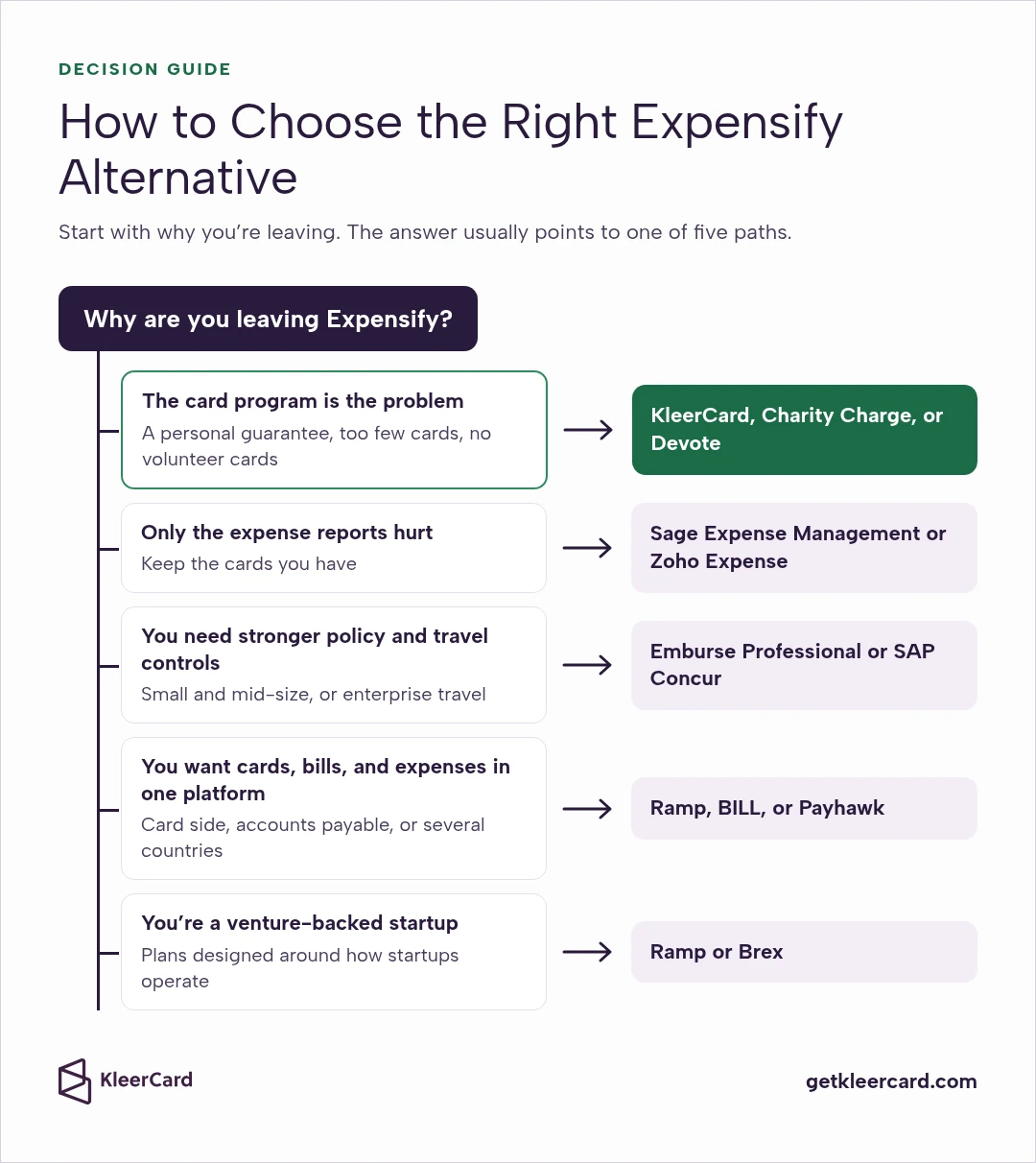
Start with why you're leaving Expensify. The answer usually points to one of five paths.
Whichever path you take, the step-by-step migration guide covers the switch itself.
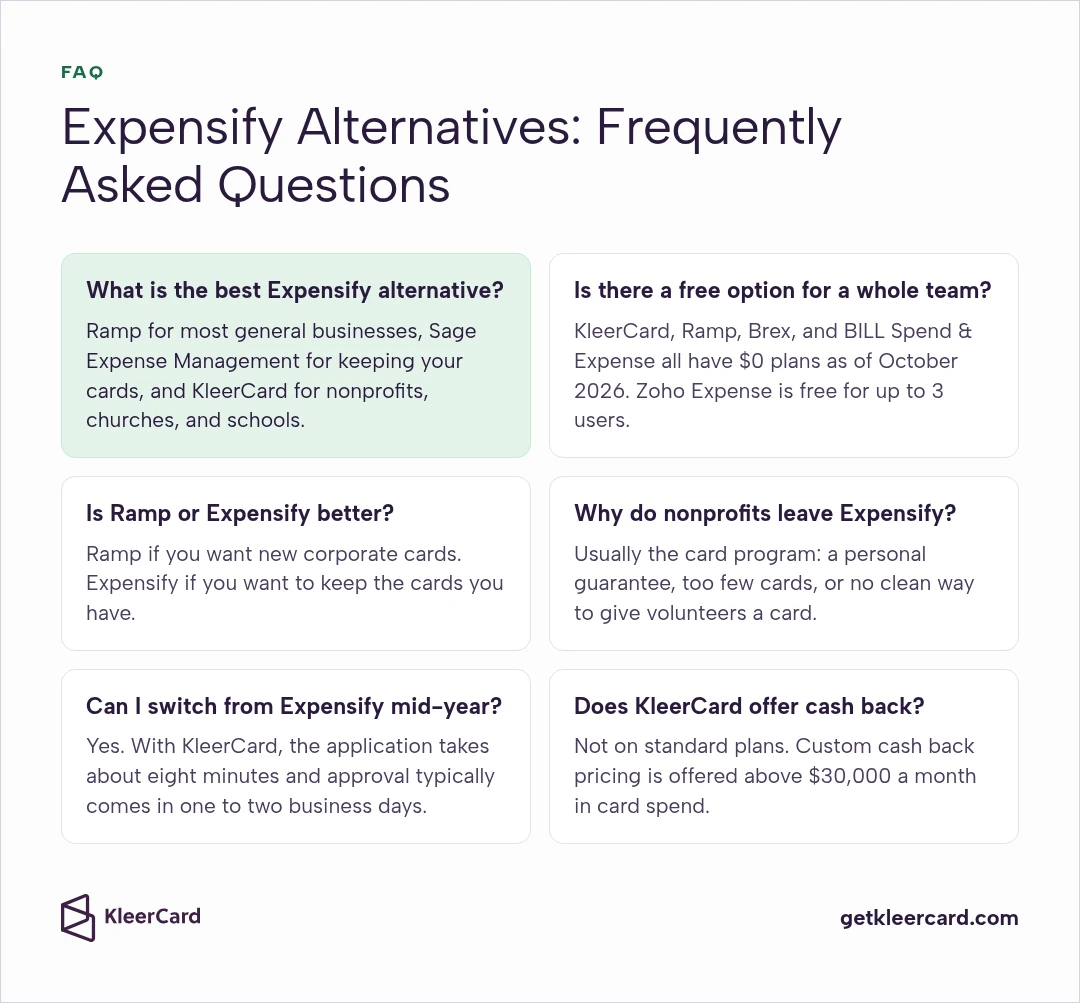
Ramp is the best Expensify alternative for most general businesses, Sage Expense Management (formerly Fyle) is best for teams keeping their existing cards, and KleerCard is best for nonprofits, churches, and schools that need organization-issued cards and fund-accounting integrations.
Expensify is still operating and is publicly traded on Nasdaq (EXFY). The change most users notice is the move from Expensify Classic to New Expensify, with new customers signing up on the new platform and existing customers moving over. Expensify's October 2026 product update added mileage and ERP features.
Expensify offers a free Submit plan for individual employees who want to code expenses and send them to an approver. Company workspaces run on the paid Collect and Control plans. If you want a free option for a whole team, KleerCard, Ramp, Brex, and BILL Spend & Expense all have $0 plans as of October 2026, and Zoho Expense is free for up to 3 users.
Ramp is usually the better choice if you want new corporate cards, and Expensify if you want to keep the cards you have. Ramp issues its own cards with a $0 plan (as of October 2026) and strong AP automation, while Expensify is built around expense reporting on the cards you use today, with its own Expensify Card as an option.
Concur fits larger organizations with heavy travel and formal policies, priced per expense report with unlimited users. Expensify fits small and mid-size teams that want simpler expense reporting on Collect or Control plans.
In my experience, most nonprofits leave because of the card program rather than the software. Their bank wants a personal guarantee, won't issue enough cards, or has no clean way to give volunteers a card. Fund accounting tools such as Aplos, ShelbyNext Financials, ACS Technologies, and Realm also aren't on Expensify's integrations list, so getting data into them usually means custom exports.
KleerCard is a strong fit for most churches because it works with church accounting systems like Realm, ACS Technologies, ParishSOFT, and Aplos, exports a file for ShelbyNext Financials, and waives the personal guarantee for religious institutions. Devote and the credit-union ministry cards from AGCU, Christian Community Credit Union, and America's Christian Credit Union are also worth a look.
You can switch at any point in the year. With KleerCard, the online application takes about eight minutes, approval typically comes in one to two business days, and physical cards ship in five to eight days, while virtual cards can be used sooner.
KleerCard is built around budget control and stewardship rather than rewards, so cash back isn't part of our standard plans. For organizations spending more than $30,000 a month on cards, we offer custom cash back pricing.
If your church, school, or nonprofit is weighing a move away from Expensify, we'd love to help you find the right fit, even if that turns out to be another tool on this list. KleerCard's Free plan covers up to 5 users with cards and software included, and our team handles setup with you. Apply for KleerCard online in about eight minutes, or compare our plans first.


Speak to a member of our team and we can have you up and running in minutes, not weeks.